FRONT WHEEL ALIGNMENT ADJUSTMENT

Note
If the wheel alignment has been adjusted, and if suspension or underbody components have been removed/installed or replaced, be sure to perform the following initialization procedure in order for the system to function normally:
-
Perform zero point calibration of the yaw rate and acceleration sensor.
-
PRECAUTION (w/ Air Suspension)
Note
Be sure to read Precaution thoroughly before servicing Click here.
-
INSPECT TIRES
-
Inspect the tires Click here.
-
-
MEASURE VEHICLE HEIGHT
Note
-
Before inspecting the wheel alignment, adjust the vehicle height to the specified value.
-
Be sure to perform measurement on a level surface.
-
If it is necessary to go under the vehicle for measurement, confirm that the parking brake is applied and the vehicle is secured with chocks.
-
Bounce the vehicle up and down at the corners to stabilize the suspension.
-
Measure the vehicle height.
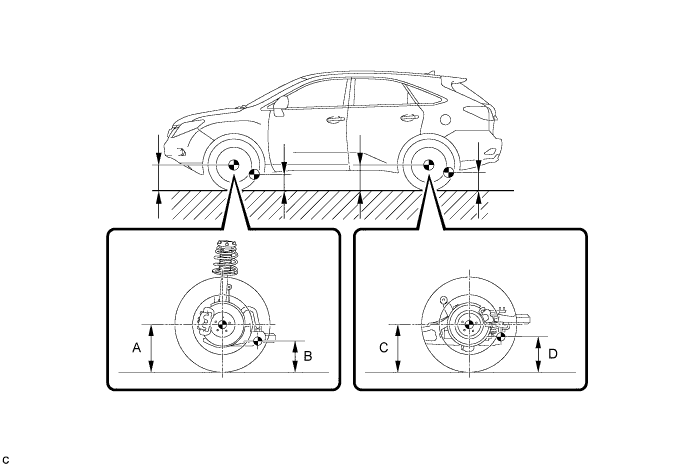
Measurement points A Ground clearance of front wheel center B Ground clearance of front lower suspension arm bushing set bolt center C Ground clearance of rear wheel center D Ground clearance of rear No. 2 suspension arm adjust bolt center Vehicle Height (Unloaded Vehicle) Model Front A - B Rear C - D 2WD 123.2 mm (4.85 in.) 50.8 mm (2.00 in.) AWD (w/o Air Suspension) 124.6 mm (4.91 in.) 53.0 mm (2.09 in.) AWD (w/ Air Suspension) 120 mm (4.72 in.) 58 mm (2.28 in.)
-
-
INSPECT CAMBER, CASTER AND STEERING AXIS INCLINATION
-
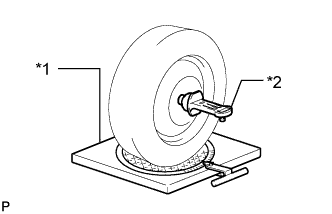
Text in Illustration *1 Wheel Alignment Tester *2 Gauge Install a camber-caster-kingpin gauge and place the front wheels on the center of a wheel alignment tester.
-
Inspect the camber, caster and steering axis inclination.
Camber (Unloaded Vehicle) Model Camber Right-left Difference 2WD -0°40' +/- 45' (-0.67° +/- 0.75°) 45' (0.75°) or less AWD (w/o Air Suspension) -0°40' +/- 45' (-0.67° +/- 0.75°) AWD (w/ Air Suspension) -0°38' +/- 45' (-0.63° +/- 0.75°) Caster (Unloaded Vehicle) Model Caster Right-left Difference 2WD 2°45' +/- 45' (2.75° +/- 0.75°) 45' (0.75°) or less AWD (w/o Air Suspension) 2°50' +/- 45' (2.83° +/- 0.75°) AWD (w/ Air Suspension) 2°52' +/- 45' (2.87° +/- 0.75°) Steering Axis Inclination (Unloaded Vehicle) Model Steering Axis Inclination Right-left Difference 2WD 10°55' +/- 45' (10.92° +/- 0.75°) 45' (0.75°) or less AWD (w/o Air Suspension) 11°00' +/- 45' (11.00° +/- 0.75°) AWD (w/ Air Suspension) 10°53' +/- 45' (10.88° +/- 0.75°)
-
-
ADJUST CAMBER
Note
Inspect toe-in after the camber has been adjusted.
-
Remove the front wheel.
-
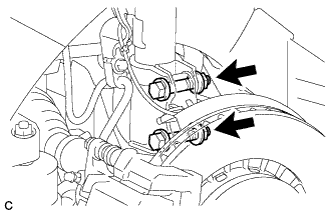
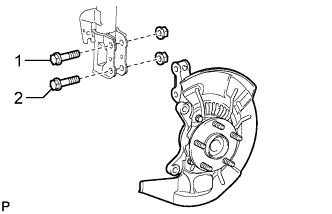
Remove the 2 nuts on the lower side of the front shock absorber.
Note
Keep the bolts inserted.
-
Remove the top and bottom bolts one at a time and confirm that the steering knuckle can move freely in the front shock absorber.
Tech Tips
-
Reinstall each bolt after removing it and confirming steering knuckle movement.
-
If the steering knuckle does not move freely in the steering knuckle, clean the installation surfaces of the front shock absorber and the steering knuckle.
-
-
Temporarily install the 2 nuts (step d).
-
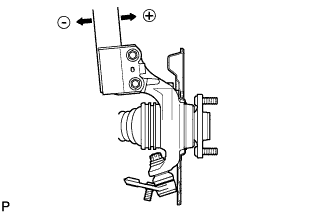
Fully push or pull the front axle hub in the direction of the required adjustment.
-
Tighten the nuts.
- Torque:
- 290 N*m { 2957 kgf*cm, 214 ft.*lbf }
Note
Keep the bolts from rotating when tightening the nuts.
-
Install the front wheel.
- Torque:
- 103 N*m { 1050 kgf*cm, 76 ft.*lbf }
-
Check the camber.
If the measured value is not within the specification, calculate the required adjustment amount using the formula below.
Camber adjustment amount = center value of the specified range - measured value
Check the combination of installed bolts. Select appropriate bolts from the table below to adjust the camber to the specified values.
Tech Tips
Try to adjust the camber to the center of the specified values.
To move the axle toward (+) in step (e) To move the axle toward (-) in step (e) Refer to table (1) (To move the axle hub toward the positive side) Refer to table (2) (To move the axle hub toward the negative side) The body and suspension may be damaged if the camber is not correctly adjusted according to the above table.
Note
Replace the nut with a new one when replacing the bolt.
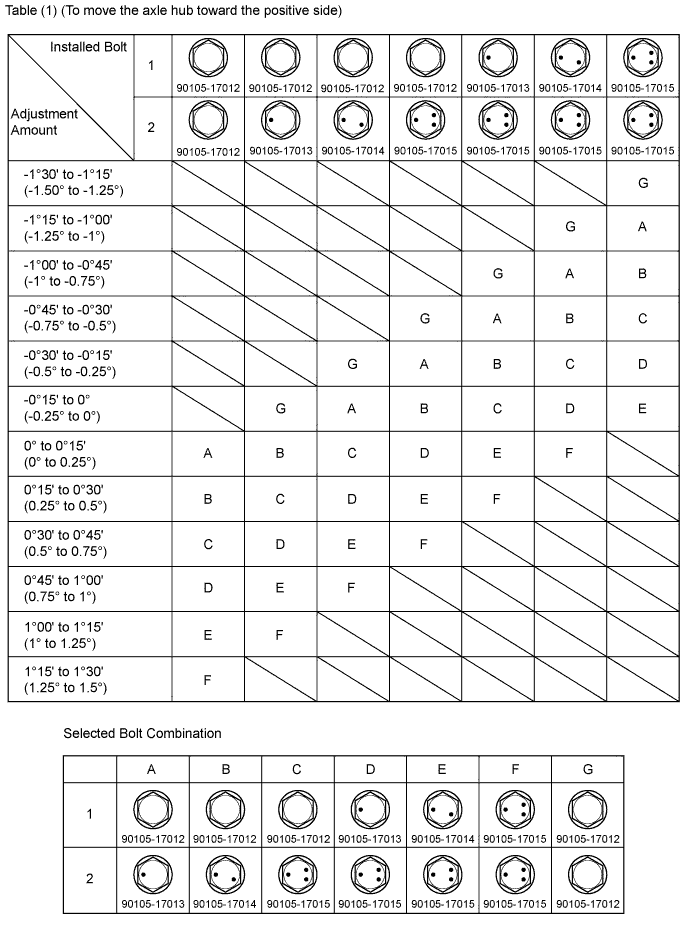
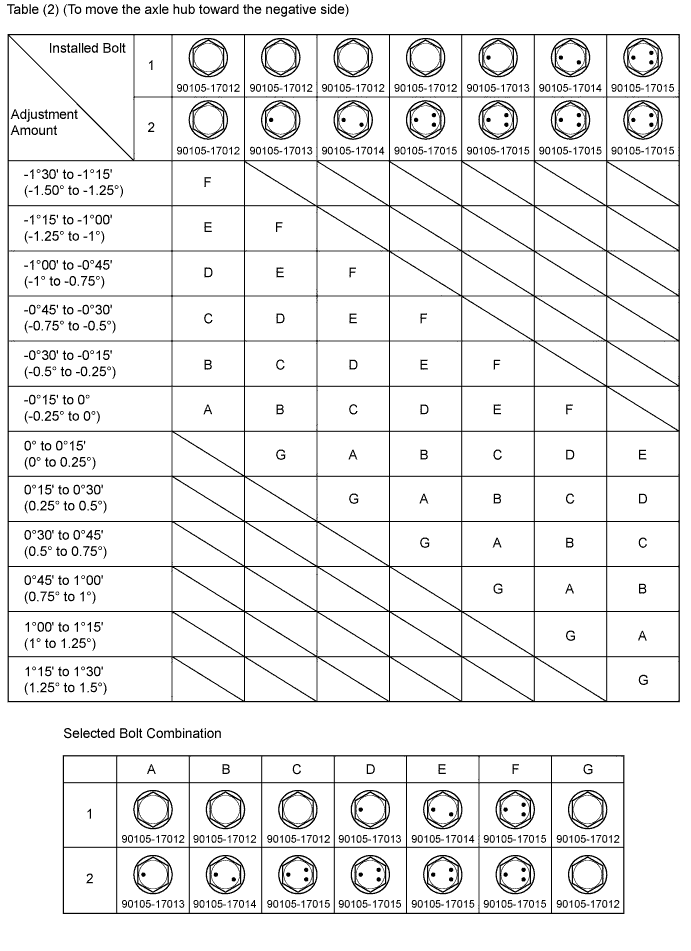
-
If the camber was out of adjustment in the previous step, repeat the adjust camber steps mentioned above. In step (d), replace the existing bolts with the 1 or 2 selected bolts.
Tech Tips
Replace one bolt at a time when replacing 2 bolts.
-
-
INSPECT TOE-IN
-
Bounce the vehicle up and down at the corners to stabilize the suspension.
-
Release the parking brake and move the shift lever to N.
-
Push the vehicle straight ahead approximately 5 m (16.4 ft.).
-
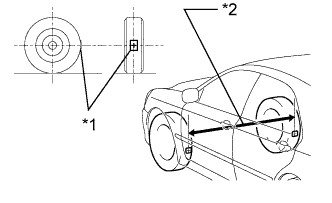
Text in Illustration *1 Tread Center Mark *2 Dimension B Put tread center marks on the rearmost points of the front wheels and measure the distance between the marks (dimension B).
-
Slowly push the vehicle straight ahead to cause the front wheels to rotate 180°. Use the front tire valve as a reference point.
Tech Tips
Do not allow the wheels to rotate more than 180°. If the wheels rotate more than 180°, perform the procedure from step (c) again.
-
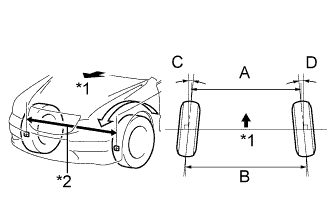
Text in Illustration *1 Front of the Vehicle *2 Dimension A Measure the distance between the tread center marks on the front side of the wheels (dimension A).
Toe-in (Unloaded Vehicle) Item Specified Condition Toe-in
(total)
C + D: 0°05' +/- 10' (0.08° +/- 0.2°)
B - A: 1.0 +/- 2.0 mm (0.0394 +/- 0.0787 in.)
If the toe-in is not within the specified range, adjust it at the rack ends.
Tech Tips
Measure "B - A" only when "C + D" cannot be measured.
-
-
ADJUST TOE-IN
-
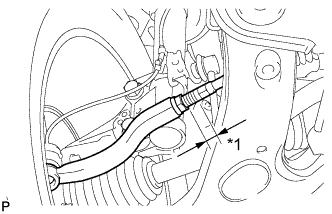
Text in Illustration *1 Difference Make sure that the lengths of the right and left rack ends are almost the same.
Standard difference 1.5 mm (0.0591 in.) or less -
Remove the rack boot set clips.
-
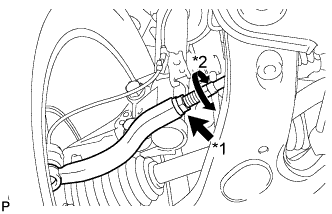
Text in Illustration *1 Loosen *2 Turn Loosen the tie rod end lock nuts.
-
Adjust the rack ends if the difference in thread length between the right and left rack ends is not within the specified range.
-
Extend the shorter rack end if the measured toe-in deviates toward the outside.
-
Shorten the longer rack end if the measured toe-in deviates toward the inside.
-
-
Turn the right and left rack ends by an equal amount to adjust the toe-in to the center value.
-
Make sure that the lengths of the right and left rack ends are the same.
-
Tighten the tie rod end lock nuts.
- Torque:
- 88 N*m { 897 kgf*cm, 65 ft.*lbf }
Note
Temporarily tighten the lock nut while holding the hexagonal part of the steering rack end so that the lock nut and the steering rack end do not turn together. Hold the width across flat of the tie rod end and tighten the lock nut.
-
Place the boots on the seats and install the clips.
Tech Tips
Make sure that the boots are not twisted.
-
-
INSPECT WHEEL ANGLE
-
Put tread center marks on the rearmost points of the turning radius gauge.
-
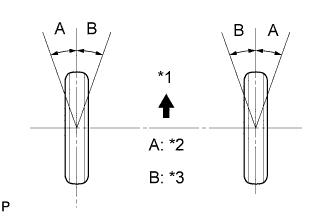
Text in Illustration *1 Front of the Vehicle *2 Inside *3 Outside Turn the steering wheel to the left and right full lock positions, and measure the turning angle.
Wheel Turning Angle (Unloaded Vehicle) Model Inside Wheel Outside Wheel Reference 2WD 36°06' +/- 1°30' (36.10° +/- 1.5°) 32°00' (32.00°) AWD (w/o Air Suspension) 36°06' +/- 1°30' (36.10° +/- 1.5°) 32°00' (32.00°) AWD (w/ Air Suspension) 36°14' +/- 1°30' (36.23° +/- 1.5°) 32°04' (32.07°) If the angles are not as specified, check and adjust the right and left rack end lengths.
-
-
PLACE FRONT WHEELS FACING STRAIGHT AHEAD
-
PERFORM YAW RATE AND ACCELERATION SENSOR ZERO POINT CALIBRATION
Tech Tips
Perform the yaw rate and acceleration sensor zero point calibration Click here.
-
PERFORM INITIALIZATION
Tech Tips
Some systems need to be initialized after the wheel alignment is adjusted Click here.