| DTC Code | DTC Name |
|---|---|
| P0A9B11 | Hybrid/EV Battery Temperature Sensor "A" Circuit Short to Ground |
| P0A9B15 | Hybrid/EV Battery Temperature Sensor "A" Circuit Short to Auxiliary Battery or Open |
| P0AC511 | Hybrid/EV Battery Temperature Sensor "B" Circuit Short to Ground |
| P0AC515 | Hybrid/EV Battery Temperature Sensor "B" Circuit Short to Auxiliary Battery or Open |
| P0ACA11 | Hybrid/EV Battery Temperature Sensor "C" Circuit Short to Ground |
| P0ACA15 | Hybrid/EV Battery Temperature Sensor "C" Circuit Short to Auxiliary Battery or Open |
| P0AE811 | Hybrid/EV Battery Temperature Sensor "D" Circuit Short to Ground |
| P0AE815 | Hybrid/EV Battery Temperature Sensor "D" Circuit Short to Auxiliary Battery or Open |
| P0BC211 | Hybrid/EV Battery Temperature Sensor "E" Circuit Short to Ground |
| P0BC215 | Hybrid/EV Battery Temperature Sensor "E" Circuit Short to Auxiliary Battery or Open |
| P0C3311 | Hybrid/EV Battery Temperature Sensor "F" Circuit Short to Ground |
| P0C3315 | Hybrid/EV Battery Temperature Sensor "F" Circuit Short to Auxiliary Battery or Open |
DESCRIPTION
The battery temperature sensors are provided at 6 locations of the HV battery. The resistance of the thermistor, which is built into each battery temperature sensor, varies in accordance with changes in the HV battery temperature. The lower the battery temperature, the higher the thermistor resistance. Conversely, the higher the temperature, the lower the resistance. The battery ECU assembly uses the battery temperature sensors to detect the HV battery temperature, and sends the detected value to the battery ECU assembly. Based on the results of this detection, the battery ECU assembly controls the blower fan. (The blower fan starts when the HV battery temperature rises above a predetermined level.)
| Temperature Sensor Identification Cross Reference Table | |||||||||||||||||||||
|---|---|---|---|---|---|---|---|---|---|---|---|---|---|---|---|---|---|---|---|---|---|
|
Use the reference table above to determine which battery temperature sensor corresponds to each DTC. For example, sensor A in the DTC title column is battery temperature sensor 0. This sensor is displayed as Hybrid Battery Temperature 1 in the Data List.
| DTC No. | Detection Item | DTC Detection Condition | Trouble Area | MIL | Warning Indicate |
|---|---|---|---|---|---|
| P0A9B11 | Hybrid/EV Battery Temperature Sensor "A" Circuit Short to Ground | The battery temperature sensor is malfunctioning, its output voltage is lower than the specified value (short circuit) and the detected temperature is higher than the specified value. (1 trip detection logic) |
|
Comes on | Master Warning Light: Comes on |
| P0A9B15 | Hybrid/EV Battery Temperature Sensor "A" Circuit Short to Auxiliary Battery or Open | The battery temperature sensor is malfunctioning, its output voltage is higher than the specified value (short to +B or open) and the detected temperature is lower than the specified value. (1 trip detection logic) |
|
Comes on | Master Warning Light: Comes on |
| P0AC511 | Hybrid/EV Battery Temperature Sensor "B" Circuit Short to Ground | The battery temperature sensor is malfunctioning, its output voltage is lower than the specified value (short circuit) and the detected temperature is higher than the specified value. (1 trip detection logic) |
|
Comes on | Master Warning Light: Comes on |
| P0AC515 | Hybrid/EV Battery Temperature Sensor "B" Circuit Short to Auxiliary Battery or Open | The battery temperature sensor is malfunctioning, its output voltage is higher than the specified value (short to +B or open) and the detected temperature is lower than the specified value. (1 trip detection logic) |
|
Comes on | Master Warning Light: Comes on |
| P0ACA11 | Hybrid/EV Battery Temperature Sensor "C" Circuit Short to Ground | The battery temperature sensor is malfunctioning, its output voltage is lower than the specified value (short circuit) and the detected temperature is higher than the specified value. (1 trip detection logic) |
|
Comes on | Master Warning Light: Comes on |
| P0ACA15 | Hybrid/EV Battery Temperature Sensor "C" Circuit Short to Auxiliary Battery or Open | The battery temperature sensor is malfunctioning, its output voltage is higher than the specified value (short to +B or open) and the detected temperature is lower than the specified value. (1 trip detection logic) |
|
Comes on | Master Warning Light: Comes on |
| P0AE811 | Hybrid/EV Battery Temperature Sensor "D" Circuit Short to Ground | The battery temperature sensor is malfunctioning, its output voltage is lower than the specified value (short circuit) and the detected temperature is higher than the specified value. (1 trip detection logic) |
|
Comes on | Master Warning Light: Comes on |
| P0AE815 | Hybrid/EV Battery Temperature Sensor "D" Circuit Short to Auxiliary Battery or Open | The battery temperature sensor is malfunctioning, its output voltage is higher than the specified value (short to +B or open) and the detected temperature is lower than the specified value. (1 trip detection logic) |
|
Comes on | Master Warning Light: Comes on |
| P0BC211 | Hybrid/EV Battery Temperature Sensor "E" Circuit Short to Ground | The battery temperature sensor is malfunctioning, its output voltage is lower than the specified value (short circuit) and the detected temperature is higher than the specified value. (1 trip detection logic) |
|
Comes on | Master Warning Light: Comes on |
| P0BC215 | Hybrid/EV Battery Temperature Sensor "E" Circuit Short to Auxiliary Battery or Open | The battery temperature sensor is malfunctioning, its output voltage is higher than the specified value (short to +B or open) and the detected temperature is lower than the specified value. (1 trip detection logic) |
|
Comes on | Master Warning Light: Comes on |
| P0C3311 | Hybrid/EV Battery Temperature Sensor "F" Circuit Short to Ground | The battery temperature sensor is malfunctioning, its output voltage is lower than the specified value (short circuit) and the detected temperature is higher than the specified value. (1 trip detection logic) |
|
Comes on | Master Warning Light: Comes on |
| P0C3315 | Hybrid/EV Battery Temperature Sensor "F" Circuit Short to Auxiliary Battery or Open | The battery temperature sensor is malfunctioning, its output voltage is higher than the specified value (short to +B or open) and the detected temperature is lower than the specified value. (1 trip detection logic) |
|
Comes on | Master Warning Light: Comes on |
| Temperature Displayed | Malfunction |
|---|---|
| Below -45°C (-49°F) | Open or +B short circuit |
| 95°C (203°F) or more | GND short circuit |
| DTC No. | Data List |
|---|---|
| P0A9B11 | Hybrid Battery Temperature 1 to 6 Hybrid Battery Current Sensor Power Supply Voltage |
| P0A9B15 | |
| P0AC511 | |
| P0AC515 | |
| P0ACA11 | |
| P0ACA15 | |
| P0AE811 | |
| P0AE815 | |
| P0BC211 | |
| P0BC215 | |
| P0C3311 | |
| P0C3315 |
-
After checking for the above DTCs, check the hybrid system Data List item "Hybrid Battery Temperature" using the GTS.
-
If the vehicle as is left as is for 24 hours, the value of "Hybrid Battery Temperature" will be almost the same as the ambient temperature.
CONFIRMATION DRIVING PATTERN
After repair has been completed, clear the DTC and then check that the vehicle has returned to normal by performing the following All Readiness check procedure.
-
Connect the GTS to the DLC3.
-
Turn the power switch on (IG) and turn the GTS on.
-
Clear the DTCs (even if no DTCs are stored, perform the clear DTC procedure).
-
Turn the power switch off and wait for 2 minutes or more.
-
Turn the power switch on (IG) and turn the GTS on.
-
With power switch on (IG) and wait for 5 seconds or more.
-
Enter the following menus: Powertrain / HV Battery / Utility / All Readiness.
-
Check the DTC judgment result.
Tip:
-
If the judgment result shows NORMAL, the system is normal.
-
If the judgment result shows ABNORMAL, the system has a malfunction.
-
If the judgment result shows INCOMPLETE, perform driving pattern again.
-
CAUTION / NOTICE / HINT
-
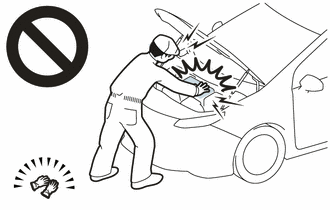
Before the following operations are conducted, take precautions to prevent electric shock by turning the power switch off, wearing insulated gloves, and removing the service plug grip from HV battery.
-
-
Inspecting the high-voltage system
-
Disconnecting the low voltage connector of the inverter with converter assembly
-
Disconnecting the low voltage connector of the HV battery
-
-
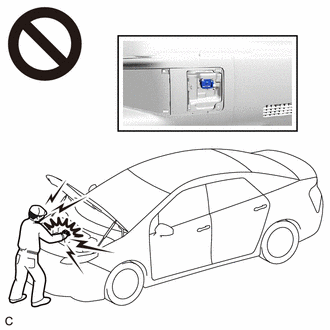
To prevent electric shock, make sure to remove the service plug grip to cut off the high voltage circuit before servicing the vehicle.
-
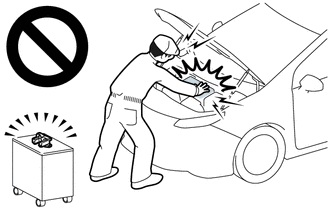
After removing the service plug grip from the HV battery, put it in your pocket to prevent other technicians from accidentally reconnecting it while you are working on the high-voltage system.
-
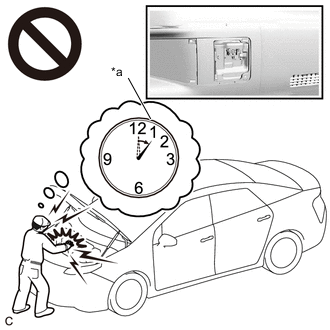
*a Without waiting for 10 minutes After removing the service plug grip, wait for at least 10 minutes before touching any of the high-voltage connectors or terminals. After waiting for 10 minutes, check the voltage at the terminals in the inspection point in the inverter with converter assembly. The voltage should be 0 V before beginning work.
Tip:Waiting for at least 10 minutes is required to discharge the high-voltage capacitor inside the inverter with converter assembly and the electric vehicle charger assembly.
-
Make sure to insulate the high-voltage connectors and terminals of the HV battery with insulating tape after removing it.
If the HV battery stored without insulating the connectors and terminals, electric shock or fire may result.
-
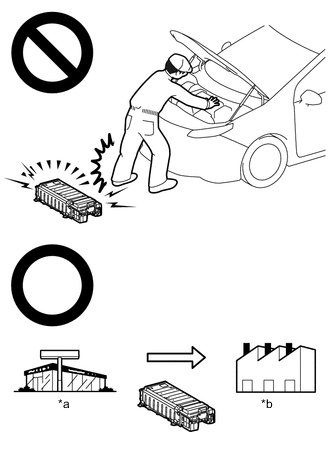
*a Dealer *b Battery Collection Agent When disposing of an HV battery, make sure to return it through an authorized collection agent who is capable of handling it safely. If the HV battery is returned via the manufacturer specified route, it will be returned properly and in a safe manner by an authorized collection agent.
-
-
Accidents such as electric shock may result if the HV battery is disposed of improperly or abandoned. Therefore, make sure to return all HV batteries through an authorized collection agent.
-
-
Before returning the HV battery, make sure to perform a recovery inspection.
-
Before returning the HV supply stack sub-assembly, make sure to perform a recovery inspection.
-
Make a note of the output DTCs as some of them may be necessary for recovery inspection of the HV battery and HV supply stack sub-assemblies.
-
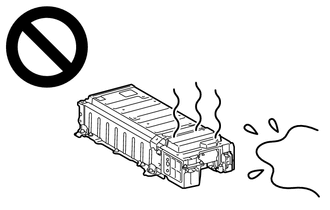
After removing the HV battery, keep it away from water. Exposure to water may cause the HV battery to produce heat, resulting in a fire.
After turning the power switch off, waiting time may be required before disconnecting the cable from the negative (-) auxiliary battery terminal. Therefore, make sure to read the disconnecting the cable from the negative (-) auxiliary battery terminal notices before proceeding with work.
PROCEDURE
- Click here
CHECK DTC OUTPUT (HV BATTERY, HYBRID CONTROL)
-
Connect the GTS to the DLC3.
-
Turn the power switch on (IG).
-
Enter the following menus: Powertrain / HV Battery and Hybrid Control / Trouble Codes.
-
Check for DTCs.
- Powertrain > HV Battery > Trouble Codes
-
-
- Powertrain > Hybrid Control > Trouble Codes
-
-
Result Result Proceed to "P0A9B11, P0A9B15, P0AC511, P0AC515, P0ACA11, P0ACA15, P0AE811, P0AE815, P0BC211, P0BC215, P0C3311 or P0C3315" only is output, or DTCs except the ones in the table below are also output. A DTCs of hybrid battery system in the table below are output. B DTCs of hybrid control system in the table below are output. C System Relevant DTC Hybrid battery system P060A47 Hybrid/EV Battery Energy Control Module Monitoring Processor Watchdog / Safety MCU Failure P060B49 Hybrid/EV Battery Energy Control Module A/D Processing Internal Electronic Failure P060687 Hybrid/EV Battery Energy Control Module Processor to Monitoring Processor Missing Message Hybrid control system P0A1F94 Hybrid/EV Battery Energy Control Module Unexpected Operation -
Turn the power switch off.
- AClick here
- B
GO TO DTC CHART (HYBRID BATTERY SYSTEM)Click here
- C
GO TO DTC CHART (HYBRID CONTROL SYSTEM)Click here
-
- Click here
READ VALUE USING GTS (HYBRID BATTERY TEMPERATURE)
-
Connect the GTS to the DLC3.
-
Turn the power switch on (IG).
-
Enter the following menus: Powertrain / HV Battery / Data List.
-
Read the Data List.
- Powertrain > HV Battery > Data List
Tester Display Measurement Item Range Reference Value Diagnostic Note Hybrid Battery Temperature 1 HV battery temperature sensor output. -50 to 205.9°C (-58 to 402.6°F) Same as ambient temperature (left as is for 24 hours)
-
Battery temperature sensor
-
Battery ECU assembly
Hybrid Battery Temperature 2 HV battery temperature sensor output. -50 to 205.9°C (-58 to 402.6°F) Same as ambient temperature (left as is for 24 hours)
-
Battery temperature sensor
-
Battery ECU assembly
Hybrid Battery Temperature 3 HV battery temperature sensor output. -50 to 205.9°C (-58 to 402.6°F) Same as ambient temperature (left as is for 24 hours)
-
Battery temperature sensor
-
Battery ECU assembly
Hybrid Battery Temperature 4 HV battery temperature sensor output. -50 to 205.9°C (-58 to 402.6°F) Same as ambient temperature (left as is for 24 hours)
-
Battery temperature sensor
-
Battery ECU assembly
Hybrid Battery Temperature 5 HV battery temperature sensor output. -50 to 205.9°C (-58 to 402.6°F) Same as ambient temperature (left as is for 24 hours)
-
Battery temperature sensor
-
Battery ECU assembly
Hybrid Battery Temperature 6 HV battery temperature sensor output. -50 to 205.9°C (-58 to 402.6°F) Same as ambient temperature (left as is for 24 hours)
-
Battery temperature sensor
-
Battery ECU assembly
-
-
-
- Powertrain > HV Battery > Data List
Tester Display Hybrid Battery Temperature 1 Hybrid Battery Temperature 2 Hybrid Battery Temperature 3 Hybrid Battery Temperature 4 Hybrid Battery Temperature 5 Hybrid Battery Temperature 6 -
-
-
-
Tip:A malfunctioning sensor (battery temperature sensor 0, 1, 2, 3, 4 or 5) can be determined by comparing the output temperature of the 6 battery temperature sensors.
- Powertrain > HV Battery > Data List
-
Turn the power switch off.
Result Proceed to NEXT
- NEXTClick here
-
- Click here
CHECK FREEZE FRAME DATA
-
Connect the GTS to the DLC3.
-
Turn the power switch on (IG).
-
Enter the following menus: Powertrain / HV battery / Trouble Codes.
-
Check and record the "Hybrid Battery Current Sensor Power Supply Voltage" freeze frame data.
- Powertrain > HV Battery > Trouble Codes
-
-
Tip:Use this for reference when measuring the hybrid battery current sensor power supply voltage.
-
Turn the power switch off.
Result Proceed to NEXT
- NEXTClick here
-
- Click here
CHECK DTC
-
Check the DTCs that were output when the vehicle was brought to the workshop.
Result Result Proceed to "P0A9B11, P0A9B15, P0AC511, P0AC515, P0ACA11 or P0ACA15" is also output. A "P0AE811, P0AE815, P0BC211, P0BC215, P0C3311 or P0C3315" is also output. B
-
- Click here
CHECK CONNECTOR CONNECTION CONDITION (NO. 1 HV SUPPLY STACK SUB-ASSEMBLY CONNECTOR)
CAUTION:Be sure to wear insulated gloves and protective goggles.
-
Check that the service plug grip is not installed.
Note:After removing the service plug grip, do not turn the power switch on (READY), unless instructed by the repair manual because this may cause a malfunction.
-
Remove the No. 2 hybrid battery shield sub-assembly.
-
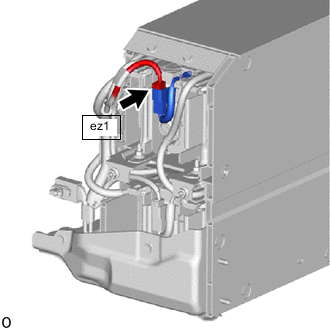
Check the connections of the ez1 No. 1 HV supply stack sub-assembly connector.
OK The connector is connected securely and there are no contact problems. -
Install the No. 2 hybrid battery shield sub-assembly.
Result Result OK NG
- OKClick here
- NG
CONNECT SECURELY
-
- Click here
CHECK CONNECTOR CONNECTION CONDITION (BATTERY ECU ASSEMBLY CONNECTOR)
CAUTION:Be sure to wear insulated gloves and protective goggles.
-
Check that the service plug grip is not installed.
Note:After removing the service plug grip, do not turn the power switch on (READY), unless instructed by the repair manual because this may cause a malfunction.
-
Remove the upper No. 1 hybrid battery cover sub-assembly.
-
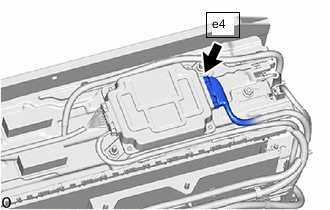
Check the connections of the e4 battery ECU assembly connector.
OK The connector is connected securely and there are no contact problems. -
Install the upper No. 1 hybrid battery cover sub-assembly.
Result Result OK NG
- OKClick here
- NG
CONNECT SECURELY
-
- Click here
CHECK HV BATTERY (BATTERY TEMPERATURE SENSOR 0 to 2)
CAUTION:Be sure to wear insulated gloves and protective goggles.
-
Check that the service plug grip is not installed.
Note:After removing the service plug grip, do not turn the power switch on (READY), unless instructed by the repair manual because this may cause a malfunction.
-
Remove the upper No. 1 hybrid battery cover sub-assembly.
-
Disconnect the e4 battery ECU assembly connector.
Note:Before disconnecting the connector, check that it is not loose or disconnected.
-
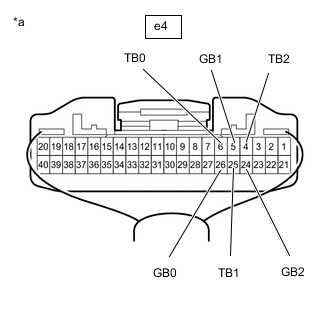
*a Rear view of wire harness connector
(to Battery ECU Assembly)
Measure the resistance of the circuit for the malfunctioning sensor (battery temperature sensor 0 to 2).
Tester Connection Tester Connection Battery Temperature Sensor e4-6(TB0) - e4-26(GB0) 0 e4-25(TB1) - e4-5(GB1) 1 e4-4(TB2) - e4-24(GB2) 2 Standard Resistance Thermistor Temperature Condition Specified Condition 0 to 10°C (32 to 50°F) Always 17.7 to 27.8 kΩ 10 to 20°C (50 to 68°F) Always 12.0 to 18.2 kΩ 20 to 30°C (68 to 86°F) Always 8.22 to 12.2 kΩ 30 to 40°C (86 to 104°F) Always 5.74 to 8.41 kΩ 40 to 50°C (104 to 122°F) Always 4.09 to 5.91 kΩ -
Measure the resistance according to the value (s) in the table below.
Standard Resistance Tester Connection Condition Specified Condition e4-6 (TB0) - Body ground and other terminals (except e4-26 (GB0)) Always 10 kΩ or higher e4-26 (GB0) - Body ground and other terminals (except e4-6 (TB0)) Always 10 kΩ or higher e4-25 (TB1) - Body ground and other terminals (except e4-5 (GB1)) Always 10 kΩ or higher e4-5 (GB1) - Body ground and other terminals (except e4-25 (TB1)) Always 10 kΩ or higher e4-4 (TB2) - Body ground and other terminals (except e4-24 (GB2)) Always 10 kΩ or higher e4-24 (GB2) - Body ground and other terminals (except e4-4 (TB2)) Always 10 kΩ or higher -
Reconnect the e4 battery ECU assembly connector.
-
Install the upper No. 1 hybrid battery cover sub-assembly.
Result Proceed to OK NG
- OKClick here
GO TO STEP 12
- NGClick here
-
- Click here
CHECK HARNESS AND CONNECTOR (BATTERY ECU ASSEMBLY - NO. 1 HV SUPPLY STACK SUB-ASSEMBLY)
CAUTION:Be sure to wear insulated gloves and protective goggles.
-
Check that the service plug grip is not installed.
Note:After removing the service plug grip, do not turn the power switch on (READY), unless instructed by the repair manual because this may cause a malfunction.
-
Remove the upper No. 1 hybrid battery cover sub-assembly.
-
Disconnect the e4 battery ECU assembly connector.
Note:Before disconnecting the connector, check that it is not loose or disconnected.
-
Disconnect the ez1 No. 1 HV supply stack sub-assembly connector.
Note:Before disconnecting the connector, check that it is not loose or disconnected.
-
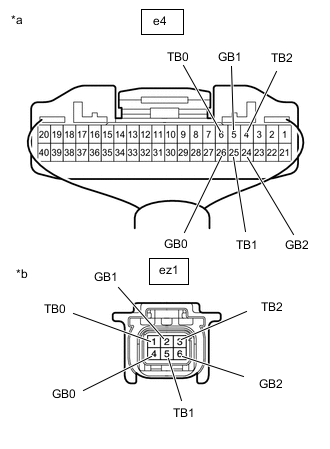
*a Rear view of wire harness connector
(to Battery ECU Assembly)
*b Front view of wire harness connector
(to No. 1 HV Supply Stack Sub-assembly)
Measure the resistance according to the value (s) in the table below.
Standard Resistance Tester Connection Condition Specified Condition e4-6 (TB0) - ez1 -1 (TB0) Always Below 1 Ω e4-26 (GB0) - ez1 -4 (GB0) Always Below 1 Ω e4-25 (TB1) - ez1 -5 (TB1) Always Below 1 Ω e4-5 (GB1) - ez1 -2 (GB1) Always Below 1 Ω e4-4 (TB2) - ez1 -3 (TB2) Always Below 1 Ω e4-24 (GB2) - ez1 -6 (GB2) Always Below 1 Ω Standard Resistance Tester Connection Condition Specified Condition e4-6 (TB0) or ez1 -1 (TB0) - Body ground and other terminals Always 10 kΩ or higher e4-26 (GB0) or ez1 -4 (GB0) - Body ground and other terminals Always 10 kΩ or higher e4-25 (TB1) or ez1 -5 (TB1) - Body ground and other terminals Always 10 kΩ or higher e4-5 (GB1) or ez1 -2 (GB1) - Body ground and other terminals Always 10 kΩ or higher e4-4 (TB2) or ez1 -3 (TB2) - Body ground and other terminals Always 10 kΩ or higher e4-24 (GB2) or ez1 -6 (GB2) - Body ground and other terminals Always 10 kΩ or higher -
Reconnect the ez1 No. 1 HV supply stack sub-assembly connector.
-
Reconnect the e4 battery ECU assembly connector.
-
Install the upper No. 1 hybrid battery cover sub-assembly.
Result Proceed to OK NG
- OK
REPLACE NO. 1 HV SUPPLY STACK SUB-ASSEMBLYClick here
- NG
REPAIR OR REPLACE HARNESS OR CONNECTOR
-
- Click here
CHECK CONNECTOR CONNECTION CONDITION (NO. 2 HV SUPPLY STACK SUB-ASSEMBLY CONNECTOR)
CAUTION:Be sure to wear insulated gloves and protective goggles.
-
Check that the service plug grip is not installed.
Note:After removing the service plug grip, do not turn the power switch on (READY), unless instructed by the repair manual because this may cause a malfunction.
-
Remove the No. 2 hybrid battery shield sub-assembly.
-
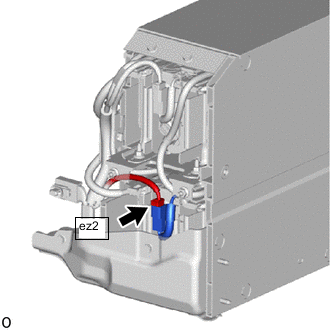
Check the connections of the ez2 No. 2 HV supply stack sub-assembly connector.
OK The connector is connected securely and there are no contact problems. -
Install the No. 2 hybrid battery shield sub-assembly.
Result Result OK NG
- OKClick here
- NG
CONNECT SECURELY
-
- Click here
CHECK CONNECTOR CONNECTION CONDITION (BATTERY ECU ASSEMBLY CONNECTOR)
CAUTION:Be sure to wear insulated gloves and protective goggles.
-
Check that the service plug grip is not installed.
Note:After removing the service plug grip, do not turn the power switch on (READY), unless instructed by the repair manual because this may cause a malfunction.
-
Remove the upper No. 1 hybrid battery cover sub-assembly.
-
Check the connections of the e4 battery ECU assembly connector.
OK The connector is connected securely and there are no contact problems. -
Install the upper No. 1 hybrid battery cover sub-assembly.
Result Result OK NG
- OKClick here
- NG
CONNECT SECURELY
-
- Click here
CHECK HV BATTERY (BATTERY TEMPERATURE SENSOR 3 to 5)
CAUTION:Be sure to wear insulated gloves and protective goggles.
-
Check that the service plug grip is not installed.
Note:After removing the service plug grip, do not turn the power switch on (READY), unless instructed by the repair manual because this may cause a malfunction.
-
Remove the upper No. 1 hybrid battery cover sub-assembly.
-
Disconnect the e4 battery ECU assembly connector.
Note:Before disconnecting the connector, check that it is not loose or disconnected.
-
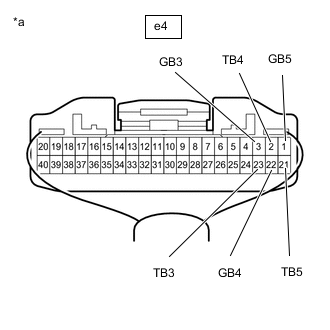
*a Rear view of wire harness connector
(to Battery ECU Assembly)
Measure the resistance of the circuit for the malfunctioning sensor (battery temperature sensor 3 to 5).
Tester Connection Tester Connection Battery Temperature Sensor e4-23(TB3) - e4-3(GB3) 3 e4-2(TB4) - e4-22(GB4) 4 e4-21(TB5) - e4-1(GB5) 5 Standard Resistance Thermistor Temperature Condition Specified Condition 0 to 10°C (32 to 50°F) Always 17.7 to 27.8 kΩ 10 to 20°C (50 to 68°F) Always 12.0 to 18.2 kΩ 20 to 30°C (68 to 86°F) Always 8.22 to 12.2 kΩ 30 to 40°C (86 to 104°F) Always 5.74 to 8.41 kΩ 40 to 50°C (104 to 122°F) Always 4.09 to 5.91 kΩ -
Measure the resistance according to the value (s) in the table below.
Standard Resistance Tester Connection Condition Specified Condition e4-23 (TB3) - Body ground and other terminals (except e4-3 (GB3)) Always 10 kΩ or higher e4-3 (GB3) - Body ground and other terminals (except e4-23 (TB3)) Always 10 kΩ or higher e4-2 (TB4) - Body ground and other terminals (except e4-22 (GB4)) Always 10 kΩ or higher e4-22 (GB4) - Body ground and other terminals (except e4-2 (TB4)) Always 10 kΩ or higher e4-21 (TB5) - Body ground and other terminals (except e4-1 (GB5)) Always 10 kΩ or higher e4-1 (GB5) - Body ground and other terminals (except e4-21 (TB5)) Always 10 kΩ or higher -
Reconnect the e4 battery ECU assembly connector.
-
Install the upper No. 1 hybrid battery cover sub-assembly.
Result Proceed to OK NG
- OKClick here
- NGClick here
-
- Click here
CHECK HARNESS AND CONNECTOR (BATTERY ECU ASSEMBLY - HV BATTERY JUNCTION BLOCK ASSEMBLY)
CAUTION:Be sure to wear insulated gloves and protective goggles.
-
Check that the service plug grip is not installed.
Note:After removing the service plug grip, do not turn the power switch on (READY), unless instructed by the repair manual because this may cause a malfunction.
-
Remove the upper No. 1 hybrid battery cover sub-assembly.
-
Disconnect the e4 battery ECU assembly connector.
Note:Before disconnecting the connector, check that it is not loose or disconnected.
-
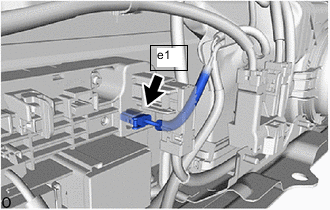
Disconnect the e1 battery current sensor connector from the HV battery junction block assembly.
Note:Before disconnecting the connector, check that it is not loose or disconnected.
-
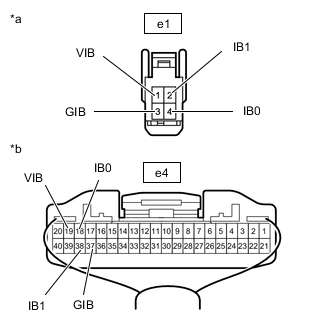
*a Front view of wire harness connector
(to HV Battery Junction Block Assembly (Battery Current Sensor))
*b Rear view of wire harness connector
(to Battery ECU Assembly)
Measure the resistance according to the value(s) in the tables below.
Standard Resistance (Check for Open) Tester Connection Condition Specified Condition e4-19(VIB) - e1-1(VIB) Always Below 1 Ω e4-38(IB1) - e1-2(IB1) Always Below 1 Ω e4-37(GIB) - e1-3(GIB) Always Below 1 Ω e4-18(IB0) - e1-4(IB0) Always Below 1 Ω Standard Resistance (Check for Short) Tester Connection Condition Specified Condition e4-19(VIB) or e1-1(VIB) - Body ground and other terminals Always 10 kΩ or higher e4-38(IB1) or e1-2(IB1) - Body ground and other terminals Always 10 kΩ or higher e4-37(GIB) or e1-3(GIB) - Body ground and other terminals Always 10 kΩ or higher e4-18(IB0) - e1-4(IB0) - Body ground and other terminals Always 10 kΩ or higher -
Reconnect the e1 battery current sensor connector to the HV battery junction block assembly.
-
Reconnect the e4 battery ECU assembly connector.
-
Install the upper No. 1 hybrid battery cover sub-assembly.
Result Proceed to OK NG
- OKClick here
- NG
REPAIR OR REPLACE HARNESS OR CONNECTOR
-
- Click here
CHECK BATTERY ECU ASSEMBLY (VIB VOLTAGE)
CAUTION:Be sure to wear insulated gloves and protective goggles.
-
Check that the service plug grip is not installed.
Note:After removing the service plug grip, do not turn the power switch on (READY), unless instructed by the repair manual because this may cause a malfunction.
-
Remove the upper No. 1 hybrid battery cover sub-assembly.
-
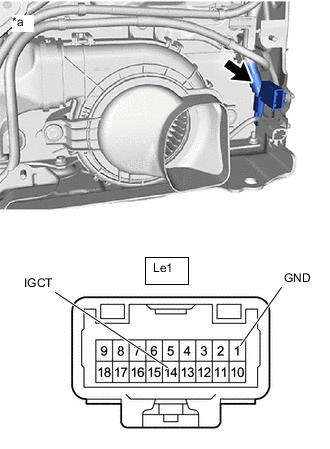
*a Front view of wire harness connector
(No. 2 HV Battery Pack Wire Connector)
Apply auxiliary battery voltage between No. 2 HV battery pack wire connector terminals Le1-14 (IGCT) - Le1-1 (GND).
Note:Make sure that the battery positive and battery negative do not contact one another.
-
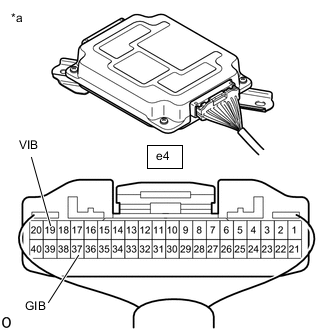
*a Component with harness connected
(to Battery ECU Assembly)
Measure the voltage according to the value(s) in the table below.
Standard Voltage Tester Connection Condition Specified Condition e4-19 (VIB) - e4-37 (GIB) Auxiliary battery positive (+) → Le1 -14 (IGCT)
Auxiliary battery negative (-) → Le1 -1 (GND)
4.6 to 5.4 V -
Disconnect the Le1 connector of the No. 2 HV battery pack wire from the auxiliary battery.
-
Install the upper No. 1 hybrid battery cover sub-assembly.
Result Proceed to OK NG
- OK
REPLACE BATTERY ECU ASSEMBLYClick here
- NGClick here
-
- Click here
HV BATTERY JUNCTION BLOCK ASSEMBLY (BATTERY CURRENT SENSOR OUTPUT VOLTAGE)
CAUTION:Be sure to wear insulated gloves and protective goggles.
-
Check that the service plug grip is not installed.
Note:After removing the service plug grip, do not turn the power switch on (READY), unless instructed by the repair manual because this may cause a malfunction.
-
Remove the upper HV battery cover panel.
-
Disconnect the e1 battery current sensor connector from the HV battery junction block assembly.
Note:Before disconnecting the connector, check that it is not loose or disconnected.
-
*a Front view of wire harness connector
(No. 2 HV Battery Pack Wire Connector)
Apply auxiliary battery voltage between No. 2 HV battery pack wire connector terminals Le1-14 (IGCT) - Le1-1 (GND).
Note:Make sure that the battery positive and battery negative do not contact one another.
-
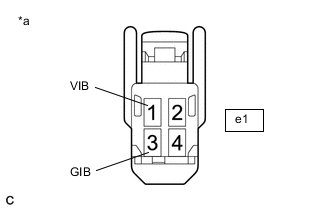
*a Front view of wire harness connector
(to HV Battery Junction Block Assembly (Battery Current Sensor))
Measure the voltage according to the value(s) in the table below.
Standard Voltage Tester Connection Condition Specified Condition e1-1(VIB) - e1-3 (GIB) Auxiliary battery positive (+) → Le1 -14 (IGCT)
Auxiliary battery negative (-) → Le1 -1 (GND)
4.6 to 5.4 V -
Disconnect the Le1 connector of the No. 2 HV battery pack wire from the auxiliary battery.
-
Reconnect the e1 battery current sensor connector to the HV battery junction block assembly.
-
Install the upper HV battery cover panel.
Result Proceed to OK NG
- OK
REPLACE HV BATTERY JUNCTION BLOCK ASSEMBLYClick here
- NG
REPLACE BATTERY ECU ASSEMBLYClick here
-
- Click here
CHECK HARNESS AND CONNECTOR (BATTERY ECU ASSEMBLY - NO. 2 HV SUPPLY STACK SUB-ASSEMBLY)
CAUTION:Be sure to wear insulated gloves and protective goggles.
-
Check that the service plug grip is not installed.
Note:After removing the service plug grip, do not turn the power switch on (READY), unless instructed by the repair manual because this may cause a malfunction.
-
Remove the upper No. 1 hybrid battery cover sub-assembly.
-
Disconnect the e4 battery ECU assembly connector.
Note:Before disconnecting the connector, check that it is not loose or disconnected.
-
Disconnect the ez2 No. 2 HV supply stack sub-assembly connector.
Note:Before disconnecting the connector, check that it is not loose or disconnected.
-
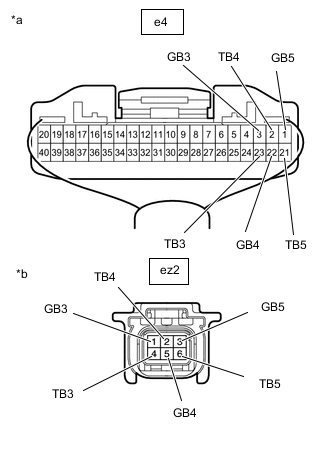
*a Rear view of wire harness connector
(to Battery ECU Assembly)
*b Front view of wire harness connector
(to No. 2 HV Supply Stack Sub-assembly)
Measure the resistance according to the value (s) in the table below.
Standard Resistance Tester Connection Condition Specified Condition e4-23 (TB3) - ez2 -4 (TB3) Always Below 1 Ω e4-3 (GB3) - ez2 -1 (GB3) Always Below 1 Ω e4-2 (TB4) - ez2 -2 (TB4) Always Below 1 Ω e4-22 (GB4) - ez2 -5 (GB4) Always Below 1 Ω e4-21 (TB5) - ez2 -6 (TB5) Always Below 1 Ω e4-1 (GB5) - ez2 -3 (GB5) Always Below 1 Ω Standard Resistance Tester Connection Condition Specified Condition e4-23 (TB3) or ez2 -4 (TB3) - Body ground and other terminals Always 10 kΩ or higher e4-3 (GB3) or ez2 -1 (GB3) - Body ground and other terminals Always 10 kΩ or higher e4-2 (TB4) or ez2 -2 (TB4) - Body ground and other terminals Always 10 kΩ or higher e4-22 (GB4) or ez2 -5 (GB4) - Body ground and other terminals Always 10 kΩ or higher e4-21 (TB5) or ez2 -6 (TB5) - Body ground and other terminals Always 10 kΩ or higher e4-1 (GB5) or ez2 -3 (GB5) - Body ground and other terminals Always 10 kΩ or higher -
Reconnect the ez2 No. 2 HV supply stack sub-assembly connector.
-
Reconnect the e4 battery ECU assembly connector.
-
Install the upper No. 1 hybrid battery cover sub-assembly.
Result Proceed to OK NG
- OK
REPLACE NO. 2 HV SUPPLY STACK SUB-ASSEMBLYClick here
- NG
REPAIR OR REPLACE HARNESS OR CONNECTOR
-