| DTC Code | DTC Name |
|---|---|
| P050500 | Idle Control System |
DESCRIPTION
The idle speed is controlled by the electronic throttle control system. The electronic throttle control system is comprised of: 1) one valve type throttle body with motor assembly; 2) the throttle actuator, which operates the throttle valve; 3) the throttle position sensor, which detects the opening angle of the throttle valve; 4) the accelerator pedal position sensor, which detects the accelerator pedal position; 5) the ECM, which controls the electronic throttle control system. Based on the target idle speed, the ECM controls the throttle actuator to provide the proper throttle valve opening angle.
| DTC No. | Detection Item | DTC Detection Condition | Trouble Area | MIL | Memory | Note |
|---|---|---|---|---|---|---|
| P050500 | Idle Control System | The idle speed differs largely from the target idle speed (2 trip detection logic). |
|
Comes on | DTC stored | SAE: P0505 |
MONITOR DESCRIPTION
The ECM monitors the idle speed and idling air flow volume to conduct idle speed control. The ECM determines that the idle speed control system is malfunctioning if either of the following conditions is met:
-
The difference between the target engine idle speed and actual engine idle speed exceeds the threshold and the idle control correction value is stuck at the upper or lower limit for 5 seconds or more.
-
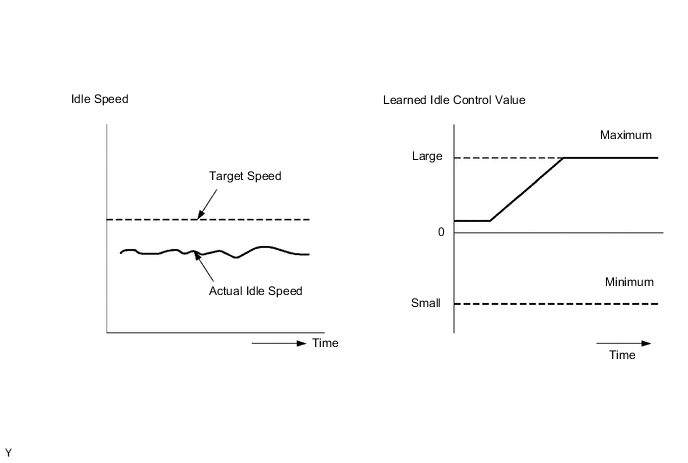
After driving at a vehicle speed of 10 km/h (6.25 mph) or more, the difference between the target and actual engine idle speed exceeds the threshold 5 times or more during a driving cycle, and then the system determines that the idle control correction value is stuck at the upper or lower limit, or that the idle control correction value has been changed by an amount that exceeds the threshold.
MONITOR STRATEGY
| Required Sensors/Components (Main) | Electronic throttle control system |
| Required Sensors/Components (Related) | Crankshaft position sensor Engine coolant temperature sensor |
| Frequency of Operation | Continuous |
TYPICAL MALFUNCTION THRESHOLDS
| Either of the following conditions is met | 1 or 2 |
| 1. Both of the following conditions A and B met | - |
| A. Engine speed - Target engine speed | Less than -100 rpm, or higher than 150 rpm |
| B. Idle control correction value | -14 Nm or less, or 30 Nm or more for 5 seconds or more |
| 2. Both of the following conditions C and D met | - |
| C. Frequency that all of following conditions (a), (b) and (c) met | 5 times or more |
| (a) Engine speed - Target engine speed | Less than -100 rpm, or higher than 150 rpm |
| (b) Idle control feedback correction amount | -7 Nm or less, or 10 Nm or more |
| (c) Vehicle condition | Stopped after being driven at 10 km/h (6.25 mph) or more |
| D. Amount of change Idle control correction value | -24.19 Nm or less, or 15.41 Nm or more |
CONFIRMATION DRIVING PATTERN
-
Connect the GTS to the DLC3.
-
Turn the power switch on (IG).
-
Turn the GTS on.
-
Clear the DTCs (even if no DTCs are stored, perform the clear DTC procedure).
-
Turn the power switch off and wait for at least 30 seconds.
-
Turn the power switch on (IG) [A].
-
Turn the GTS on.
-
Put the engine in Inspection Mode (2WD for measuring Exhaust Gas).
-
Start the engine and warm it up until the engine coolant temperature is 75°C (167°F) or higher with the A/C switch and all the accessories off [B].
-
Turn the power switch off and wait for at least 30 seconds.
-
Disconnect the cable from the negative (-) auxiliary battery terminal.
-
Reconnect the cable to the negative (-) auxiliary battery terminal.
-
Turn the power switch on (IG).
-
Turn the GTS on.
-
Put the engine in Inspection Mode (2WD for measuring Exhaust Gas).
-
Start the engine and rev the engine for 5 seconds or more with the park (P) selected [C].
Tip:During charge control, the engine speed is set at idle. Therefore, the engine speed will not increase when the accelerator pedal is depressed. In this case, perform step [C] after charge control has completed.
-
Idle the engine for 5 minutes or more [D].
Tip:In order to keep the idling stable, turn off the A/C and all other electric loads and do not perform any shift operations.
-
Enter the following menus: Powertrain / Engine / Trouble Codes [E].
-
Read the pending DTCs.
Tip:
-
If a pending DTC is output, the system is malfunctioning.
-
If a pending DTC is not output, perform the following procedure.
-
-
Enter the following menus: Powertrain / Engine / Utility / All Readiness.
-
Input the DTC: P050500.
-
Check the DTC judgment result.
GTS Display Description NORMAL
-
DTC judgment completed
-
System normal
ABNORMAL
-
DTC judgment completed
-
System abnormal
INCOMPLETE
-
DTC judgment not completed
-
Perform driving pattern after confirming DTC enabling conditions
Tip:
-
If the judgment result shows NORMAL, the system is normal.
-
If the judgment result shows ABNORMAL, the system is malfunctioning.
-
If the judgment result shows INCOMPLETE, perform steps [F] through [I].
-
-
With the engine running, accelerate the vehicle to 10 km/h (6.25 mph) or more [F].
CAUTION:When performing the confirmation driving pattern, obey all speed limits and traffic laws.
Tip:If the engine stops, further depress the accelerator pedal to restart the engine.
-
Stop the vehicle and rev the engine for 5 seconds or more with the park (P) selected [G].
Tip:During charge control, the engine speed is set at idle. Therefore, the engine speed will not increase when the accelerator pedal is depressed. In this case, perform step [G] after charge control has completed.
-
Idle the engine for 20 seconds or more [H].
-
Repeat the steps [F] through [H] 10 times [I].
-
Enter the following menus: Powertrain / Engine / Trouble Codes [J].
-
Read the pending DTCs.
Tip:
-
If a pending DTC is output, the system is malfunctioning.
-
If a pending DTC is not output, perform the following procedure.
-
-
Enter the following menus: Powertrain / Engine / Utility / All Readiness.
-
Input the DTC: P050500.
-
Check the DTC judgment result.
GTS Display Description NORMAL
-
DTC judgment completed
-
System normal
ABNORMAL
-
DTC judgment completed
-
System abnormal
INCOMPLETE
-
DTC judgment not completed
-
Perform driving pattern after confirming DTC enabling conditions
Tip:
-
If the judgment result shows NORMAL, the system is normal.
-
If the judgment result shows ABNORMAL, the system is malfunctioning.
-
CAUTION / NOTICE / HINT
-
After turning power switch off, waiting time may be required before disconnecting the cable from the negative (-) auxiliary battery terminal. Therefore, make sure to read the disconnecting the cable from the negative (-) auxiliary battery terminal notices before proceeding with work.
-
Vehicle Control History may be stored in the hybrid vehicle control ECU if the engine is malfunctioning. Certain vehicle condition information is recorded when Vehicle Control History is stored. Reading the vehicle conditions recorded in both the freeze frame data and Vehicle Control History can be useful for troubleshooting.
(Select Powertrain in Health Check and then check the time stamp data.)
-
If any "Engine Malfunction" Vehicle Control History item has been stored in the hybrid vehicle control ECU, make sure to clear it. However, as all Vehicle Control History items are cleared simultaneously, if any Vehicle Control History items other than "Engine Malfunction" are stored, make sure to perform any troubleshooting for them before clearing Vehicle Control History.
-
The following conditions may also cause DTC P050500 to be stored:
-
-
If the floor carpet or floor mat is resting slightly on the accelerator pedal, causing the accelerator pedal to be slightly depressed and therefore the throttle valve position to be slightly open.
-
The accelerator pedal is not fully released.
-
-
Refer to "Data List / Active Test" [Engine Speed and ISC Learning Value].
-
Read freeze frame data using the GTS. The ECM records vehicle and driving condition information as freeze frame data the moment a DTC is stored. When troubleshooting, freeze frame data can help determine if the vehicle was moving or stationary, if the engine was warmed up or not, if the air fuel ratio was lean or rich, and other data from the time the malfunction occurred.
PROCEDURE
- Click here
CHECK ANY OTHER DTCS OUTPUT (IN ADDITION TO DTC P050500)
-
Connect the GTS to the DLC3.
-
Turn the power switch on (IG).
-
Turn the GTS on.
-
Enter the following menus: Powertrain / Engine / Trouble Codes.
-
Read the DTCs.
- Powertrain > Engine > Trouble Codes
-
-
Result Result Proceed to DTC P050500 is output A DTC P050500 and other DTCs are output B Tip:If any DTCs other than P050500 are output, troubleshoot those DTCs first.
- AClick here
- B
GO TO DTC CHARTClick here
-
- Click here
CHECK PCV HOSE CONNECTIONS
-
Check the PCV hose connections.
OK PCV valve and hose are connected correctly and are not damaged. Result Proceed to OK NG
- OKClick here
- NG
REPAIR OR REPLACE PCV HOSE
-
- Click here
CHECK INTAKE SYSTEM
-
Check the intake system for vacuum leaks.
OK No leaks from the intake system. Result Proceed to OK NG
- OKClick here
- NG
REPAIR OR REPLACE INTAKE SYSTEM
-
- Click here
PERFORM ACTIVE TEST USING GTS (CONTROL THE EGR STEP POSITION)
-
Connect the GTS to the DLC3.
-
Turn the power switch on (IG).
-
Turn the GTS on.
-
Put the engine in Inspection Mode (2WD for measuring Exhaust Gas).
- Powertrain > Hybrid Control > Utility
Tester Display Inspection Mode -
-
-
-
- Powertrain > Hybrid Control > Utility
-
Start the engine and warm it up until the engine coolant temperature is 75°C (167°F) or higher.
Tip:The A/C switch and all accessories should be off.
-
Enter the following menus: Powertrain / Engine / Active Test / Control the EGR Step Position / Data List / Intake Manifold Absolute Pressure and Engine Independent.
- Powertrain > Engine > Active Test
Active Test Display Control the EGR Step Position Data List Display Intake Manifold Absolute Pressure Engine Independent -
-
-
-
- Powertrain > Engine > Active Test
-
Confirm that the value of Data List item Engine Independent is "Operate" then check the value of Intake Manifold Absolute Pressure while performing the Active Test.
Note:
-
Make sure that the value of Data List item Engine Independent is "Operate" while performing the Active Test.
-
Do not leave the EGR valve open for 10 seconds or more during the Active Test.
-
Be sure to return the EGR valve to step 0 when the Active Test is completed.
-
Do not open the EGR valve 30 steps or more during the Active Test.
OK The value of Intake Manifold Absolute Pressure changes in response to the EGR step position when the value of Engine Independent is "Operate". Standard - Control the EGR Step Position (Active Test) 0 Steps 0 to 30 Steps Intake Manifold Absolute Pressure
(Data List)
(EGR valve is fully closed) Intake Manifold Absolute Pressure value is at least +10 kPa (1.45 psi) higher than when EGR valve is fully closed Tip:
-
If the value of Data List item Engine Independent is "Not Opr" when the engine is idling, charge control is being performed. Perform the Active Test after charge control is complete ("Operate" is displayed).
-
While performing the Active Test, if the increase in the value of Intake Manifold Absolute Pressure is small, the EGR valve assembly may be malfunctioning.
-
Even if the EGR valve assembly is malfunctioning, rough idling or an increase in the value of Intake Manifold Absolute Pressure may occur while performing the Active Test. However, the amount that the value of Intake Manifold Absolute Pressure increases will be smaller than normal.
Result Proceed to OK NG -
- OKClick here
GO TO STEP 6
- NGClick here
-
- Click here
INSPECT EGR VALVE ASSEMBLY
-
Remove the EGR valve assembly.
-
Check if the EGR valve is stuck open.
OK EGR valve is tightly closed. Result Proceed to OK NG
- OKClick here
- NG
REPLACE EGR VALVE ASSEMBLYClick here
-
- Click here
INSPECT THROTTLE BODY WITH MOTOR ASSEMBLY (THROTTLE VALVE)
-
Check the throttle body with motor assembly condition.
OK Throttle valve is not contaminated with foreign matter and moves smoothly. Tip:Perform "Inspection After Repair" after replacing the throttle body with motor assembly.
Result Proceed to OK NG
- OKClick here
- NG
REPLACE THROTTLE BODY WITH MOTOR ASSEMBLYClick here
-
- Click here
CLEAR DTC
-
Connect the GTS to the DLC3.
-
Turn the power switch on (IG).
-
Turn the GTS on.
-
Clear the DTCs.
- Powertrain > Engine > Clear DTCs
-
-
-
Turn the power switch off and wait for at least 30 seconds.
Result Proceed to NEXT
- NEXTClick here
-
- Click here
CONFIRM WHETHER DTC OUTPUT RECURS (DTC P050500)
-
Drive the vehicle in accordance with the driving pattern described in Confirmation Driving Pattern.
-
Enter the following menus: Powertrain / Engine / Trouble Codes.
-
Read the pending DTCs.
- Powertrain > Engine > Trouble Codes
-
-
Result Result Proceed to DTCs are not output A DTC P050500 is output B
- A
END
- B
REPLACE ECMClick here
-