ECD SYSTEM (w/ EGR Cooler), Diagnostic DTC:P0087, P0190, P0192, P0193
| DTC Code | DTC Name |
|---|---|
| P0087 | Fuel Rail / System Pressure - Too Low |
| P0190 | Fuel Rail Pressure Sensor Circuit |
| P0192 | Fuel Rail Pressure Sensor Circuit Low Input |
| P0193 | Fuel Rail Pressure Sensor Circuit High Input |
DESCRIPTION
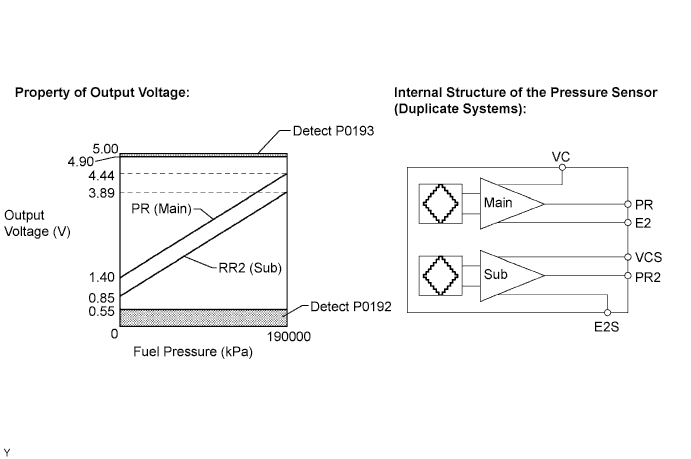
The ECM monitors the internal fuel pressure of the common rail using the fuel pressure sensor, and controls the suction control valve to regulate the internal pressure to the target pressure. The pressure sensor is a semiconductor that varies electrical resistance when pressure is applied to its silicon chip. This sensor outputs the voltage in proportion to the internal fuel pressure. The sensor has been designed as a duplicate circuit, and its main (PR) circuit is used under normal conditions. Even if either of the sensor circuits fail, the other normal circuit will be used to monitor the internal fuel pressure.
| DTC No. | DTC Detection Condition | Trouble Area |
|---|---|---|
| P0087 | Fuel pressure sensor output voltage stays at fixed value (1 trip detection logic) |
|
| P0190 | Fuel pressure sensor output voltage is 0.55 V or less, or 4.9 V or more for 0.5 seconds (1 trip detection logic) |
|
| P0192 | Fuel pressure sensor output voltage is 0.55 V or less for 0.5 seconds (1 trip detection logic) |
|
| P0193 | Fuel pressure sensor output voltage is 4.9 V or more for 0.5 seconds (1 trip detection logic) |
|
Tech Tips
-
For more information on the fuel pressure sensor and common rail system, refer to the system description Click here.
-
When DTC P0087, P0190, P0192 and/or P0193 is set, check the internal fuel pressure of the common rail by entering the following menus on the intelligent tester: Powertrain / Engine and ECT / Data List / Fuel Press.
Reference Engine Speed Fuel Pressure Idling Approximately 25000 to 35000 kPa 3000 rpm (No engine load) Approximately 50000 to 70000 kPa
MONITOR DESCRIPTION
P0087 (Fuel pressure sensor output stays at fixed value):Under normal conditions, the internal fuel pressure of the common rail usually fluctuates 1000 to 2000 kPa (10 to 20 kgf/cm2, 145 to 290 psi) even when the driving conditions are constant. The internal fuel pressure is approximately 25000 to 35000 kPa (255 to 357 kgf/cm2, 3626 to 5076 psi) when idling, and it increases to approximately 50000 to 70000 kPa (510 to 714 kgf/cm2, 7250 to 10150 psi) when running the engine at 3000 rpm. This DTC is set if there is no fluctuation of the fuel pressure.
If this DTC is set, the ECM enters fail-safe mode and limits engine power. The fail-safe mode continues until the ignition switch is turned OFF.
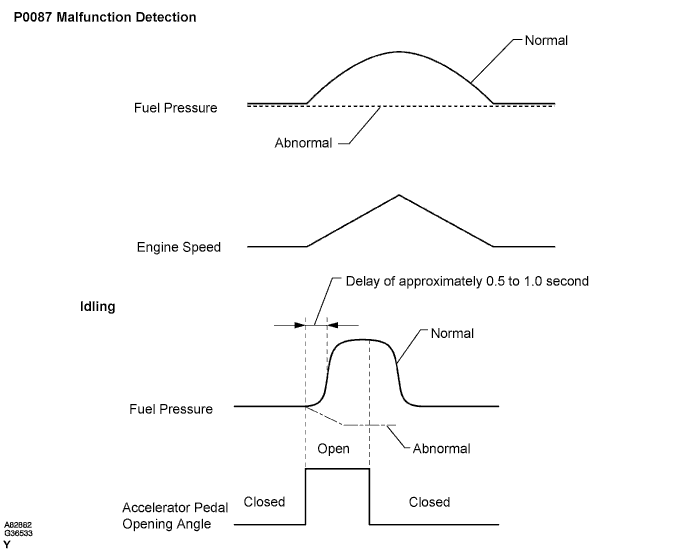
These DTCs are set if the fuel pressure sensor output voltage is out of the standard range and an open or short malfunction of the sensor circuit has occurred.
If these DTCs are set, the ECM enters fail-safe mode and limits the engine power. The fail-safe mode continues until the ignition switch is turned OFF.
MONITOR STRATEGY
| Required Sensors | Fuel pressure sensor |
| Frequency of operation | Continuous |
| Duration | 1 second |
| MIL operation | 1 driving cycle |
| Required Sensors | Fuel pressure sensor |
| Frequency of operation | Continuous |
| Duration | 0.5 seconds |
| MIL operation | 1 driving cycle |
| Required Sensors | Fuel pressure sensor |
| Frequency of operation | Continuous |
| Duration | 0.5 seconds |
| MIL operation | 1 driving cycle |
| Required Sensors | Fuel pressure sensor |
| Frequency of operation | Continuous |
| Duration | 0.5 seconds |
| MIL operation | 1 driving cycle |
TYPICAL ENABLING CONDITIONS
| Item | Specification | Specification |
|---|---|---|
| Minimum | Maximum | |
| Engine speed | 500 rpm | - |
| Battery voltage | 8 V | - |
| Fuel volume | 5 mm3 |
- |
| The monitor will not run if the fuel pressure sensor circuit (P0190, P0192 and P0193) is malfunctioning. | ||
TYPICAL MALFUNCTION THRESHOLDS
| Detection Criteria | Threshold |
|---|---|
| Changing value of fuel pressure | Virtually no fluctuation |
| Detection Criteria | Threshold |
|---|---|
| Fuel pressure sensor output voltage | Less than 0.55 V or more than 4.9 V |
| Detection Criteria | Threshold |
|---|---|
| Fuel pressure sensor output voltage | Less than 0.55 V |
| Detection Criteria | Threshold |
|---|---|
| Fuel pressure sensor output voltage | More than 4.9 V |
WIRING DIAGRAM
INSPECTION PROCEDURE
Note
After replacing the ECM, the new ECM needs registration Click here and initialization Click here.
Tech Tips
-
After completing repairs, check that P0087, P0190, P0192 and/or P0193 is not set again.
-
If different DTCs related to different systems that have terminal E2 as the ground terminal are output simultaneously, terminal E2 may have an open circuit.
-
Read freeze frame data using the intelligent tester. Freeze frame data records the engine condition when malfunctions are detected. When troubleshooting, freeze frame data can help determine if the vehicle was moving or stationary, if the engine was warmed up or not, and other data from the time the malfunction occurred.
PROCEDURE
-
READ VALUE USING INTELLIGENT TESTER (FUEL PRESS)
-
Connect the intelligent tester to the DLC3.
-
Start the engine and turn the intelligent tester ON.
-
Enter the following menus: Powertrain / Engine and ECT / Data List / Fuel Press.
-
Read the values.
OK The internal fuel pressure of the common rail is within the specification below. Result Engine Speed Fuel Pressure Idling Approximately 25000 to 35000 kPa 3000 rpm (No engine load) Approximately 50000 to 70000 kPa
NG 
CHECK HARNESS AND CONNECTOR (FUEL PRESSURE SENSOR - ECM) Click here
OK 
-
-
CHECK IF DTC OUTPUT RECURS
-
Connect the intelligent tester to the DLC3.
-
Turn the ignition switch ON (IG) and turn the tester ON.
-
Enter the following menus: Powertrain / Engine and ECT / DTC.
-
Clear the DTC(s).
-
Let the engine idle for 60 seconds, and then repeat quick engine RPM accelerations (to 2500 rpm) for 30 seconds.
-
Enter the following menus: Powertrain / Engine and ECT / DTC.
-
Read the DTC(s).
Result Display (DTC Output) Proceed to P0087, P0190, P0192 and/or P0193 A No output B
B 
CHECK FOR INTERMITTENT PROBLEMS Click here
A 
REPLACE ECM Click here
-
-
CHECK HARNESS AND CONNECTOR (FUEL PRESSURE SENSOR - ECM)
-
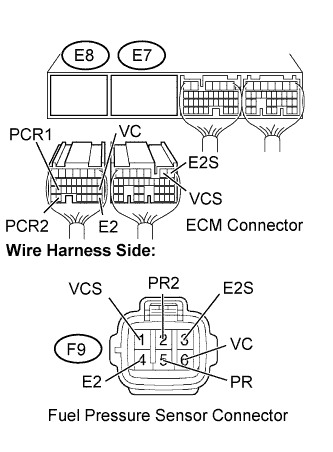
Disconnect the E7 and E8 ECM connectors.
-
Disconnect the F9 fuel pressure sensor connector.
-
Measure the resistance of the wire harness side connectors.
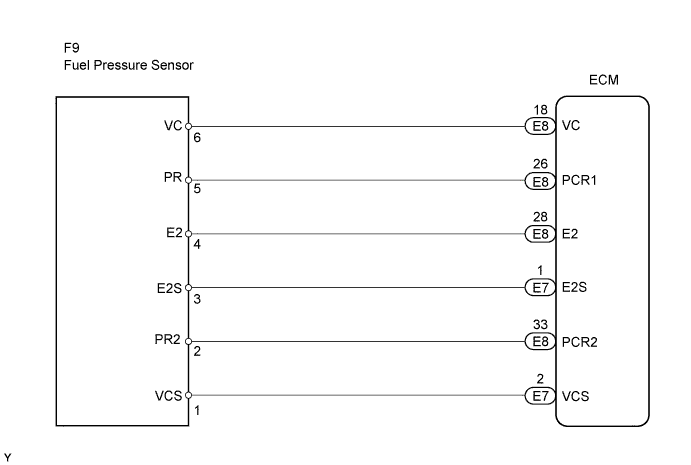
Standard resistance (Check for open) Tester Connection Specified Condition PCR1 (E8-26) - PR (F9-5) Below 1 Ω PCR2 (E8-33) - PR2 (F9-2) Below 1 Ω VCS (E7-2) - VCS (F9-1) Below 1 Ω VC (E8-18) - VC (F9-6) Below 1 Ω E2 (E8-28) - E2 (F9-4) Below 1 Ω E2S (E7-1) - E2S (F9-3) Below 1 Ω Standard resistance (Check for short) Tester Connection Specified Condition PCR1 (E8-26) or PR (F9-5) - Body ground 10 kΩ or higher PCR2 (E8-33) or PR2 (F9-2) - Body ground 10 kΩ or higher VCS (E7-2) or VCS (F9-1) - Body ground 10 kΩ or higher VC (E8-18) or VC (F9-6) - Body ground 10 kΩ or higher E2 (E8-28) or E2 (F9-4) - Body ground 10 kΩ or higher E2S (E7-1) or E2S (F9-3) - Body ground 10 kΩ or higher
NG
REPAIR OR REPLACE HARNESS OR CONNECTOR
OK
REPLACE COMMON RAIL ASSEMBLY (FUEL PRESSURE SENSOR) Click here
-