ECD SYSTEM (w/ EGR Cooler), Diagnostic DTC:P0400
| DTC Code | DTC Name |
|---|---|
| P0400 | Exhaust Gas Recirculation Flow |
DESCRIPTION
The EGR system recirculates exhaust gases, in order to suit every driving condition. The recirculated gas mingles with intake air, therefore the EGR system can slow combustion speed and keep the combustion temperature down. This helps reduce NOx emission.
In order to increase EGR circulation efficiency, the ECM adjusts the lift amount of the EGR valve and throttle valve angle.
| DTC No. | DTC Detection Condition | Trouble Area |
|---|---|---|
| P0400 | When either condition below is met:
|
|
MONITOR DESCRIPTION
-
If the EGR valve is forcibly operated but the intake air amount does not vary, the ECM determines that the EGR valve is malfunctioning. The ECM then illuminates the MIL.
-
When the target and actual positions of the EGR valve are different, the ECM interprets this as a malfunction of the EGR valve and illuminates the MIL.
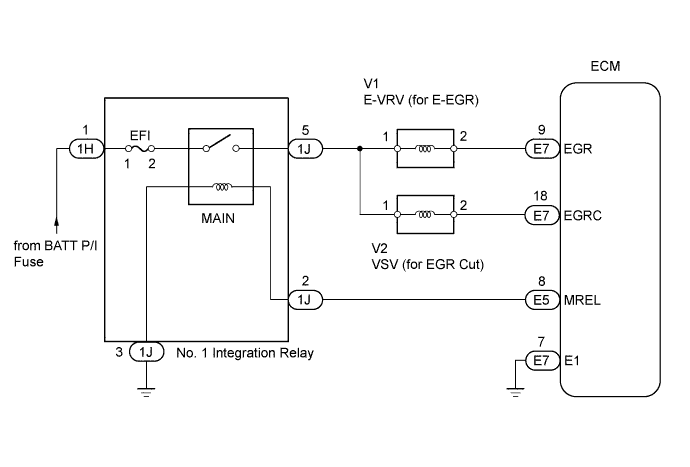
WIRING DIAGRAM
INSPECTION PROCEDURE
Note
After replacing the ECM, the new ECM needs registration Click here and initialization Click here.
Tech Tips
-
Read freeze frame data using the intelligent tester. The ECM records vehicle and driving condition information as freeze frame data the moment a DTC is stored. When troubleshooting, freeze frame data can help determine if the vehicle was running or stopped, if the engine was warmed up or not, and other data from the time the malfunction occurred.
-
After warming up the engine, DTC P0400 can be set if 1 second or more passes after quickly accelerating the engine from idling.
PROCEDURE
-
CHECK OTHER DTC OUTPUT (IN ADDITION TO DTC P0400)
-
Connect the intelligent tester to the DLC3.
-
Turn the ignition switch ON and turn the tester ON.
-
Enter the following menus: Powertrain / Engine / DTC.
-
Read DTCs.
Result Display (DTC Output) Proceed to P0400 A P0400 and P0405 and/or P0406 B Tech Tips
If codes other than P0400 are output, perform troubleshooting for those DTCs first.
B 
GO TO DTC CHART Click here
A 
-
-
CHECK VACUUM PUMP ASSEMBLY
-
Check the negative pressure of the vacuum pump.
Standard More than 86.7 kPa (650 mmHg, 26 in.Hg)
NG
REPLACE VACUUM PUMP ASSEMBLY
OK
-
-
CHECK VACUUM HOSES
-
Check the vacuum hoses.
OK The hoses are not damaged and securely connected.
NG
REPAIR OR REPLACE VACUUM HOSE
OK
-
-
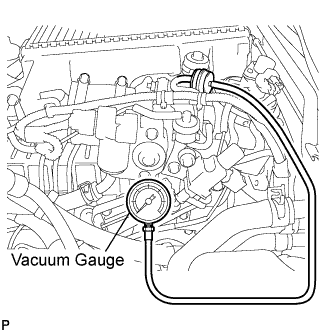
INSPECT ELECTRIC VACUUM REGULATING VALVE (FOR E-EGR)
-
Disconnect the vacuum hose to the EGR valve.
-
Connect the vacuum gauge.
-
Connect the intelligent tester to the DLC3.
-
Start the engine.
-
Warm up the engine.
Tech Tips
The engine coolant temperature is 80°C (176°F) or more.
-
Enter the following menus: Powertrain / Engine / Active Test / Control the EGR system.
-
Check the vacuum change when the Active Test is used to turn the E-VRV (for E-EGR) from OFF to ON.
Result Active Test Vacuum gauge Proceed to OFF to ON Changes from above 28 kPa (210 mmHg, 8.3 in.Hg) to 0 kPa (0 mmHg, 0 in.Hg) A Stays at 0 kPa (0 mmHg, 0 in.Hg), or stays above 28 kPa (210 mmHg, 8.3 in.Hg) B
B 
INSPECT ELECTRIC VACUUM REGULATING VALVE (E-VRV FOR E-EGR) Click here
A
-
-
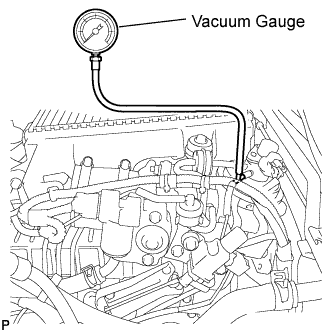
INSPECT NO. 1 VACUUM SWITCHING VALVE (FOR EGR CUT)
-
Using a 3-way connector, connect a vacuum gauge to the hose between the VSV (for EGR Cut) and EGR valve.
-
Connect the intelligent tester to the DLC3.
-
Start the engine and turn the tester ON.
-
Enter the following menus: Powertrain / Engine / Active Test / Activate the VSV for EGR Cut.
-
Check the vacuum change when the Active Test is used to turn the E-VRV (for E-EGR) from OFF to ON.
Result Active Test Vacuum gauge Proceed to OFF to ON Changes from above 28 kPa (210 mmHg, 8.3 in.Hg) to 0 kPa (0 mmHg, 0 in.Hg) A Stays at 0 kPa (0 mmHg, 0 in.Hg), or stays above 28 kPa (210 mmHg, 8.3 in.Hg) B
B
INSPECT NO. 1 VACUUM SWITCHING VALVE FOR EGR CUT (RESISTANCE) Click here
A
-
-
INSPECT ELECTRIC EGR CONTROL VALVE ASSEMBLY
-
Inspect the electric EGR control valve assembly Click here.
OK The valve is not stuck and does not have heavy carbon deposits.
NG
REPLACE EGR CONTROL VALVE ASSEMBLY Click here
OK
-
-
CHECK FOR BLOCKAGE IN EGR GAS PASSAGE (EXHAUST MANIFOLD - ELECTRIC EGR CONTROL VALVE)
-
Check for blockage in the EGR gas passage between the exhaust manifold and electric EGR control valve assembly.
OK No blockage in the EGR gas passage Tech Tips
When performing the check for deposits check the interior of the EGR valve, EGR pipe, EGR cooler, EGR cooler bypass valve and the entire EGR passage.
NG
REPAIR OR REPLACE MALFUNCTIONING PARTS, COMPONENT AND AREA
OK 
REPLACE ECM Click here
-
-
INSPECT ELECTRIC VACUUM REGULATING VALVE (E-VRV FOR E-EGR)
-
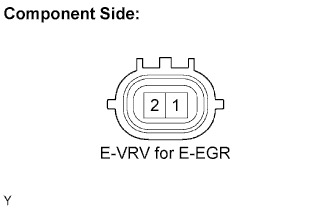
Disconnect the V1 E-VRV for E-EGR connector.
-
Measure the resistance of the E-VRV for E-EGR.
Standard resistance Tester Connection Condition Specified Condition 1 - 2 20°C (68°F) 11 to 13 Ω
NG
REPLACE EGR CONTROL VALVE ASSEMBLY Click here
OK
-
-
CHECK HARNESS AND CONNECTOR (E-VRV FOR E-EGR - ECM)
-
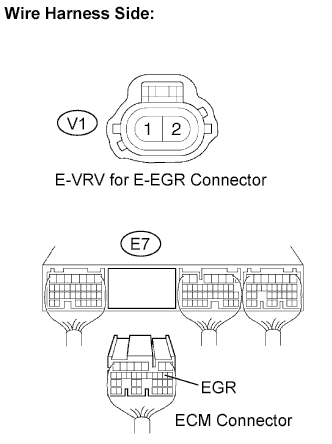
Disconnect the V1 E-VRV for E-EGR connector.
-
Disconnect the E7 ECM connector.
-
Measure the resistance of the wire harness side connector.
Standard resistance (Check for open) Tester Connection Specified Condition V1-2 - EGR (E7-9) Below 1 Ω Standard resistance (Check for short) Tester Connection Specified Condition V1-2 or EGR (E7-9) - Body ground 10 kΩ or higher
NG
REPAIR OR REPLACE HARNESS OR CONNECTOR
OK
-
-
CHECK HARNESS AND CONNECTOR (E-VRV FOR E-EGR - NO. 1 INTEGRATION RELAY)
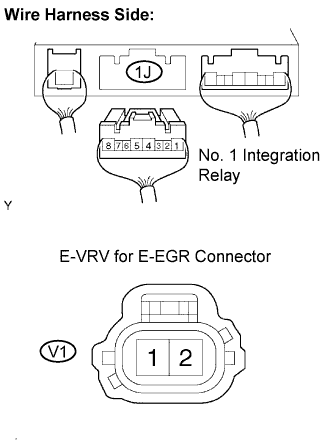
-
Remove the No. 1 integration relay from the engine room junction block Click here.
-
Disconnect the 1J No. 1 integration relay connector.
-
Disconnect the V1 E-VRV for E-EGR connector.
-
Measure the resistance of the wire harness side connectors.
Standard resistance (Check for open) Tester Connection Specified Condition 1J-5 - V1-1 Below 1 Ω Standard resistance (Check for short) Tester Connection Specified Condition 1J-5 or V1-1 - Body ground 10 kΩ or higher
NG
REPAIR OR REPLACE HARNESS OR CONNECTOR
OK
REPLACE ECM Click here
-
-
INSPECT NO. 1 VACUUM SWITCHING VALVE FOR EGR CUT (RESISTANCE)
-
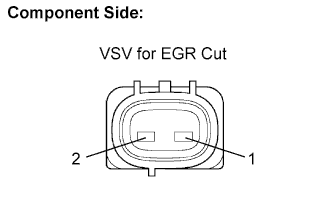
Disconnect the V2 VSV for EGR cut connector.
-
Measure the resistance of the VSV for EGR Cut.
Standard resistance Tester Connection Condition Specified Condition 1 - 2 20°C (68°F) 37 to 44 Ω
NG
REPLACE NO. 1 VACUUM SWITCHING VALVE FOR EGR CUT Click here
OK
-
-
CHECK HARNESS AND CONNECTOR (NO. 1 VACUUM SWITCHING VALVE FOR EGR CUT - ECM)
-
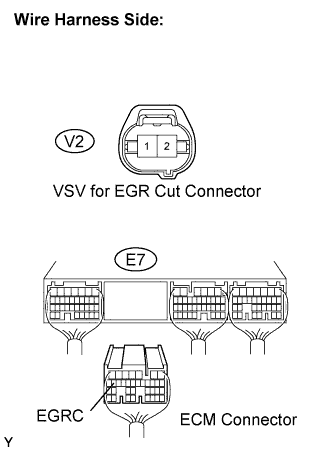
Disconnect the V2 VSV for EGR Cut connector.
-
Disconnect the E7 ECM connector.
-
Measure the resistance of the wire harness side connectors.
Standard resistance (Check for open) Tester Connection Specified Condition EGRC (E7-18) - V2-2 Below 1 Ω Standard resistance (Check for short) Tester Connection Specified Condition EGRC (E7-18) or V2-2 - Body ground 10 kΩ or higher
NG
REPAIR OR REPLACE HARNESS OR CONNECTOR
OK
-
-
CHECK HARNESS AND CONNECTOR (VSV FOR EGR CUT - NO. 1 INTEGRATION RELAY)
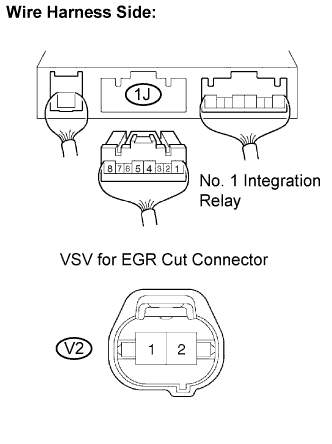
-
Remove the No. 1 integration relay from the engine room junction block Click here.
-
Disconnect the 1J No. 1 integration relay connector.
-
Disconnect the V2 VSV for EGR cut connector.
-
Measure the resistance of the wire harness side connectors.
Standard resistance (Check for open) Tester Connection Specified Condition 1J-5 - V2-1 Below 1 Ω Standard resistance (Check for short) Tester Connection Specified Condition 1J-5 or V2-1 - Body ground 10 kΩ or higher
NG
REPAIR OR REPLACE HARNESS OR CONNECTOR
OK
REPLACE ECM Click here
-