SFI SYSTEM (w/o Secondary Air Injection System), Diagnostic DTC:P0130
| DTC Code | DTC Name |
|---|---|
| P0130 | Oxygen Sensor Circuit Malfunction (Bank 1 Sensor 1) |
DESCRIPTION
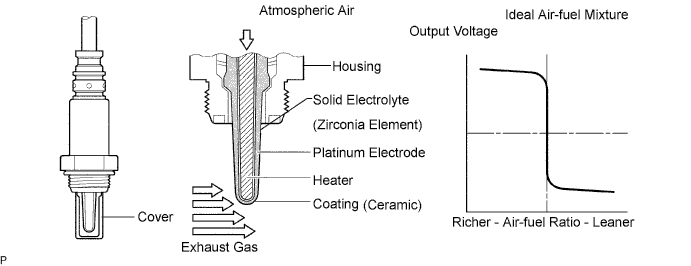
To obtain a high purification rate for the CO, HC and NOx components of the exhaust gas, a three-way catalytic converter is used, but for the most efficient use of the three-way catalytic converter, the air-fuel ratio must be precisely controlled so that it is always close to the stoichiometric air-fuel ratio.
The heated oxygen sensor has the characteristic where by its output voltage changes suddenly in the vicinity of the stoichiometric air-fuel ratio. This is used to detect the oxygen concentration in the exhaust gas and provide the ECM with feedback to control the air-fuel ratio.
When the air-fuel ratio becomes LEAN, the oxygen concentration in the exhaust gas increases. And the heated oxygen sensor informs the ECM of the LEAN condition (small electromotive force: <0.45 V).
When the air-fuel ratio is RICHER than the stoichiometric air-fuel ratio, the oxygen concentration in the exhaust gas is reduced. And the heated oxygen sensor informs the ECM of the RICH condition (large electromotive force: >0.45 V). The ECM judges by the electromotive force from the heated oxygen sensor whether the air-fuel ratio is RICH or LEAN and controls the injection time accordingly. However, if the malfunction of the heated oxygen sensor causes an output of abnormal electromotive force, the ECM becomes unable to perform the accurate air-fuel ratio control.
The heated oxygen sensor is included a heater which heats the zirconia element. The heater is controlled by the ECM. When the intake air volume is low (the temperature of the exhaust gas is low), current flows to the heater in order to heat the sensor for the accurate oxygen concentration detection.
| DTC No. | DTC Detection Conditions | Trouble Area |
|---|---|---|
| P0130 |
|
|
Tech Tips
After confirming DTC P0130, use the intelligent tester to confirm the output voltage of the heated oxygen sensor from the "Powertrain / Engine and ECT / Data List". If voltage output of the heated oxygen sensor is less than 0.1 V, the heated oxygen sensor circuit may be open or short.
CONFIRMATION DRIVING PATTERN
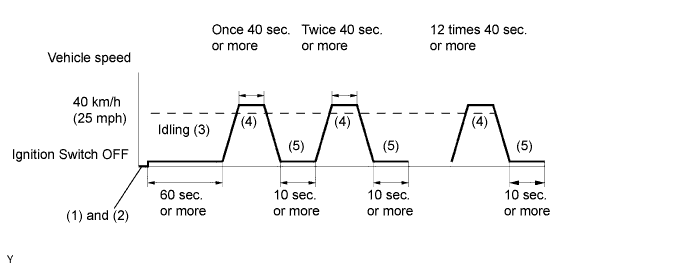
(1) Connect the intelligent tester to the DLC3.
(2) Switch the intelligent tester from the normal mode to the check mode.
(3) Start the engine and let the engine idle for 60 seconds or more.
(4) Drive the vehicle at 40 km/h (25 mph) or more for 40 seconds or more.
(5) Let the engine idle for 10 seconds or more.
(6) Perform steps (4) and (5) 12 times.
Tech Tips
If a malfunction exists, the MIL will light up during step (6).
Note
If the conditions in this test are not strictly followed, detection of the malfunction will not be possible. If you do have an intelligent tester, turn the ignition switch OFF after performing steps from (3) to (6), then perform steps from (3) to (6) again.
WIRING DIAGRAM
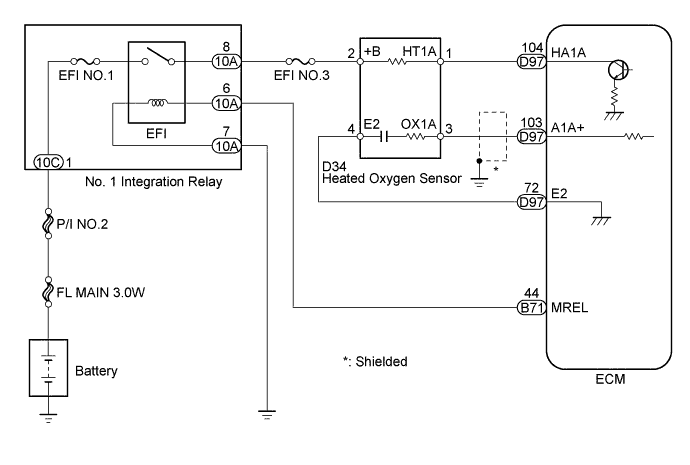
INSPECTION PROCEDURE
Note
Inspect the fuses for circuits related to this system before performing the following inspection procedure.
Tech Tips
Read freeze frame data using the intelligent tester. Freeze frame data records the engine conditions when malfunctions are detected. When troubleshooting, freeze frame data can help determine if the vehicle was moving or stationary, if the engine was warmed up or not, if the air-fuel ratio was lean or rich, and other data from the time the malfunction occurred.
PROCEDURE
-
READ OUTPUT DTC
-
Connect the intelligent tester to the DLC3.
-
Enter the following menus: Powertrain / Engine and ECT / DTC.
-
Read the DTCs.
Result Result Proceed to DTC P0130 is output A DTC P0130 and other DTCs are output B Tech Tips
If any DTCs other than P0130 are output, perform troubleshooting for those DTCs first.
B 
GO TO RELEVANT DTC CHART Click here
A 
-
-
READ VALUE USING INTELLIGENT TESTER (OUTPUT VOLTAGE OF HEATED OXYGEN SENSOR)
-
Warm up the engine to the normal operating temperature above 75°C (169°F).
-
Connect the intelligent tester to the DLC3.
-
Turn the ignition switch ON and turn the tester on.
-
Enter the following menus: Powertrain / Engine and ECT / Data List / O2S B1S1.
-
Allow the engine to idle.
-
Read the heated oxygen sensor output voltage when the engine is suddenly raced.
Standard Heated oxygen sensor outputs a RICH signal (0.45 V or more) at least once Tech Tips
Perform a quick racing to 4000 rpm 3 times by using the accelerator pedal.
NG 
CHECK PCV HOSE Click here
OK
-
-
PERFORM CONFIRMATION DRIVING PATTERN
-
Drive the vehicle in accordance with the driving pattern described in Confirmation Driving Pattern.
NEXT
-
-
CHECK WHETHER DTC OUTPUT RECURS (DTC P0130 IS OUTPUT AGAIN)
-
Connect the intelligent tester to the DLC3.
-
Turn the intelligent tester on.
-
Enter the following menus: Powertrain / Engine and ECT / DTC.
-
Read the DTCs.
Result Display (DTC Output) Proceed to No DTC is output A P0130 is output B
B
REPLACE ECM Click here
A
-
-
CONFIRM IF VEHICLE HAS RUN OUT OF FUEL IN PAST
-
Has the vehicle run out of fuel in the past?
NO
CHECK FOR INTERMITTENT PROBLEMS Click here
YES 
DTC CAUSED BY RUNNING OUT OF FUEL
-
-
CHECK PCV HOSE
-
Check the PCV hose connections.
OK PCV hose is connected correctly and is not damaged.
NG
REPAIR OR REPLACE VENTILATION HOSE
OK
-
-
INSPECT HEATED OXYGEN SENSOR
-
Inspect the heated oxygen sensor Click here.
NG
REPLACE HEATED OXYGEN SENSOR Click here
OK
-
-
INSPECT NO. 1 INTEGRATION RELAY (EFI) (POWER SOURCE VOLTAGE)
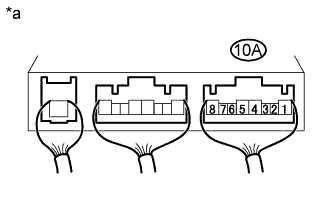
Text in Illustration *a Component with harness connected
(No. 1 Integration Relay)
-
Remove the No. 1 integration relay from the No. 1 engine room relay block.
-
Measure the voltage according to the value(s) in the table below.
Standard Voltage Tester Connection Condition Specified Condition 10A-8 - Body ground Ignition switch ON 11 to 14 V
NG
CHECK ECM POWER SOURCE CIRCUIT Click here
OK
-
-
CHECK HARNESS AND CONNECTOR (HEATED OXYGEN SENSOR - ECM)
-
Disconnect the heated oxygen sensor connector.
-
Disconnect the ECM connector.
-
Measure the resistance according to the value(s) in the table below.
Standard Resistance Tester Connection Condition Specified Condition D34-1 (HT1A) - D97-104 (HA1A) Always Below 1 Ω D34-3 (OX1A) - D97-103 (A1A+) Always Below 1 Ω D34-4 (E2) - D97-72 (E2) Always Below 1 Ω D34-1 (HT1A) or D97-104 (HA1A) - Body ground Always 10 kΩ or higher D34-3 (OX1A) or D97-103 (A1A+) - Body ground Always 10 kΩ or higher
NG
REPAIR OR REPLACE HARNESS OR CONNECTOR
OK
-
-
CHECK AIR INDUCTION SYSTEM
-
Check the air induction system for vacuum leaks.
OK No leaks in air induction system.
NG
REPAIR OR REPLACE INTAKE SYSTEM
OK
-
-
CHECK FUEL PRESSURE
-
Check the fuel pressure Click here.
NG
REPAIR OR REPLACE FUEL SYSTEM
OK
-
-
INSPECT FUEL INJECTOR ASSEMBLY
-
Check the fuel injector assembly (whether fuel volume is high or low, and whether injector pattern is poor) Click here.
NG
REPLACE FUEL INJECTOR ASSEMBLY Click here
OK
-
-
CHECK FOR EXHAUST GAS LEAK
-
Check for exhaust gas leaks.
OK No gas leaks.
NG
REPAIR OR REPLACE EXHAUST SYSTEM
OK
REPLACE HEATED OXYGEN SENSOR Click here
-