SFI SYSTEM, Diagnostic DTC:P22AB11, P22AB12, P22AB13, P22AB16, P22AB17, P22B211, P22B212
| DTC Code | DTC Name |
|---|---|
| P22AB11 | A/F (O2) Sensor Positive Current Control Bank 1 Sensor 2 Circuit Short to Ground |
| P22AB12 | A/F (O2) Sensor Positive Current Control Bank 1 Sensor 2 Circuit Short to Battery |
| P22AB13 | A/F (O2) Sensor Positive Current Control Bank 1 Sensor 2 Circuit Open |
| P22AB16 | A/F (O2) Sensor Positive Current Control Bank 1 Sensor 2 Circuit Voltage Below Threshold |
| P22AB17 | A/F (O2) Sensor Positive Current Control Bank 1 Sensor 2 Circuit Voltage Above Threshold |
| P22B211 | A/F (O2) Sensor Negative Current Control Bank 1 Sensor 2 Circuit Short to Ground |
| P22B212 | A/F (O2) Sensor Negative Current Control Bank 1 Sensor 2 Circuit Short to Battery |
DESCRIPTION
Refer to DTC P003612.
| DTC No. | Detection Item | DTC Detection Condition | Trouble Area | MIL | Memory | Note |
|---|---|---|---|---|---|---|
| P22AB11 | A/F (O2) Sensor Positive Current Control Bank 1 Sensor 2 Circuit Short to Ground | The A1B+ voltage is 1.43 V or less for 5 seconds or more (2 trip detection logic). |
|
Comes on | DTC stored | SAE: P22AC |
| P22AB12 | A/F (O2) Sensor Positive Current Control Bank 1 Sensor 2 Circuit Short to Battery | The A1B+ voltage is higher than 6.135 V for 5 seconds or more (2 trip detection logic). |
|
Comes on | DTC stored | SAE: P22AD |
| P22AB13 | A/F (O2) Sensor Positive Current Control Bank 1 Sensor 2 Circuit Open | 100 seconds or more elapse after the air fuel ratio sensor (sensor 2) heater turns on and the air fuel ratio sensor (sensor 2) impedance is higher than 510 Ω (2 trip detection logic). |
|
Comes on | DTC stored | SAE: P22AB |
| P22AB16 | A/F (O2) Sensor Positive Current Control Bank 1 Sensor 2 Circuit Voltage Below Threshold | When A1B+ voltage is higher than 2.77 V, the difference between terminals A1B+ and A1B- is 0.2 V or less for 5 seconds or more (2 trip detection logic). |
|
Comes on | DTC stored | SAE: P22AC |
| P22AB17 | A/F (O2) Sensor Positive Current Control Bank 1 Sensor 2 Circuit Voltage Above Threshold | Difference between terminals A1B+ and A1B- is higher than 1.72 V for 5 seconds or more (2 trip detection logic). |
|
Comes on | DTC stored | SAE: P22AD |
| P22B211 | A/F (O2) Sensor Negative Current Control Bank 1 Sensor 2 Circuit Short to Ground | The A1B- voltage is 1.07 V or less for 5 seconds or more (2 trip detection logic). |
|
Comes on | DTC stored | SAE: P22B3 |
| P22B212 | A/F (O2) Sensor Negative Current Control Bank 1 Sensor 2 Circuit Short to Battery | The A1B- voltage is higher than 4.59 V for 5 seconds or more (2 trip detection logic). |
|
Comes on | DTC stored | SAE: P22B4 |
MONITOR DESCRIPTION
These DTCs are stored when there is an open or short in the air fuel ratio sensor (sensor 2) circuit, or the air fuel ratio sensor (sensor 2) output value is abnormal. The voltage of the air fuel ratio sensor (sensor 2) is when turning the ignition switch to ON, or the impedance (impedance is an electrical term that indicates the difficulty of flow of current) is checked while engine running. If the voltage of the air fuel ratio sensor (sensor 2) is outside the normal range, or the impedance is outside the normal range, the ECM illuminates the MIL and stores a DTC.
MONITOR STRATEGY
| Required Sensors/Components | Air fuel ratio sensor (sensor 2) |
| Frequency of Operation | Continuous |
CONFIRMATION DRIVING PATTERN
-
Connect the GTS to the DLC3.
-
Turn the ignition switch to ON.
-
Turn the GTS on.
-
Clear the DTCs (even if no DTCs are stored, perform the clear DTC procedure).
-
Turn the ignition switch off and wait for at least 30 seconds.
-
Start the engine and wait 5 minutes or more.
-
Turn the GTS on.
-
Enter the following menus: Powertrain / Engine / Trouble Codes.
-
Read the pending DTCs.
Tech Tips
-
If a pending DTC is output, the system is malfunctioning.
-
If a pending DTC is not output, perform the following procedure.
-
-
Enter the following menus: Powertrain / Engine / Utility / All Readiness.
-
Input the DTC: P22AB11, P22AB12, P22AB13, P22AB16, P22AB17, P22B211 or P22B212.
-
Check the DTC judgment result.
GTS Display Description NORMAL
-
DTC judgment completed
-
System normal
ABNORMAL
-
DTC judgment completed
-
System abnormal
INCOMPLETE
-
DTC judgment not completed
-
Perform driving pattern after confirming DTC enabling conditions
Tech Tips
-
If the judgment result is NORMAL, the system is normal.
-
If the judgment result is ABNORMAL, the system is malfunctioning.
-
If the judgment result is INCOMPLETE, idle the engine for 5 minutes and check the DTC judgment result again.
-
CAUTION / NOTICE / HINT
Note
Inspect the fuses for circuits related to this system before performing the following procedure.
Tech Tips
-
Refer to "Data List / Active Test" [A/F (O2) Sensor Current B1S2.
-
Read Freeze Frame Data using the GTS. The ECM records vehicle and driving condition information as Freeze Frame Data the moment a DTC is stored. When troubleshooting, Freeze Frame Data can help determine if the vehicle was moving or stationary, if the engine was warmed up or not, if the air fuel ratio was lean or rich, and other data from the time the malfunction occurred.
-
Sensor 1 refers to the sensor closest to the engine assembly.
-
Sensor 2 refers to the sensor farthest away from the engine assembly.
PROCEDURE
-
CHECK TERMINAL VOLTAGE (AIR FUEL RATIO SENSOR (SENSOR 2) VOLTAGE)
Tech Tips
Make sure that the connector is properly connected. If it is not, securely connect it and check for DTCs again.
-
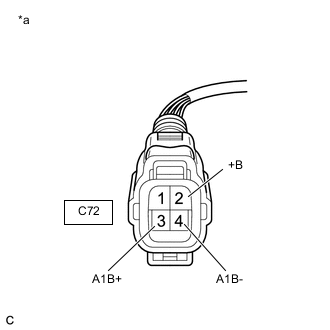
*a Front view of wire harness connector
(to Air Fuel Ratio Sensor (Sensor 2))
Disconnect the C72 air fuel ratio sensor (sensor 2) connector.
-
Turn the ignition switch to ON.
-
Measure the voltage according to the value(s) in the table below.
Standard Voltage Tester Connection Condition Specified Condition C72-3 (A1B+) - Body ground Ignition switch ON 2.8 to 3.2 V C72-4 (A1B-) - Body ground Ignition switch ON 2.3 to 2.7 V C72-3 (A1B+) - C72-4 (A1B-) Ignition switch ON 0.1 to 0.9 V Tech Tips
Perform "Inspection After Repair" after replacing the air fuel ratio sensor (sensor 2).
Result Proceed to OK NG
OK 
REPLACE AIR FUEL RATIO SENSOR (SENSOR 2) Click here
NG 
-
-
CHECK HARNESS AND CONNECTOR (AIR FUEL RATIO SENSOR (SENSOR 2) - ECM)
-
Disconnect the C72 air fuel ratio sensor (sensor 2) connector.
-
Disconnect the C62 ECM connector.
-
Measure the resistance according to the value(s) in the table below.
Standard Resistance Tester Connection Condition Specified Condition C72-1 (HA1B) - C62-52 (HA1B) Always Below 1 Ω C72-3 (A1B+) - C62-99 (A1B+) Always Below 1 Ω C72-4 (A1B-) - C92-100 (A1B-) Always Below 1 Ω C72-1 (HA1B) or C62-52 (HA1B) - Body ground and other terminals Always 10 kΩ or higher C72-3 (A1B+) or C62-99 (A1B+) - Body ground and other terminals Always 10 kΩ or higher C72-4 (A1B-) or C92-100 (A1B-) - Body ground and other terminals Always 10 kΩ or higher Result Proceed to OK NG
OK
REPLACE ECM Click here
NG
REPAIR OR REPLACE HARNESS OR CONNECTOR
-