OIL PUMP (for DPF) INSTALLATION
Note
-
When replacing the injectors (including shuffling the injectors between the cylinders), common rail or cylinder head, it is necessary to replace the injection pipes with new ones.
-
When replacing the fuel supply pump, common rail, cylinder block, cylinder head, cylinder head gasket or timing gear case, it is necessary to replace the fuel inlet pipe with a new one.
-
After removing the injection pipes, clean them with a brush and compressed air.
-
INSTALL TIMING GEAR CASE ASSEMBLY
-
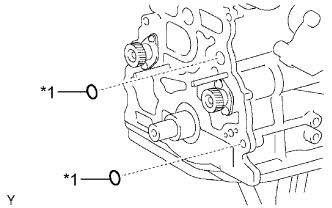
Text in Illustration *1 New O-Ring Install 2 new O-rings to the cylinder block.
-
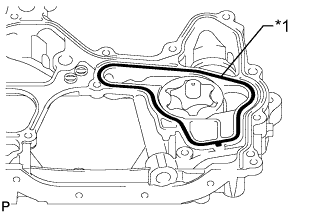
Text in Illustration *1 New Gasket Install a new gasket to the groove of the timing gear case.
-
Remove any old seal packing (FIPG material).
-
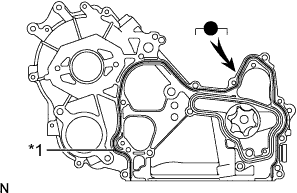
Text in Illustration *1 Seal Packing Apply seal packing to the timing gear case as shown in the illustration.
Seal packing Toyota Genuine Seal Packing Black, Three Bond 1207B or equivalent Standard seal diameter 4 mm (0.157 in.) Note
After applying seal packing, install the timing gear case assembly within 3 minutes and tighten the bolts within 15 minutes.
-
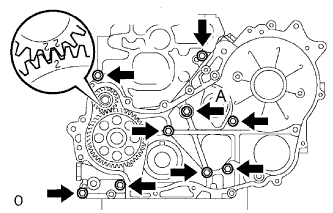
Align the "2" marks of the No. 1 balanceshaft driven gear and oil pump drive gear.
-
Install the timing gear case with the union bolt and 8 bolts.
- Torque:
- for union bolt (A)
- 16 N*m { 163 kgf*cm, 12 ft.*lbf }
- for bolt
- 13 N*m { 133 kgf*cm, 10 ft.*lbf }
-
-
INSTALL OIL STRAINER SUB-ASSEMBLY
-
Install a new gasket and the oil strainer with the 2 bolts and 2 nuts.
- Torque:
- 8.0 N*m { 82 kgf*cm, 71 in.*lbf }
-
-
INSTALL OIL PAN SUB-ASSEMBLY
-
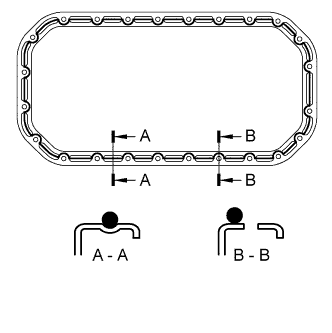
Remove any old seal packing (FIPG material).
-
Apply seal packing to the oil pan as shown in the illustration.
Seal packing Toyota Genuine Seal Packing Black, Three Bond 1207B or equivalent Standard seal packing diameter 4 mm (0.157 in.) Note
After applying seal packing, install the oil pan within 3 minutes and tighten the bolts and nuts within 15 minutes.
-
Install the oil pan with the 22 bolts and 2 nuts.
- Torque:
- 12 N*m { 122 kgf*cm, 9 ft.*lbf }
-
-
INSTALL INJECTION GEAR
-
Install a new O-ring and the fuel supply pump with the 2 nuts.
- Torque:
- 21 N*m { 214 kgf*cm, 15 ft.*lbf }
-
Temporarily install the injection gear with the nut.
Tech Tips
Fit the key (protrusion) of the fuel supply pump into the key slot of the injection gear.
-
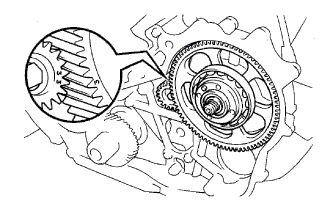
Align the "3" marks of the No. 2 balanceshaft driven gear and injection gear.
-
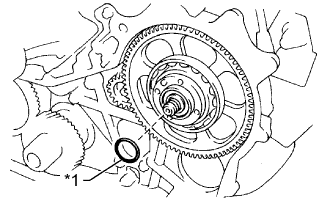
Text in Illustration *1 New O-Ring Install a new O-ring to the injection gear.
-
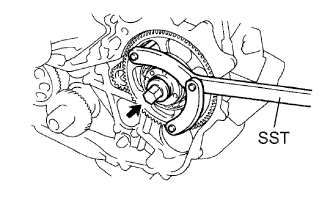
Install the injection gear set nut.
-
Using SST, tighten the set nut.
- SST
- 09960-10010 ( 09962-01000, 09963-01000 )
- Torque:
- 64 N*m { 650 kgf*cm, 47 ft.*lbf }
-
-
INSTALL CRANKSHAFT TIMING GEAR
-
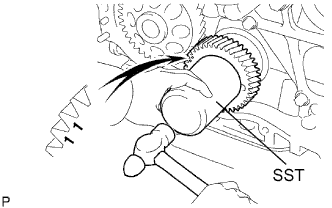
Position the crankshaft timing gear with the "1" timing marks facing forward.
-
Align the key groove of the crankshaft timing gear with the set key on the crankshaft.
-
Using SST and a hammer, tap on the timing gear to install it.
- SST
- 09223-00010
-
-
INSTALL NO. 1 IDLE GEAR SHAFT
-
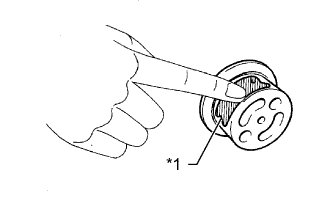
Text in Illustration *1 Engine Oil Apply a coat of engine oil to the No. 1 idle gear shaft.
-
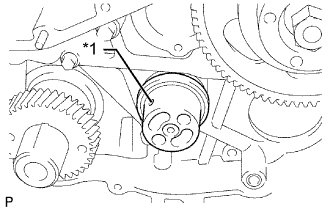
Text in Illustration *1 Oil Hole Install the gear shaft as shown in the illustration.
-
-
INSTALL NO. 1 IDLE GEAR
-
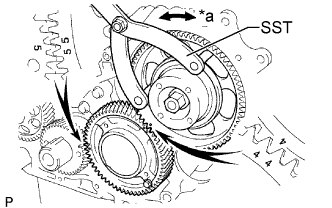
Text in Illustration *a Turn Align the "4" and "5" timing marks of the idle gear and crankshaft timing gear.
-
Using SST, turn the injection gear and align the "4" timing marks of the idle gear and injection gear, and then mesh the gears.
- SST
- 09960-10010 ( 09962-01000, 09963-00700 )
-
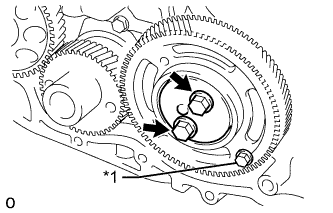
Text in Illustration *1 Service Bolt Position the idle gear thrust plate with the protrusion facing forward.
-
Align the bolt holes and install the idle gear thrust plate with the 2 bolts.
- Torque:
- 50 N*m { 510 kgf*cm, 37 ft.*lbf }
-
Remove the service bolt.
-
-
INSTALL NO. 1 CRANKSHAFT POSITION SENSOR PLATE
-
Align the key groove of the No. 1 crankshaft position sensor plate with the set key.
-
Install the No. 1 crankshaft position sensor plate with the cupped side facing outward.
-
-
INSTALL TIMING GEAR COVER
-
Remove any old seal packing (FIPG material).
-
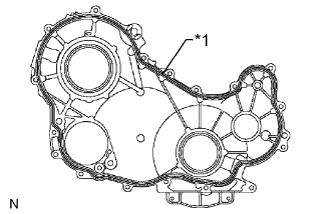
Text in Illustration *1 Seal Packing Apply seal packing to the timing gear cover as shown in the illustration.
Seal packing Toyota Genuine Seal Packing Black, Three Bond 1207B or equivalent Standard seal diameter 4 mm (0.157 in.) Note
After applying seal packing, install the timing gear cover within 3 minutes and tighten the bolts within 15 minutes.
-
Install a new O-ring to the timing gear case.
-
Install the timing gear cover with the 14 bolts and 2 nuts.
- Torque:
- 13 N*m { 133 kgf*cm, 10 ft.*lbf }
-
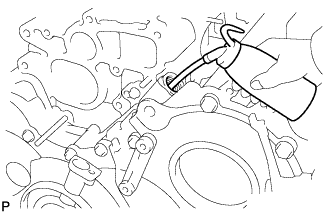
Remove the screw plug and gasket.
-
Pour approximately 50 cc (3.05 cu. in.) of engine oil into the oil pump.
-
Install a new gasket and the screw plug.
- Torque:
- 44 N*m { 449 kgf*cm, 32 ft.*lbf }
-
Install the No. 1 vacuum transmitting pipe with the bolt.
- Torque:
- 13 N*m { 133 kgf*cm, 10 ft.*lbf }
-
-
INSTALL CRANKSHAFT PULLEY
-
Align the keyway of the pulley with the key located on the crankshaft, and then slide the pulley into place to install it.
-
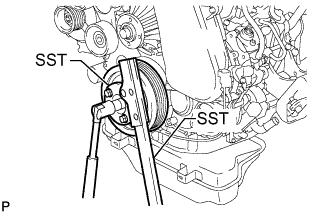
Using SST, install the pulley bolt.
- SST
- 09213-58014
- 09330-00021
- Torque:
- 365 N*m { 3722 kgf*cm, 269 ft.*lbf }
-
-
INSTALL PUMP DRIVE SHAFT PULLEY
-
Install a new O-ring to the fuel supply pump.
-
Temporarily install the fuel supply pump with the nut.
-
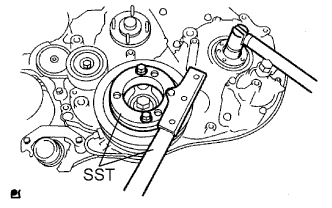
Using SST, hold the crankshaft pulley and tighten the nut.
- SST
- 09213-58014
- 09330-00021
- Torque:
- 64 N*m { 650 kgf*cm, 47 ft.*lbf }
-
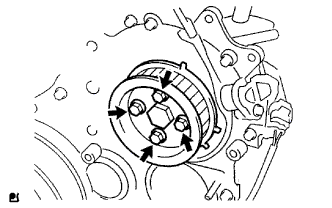
Install the No. 2 camshaft timing pulley flange and pump drive shaft pulley with the 4 bolts.
- Torque:
- 31 N*m { 316 kgf*cm, 23 ft.*lbf }
-
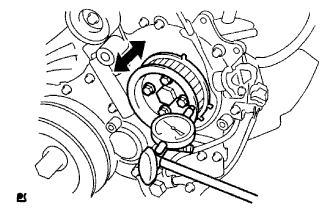
Using a dial indicator, check the thrust clearance of the pump drive shaft while moving the pump drive shaft pulley back and forth.
Standard thrust clearance 0.15 to 0.55 mm (0.0059 to 0.0217 in.) Tech Tips
If the clearance is not within the specified range, remove and reinstall the fuel supply pump and pump drive shaft pulley. Then repeat the step above.
-
-
INSTALL CRANKSHAFT POSITION SENSOR
-
Apply a light coat of engine oil to the O-ring of the sensor.
-
Install the sensor with the bolt.
- Torque:
- 8.5 N*m { 87 kgf*cm, 75 in.*lbf }
-
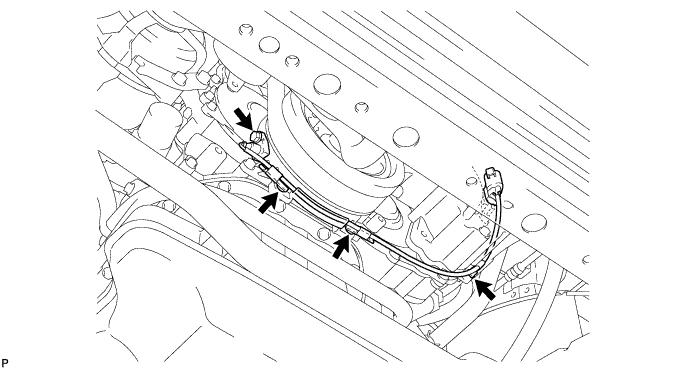
Install the 3 clips and connect the sensor connector.
Note
Insert the crankshaft position sensor wire harness into the protrusions of the timing gear cover as shown in the illustration.
-
-
INSTALL CAMSHAFT POSITION SENSOR
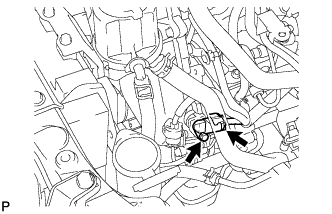
-
Apply a light coat of engine oil to the O-ring of the sensor.
-
Install the sensor with the bolt.
- Torque:
- 8.5 N*m { 87 kgf*cm, 75 in.*lbf }
-
Connect the sensor connector.
-
-
INSTALL VANE PUMP ASSEMBLY
-
Install a new O-ring to the vane pump.
-
Install the vane pump with the 2 nuts.
- Torque:
- 41 N*m { 418 kgf*cm, 30 ft.*lbf }
-
-
INSTALL VACUUM PUMP ASSEMBLY
-
Install 2 new O-rings to the vacuum pump.
-
Install the vacuum pump with the 2 nuts.
- Torque:
- 21 N*m { 210 kgf*cm, 15 ft.*lbf }
-
-
INSTALL WATER PUMP ASSEMBLY
-
Install a new gasket and the water pump with the 5 bolts and 2 nuts.
- Torque:
- 13 N*m { 133 kgf*cm, 10 ft.*lbf }
-
-
INSTALL NO. 2 TIMING BELT COVER
-
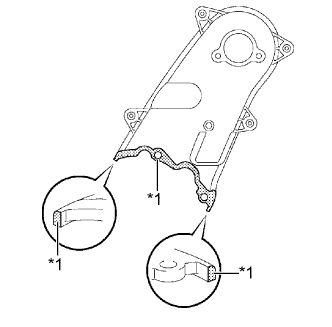
Text in Illustration *1 Seal Packing Apply seal packing (FIPG) to the specified areas shown in the illustration.
Seal packing Toyota Genuine Seal Packing Black, Three Bond 1207B or equivalent Note
After applying seal packing, install the No. 2 timing belt cover within 3 minutes and tighten the bolts and nut within 15 minutes.
-
Clean the bolts and their holes.
-
Apply adhesive to 2 or 3 threads at the end of each of the 4 bolts.
Adhesive Toyota Genuine Adhesive 1324, Three Bond 1324 or equivalent -
Install the No. 2 timing belt cover with the 4 bolts and nut.
- Torque:
- 10 N*m { 102 kgf*cm, 7 ft.*lbf }
-
-
INSTALL CAMSHAFT TIMING PULLEY
-
Install the camshaft timing pulley.
-
Install the bolt of the camshaft timing pulley while holding the camshaft with a wrench.
- Torque:
- 98 N*m { 1000 kgf*cm, 72 ft.*lbf }
-
-
INSTALL CYLINDER HEAD COVER SUB-ASSEMBLY
-
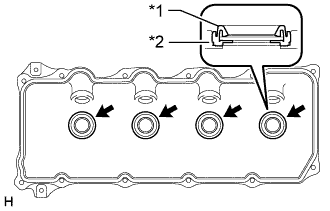
Text in Illustration *1 No. 3 Cylinder Head Cover Gasket *2 Cylinder Head Cover Install 4 new No. 3 cylinder head cover gaskets to the cylinder head cover in the directions shown in the illustration.
Note
-
Do not install the No. 3 cylinder head cover gaskets at an angle.
-
Check that there is no foreign matter at the installation location of the No. 3 cylinder head cover gaskets.
-
-
Remove any old seal packing (FIPG material) from the cylinder head.
-
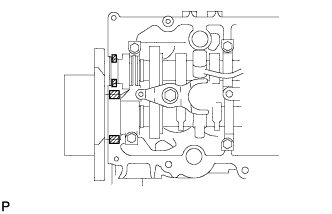
Apply seal packing to the areas shown in the illustration.
Seal packing Toyota Genuine Seal Packing Black, Three Bond 1207B or equivalent Text in Illustration 
Seal Packing Note
-
Remove any oil from the contact surface.
-
Install the cylinder head cover within 3 minutes after applying seal packing.
-
Do not start the engine for at least 2 hours after installing the cylinder head cover.
-
-
Install a new cylinder head cover gasket to the cylinder head cover.
-
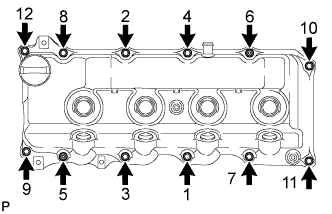
Temporarily install the cylinder head cover with the 10 bolts and 2 nuts in the order shown in the illustration. Then, tighten the 10 bolts and 2 nuts in the order shown in the illustration in 2 progressive steps.
- Torque:
- 9.0 N*m { 92 kgf*cm, 80 in.*lbf }
-
Connect the ventilation hose.
-
Install 4 new nozzle holder seals.
-
-
INSTALL NO. 2 CYLINDER HEAD COVER SUB-ASSEMBLY
-
Install the No. 2 cylinder head cover with the 3 bolts.
- Torque:
- 8.0 N*m { 82 kgf*cm, 71 in.*lbf }
-
-
INSTALL NO. 2 NOZZLE LEAKAGE PIPE ASSEMBLY
-
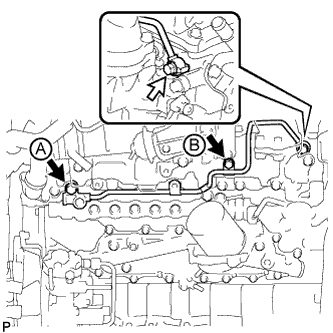
Temporarily install the No. 2 nozzle leakage pipe with the 2 bolts.
Text in Illustration 
Union Bolt -
Temporarily install a new gasket and the union bolt.
-
Tighten the 2 bolts and union bolt.
- Torque:
- for bolt A
- 21 N*m { 214 kgf*cm, 15 ft.*lbf }
- for bolt B
- 13 N*m { 130 kgf*cm, 9 ft.*lbf }
- for union bolt
- 21 N*m { 214 kgf*cm, 15 ft.*lbf }
-
-
INSTALL NO. 3 NOZZLE LEAKAGE PIPE
-
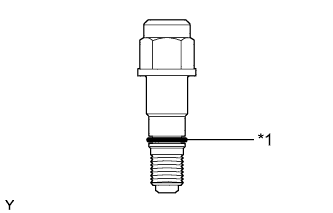
Text in Illustration *1 O-Ring Apply a light coat of fuel to the O-ring of the fuel check valve.
-
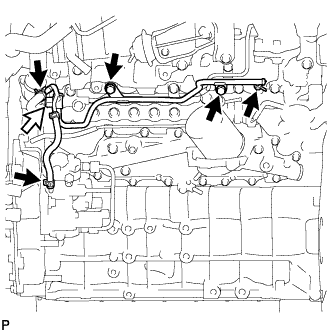
Temporarily install the No. 3 nozzle leakage pipe with the 2 bolts.
Text in Illustration Fuel Check Valve -
Temporarily install a new gasket and the fuel check valve.
-
Tighten the 2 bolts and fuel check valve.
- Torque:
- for bolt
- 13 N*m { 130 kgf*cm, 9 ft.*lbf }
- for fuel check valve
- 32 N*m { 321 kgf*cm, 23 ft.*lbf }
-
Connect the 3 fuel hoses.
-
-
INSTALL NO. 2 FUEL PIPE
-
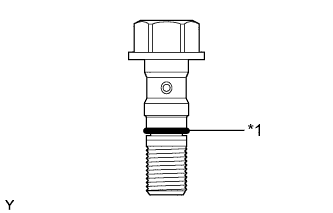
Text in Illustration *1 O-Ring Apply a light coat of fuel to the O-ring of the fuel check valve.
-
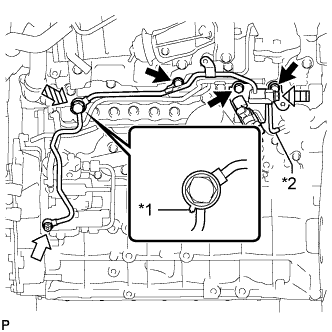
Text in Illustration *1 Gasket *2 No. 1 Fuel Pipe 
Bolt Supply Pump Hollow Screw 
Fuel Check Valve 
Union Bolt Temporarily install the No. 2 fuel pipe with the 3 bolts.
-
Install a new gasket to the No. 1 fuel pipe and temporarily install the union bolt.
-
Temporarily install a new gasket and the fuel check valve.
Note
When temporarily installing the fuel check valve, position the gasket as shown in the illustration.
-
Temporarily install a new gasket and the supply pump hollow screw.
-
Using a 6 mm hexagon wrench, tighten the supply pump hollow screw.
- Torque:
- 21 N*m { 214 kgf*cm, 15 ft.*lbf }
-
Tighten the 3 bolts, fuel check valve and union bolt.
- Torque:
- for bolt
- 20 N*m { 204 kgf*cm, 15 ft.*lbf }
- for fuel check valve
- 32 N*m { 321 kgf*cm, 23 ft.*lbf }
- for union bolt
- 21 N*m { 214 kgf*cm, 15 ft.*lbf }
Note
When tightening the fuel check valve, replace the gasket if it becomes deformed.
-
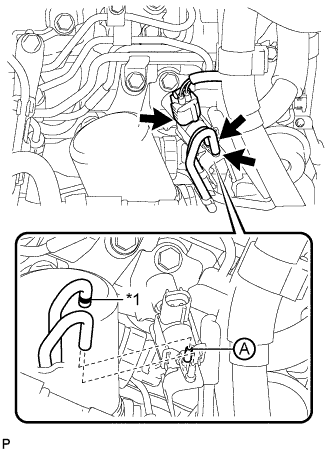
Text in Illustration *1 Paint Mark Connect the vacuum switching valve connector and 2 vacuum transmitting hoses.
Tech Tips
When connecting the vacuum transmitting hoses, connect the hose that has the paint mark to the port labeled A in the illustration.
-
-
INSTALL NO. 4 INJECTION PIPE SUB-ASSEMBLY
Note
-
When replacing an injector, it is necessary to replace the 4 injection pipes with new ones.
-
Keep the joints of the injection pipe clean.
-
Temporarily install the No. 4 injection pipe with the union nuts.
-
Install the 2 No. 2 injection pipe clamps with the bolt and nut.
- Torque:
- 5.0 N*m { 51 kgf*cm, 44 in.*lbf }
-
Using a 17 mm union nut wrench, tighten the injection pipe union nut on the common rail side.
- Torque:
- 35 N*m { 357 kgf*cm, 26 ft.*lbf }
Note
Use the formula to calculate special torque values for situations where a union nut wrench is combined with a torque wrench Click here.
-
Using a 17 mm union nut wrench, tighten the injection pipe union nuts on the injector side.
- Torque:
- 35 N*m { 357 kgf*cm, 26 ft.*lbf }
Note
Use the formula to calculate special torque values for situations where a union nut wrench is combined with a torque wrench Click here.
-
-
INSTALL ELECTRIC EGR CONTROL VALVE ASSEMBLY WITH NO. 2 EGR VALVE AND COOLER
-
INSTALL NO. 1 COMPRESSOR MOUNTING BRACKET (w/ Air Conditioning System)
-
Install the No. 1 compressor mounting bracket with the 4 bolts.
- Torque:
- 45 N*m { 459 kgf*cm, 33 ft.*lbf }
-
-
INSTALL V-RIBBED BELT TENSIONER ASSEMBLY
-
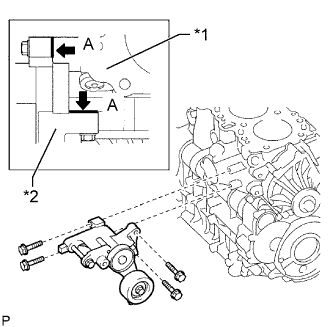
Text in Illustration *1 Cylinder Block *2 V-ribbed Belt Tensioner Install the V-ribbed belt tensioner with the 4 bolts.
- Torque:
- 21 N*m { 214 kgf*cm, 15 ft.*lbf }
Tech Tips
Firmly press and hold the V-ribbed belt tensioner against the cylinder block to eliminate any gaps in the areas labeled A in the illustration. Then uniformly tighten the 4 bolts.
-
-
INSTALL GENERATOR BRACKET
-
Install the generator bracket with the bolt.
- Torque:
- 25 N*m { 255 kgf*cm, 18 ft.*lbf }
-
-
INSTALL GENERATOR ASSEMBLY
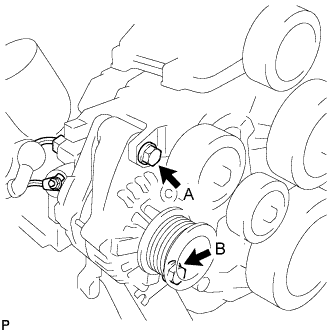
-
Install the generator with the 2 bolts.
- Torque:
- 62 N*m { 632 kgf*cm, 46 ft.*lbf, for bolt A }
- 25 N*m { 255 kgf*cm, 18 ft.*lbf, for bolt B }
-
Install the generator wire with the nut.
- Torque:
- 9.8 N*m { 100 kgf*cm, 87 in.*lbf }
-
Connect the generator connector.
-
-
INSTALL NO. 2 IDLE PULLEY ASSEMBLY
-
Install the spacer, No. 2 idle pulley and pulley plate with the bolt.
- Torque:
- 45 N*m { 459 kgf*cm, 33 ft.*lbf }
-
-
INSTALL NO. 1 VISCOUS HEATER BRACKET SUB-ASSEMBLY (w/ Viscous Heater)
-
Install the No. 1 viscous heater bracket with the 4 bolts.
- Torque:
- 45 N*m { 459 kgf*cm, 33 ft.*lbf }
-
-
INSTALL VISCOUS HEATER WITH MAGNET CLUTCH ASSEMBLY (w/ Viscous Heater)
-
INSTALL NO. 1 TIMING BELT IDLER SUB-ASSEMBLY
-
Using a 10 mm hexagon wrench, install a new washer and the No. 1 timing belt idler with the bolt.
- Torque:
- 35 N*m { 357 kgf*cm, 26 ft.*lbf }
-
Check that the idler pulley moves smoothly.
If the idler pulley does not move smoothly, check the installation condition of the idler and washer.
-
-
INSTALL TIMING BELT
-
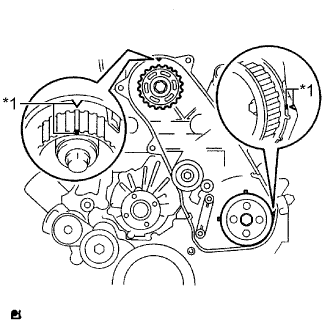
Text in Illustration *1 Timing Mark Check that the timing marks are aligned as shown in the illustration.
Note
-
Make sure that the engine is cold.
-
When turning the crankshaft, the valve heads will hit against the piston. Do not turn the crankshaft more than necessary.
Tech Tips
If reusing the timing belt, align the points marked during removal, and install the belt with the arrow pointing in the direction of crankshaft revolution.
-
-
Install the timing belt to the pump drive shaft pulley, camshaft timing pulley and No. 1 timing belt idler in sequence.
-
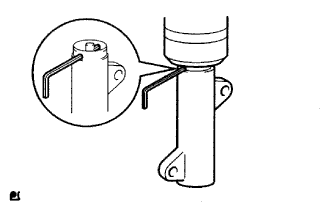
Place the tensioner upright. Then set a press on the top of the tensioner.
Note
-
Do not scratch or deform the rod end.
-
Press in the tensioner rod.
-
Protect the tip of the push rod with a cloth in order to prevent damage.
-
-
Using the press, slowly push in the push rod using 981 to 9800 N (100 to 999 kgf, 220 to 2203 lbf) of force.
Note
Do not apply a load of over 9800 N (999 kgf, 2203 lbf) to the push rod.
-
Align the holes of the push rod and housing. Then pass a 1.5 mm hexagon wrench through the holes to fix the push rod in place.
-
Temporarily install the timing belt tensioner with the 2 bolts while pushing the idler pulley toward the timing belt.
-
Tighten the 2 bolts.
- Torque:
- 13 N*m { 133 kgf*cm, 10 ft.*lbf }
Note
Uniformly tighten the 2 bolts.
-
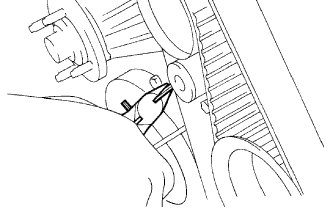
Remove the 1.5 mm hexagon wrench from the tensioner.
-
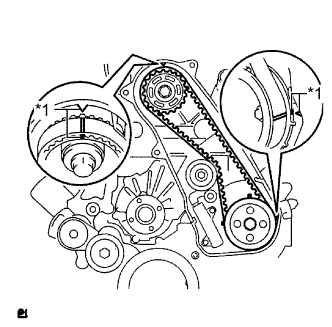
Text in Illustration *1 Timing Mark Turn the crankshaft clockwise 720° and check that the timing marks are aligned as shown in the illustration.
-
-
INSTALL NO. 1 TIMING BELT COVER
-
Install the timing belt cover and 6 washers with the 6 bolts.
- Torque:
- 6.0 N*m { 61 kgf*cm, 53 in.*lbf }
-
-
INSTALL ENGINE ASSEMBLY
-
ADD ENGINE OIL
-
Add new engine oil.
Standard Oil Grade Oil Grade Oil Viscosity (SAE) ACEA C2 - 0W-30
- 5W-30
Standard Capacity Item Specified Condition Drain and refill without oil filter change 6.6 liters (7.0 US qts, 5.8 Imp. qts) Drain and refill with oil filter change 6.9 liters (7.3 US qts, 6.1 Imp. qts) Dry fill 7.4 liters (7.8 US qts, 6.5 Imp. qts) -
Install the oil filler cap.
-
-
CONNECT CABLE TO NEGATIVE BATTERY TERMINAL
Note
When disconnecting the cable, some systems need to be initialized after the cable is reconnected Click here.
-
BLEED AIR FROM FUEL SYSTEM
-
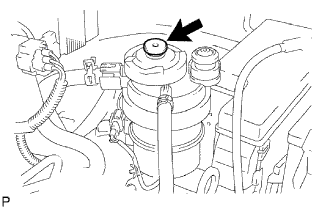
Using the hand pump mounted on the fuel filter cap, bleed the air from the fuel system. Continue pumping until the pump resistance increases.
Note
-
Hand pump pumping speed: Max. 2 strokes/ sec.
-
The hand pump must be pushed with a full stroke during pumping.
-
When the fuel pressure at the supply pump inlet port reaches a saturated pressure, the hand pump resistance increases.
-
If pumping is interrupted during the air bleeding process, fuel in the fuel line may return to the fuel tank. Continue pumping until the hand pump resistance increases.
-
If the hand pump resistance does not increase despite consecutively pumping 200 times or more, there may be a fuel leak between the fuel tank and fuel filter, the hand pump may be malfunctioning, or the vehicle may have run out of fuel.
-
If air bleeding using the hand pump is incomplete, the common rail pressure does not rise to the pressure range necessary for normal use, and the engine cannot be started.
-
-
Check if the engine starts.
Note
-
Even if air bleeding using the hand pump has been completed, the starter may need to be cranked for 10 seconds or more to start the engine.
-
Do not crank the engine continuously for more than 20 seconds. The battery may be discharged.
-
Use a fully-charged battery.
-
When the engine can be started, proceed to the next step.
-
If the engine cannot be started, bleed the air again using the hand pump until the hand pump resistance increases (refer to the procedures above). Then start the engine.
-
-
Turn the ignition switch off.
-
Connect the intelligent tester to the DLC3.
-
Turn the ignition switch to ON and turn the intelligent tester on.
-
Clear the DTCs Click here.
-
Start the engine.*1
-
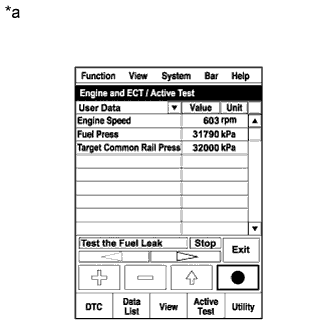
Text in Illustration *a Reference
(Active Test Operation)
Enter the following menus: Powertrain / Engine and ECT / Active Test / Test the Fuel Leak.*2
-
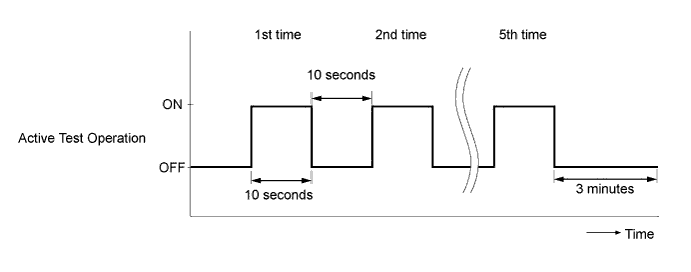
Perform the following test 5 times with on/off intervals of 10 seconds: Active Test / Test the Fuel Leak.*3
-
Allow the engine to idle for 3 minutes or more after performing the Active Test for the fifth time.
Tech Tips
When the Active Test "Test the Fuel Leak" is used to change the pump control mode, the actual fuel pressure inside the common rail drops below the target fuel pressure when the Active Test is off, but this is normal and does not indicate a pump malfunction.
-
Enter the following menus: Powertrain / Engine and ECT / DTC.
-
Read Current DTCs.
-
Clear the DTCs Click here.
Tech Tips
It is necessary to clear the DTCs, as DTC P1604 or P1605 may be stored when air is bled from the fuel system after replacing or repairing fuel system parts.
-
Repeat steps *1 to *3.
-
Enter the following menus: Powertrain / Engine and ECT / DTC.
-
Read Current DTCs.
OK No DTCs are output.
-
-
ADD ENGINE COOLANT
-
Tighten the cylinder block drain cock plug.
- Torque:
- 8.0 N*m { 82 kgf*cm, 71 in.*lbf }
-
Tighten the radiator drain cock plug by hand.
-
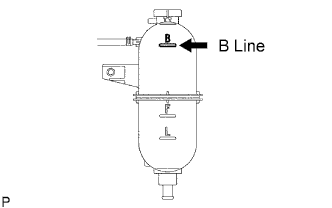
Fill the radiator with TOYOTA Super Long Life Coolant (SLLC) to the reservoir tank's B line.
Standard capacity Item Specified Condition A/T 11.1 liters (11.7 US qts, 9.8 Imp. qts) M/T 9.8 liters (10.4 US qts, 8.6 Imp. qts) Tech Tips
TOYOTA vehicles are filled with TOYOTA SLLC at the factory. In order to avoid damage to the engine cooling system and other technical problems, only use TOYOTA SLLC or similar high quality ethylene glycol based non-silicate, non-amine, non-nitrite, non-borate coolant with long-life hybrid organic acid technology (coolant with long-life hybrid organic acid technology consists of a combination of low phosphates and organic acids).
Note
Never use water as a substitute for engine coolant.
-
Press the inlet and outlet radiator hoses several times by hand, and then check the level of the coolant.
If the coolant level drops below the B line, add TOYOTA SLLC to the B line.
-
Install the radiator reservoir cap.
-
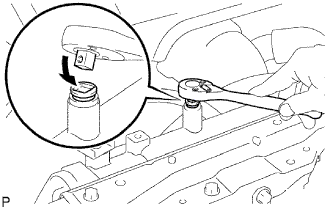
Using a wrench, install the vent plug.
- Torque:
- 2.0 N*m { 20 kgf*cm, 18 in.*lbf }
-
Bleed air from the cooling system.
-
Warm up the engine until the thermostat opens. While the thermostat is open, circulate the coolant for several minutes.
Tech Tips
The thermostat open timing can be confirmed by pressing the inlet radiator hose by hand, and checking when the engine coolant starts to flow inside the hose.
-
Maintain the engine speed at 2500 to 3000 rpm.
-
Press the inlet and outlet radiator hoses several times by hand to bleed air.
CAUTION:
When pressing the radiator hoses:
-
Wear protective gloves.
-
Be careful as the radiator hoses are hot.
-
Keep your hands away from the radiator fan.
-
-
Stop the engine and wait until the coolant cools down to ambient temperature.
CAUTION:
Do not remove the radiator reservoir cap while the engine and radiator are still hot. Pressurized, hot engine coolant and steam may be released and cause serious burns.
-
-
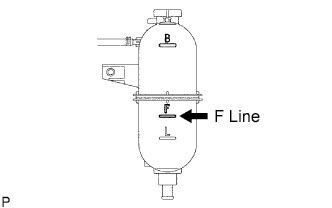
After the coolant cools down, check that the coolant level is at the F line.
If the coolant level is below the F line, add TOYOTA SLLC to the F line.
-
-
BLEED AIR FROM POWER STEERING SYSTEM
-
Check the fluid level.
-
Jack up the front of the vehicle and support it with stands.
-
Turn the steering wheel.
-
With the engine stopped, turn the steering wheel slowly from lock to lock several times.
-
-
Lower the vehicle.
-
Start the engine. Run the engine at idle for a few minutes.
-
Turn the steering wheel.
-
With the engine idling, turn the steering wheel to the left or right full lock position and hold it there for 2 to 3 seconds. Then turn the steering wheel to the opposite full lock position and hold it there for 2 to 3 seconds.
-
Repeat the step above several times.
-
-
Stop the engine.
-
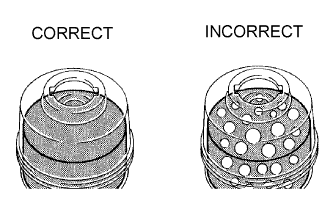
Check for foaming or emulsification. If the system has to be bled twice because of forming or emulsification, check for fluid leaks in the system.
-
Check the fluid level.
-
-
INSPECT FOR POWER STEERING FLUID LEVEL
-
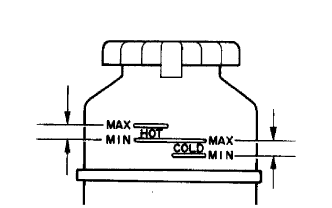
Keep the vehicle level.
-
With the engine stopped, check the power steering fluid level in the oil reservoir. If necessary, add power steering fluid.
Power steering fluid (for TMT made) "TEXAMATIC 1888" or equivalent (for TSAM made) "TEXAMATIC 1322S" or equivalent Tech Tips
If the fluid is hot, check that the fluid level is within the HOT range on the oil reservoir. If the fluid is cold, check that the fluid level is within the COLD range.
-
Start the engine and run it at idle.
-
Turn the steering wheel to the left or right full lock position, and then the wheel to the opposite full lock position. Repeat several times to raise fluid temperature.
Standard fluid temperature 75 to 80°C (167 to 176°F) -
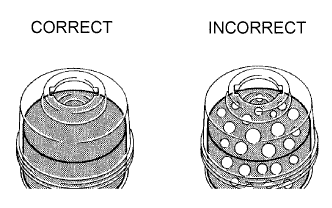
Check for foaming or emulsification. If foaming or emulsification is identified, bleed air from the power steering system.
-
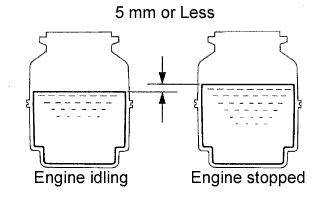
With the engine idling, measure the fluid level in the oil reservoir.
-
Stop the engine.
-
Wait a few minutes and remeasure the fluid level in the oil reservoir.
Maximum fluid level increase 5 mm (0.20 in.) If a problem is found, bleed air from the power steering system.
-
Check the fluid level.
-
-
PERFORM REGISTRATION
-
Perform registration of the injector compensation codes Click here.
-
Perform pilot quantity learning Click here.
-
-
INSPECT FOR OIL LEAK
-
Start the engine. Make sure that there are no oil leaks from the areas that were worked on.
-
-
INSPECT FOR COOLANT LEAK
Note
Do not remove the radiator reservoir cap while the engine and radiator are still hot. Pressurized, hot engine coolant and steam may be released and cause serious burns.
-
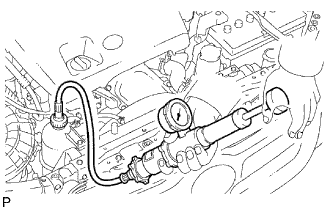
Fill the radiator with coolant and attach a radiator cap tester to the radiator reservoir.
-
Warm up the engine.
-
Using a radiator cap tester, increase the pressure inside the radiator to 118 kPa (1.2 kgf/cm2, 17.1 psi), and check that the pressure does not drop.
If the pressure drops, check the hoses, radiator and water pump for leaks.
If no external leaks are found, check the cylinder block and head.
-
-
INSPECT FOR EXHAUST GAS LEAK
-
If gas is leaking, tighten the areas necessary to stop the leak. Replace damaged parts as necessary.
-
-
INSPECT FOR FUEL LEAK
-
Perform the Active Test.
-
Connect the intelligent tester to the DLC3.
-
Turn the ignition switch to ON.
-
Turn the intelligent tester on.
-
Enter the following menus: Powertrain / Engine and ECT / Active Test.
-
Perform the Active Test.
Intelligent Tester Display Test Part Control Range Diagnostic Note Test the Fuel Leak Pressurize common rail interior and check for fuel leaks Stop/Start
-
The fuel pressure inside the common rail increases to the specified value and the engine speed increases to 2000 rpm when the Active Test is performed.
-
The above conditions are maintained while the Active Test is being performed.
-
-
-
-
INSPECT ENGINE OIL LEVEL
-
Warm up the engine, stop the engine and wait 5 minutes. The engine oil level should be between the dipstick low level mark and full level mark.
If low, check for leakage and add oil up to the full level mark.
Note
Do not fill engine oil above the full level mark.
-