ТОПЛИВНАЯ СИСТЕМА ПРОВЕРКА БЕЗ СНЯТИЯ С АВТОМОБИЛЯ

-
CHECK FUEL PUMP OPERATION AND INSPECT FOR FUEL LEAK
-
Check fuel pump with filter assembly operation.
-
Connect the GTS to the DLC3.
-
Turn the power switch on (IG).
Note
Do not start the engine.
-
Turn the GTS on.
-
Enter the following menus: Powertrain / Engine and ECT / Active Test / Control the Fuel Pump / Speed.
-
Check for pressure in the fuel tube sub-assembly from the fuel line. Check that sounds of fuel flowing from the fuel tank assembly can be heard.
If no sounds can be heard, check the No. 1 integration relay, fuel pump with filter assembly, ECM and wiring connectors.
-
-
Inspect for fuel leaks.
-
Check that there are no fuel leaks from the fuel system after doing any maintenance or repairs.
If there is a fuel leak, repair or replace parts as necessary.
-
-
Turn the power switch off.
-
Disconnect the GTS from the DLC3.
-
-
CHECK FUEL PRESSURE
-
Discharge fuel system pressure Click here.
-
Using a voltmeter, measure the auxiliary battery voltage according to the value(s) in the table below.
Standard Voltage Tester Connection Condition Specified Condition Positive (+) terminal - Negative (-) terminal Power switch off 11 to 14 V -
Disconnect the cable from the negative (-) auxiliary battery terminal.
Note
When disconnecting the cable, some systems need to be initialized after the cable is reconnected Click here.
-
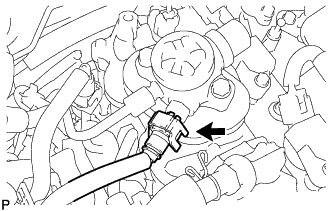
Disconnect the fuel tube sub-assembly from the No. 1 fuel pipe (direct injection side) Click here.
-
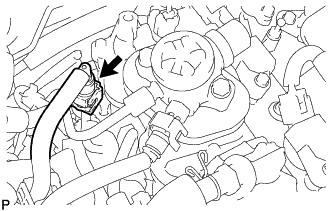
Disconnect the fuel tube sub-assembly from the fuel delivery pipe (port injection side) Click here.
-
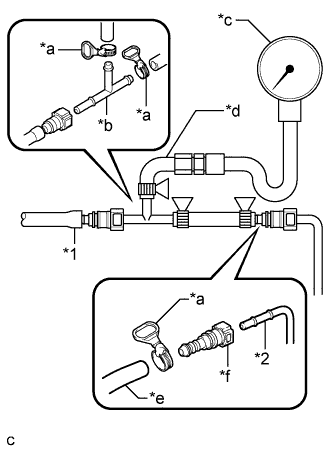
Text in Illustration *1 Fuel Tube Sub-assembly (Vehicle Side) *2 Fuel Pipe (Vehicle Side) *a SST (Hose Band) *b SST (T-joint) *c SST (Gauge) *d SST (Hose Joint) *e SST (Hose) *f SST (Fuel Tube Connector) Install SST (EFI fuel pressure gauge) as shown in the illustration.
- SST
- 09268-45101 ( 09268-41250, 09268-41260, 09268-41280, 09268-41500, 09268-41700, 95336-08070 )
-
Wipe up any spilled fuel.
-
Connect the cable to the negative (-) auxiliary battery terminal.
Note
When disconnecting the cable, some systems need to be initialized after the cable is reconnected Click here.
-
Connect the GTS to the DLC3.
-
Turn the power switch on (IG).
Note
Do not start the engine.
-
Turn the GTS on.
-
Enter the following menus: Powertrain / Engine and ECT / Active Test / Control the Fuel Pump / Speed.
-
Measure the fuel pressure.
Standard Fuel Pressure 196 to 588 kPa (2.0 to 6.0 kgf/cm2, 28 to 85 psi)
-
If the fuel pressure is more than the standard, replace the fuel pressure regulator assembly.
-
If the fuel pressure is less than the standard, check the fuel hoses and connections, fuel pump, fuel filter and fuel pressure regulator assembly.
-
-
Disconnect the GTS from the DLC3.
-
Put the engine in inspection mode (maintenance mode) Click here.
-
Start the engine.
-
Measure the fuel pressure at idle.
Standard Fuel Pressure 196 to 588 kPa (2.0 to 6.0 kgf/cm2, 28 to 85 psi) Tech Tips
Refer to Standard Idle Speed Click here.
-
Stop the engine.
-
After checking the fuel pressure, disconnect the cable from the negative (-) auxiliary battery terminal and carefully remove SST to prevent fuel from spraying.
Note
When disconnecting the cable, some systems need to be initialized after the cable is reconnected Click here.
-
Connect the fuel tube sub-assembly to the No. 1 fuel pipe (direct injection side) Click here.
-
Connect the fuel tube sub-assembly to the fuel delivery pipe (port injection side) Click here.
-
Inspect for fuel leaks.
-
-
CHECK FUEL PRESSURE (for High Pressure)
-
Connect the GTS to the DLC3.
-
Turn the power switch on (IG).
-
Turn the GTS on.
-
Put the engine in inspection mode (maintenance mode) Click here.
-
Start and warm up the engine.
-
Enter the following menus: Powertrain / Engine and ECT / Data List / Fuel Press.
-
Check the high pressure side fuel pressure.
Standard Fuel Pressure 2500 to 6000 kPa (25.5 to 61.2 kgf/cm2, 363 to 870 psi) If the pressure is not as specified, check the fuel pump with filter assembly, high pressure side fuel pump assembly, fuel pressure sensor and wiring.
-
Stop the engine.
-