BRAKE PEDAL INSTALLATION

Tech Tips
-
Use the same procedure for the RHD and LHD vehicles.
-
The Procedure listed below is for the LHD vehicles.
-
INSTALL BRAKE PEDAL PAD
-
Install the brake pedal pad to the brake pedal support assembly.
-
-
INSTALL BRAKE PEDAL SUPPORT ASSEMBLY
-
Temporarily install the brake pedal support reinforcement set bolt.
-
Install the brake booster assembly Click here.
-
Tighten the brake pedal support assembly with the 4 nuts.
- Torque:
- 13 N*m { 130 kgf*cm, 9 ft.*lbf }
-
Tighten the brake pedal support reinforcement set bolt.
- Torque:
- 21 N*m { 214 kgf*cm, 15 ft.*lbf }
-
-
INSTALL PUSH ROD PIN
-
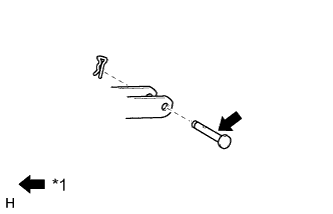
Text in Illustration *1 Lithium soap base glycol grease Apply a light coat of lithium soap base glycol grease to the push rod pin.
-
Set the push rod clevis in place, insert the push rod pin from outside the vehicle and then install a new clip.
Note
After installation, check that the pedal operates smoothly.
-
-
INSTALL BRAKE PEDAL RETURN SPRING
-
Install the brake pedal return spring to the brake pedal support assembly.
-
-
INSTALL STOP LIGHT SWITCH ASSEMBLY
-
Temporarily install the stop light switch assembly to the brake pedal support with the lock nut.
Tech Tips
The lock nut is tightened when inspecting and adjusting the brake pedal height.
-
Attach the 2 clamps to the brake pedal support.
-
Connect the 2 connectors.
-
-
INSTALL LOWER NO. 1 INSTRUMENT PANEL AIRBAG ASSEMBLY
-
CONNECT CABLE TO NEGATIVE BATTERY TERMINAL
Note
When disconnecting the cable some systems need to be initialized after the cable is reconnected Click here.
-
CHECK AND ADJUST BRAKE PEDAL
-
BLEED BRAKE SYSTEM
CAUTION:
If air is bled without using the GTS, damage or accidents may result. Therefore, always use the GTS when bleeding air.
-
Remove the brake master cylinder reservoir filler cap assembly.
-
Add brake fluid until the fluid level is between the MIN and MAX lines of the reservoir.
-
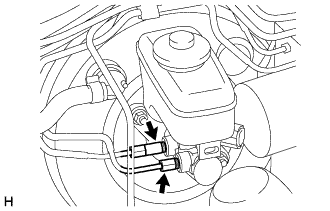
Using a union nut wrench, disconnect the 2 brake tubes from the master cylinder.
-
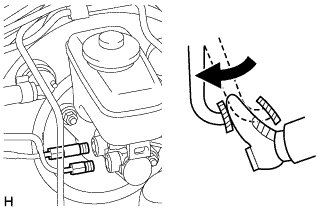
Slowly depress and hold the brake pedal.
-
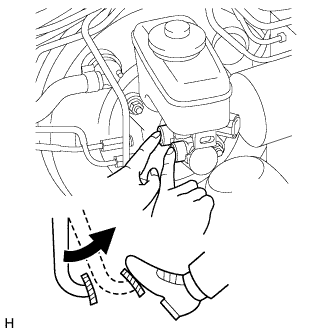
Block the tube holes with your fingers, and then release the brake pedal.
-
Remove your fingers, slowly depress and hold the brake pedal, block the tube holes with your fingers again, and then release the brake pedal. Repeat this step 3 or 4 times.
-
Using a union nut wrench, connect the 2 brake tubes to the brake master cylinder assembly.
- Torque:
- 15 N*m { 155 kgf*cm, 11 ft.*lbf }
Note
Use the formula to calculate special torque values for situations where a union nut wrench is combined with a torque wrench Click here.
-
Loosen the bleeder plug of the front brake cylinder RH.
-
Repeatedly depress the brake pedal and bleed the air from the bleeder plug of the front brake cylinder RH.
Note
Add fluid as necessary so that the fluid in the reservoir does not decrease below the MIN level.
-
After air is completely bled out, tighten the bleeder plug while depressing the brake pedal.
- Torque:
- 11 N*m { 110 kgf*cm, 8 ft.*lbf }
-
Bleed the air from the bleeder plug of the front disc brake cylinder LH using the same procedure as for the RH side.
-
Loosen the bleeder plug of the rear brake cylinder RH.
-
Repeatedly depress the brake pedal and bleed the air from the bleeder plug of the rear brake cylinder RH.
Note
Add fluid as necessary so that the fluid in the reservoir does not decrease below the MIN level.
-
After the air is completely bled out, tighten the bleeder plug while depressing the brake pedal.
- Torque:
- 8.3 N*m { 85 kgf*cm, 73 in.*lbf }
-
Bleed the air from the bleeder plug of the rear disc brake cylinder LH using the same procedure as for the RH side.
-
Depress the brake pedal more than 20 times with the engine switch off.
-
Connect the GTS to the DLC3.
-
Turn the engine switch on (IG) and turn the tester on.
Note
Do not start the engine.
-
Enter the following menus: Chassis / ABS/VSC/TRC / Utility / Air Bleeding.
-
Select and run "Inhalation" from the Air Bleeding screen on the GTS.
Note
Follow the prompts on the tester screen to bleed the air for both wheels (front and rear) on the right side.
-
Loosen the bleeder plug of the right front wheel.*1
-
Using the GTS, operate the actuator.
Tech Tips
-
To protect the actuator, the operation stops automatically.
-
Make sure the brake pedal is released.
-
-
Check the GTS screen to confirm that the operation stopped.
-
Tighten the bleeder plug.*2
-
Repeat the procedures above from *1 to *2 until the air is completely bled out.
-
Tighten the bleeder plug.
- Torque:
- 11 N*m { 110 kgf*cm, 8 ft.*lbf }
-
Bleed the air for the right rear wheel using the same procedure as for the right front wheel.
-
Select and run "Decrease" from the Air Bleeding screen on the GTS.
Note
Follow the prompts on the tester screen to bleed the air for all 4 wheels.
-
Loosen the bleeder plug of the right front wheel.*3
-
Using the GTS, operate the actuator and at the same time fully depress and hold the brake pedal.
Tech Tips
To protect the solenoids, the actuator operation stops automatically in 4 seconds. When operating the actuator repeatedly, follow the prompts on the tester screen and wait for 20 seconds or more between each operation.
Note
-
At this time, the brake pedal becomes difficult to depress. However, be sure to hold the brake pedal in the fully depressed position until brake fluid comes out of the bleeder plug.
-
Do not repeatedly depress the brake pedal; hold the brake pedal in the fully depressed position.
-
-
Tighten the bleeder plug and release the brake pedal.*4
-
Repeat the procedures above from *3 to *4 until the air is completely bled out.
-
Tighten the bleeder plug.
- Torque:
- for Front Brake
- 11 N*m { 110 kgf*cm, 8 ft.*lbf }
- for Rear Brake
- 8.3 N*m { 85 kgf*cm, 73 in.*lbf }
-
Bleed the air for the other 3 wheels using the same procedure as for the right front wheel.
-
Repeat the procedure in which air is bled from the brake line by repeatedly depressing the brake pedal.
Note
Repeat this step for each wheel until air is completely bled out.
-
Check for brake fluid leaks.
-
Check the fluid level in the reservoir Click here.
-