STOP AND START SYSTEM Backup Boost Converter Circuit
DESCRIPTION
A backup boost converter is built into the engine stop and start ECU. The backup boost converter helps maintain the power source voltage when the engine is restarted by stop and start control.
This prevents various functions such as the meter/gauge system from failing if the power source voltage drops due to the battery voltage dropping when the engine is restarted by stop and start control.
If a DTC is output, troubleshoot the DTC first.
Tech Tips
A relay function and fuse function are provided in the backup boost converter.
If there is a malfunction in any of the electrical system circuits connected to the backup boost converter, the fuse and relay functions shut off the malfunctioning circuit to protect other circuits (remains shut off until next trip).
When the electrical system circuit is shut off, power to the circuit is cut off, causing any systems connected to the circuit to be disabled.
The fuse function is reset*1 when the ignition switch is turned off. If the malfunction still exists in the electrical system circuit that has been shut off by the relay function, it will be shut off again by the relay and fuse functions the next time the ignition switch is turned to ON.
*1: A semiconductor fuse self resets according to electric signal Backup boost converter supplies power to:
-
Main body ECU (multiplex network body ECU)
-
VSC system
-
Power steering system
-
Meter/gauge system
WIRING DIAGRAM
Refer to P323B Click here.
CAUTION / NOTICE / HINT
Note
-
If the engine stop and start ECU is being replaced, register the previously recorded number of starter operations into the new engine stop and start ECU Click here.
-
After the engine stop and start ECU is replaced or after an air conditioner kit is installed, clear the A/C information stored in the engine stop and start ECU Click here.
-
After the engine stop and start ECU or airbag sensor assembly (yaw rate sensor) is replaced, initialize and calibrate 0 point of deceleration sensor Click here.
-
Inspect the fuses for circuits related to this system before performing the following inspection procedure.
PROCEDURE
-
CHECK PROBLEM SYMPTOM
-
Determine the trouble area by referring to the table below.
Effect on Vehicle Trouble Area/Cause Fail-safe DTC Output Stop and start cancel indicator light Proceed to Symptom When the engine is restarted by stop and start control:
The following symptoms may occur.
-
The combination meter fades in and out
-
The steering wheel feels heavy when the engine is restarted*
*A DTC may be stored in the power steering system
Backup boost converter internal malfunction
-
Internal power source malfunction
-
Internal power source overvoltage
-
Duty error
-
Communication cycle error
Stop and Start system control prohibited P323B Blinks A Converter output voltage cannot be boosted when the engine is restarted Battery voltage drop Systems on the converter output side do not operate
BO1 terminal: All of the following will not function
IGO1 terminal : All of the following will not operate
-
VSC system
-
Power steering system
-
Systems whose power is supplied from the main body ECU (multiplex network body)
Overcurrent applied to an output terminal (output terminal relay circuit is shutoff) Stop and Start System control is prohibited (Connected ECU or sensors may detect power source malfunction DTCs) B22C0 Blinks A Systems do not operate as power supply from the converter is cut off Systems do not operate (Due to converter input side malfunction)
IG1 terminal: All of the following do not operate
-
VSC system
-
Power steering system
IG2 terminal: The combination meter assembly will not function
Converter input circuit malfunction
-
Open or short to GND in IG1 circuit
-
Open or short to GND in IG2 circuit
-
Open or short to GND in ACC circuit
Stop and Start control prohibited - Does not blinks (Blinks when communication error DTCs are stored) B Systems do not operate as power supply from the converter is cut off Systems on the converter output side do not operate (varies depending on the malfunctioning relay circuit the converter detected)
IGO2 terminal: the combination meter assembly will not function
Malfunction in circuits the converter supplies power to
(between converter and ECUs or sensors)
-
Open or short in the combination meter assembly circuit
Related systems do not operate as the relay circuit in the converter is turned off - Does not blink (Blinks when communication error DTCs are stored) B Systems do not operate as power supply from the converter is cut off All of the following will occur
-
VSC system
-
Power steering system
-
Meter/ gauge system
-
Open in BBC fuse circuit
-
Short in converter circuit
-
Backup boost converter malfunction
Stop and Start control prohibited P0617 Does not blink (Due to disabled meter/gauge system) A All systems that the converter supplies power to do not operate (see circuit diagram) P323B The combination meter assembly cannot be turned off (short between IGO2 and +B)
Communication error DTCs may be stored due to short between IGO1 and +B
Tech Tips
Varies depending on the number of times an open occurs in the +B circuit
Converter circuit malfunction
-
Short between ACO and +B
-
Short between IGO1 and +B
-
Short between IGO2 and +B
- - Does not blink B The converter shut off power source when the ignition switch is turned off Ignition switch does not turn to ACC (short between ACC and +B)
Ignition switch does not turn off (short between IG1 or IG2 and +B)
Engine stop and start ECU power source circuit malfunction
-
Short between ACC and +B
-
Short between IG1 and +B
-
Short between IG2 and +B
- - Does not blink B
-
Ignition switch does not turn to AC
-
Ignition switch does not turn off
-
A 
GO TO DTC CHART
B 
-
-
INSPECT ENGINE STOP AND START ECU (POWER SOURCE)
-
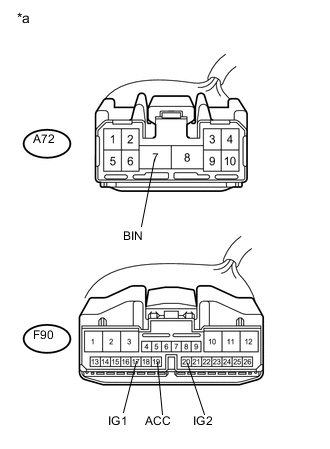
Text in Illustration *a Front view of wire harness connector:
(to Engine Stop and Start ECU)
Disconnect the A72 and F90 engine stop and start ECU connectors.
-
Measure the voltage according to the value(s) in the table below.
Standard Voltage Tester Connection Condition Specified Condition A72-7 (BIN) - body ground Always 9.5 to 14 V -
Turn the ignition switch to ON.
-
Measure the voltage according to the value(s) in the table below.
Standard Voltage Tester Connection Switch Condition Specified Condition F90-17 (IG1) - Body ground Ignition switch ON 9.5 to 14 V F90-19 (ACC) - Body ground Ignition switch ON 9.5 to 14 V F90-20 (IG2) - Body ground Ignition switch ON 9.5 to 14 V -
Turn the ignition switch off.
-
Measure the voltage according to the value(s) in the table below.
Standard Voltage Tester Connection Switch Condition Specified Condition F90-17 (IG1) - Body ground Ignition switch off 0 to 1 V F90-19 (ACC) - Body ground Ignition switch off 0 to 1 V F90-20 (IG2) - Body ground Ignition switch off 0 to 1 V
NG
REPAIR OR REPLACE HARNESS OR CONNECTOR
OK
-
-
CHECK HARNESS AND CONNECTOR (EACH SYSTEM - ENGINE STOP AND START ECU)
-
Disconnect the F90 engine stop and start ECU connector.
-
Disconnect the connector from the corresponding system ECU/sensor.
-
Measure the resistance according to the value(s) in the table below.
Standard Resistance (for Audio Connector) Tester Connection Switch Condition Specified Condition F90-2 (BO1) - F45-4 (+B1) Always Below 1 Ω F90-3 (ACO) - F45-3 (ACC1) Always Below 1 Ω F90-2 (BO1) or F45-4 (+B1) - Body ground Always 10 kΩ or higher F90-3 (ACO) or F45-3 (ACC1) - Body ground Always 10 kΩ or higher Standard Resistance (for VSC System) Tester Connection Switch Condition Specified Condition F90-12 (IGO1) - A54-34 (IG1) Always Below 1 Ω F90-12 (IGO1) or A54-34 (IG1) - Body ground Always 10 kΩ or higher Standard Resistance (for Spiral with Sensor Cable Sub-assembly) Tester Connection Switch Condition Specified Condition F90-12 (IGO1) - F30-5 (IG) Always Below 1 Ω F90-12 (IGO1) or F30-5 (IG) - Body ground Always 10 kΩ or higher Standard Resistance (for Power Steering System) Tester Connection Switch Condition Specified Condition F90-12 (IGO1) - F6-1 (IG) Always Below 1 Ω F90-12 (IGO1) or F6-1 (IG) - Body ground Always 10 kΩ or higher Standard Resistance (for Meter and Gauge System) Tester Connection Switch Condition Specified Condition F90-11 (IGO2) - F1-39 (IG+) Always Below 1 Ω F90-11 (IGO2) or F1-39 (IG+) - Body ground Always 10 kΩ or higher Standard Resistance (for Main body ECU) Tester Connection Switch Condition Specified Condition F90-12 (IGO1) - 3A-40 (IG) Always Below 1 Ω F90-12 (IGO1) or 3A-40 (IG) - Body ground Always 10 kΩ or higher
NG
REPAIR OR REPLACE HARNESS OR CONNECTOR (CORRESPONDING SYSTEM - ENGINE STOP AND START ECU)
OK
-
-
INSPECT ENGINE STOP AND START ECU (OUTPUT VOLTAGE FOR EACH SYSTEM)
-
Disconnect the connector from the corresponding system ECU/sensor.
-
Turn the ignition switch to ON.
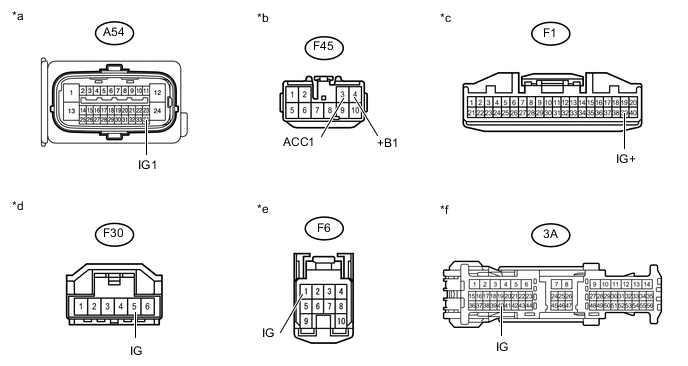
-
Measure the voltage according to the value(s) in the table below.
Tech Tips
Measure the voltage at the corresponding terminals.
Standard Voltage Tester Connection Switch Condition Specified Condition A54-34 (IG1) - Body ground Ignition switch ON 9.5 to 14 V F45-4 (+B1) - Body ground Always 9.5 to 14 V F45-3 (ACC1) - Body ground Ignition switch ACC 9.5 to 14 V F1-39 (IG+) - Body ground Ignition switch ON 9.5 to 14 V F30-5 (IG) - Body ground Ignition switch ON 9.5 to 14 V F6-1 (IG) - Body ground Ignition switch ON 9.5 to 14 V 3A-40 (IG) - Body ground Ignition switch ON 9.5 to 14 V Text in Illustration *a Front view of wire harness connector:
(to Skid Control ECU (Brake Actuator Assembly))
*b Front view of wire harness connector:
(to Audio Connector)
*c Front view of wire harness connector:
(to Combination Meter Assembly)
*d Front view of wire harness connector:
(to Spiral with Sensor Cable Sub-assembly)
*e Front view of wire harness connector:
(to Power Steering ECU Assembly)
*f Front view of wire harness connector:
(to Main Body ECU (multiplex network body ECU))
OK
INSPECT POWER SOURCE CIRCUIT OF CORRESPONDING SYSTEM
NG
REPLACE ENGINE STOP AND START ECU Click here
-