ELECTRONICALLY CONTROLLED BRAKE SYSTEM, Diagnostic DTC:C1341/62, C1342/63, C1343/64, C1344/65

| DTC Code | DTC Name |
|---|---|
| C1341/62 | Front Hydraulic System RH Malfunction |
| C1342/63 | Front Hydraulic System LH Malfunction |
| C1343/64 | Rear Hydraulic System RH Malfunction |
| C1344/65 | Rear Hydraulic System LH Malfunction |
DESCRIPTION
The skid control ECU controls braking force according to the hybrid control system regenerative braking force and inputs the hydraulic pressure necessary for operating each wheel cylinder according to the wheel cylinder pressure sensor.
DTCs may be stored if one of the following occurs:
-
Brake fluid leaks.
-
Wheel cylinder vibrates due to uneven wear of a brake rotor.
-
Foreign matter enters solenoid valve.
-
Line pressure drops during air bleeding.
-
Brake pad is replaced.
-
Rotor is replaced.
Tech Tips
When replacing the brake pad, retracting the brake calipers piston and attaching a new brake pad will greatly increase the clearance between the brake pad and brake disc, which will likely cause these DTCs to be set the next time the brake pedal is depressed. As there is not malfunction, clear the DTCs.
| DTC Code | INF Code | DTC Detection Condition | Trouble Area |
|---|---|---|---|
| C1341/62 | 551 | Decrease in FR wheel hydraulic pressure control performance. (Pressure increase malfunction) |
|
| ↑ | 552 | Decrease in FR wheel hydraulic pressure control performance. (Pressure decrease malfunction) |
↑ |
| ↑ | 553 | There is a malfunction or leak in the FR wheel pressure increase control valve. |
|
| ↑ | 554 555 |
There is a malfunction or leak in the FR wheel pressure decrease control valve. | ↑ |
| C1342/63 | 561 | Decrease in FL wheel hydraulic pressure control performance. (Pressure increase malfunction) |
|
| ↑ | 562 | Decrease in FL wheel hydraulic pressure control performance. (Pressure decrease malfunction) |
↑ |
| ↑ | 563 | There is a malfunction or leak in the FL wheel pressure increase control valve. |
|
| ↑ | 564 565 |
There is a malfunction or leak in the FL wheel pressure decrease control valve. | ↑ |
| C1343/64 | 571 | Decrease in RR wheel hydraulic pressure control performance. (Pressure increase malfunction) |
|
| ↑ | 572 | Decrease in RR wheel hydraulic pressure control performance. (Pressure decrease malfunction) |
↑ |
| ↑ | 573 | There is a malfunction or leak in the RR wheel pressure increase control valve. |
|
| ↑ | 574 575 |
There is a malfunction or leak in the RR wheel pressure decrease control valve. | ↑ |
| C1344/65 | 581 | Decrease in RL wheel hydraulic pressure control performance. (Pressure increase malfunction) |
|
| ↑ | 582 | Decrease in RL wheel hydraulic pressure control performance. (Pressure decrease malfunction) |
↑ |
| ↑ | 583 | There is a malfunction or leak in the RL wheel pressure increase control valve. |
|
| ↑ | 584 585 |
There is a malfunction or leak in the RL wheel pressure decrease control valve. | ↑ |
WIRING DIAGRAM
Refer to DTCs C1246/46, C1281/81 and C1364/61 Click here.
INSPECTION PROCEDURE
Note
When replacing the brake actuator assembly, perform initialization and calibration of the linear solenoid valve Click here.
Tech Tips
When C1364/61 is output together with C1341/62, C1342/63, C1343/64 and/or C1344/65, inspect and repair the trouble areas indicated by C1364/61 first Click here.
PROCEDURE
-
CHECK FOR FLUID LEAK
-
Check that there is no fluid leakage in the brake line between the brake actuator and the wheel cylinder which is indicated by DTCs.
-
Check that the brake is not dragging.
OK There is no fluid leakage or dragging.
NG 
REPAIR OR REPLACE APPLICABLE PART
OK 
-
-
PERFORM AIR BLEEDING
-
Bleed the air from the front and rear brake systems Click here.
NEXT
-
-
CHECK HARNESS AND CONNECTOR (SKID CONTROL ECU - BODY GROUND)
-
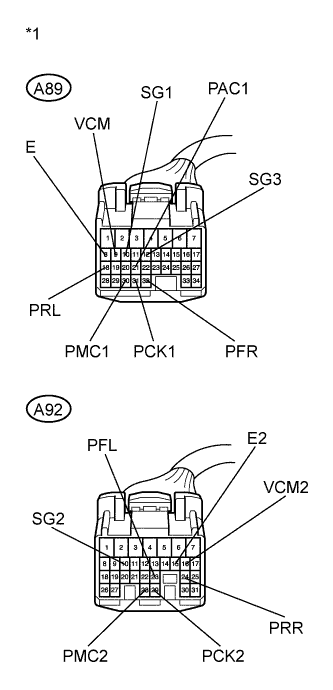
Text in Illustration *1 Front view of wire harness connector
(to Skid Control ECU)
Make sure that there is no looseness at the locking part and the connecting part of the connectors.
-
Disconnect the skid control ECU connectors and the brake actuator connector.
-
Measure the resistance according to the value(s) in the table below.
Standard Resistance Tester connection Condition Specified condition A89-8 (E) - Body ground Always 10 kΩ or higher A89-9 (VCM) - Body ground Always 10 kΩ or higher A89-10 (SG1) - Body ground Always 10 kΩ or higher A89-12 (SG3) - Body ground Always 10 kΩ or higher A89-18 (PRL) - Body ground Always 10 kΩ or higher A89-21 (PAC1) - Body ground Always 10 kΩ or higher A89-30 (PMC1) - Body ground Always 10 kΩ or higher A89-31 (PCK1) - Body ground Always 10 kΩ or higher A89-32 (PFR) - Body ground Always 10 kΩ or higher A92-10 (SG2) - Body ground Always 10 kΩ or higher A92-15 (E2) - Body ground Always 10 kΩ or higher A92-16 (VCM2) - Body ground Always 10 kΩ or higher A92-23 (PFL) - Body ground Always 10 kΩ or higher A92-24 (PRR) - Body ground Always 10 kΩ or higher A92-28 (PMC2) - Body ground Always 10 kΩ or higher A92-29 (PCK2) - Body ground Always 10 kΩ or higher
NG
REPAIR OR REPLACE HARNESS OR CONNECTOR
OK
-
-
READ VALUE USING INTELLIGENT TESTER (WHEEL CYLINDER PRESSURE SENSOR)
-
Reconnect the skid control ECU connectors and the brake actuator connector.
-
Connect an pedal effort gauge Click here.
-
Connect the intelligent tester to the DLC3.
-
Turn the power switch on (IG).
-
Select the Data List on the intelligent tester Click here.
ABS/VSC/TRC Tester Display Measurement Item/Range Normal Condition Diagnostic Note FR W/C Sensor FR wheel cylinder pressure sensor / Min.: 0 V, Max.: 5 V When brake pedal is released:
0.3 to 0.7 V
Reading increases when brake pedal is depressed FL W/C Sensor FL wheel cylinder pressure sensor / Min.: 0 V, Max.: 5 V When brake pedal is released:
0.3 to 0.7 V
Reading increases when brake pedal is depressed RR W/C Sensor RR wheel cylinder pressure sensor / Min.: 0 V, Max.: 5 V When brake pedal is released:
0.3 to 0.7 V
Reading increases when brake pedal is depressed RL W/C Sensor RL wheel cylinder pressure sensor / Min.: 0 V, Max.: 5 V When brake pedal is released:
0.3 to 0.7 V
Reading increases when brake pedal is depressed -
Check the output value of the wheel cylinder pressure sensor at each hydraulic pressure level during the electronically controlled brake system control.
Standard Voltage for Front Wheel Cylinder Pressure Sensor Hydraulic Pressure
MPa (kgf/cm2, psi)
FR W/C Sensor
(Data List Display)
FL W/C Sensor
(Data List Display)
2.4 (24.5, 348) 0.80 to 1.20 V 0.80 to 1.20 V 5.4 (54.1, 783) 1.40 to 1.80 V 1.40 to 1.80 V 6.5 (66.3, 943) 1.60 to 2.00 V 1.60 to 2.00 V 7.1 (72.4, 1030) 1.75 to 2.15 V 1.75 to 2.15 V for Rear Wheel Cylinder Pressure Sensor Hydraulic Pressure
MPa (kgf/cm2, psi)
RR W/C Sensor
(Data List Display)
RL W/C Sensor
(Data List Display)
2.4 (24.5, 348) 0.80 to 1.20 V 0.80 to 1.20 V 5.0 (51.0, 725) 1.30 to 1.70 V 1.30 to 1.70 V
NG
REPLACE BRAKE ACTUATOR ASSEMBLY Click here
OK
-
-
CHECK BRAKE DISC
-
Turn the power switch off.
-
Disconnect the brake pedal stroke sensor connector.
-
Perform a road test according to Freeze Frame Data or customer problem analysis. Check for brake line pressure vibration caused due to uneven wear of the disc according to brake pedal vibration.
OK The brake pedal does not vibrate during braking. Tech Tips
-
The brake pedal does not kick back due to wheel cylinder piston vibration during electronically controlled brake system control.
-
If the brake pedal stroke sensor connector is disconnected, the fail-safe function will prohibit electronically controlled brake system control.
-
The Active Test does not prohibit electronically controlled brake system control when the vehicle is driving, so disconnect the stroke sensor connector before continuing with inspection.
-
Disc wear can be checked by measuring the disc thickness Click here for front, or Click here for rear).
-
NG
REPLACE BRAKE DISC
OK
-
-
RECONFIRM DTC
-
Reconnect the brake pedal stroke sensor connector.
-
Clear the DTCs Click here.
-
Perform a road test under the same malfunction conditions recreated based on the Freeze Frame Data or customer problem analysis.
-
Check if the same DTC is recorded Click here.
Result Result Proceed to DTCs (C1341/62, C1342/63, C1343/64 and C1344/65) are not output A DTCs (C1341/62, C1342/63, C1343/64 and/or C1344/65) are output B
B
REPLACE BRAKE ACTUATOR ASSEMBLY Click here
A 
CHECK FOR INTERMITTENT PROBLEMS Click here
-