ELECTRONICALLY CONTROLLED BRAKE SYSTEM, Diagnostic DTC:C0371/71, C1234/34, C1243/43, C1244/44, C1245/45, C1279/79, C1381/97

| DTC Code | DTC Name |
|---|---|
| C0371/71 | Yaw Rate Sensor (Test Mode DTC) |
| C1234/34 | Yaw Rate Sensor Malfunction |
| C1243/43 | Acceleration Sensor Stuck Malfunction |
| C1244/44 | Open or Short in Acceleration Sensor Circuit |
| C1245/45 | Acceleration Sensor Output Malfunction |
| C1279/79 | Acceleration Sensor Output Voltage Malfunction (Test Mode DTC) |
| C1381/97 | Acceleration Sensor Power Supply Voltage Malfunction |
DESCRIPTION
The skid control ECU receives signals from the yaw rate and acceleration sensor via the CAN communication system.
The yaw rate sensor has a built-in acceleration sensor and detects the vehicle's condition using 2 circuits (GL1, GL2).
If there are any problems in the bus lines between the yaw rate and acceleration sensor and the CAN communication system, DTCs U0123/62 (Lost Communication with Yaw Rate Sensor Module) and U0124/95 (Lost Communication with Lateral Acceleration Sensor Module) are output.
These DTCs are also output when calibration has not been completed.
DTCs C0371/71 and C1279/79 will be cleared when the yaw rate and acceleration sensor sends a yaw rate and/or acceleration signal or when Test Mode ends. DTCs C0371/71 and C1279/79 are output only in Test Mode.
| DTC Code | INF Code | DTC Detection Condition | Trouble Area |
|---|---|---|---|
| C1234/34 | - | Either of the following is detected:
|
Yaw rate and acceleration sensor |
| ↑ | 333 | Yaw rate sensor circuit 1 malfunction | ↑ |
| ↑ | 334 | Yaw rate sensor circuit 2 malfunction | ↑ |
| ↑ | 335 | Yaw rate sensor zero point malfunction | ↑ |
| ↑ | 337 | The output of two yaw rate sensor in different. | ↑ |
| C1243/43 | 311 | Sensor (GL1) input stuck malfunction. | Yaw rate and acceleration sensor |
| ↑ | 312 | Sensor (GL2) input stuck malfunction. | ↑ |
| ↑ | 317 | While the vehicle speed changes from over 30 km/h (18 mph) to 0 km/h (0 mph), the values of GL1 and GL2 do not change 16 times or more. |
|
| C1244/44 | 314 | Either of the following is detected:
|
|
| C1245/45 | 313 | At a vehicle speed of 30 km/h (18 mph) or more, the difference between the forward and backward G calculated from the acceleration sensor value and that calculated from the vehicle speed sensor exceeds 0.35 G for 60 seconds or more. | Yaw rate and acceleration sensor |
| C1381/97 | 315 | At a vehicle speed of more than 3 km/h (2 mph), the acceleration sensor power source malfunction signal is received for 10 seconds or more. |
|
| C0371/71 | - | Detected only during Test Mode. |
|
| C1279/79 | - | Detected only during Test Mode. |
|
WIRING DIAGRAM
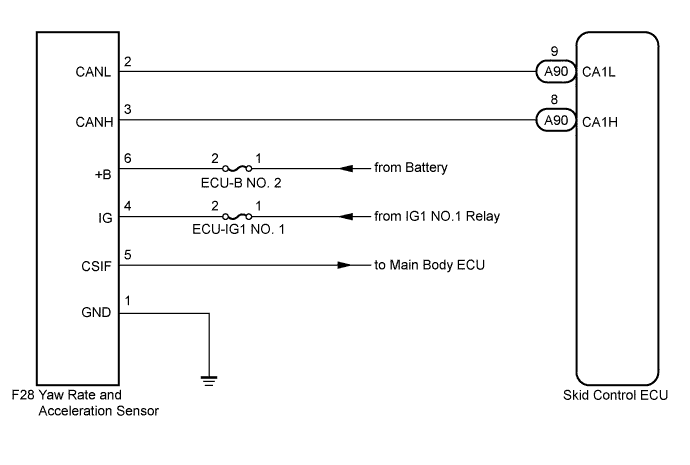
INSPECTION PROCEDURE
Note
When replacing the yaw rate and acceleration sensor, perform zero point calibration Click here.
Tech Tips
When U0123/62 and/or U0124/95 is output together with C1234/34, C1243/43, C1244/44, C1245/45, and/or C1381/97, inspect and repair the trouble areas indicated by U0123/62 and/or U0124/95 first Click here.
PROCEDURE
-
CHECK DTC
-
Clear the DTCs Click here.
-
Turn the power switch off.
-
Turn the power switch on (READY).
-
Drive the vehicle at a speed of 30 km/h (18 mph) or more, turn the steering wheel, and decelerate (depress the brake pedal) the vehicle.
-
Turn the power switch on (IG) again and check that no CAN communication system DTC is output Click here.
-
Check if DTC C1210/36 (Zero Point Calibration of Yaw Rate Sensor Undone) or C1336/98 (Zero Point Calibration of Acceleration Sensor Undone) is output Click here.
Result Result Proceed to DTCs (C1210/36, C1336/98 and CAN communication system DTC) are not output A CAN communication system DTC is output B DTCs (C1210/36 and/or C1336/98) are output C
B 
INSPECT CAN COMMUNICATION SYSTEM Click here
C
REPAIR CIRCUITS INDICATED BY OUTPUT DTCS Click here
A 
-
-
CHECK YAW RATE AND ACCELERATION SENSOR INSTALLATION
-
Turn the power switch off.
-
Check that the yaw rate and acceleration sensor has been installed properly Click here.
OK The sensor is tightened to the specified torque. The sensor is not tilted.
NG
INSTALL YAW RATE AND ACCELERATION SENSOR CORRECTLY Click here
OK
-
-
INSPECT YAW RATE AND ACCELERATION SENSOR (POWER SOURCE TERMINAL)
-
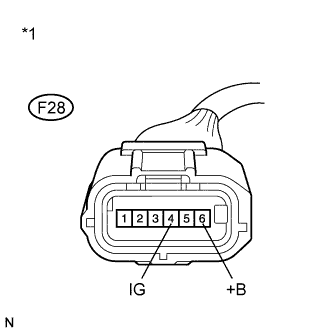
Text in Illustration *1 Front view of wire harness connector
(to Yaw Rate and Acceleration Sensor)
Make sure that there is no looseness at the locking part and the connecting part of the connector.
-
Disconnect the yaw rate and acceleration sensor connector.
-
Measure the voltage according to the value(s) in the table below.
Standard Voltage Tester Connection Condition Specified Condition F28-4 (IG) - Body ground Power switch on (IG) 11 to 14 V F28-6 (+B) - Body ground Always 11 to 14 V
NG
REPAIR OR REPLACE HARNESS OR CONNECTOR (POWER SOURCE CIRCUIT)
OK
-
-
INSPECT YAW RATE AND ACCELERATION SENSOR (GND TERMINAL)
-
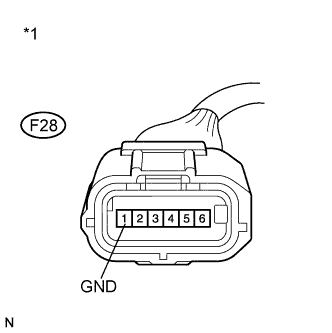
Text in Illustration *1 Front view of wire harness connector
(to Yaw Rate and Acceleration Sensor)
Turn the power switch off.
-
Measure the resistance according to the value(s) in the table below.
Standard Resistance Tester Connection Condition Specified Condition F28-1 (GND) - Body ground Always Below 1 Ω Note
Check the yaw rate and acceleration sensor signal after replacement Click here.
Tech Tips
If troubleshooting has been carried out according to Problem Symptoms Table, refer back to the table and proceed to the next step Click here.
NG
REPAIR OR REPLACE HARNESS OR CONNECTOR (GND CIRCUIT)
OK 
REPLACE YAW RATE AND ACCELERATION SENSOR Click here
-