SFI SYSTEM, Diagnostic DTC:P2195, P2196

| DTC Code | DTC Name |
|---|---|
| P2195 | Oxygen (A/F) Sensor Signal Stuck Lean (Bank 1 Sensor 1) |
| P2196 | Oxygen (A/F) Sensor Signal Stuck Rich (Bank 1 Sensor 1) |
DESCRIPTION
Tech Tips
-
Although the DTC titles say oxygen sensor, these DTCs relate to the Air Fuel Ratio (A/F) sensor.
-
Sensor 1 refers to the sensor mounted in front of the Three-Way Catalytic Converter (TWC) and located near the engine assembly.
The A/F sensor generates a voltage* that corresponds to the actual A/F. This sensor voltage is used to provide the ECM with feedback so that it can control the A/F. The ECM determines the deviation from the stoichiometric A/F level, and regulates the fuel injection time. If the A/F sensor malfunctions, the ECM is unable to control the A/F accurately.
The A/F sensor is of the planar type and is integrated with the heater, which heats the solid electrolyte (zirconia element). This heater is controlled by the ECM. When the intake air volume is low (the exhaust gas temperature is low), a current flows into the heater to heat the sensor, in order to facilitate accurate air-fuel ratio detection. In addition, the sensor and heater portions are narrower than the conventional type. The heat generated by the heater is conducted to the solid electrolyte through the alumina, and therefore the sensor activation is accelerated.
A TWC is used in order to convert the carbon monoxide (CO), hydrocarbons (HC), and nitrogen oxides (NOx) into less harmful substances. To allow the TWC to function effectively, it is necessary to keep the A/F of the engine near the stoichiometric A/F.
*: Value changes inside the ECM. Since the A/F sensor is the current output element, a current is converted into a voltage inside the ECM. Any measurements taken at the A/F sensor or ECM connectors will show a constant voltage.
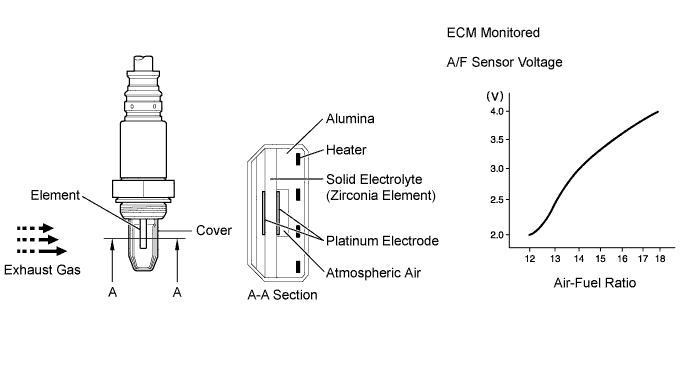
| DTC No. | DTC Detection Condition | Trouble Area |
|---|---|---|
| P2195 | Conditions (a) and (b) continue for 5 seconds or more (2 trip detection logic): (a) Air fuel ratio sensor voltage more than 3.8 V (b) Heated oxygen sensor voltage rises from less than 0.21 V to 0.59 V or more |
|
| P2195 | While fuel-cut operation is performed (during vehicle deceleration), air fuel ratio sensor current is 3.6 mA or more for 3 seconds (2 trip detection logic) |
|
| P2196 | Conditions (a) and (b) continue for 5 seconds or more (2 trip detection logic): (a) Air fuel ratio sensor voltage less than 2.8 V (b) Heated oxygen sensor voltage falls from 0.59 V or more to less than 0.21 V |
|
| P2196 | While fuel-cut operation is performed (during vehicle deceleration), air fuel ratio sensor current is 1.57 mA for 3 seconds (2 trip detection logic) |
|
Tech Tips
-
When either of these DTCs is set, check the air fuel ratio sensor output voltage by entering the following menus: Powertrain / Engine and ECT / Data List / AFS Voltage B1S1.
-
Short-term fuel trim values can also be read using the intelligent tester.
-
The ECM regulates the voltages at the A1A+ and A1A- terminals of the ECM to a constant level. Therefore, the air fuel ratio sensor output voltage cannot be confirmed without using the intelligent tester.
-
If the air fuel ratio sensor is malfunctioning, the ECM sets DTC P2195 or P2196.
CONFIRMATION DRIVING PATTERN
-
This confirmation driving pattern is used in the "Perform Confirmation Driving Pattern" procedure of the following diagnostic troubleshooting procedure.
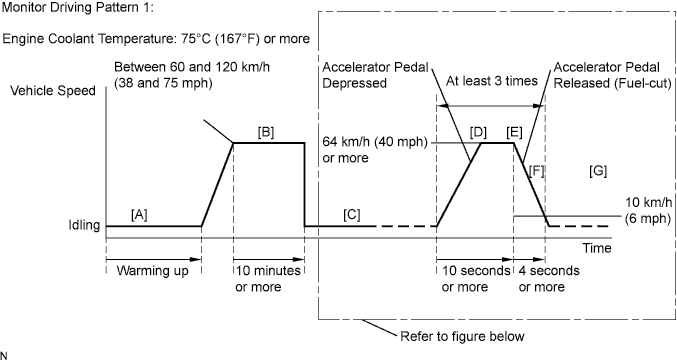
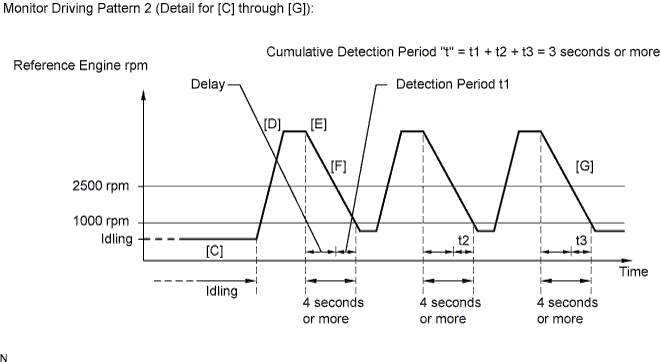
-
Connect the intelligent tester to the DLC3.
-
Turn the ignition switch to ON.
-
Turn the tester on.
-
Clear the DTCs Click here.
-
Turn the ignition switch off and wait for at least 30 seconds.
-
Start the engine, and warm it up until the ECT reaches 75°C (167°F) or higher [A].
-
Enter the following menus to check the fuel-cut status: Powertrain / Engine and ECT / Data List / All Data / Idle Fuel Cut.
-
Drive the vehicle at between 60 km/h (38 mph) and 120 km/h (75 mph) for at least 10 minutes [B].
CAUTION:
When performing the confirmation driving pattern, obey all speed limits and traffic laws.
-
Move the shift lever to B (for CVT) [C].
-
Change the transaxle to 2nd gear (for Manual Transaxle) [C].
-
Drive the vehicle at a proper vehicle speed to perform fuel-cut operation [D] (refer to the following HINT).
Tech Tips
Fuel-cut is performed when the following conditions are met:
-
Accelerator pedal is fully released.
-
Engine speed is 2500 rpm or more (fuel injection resumes at 1000 rpm).
-
-
Accelerate the vehicle to 64 km/h (40 mph) or more by depressing the accelerator pedal for at least 10 seconds [E].
CAUTION:
When performing the confirmation driving pattern, obey all speed limits and traffic laws.
-
Soon after performing Procedure [E] above, release the accelerator pedal for at least 4 seconds without depressing the brake pedal, in order to execute fuel-cut control [F].
-
Allow the vehicle to decelerate until the vehicle speed declines to less than 10 km/h (6 mph).
-
Repeat steps from Procedure [C] through Procedure [F] above at least 3 times in one driving cycle [G].
-
Enter the following menus: Powertrain / Engine and ECT / DTC.
-
Read pending DTCs.
Tech Tips
-
If a pending DTC is output, the system is malfunctioning.
-
If a pending DTC is not output, perform the following procedure.
-
-
Enter the following menus: Powertrain / Engine and ECT / Utility / All Readiness.
-
Input the DTC P2195 or P2196.
-
Check the DTC judgment result.
Intelligent Tester Tester Display Description NORMAL
-
DTC judgment completed
-
System normal
ABNORMAL
-
DTC judgment completed
-
System abnormal
INCOMPLETE
-
DTC judgment not completed
-
Perform driving pattern after confirming DTC enabling conditions
UNKNOWN
-
Unable to perform DTC judgment
-
Number of DTCs which do not fulfill DTC preconditions has reached ECU memory limit
Tech Tips
-
If the judgment result shows NORMAL, the system is normal.
-
If the judgment result shows ABNORMAL, the system has a malfunction.
-
If the judgment result shows INCOMPLETE or UNKNOWN, perform steps [B] through [F] again.
-
WIRING DIAGRAM
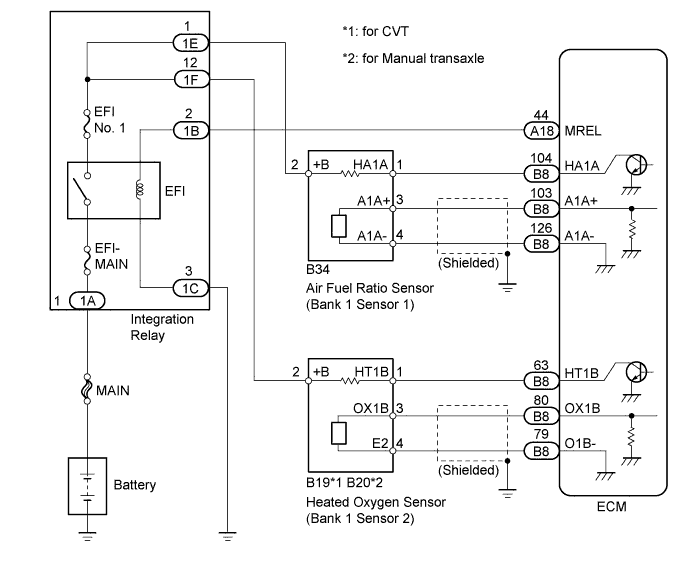
INSPECTION PROCEDURE
Note
Inspect the fuses for circuits related to this system before performing the following inspection procedure.
Tech Tips
-
DTC P2A00 may be set when the air fuel ratio is stuck rich or lean.
-
Read freeze frame data using the intelligent tester. The ECM records vehicle and driving condition information as freeze frame data the moment a DTC is stored. When troubleshooting, freeze frame data can help determine if the vehicle was moving or stationary, if the engine was warmed up or not, if the air fuel ratio was lean or rich, and other data from the time the malfunction occurred.
-
A low air fuel ratio sensor voltage could be caused by a rich air-fuel mixture. Check for conditions that would cause the engine to run rich.
-
A high air fuel ratio sensor voltage could be caused by a lean air-fuel mixture. Check for conditions that would cause the engine to run lean.
-
Sensor 1 refers to the sensor closest to the engine assembly.
-
Sensor 2 refers to the sensor farthest away from the engine assembly.
PROCEDURE
-
CHECK ANY OTHER DTCS OUTPUT (IN ADDITION TO P2195 OR P2196)
-
Connect the intelligent tester to the DLC3.
-
Turn the ignition switch to ON.
-
Turn the tester on.
-
Enter the following menus: Powertrain / Engine and ECT / DTC.
-
Read the DTC.
Result Result Proceed to DTC P2195 or P2196 is output A DTC P2195 or P2196 and P0136, P0137 or P0138 are output A DTC P2195 or P2196 and other DTCs are output B Tech Tips
If any DTCs other than P2195 or P2196 are output, troubleshoot those DTCs first.
B 
GO TO DTC CHART Click here
A 
-
-
CONFIRM IF VEHICLE HAS RUN OUT OF FUEL IN PAST
-
Has the vehicle run out of fuel in the past?
NO 
READ VALUE USING INTELLIGENT TESTER (AFS CURRENT) Click here
YES
-
-
PERFORM CONFIRMATION DRIVING PATTERN
-
Perform the confirmation driving pattern.
Tech Tips
Refer to the CONFIRMATION DRIVING PATTERN.
Result Result Proceed to NORMAL
(No DTC outputs)
A ABNORMAL
(DTC P2195 or P2196 outputs)
B
B
READ VALUE USING INTELLIGENT TESTER (AFS CURRENT) Click here
A 
DTC CAUSED BY RUNNING OUT OF FUEL
-
-
READ VALUE USING INTELLIGENT TESTER (AFS CURRENT)
-
Connect the intelligent tester to the DLC3.
-
Turn the ignition switch to ON.
-
Turn the tester on.
-
Clear DTCs Click here.
-
Enter the following menus: Powertrain / Engine and ECT / Data List / AFS Current B1S1.
-
Check the test value of the air fuel ratio sensor output current during fuel-cut, referring to the Monitor Driving Pattern 2 (Detail for Procedure "C" through Procedure "G") in the Confirmation Driving Pattern.
Tech Tips
-
To measure the air fuel ratio sensor current precisely, perform the fuel-cut operation as long as possible.
-
If it is difficult to measure the air fuel ratio sensor current, use the snapshot function of the intelligent tester.
Result Result Proceed to Within normal range (1.57 mA or more, and less than 3.6 mA) A Outside normal range (Less than 1.57 mA, or 3.6 mA or more) B -
B
REPLACE AIR FUEL RATIO SENSOR Click here
A
-
-
READ VALUE USING INTELLIGENT TESTER (OUTPUT VOLTAGE OF AIR FUEL RATIO SENSOR)
-
Connect the intelligent tester to the DLC3.
-
Start the engine.
-
Turn the tester on.
-
Warm up the air fuel ratio sensor at an engine speed of 2500 rpm for 90 seconds.
-
Enter the following menus: Powertrain / Engine and ECT / Active Test / Control the Injection Volume.
-
Perform the Control the Injection Volume operation with the engine idling.
-
Monitor the output voltages of the air fuel ratio and heated oxygen sensors (AFS Voltage B1S1 and O2S B1S2) displayed on the tester.
Tech Tips
-
Change the fuel injection volume within the range of -12.0% to +12.0%. The injection volume can be changed in fine gradations.
-
The air fuel ratio sensor has an output delay of a few seconds and the heated oxygen sensor has a maximum output delay of approximately 20 seconds.
Tester Display (Sensor) Injection Volume Status Voltage AFS Voltage B1S1
(Air fuel ratio)
+12.0% Rich Below 3.1 V AFS Voltage B1S1
(Air fuel ratio)
-12.0% Lean Higher than 3.4 V O2S B1S2
(Heated oxygen)
+12.0% Rich Higher than 0.55 V O2S B1S2
(Heated oxygen)
-12.0% Lean Below 0.4 V Result Status of AFS Voltage B1S1 Status of O2S B1S2 Air Fuel Ratio Condition and Air Fuel Ratio Sensor Condition Misfire Suspected Trouble Area Proceed to Lean Lean Actual air fuel ratio lean May occur
-
PCV valve and hose
-
PCV hose connections
-
Fuel injector blockage
-
Gas leaks from exhaust system
-
Intake system
-
Fuel pressure
-
Mass air flow meter assembly
-
Manifold absolute pressure sensor
-
Engine coolant temperature sensor
-
EGR valve assembly
A Rich Rich Actual air fuel ratio rich -
-
Fuel injector leakage or blockage
-
Gas leaks from exhaust system
-
Ignition system
-
Fuel pressure
-
Mass air flow meter assembly
-
Manifold absolute pressure sensor
-
Engine coolant temperature sensor
A Lean Lean/Rich Air fuel ratio sensor malfunction - Air fuel ratio sensor B Rich Lean/Rich Air fuel ratio sensor malfunction - Air fuel ratio sensor B Lean/Rich Lean/Rich Normal - - B Lean: During the Control the Injection Volume Active Test, the air fuel ratio sensor output voltage (AFS Voltage) is consistently higher than 3.4 V, and the heated oxygen sensor output voltage (O2S) is consistently below 0.4 V.
Rich: During the Control the Injection Volume Active Test, the AFS Voltage is consistently below 3.1 V, and the O2S is consistently higher than 0.55 V.
Lean/Rich: During the Control the Injection Volume Active Test, the output voltage of the air fuel ratio or heated oxygen sensor alternates correctly.
Tech Tips
Refer to "Data List / Active Test" [AFS Voltage B1S1, O2S B1S2] Click here.
-
B
REPLACE AIR FUEL RATIO SENSOR Click here
A
-
-
CHECK INTAKE SYSTEM
-
Check the intake system for vacuum leak Click here.
OK No leak from intake system.
NG
REPAIR OR REPLACE INTAKE SYSTEM
OK
-
-
CHECK FOR EXHAUST GAS LEAK
-
Check for exhaust gas leaks.
OK No gas leaks.
NG
REPAIR OR REPLACE EXHAUST SYSTEM
OK
-
-
CHECK FUEL PRESSURE
-
Check the fuel pressure Click here.
NG
CHECK FUEL LINE Click here
OK
-
-
INSPECT FUEL INJECTOR ASSEMBLY
-
Check the fuel injector injection (whether fuel volume is high or low, and whether injection pattern is poor) Click here.
NG
REPLACE FUEL INJECTOR ASSEMBLY Click here
OK
-
-
REPLACE AIR FUEL RATIO SENSOR
-
Replace the air fuel ratio sensor Click here.
NEXT
-
-
CHECK WHETHER DTC OUTPUT RECURS (DTC P2195 OR P2196)
-
Perform the confirmation driving pattern.
Tech Tips
Refer to the CONFIRMATION DRIVING PATTERN.
Result Result Proceed to ABNORMAL
(DTC P2195 or P2196 outputs)
A NORMAL
(No DTC outputs)
B
B
END
A
-
-
READ VALUE USING INTELLIGENT TESTER (CONTROL THE EGR STEP POSITION)
-
Connect the intelligent tester to the DLC3.
-
Start the engine.
-
Warm it up until the engine coolant temperature reaches 75°C (167°F) or higher.
Tech Tips
The A/C switch and all accessory switches should be off.
-
Turn the tester on.
-
Enter the following menus: Powertrain / Engine and ECT / Active Test / Control the EGR Step Position.
-
Check the MAP and Engine Speed in Data List and the idling condition while performing Active Test.
OK MAP and idling condition change in response to EGR step position. Standard - EGR Step Position (Active Test) 0 Steps 0 to 30 Steps Idling condition Steady idling Engine changes from steady to rough idling MAP
(Data List)
MAP value is 20 to 40 kPa (150 to 300 mmHg)
(EGR valve is fully closed)
MAP value is at least +10 kPa (75 mmHg) higher than when EGR valve is fully closed Tech Tips
During Active Test, if the idling condition does not change in response to EGR step position, then there is probably a malfunction in EGR valve.
Result Result Proceed to NG A OK B
B
REPLACE ECM Click here
A
-
-
INSPECT EGR VALVE ASSEMBLY
-
Remove the EGR valve assembly Click here.
-
Check for contamination between the EGR valve and housing.
OK EGR valve is not contaminated with foreign objects. -
Reinstall the EGR valve assembly Click here.
NG
REPLACE EGR VALVE ASSEMBLY Click here
OK
-
-
REPLACE ECM
-
Replace the ECM Click here.
NEXT
-
-
CONFIRM WHETHER MALFUNCTION HAS BEEN SUCCESSFULLY REPAIRED
-
Perform the confirmation driving pattern.
Tech Tips
Refer to the CONFIRMATION DRIVING PATTERN.
NEXT
END
-
-
REPLACE AIR FUEL RATIO SENSOR
-
Replace the air fuel ratio sensor Click here.
NEXT
-
-
CHECK WHETHER DTC OUTPUT RECURS (DTC P2195 OR P2196)
-
Perform the confirmation driving pattern.
Tech Tips
Refer to the CONFIRMATION DRIVING PATTERN.
Result Result Proceed to NORMAL A ABNORMAL B
B
REPLACE ECM Click here
A
END
-
-
CHECK FUEL LINE
-
Check the fuel lines for leaks or blockage.
NG
REPAIR OR REPLACE FUEL LINE
OK
REPLACE FUEL PUMP Click here
-