ECD SYSTEM (w/ DPF), Diagnostic DTC:P0201, P0202, P0203, P0204, P062D

| DTC Code | DTC Name |
|---|---|
| P0201 | Injector Circuit / Open - (Cylinder 1) |
| P0202 | Injector Circuit / Open - (Cylinder 2) |
| P0203 | Injector Circuit / Open - (Cylinder 3) |
| P0204 | Injector Circuit / Open - (Cylinder 4) |
| P062D | No. 1 Fuel Injector Driver Circuit Performance |
DESCRIPTION
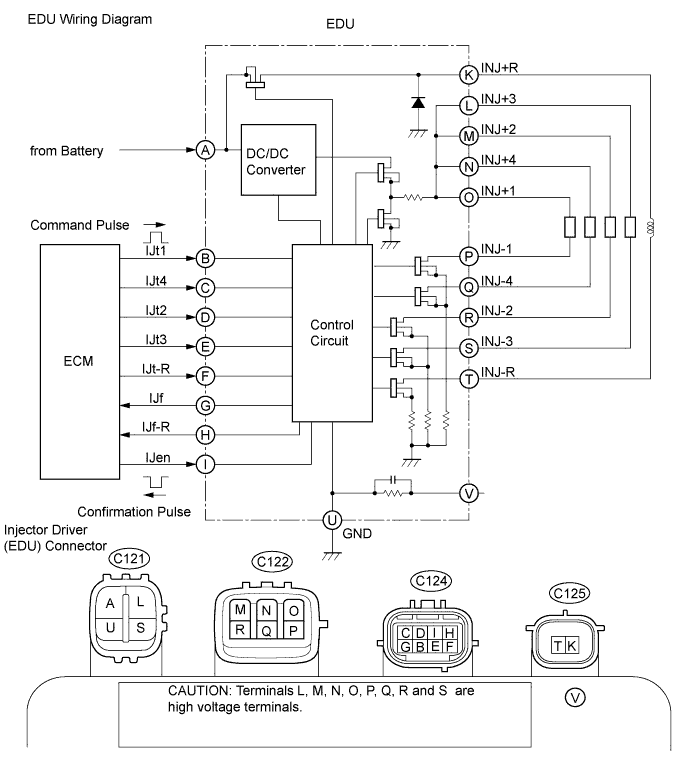
The injector driver (EDU) delivers drive signals to fuel injectors using the DC/DC converter, which provides a high-voltage and quick-charging system.
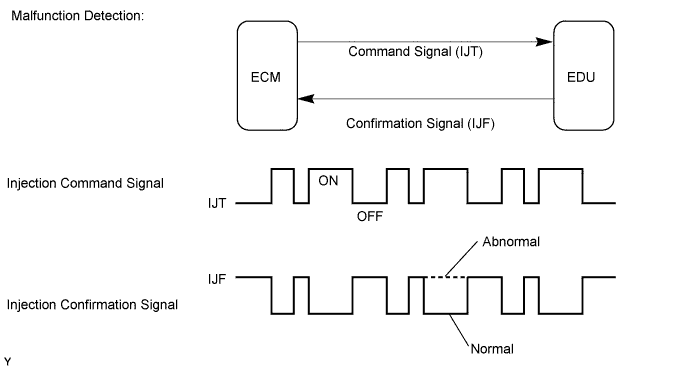
Soon after the injector driver (EDU) receives a fuel injection command (IJT) signal from the ECM, the injector driver (EDU) responds to the command with an injector injection confirmation (IJF) signal when the current is applied to the fuel injector.
| DTC Detection Drive Pattern | DTC Detection Condition | Trouble Area |
|---|---|---|
| Idling for 5 seconds | Open or short in injector circuit occurs a certain number of times (a maximum of approx. 0.5 seconds). (1 trip detection logic) |
|
| DTC Detection Drive Pattern | DTC Detection Condition | Trouble Area |
|---|---|---|
| Idling for 5 seconds | Inconsistency in the injection waveforms between the injector driver and ECM while the engine is running a certain number of times (a maximum of approx. 0.5 seconds). (1 trip detection logic) |
|
MONITOR DESCRIPTION
P0201, P0202, P0203, P0204:The ECM compares injection command (# 1 to # 4) signals and injection confirmation (INJF) signals for each cylinder. If the ECM determines that a cylinder has a malfunction, DTC P0201, P0202, P0203 or P0204 will be stored.
P062D:The ECM continuously monitors both injection command (IJT) signals and injection confirmation (IJF) signals. This DTC will be stored if the ECM determines that the number of IJT signals and IJF signals are inconsistent.
The fuel injectors are grounded over a Field Effect Transistor (FET) and a serial resistor. This resistor creates a voltage drop, which is monitored by the injector driver (EDU) (injector drive circuit) in relation to the current drawn by the fuel injector. When the fuel injector current becomes too high, the voltage drop over the resistor exceeds a specified level and no IJF signal for that cylinder is sent to the ECM.
After the engine is started, when there is no injection confirmation (IJF) signal from the injector driver (EDU) to the ECM even though the ECM sends injection command (IJT) signals to the injector driver (EDU), DTC P062D is stored.
If this DTC is stored, the ECM enters fail-safe mode and limits engine power or stops the engine. The fail-safe mode continues until the engine switch is turned off.
WIRING DIAGRAM
INSPECTION PROCEDURE
CAUTION:
Make sure to perform work on high voltage circuits with the engine switch off.
Note
-
Inspect the fuses of circuits related to this system before performing the following inspection procedure.
-
After replacing the ECM, the new ECM needs registration Click here and initialization Click here.
-
After replacing the fuel supply pump assembly, the ECM needs initialization Click here.
-
After replacing an injector assembly, the ECM needs registration Click here.
Tech Tips
Read freeze frame data using the intelligent tester. Freeze frame data records the engine condition when malfunctions are detected. When troubleshooting, freeze frame data can help determine if the vehicle was moving or stationary, if the engine was warmed up or not, and other data from the time the malfunction occurred.
PROCEDURE
-
CHECK ENGINE CRANKING CONDITION
-
Check the engine cranking condition.
Result Result Proceed to Engine does not start*1 A Engine starts, but idling is rough*2 B Except above C Tech Tips
-
*1: Once DTC P062D is cleared, it is not stored again even when the engine does not start due to a malfunction in the injector driver (EDU).
When the engine cannot be started due to a malfunction in the injector driver (EDU), the value for "Fuel Press" is higher than the value for "Target Common Rail Pressure"
-
*2: DTC P0201, P0202, P0203, P0204 and P062D are stored at this time.
-
B 
CHECK WHETHER DTC OUTPUT RECURS Click here
C 
CHECK FOR INTERMITTENT PROBLEMS Click here
A 
-
-
INSPECT ECM
-
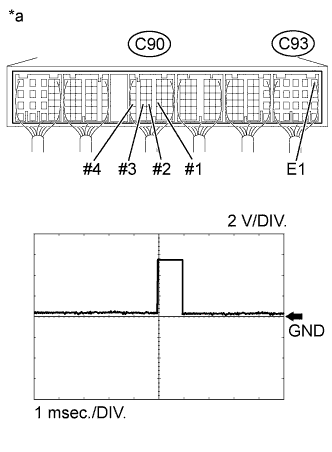
Text in Illustration *a Component with harness connected
(ECM)
Check the waveform of the ECM connectors using an oscilloscope.
OK Tester Connection Condition Specified Condition C90-21 (#1) - C93-1 (E1) Cranking Correct waveform is as shown C90-22 (#2) - C93-1 (E1) Cranking Correct waveform is as shown C90-23 (#3) - C93-1 (E1) Cranking Correct waveform is as shown C90-24 (#4) - C93-1 (E1) Cranking Correct waveform is as shown
NG
REPLACE ECM Click here
OK
-
-
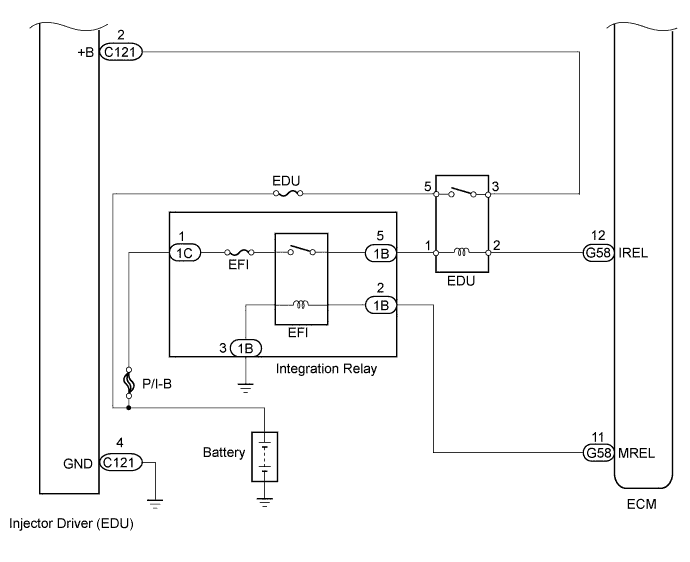
CHECK TERMINAL VOLTAGE INJECTOR DRIVER POWER SOURCE
-
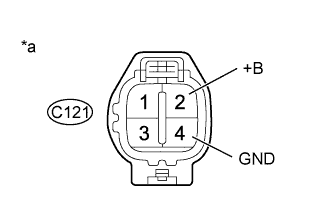
Text in Illustration *a Front view of wire harness connector
(to Injector Driver)
Disconnect the injector driver connectors.
-
Measure the voltage according to the value(s) in the table below.
Standard Voltage Tester Connection Switch Condition Specified Condition C121-2 (+B) - C121-4 (GND) Engine switch on (IG) 11 to 14 V -
Reconnect the injector driver connectors.
NG
REPAIR OR REPLACE HARNESS OR CONNECTOR Click here
OK
-
-
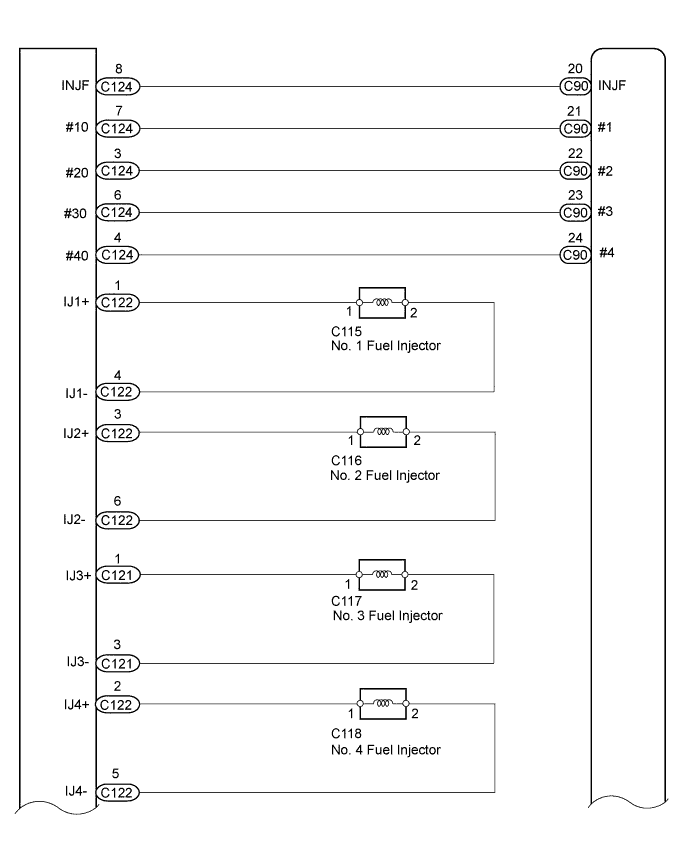
CHECK HARNESS AND CONNECTOR (INJECTOR DRIVER - ECM)
-
Disconnect the injector driver connector.
-
Disconnect the ECM connector.
-
Measure the resistance according to the value(s) in the table below.
Standard Resistance (Check for Open) Tester Connection Condition Specified Condition C124-7 (#10) - C90-21 (#1) Always Below 1 Ω C124-3 (#20) - C90-22 (#2) Always Below 1 Ω C124-6 (#30) - C90-23 (#3) Always Below 1 Ω C124-4 (#40) - C90-24 (#4) Always Below 1 Ω C124-8 (INJF) - C90-20 (INJF) Always Below 1 Ω Standard Resistance (Check for Short) Tester Connection Condition Specified Condition C124-7 (#10) or C90-21 (#1) - Body ground Always 10 kΩ or higher C124-3 (#20) or C90-22 (#2) - Body ground Always 10 kΩ or higher C124-6 (#30) or C90-23 (#3) - Body ground Always 10 kΩ or higher C124-4 (#40) or C90-24 (#4) - Body ground Always 10 kΩ or higher C124-8 (INJF) or C90-20 (INJF) - Body ground Always 10 kΩ or higher -
Reconnect the injector driver connector.
-
Reconnect the ECM connector.
NG
REPAIR OR REPLACE HARNESS OR CONNECTOR Click here
OK
-
-
REPLACE INJECTOR DRIVER
-
Replace the injector driver Click here.
NEXT
CONFIRM WHETHER MALFUNCTION HAS BEEN SUCCESSFULLY REPAIRED Click here
-
-
CHECK WHETHER DTC OUTPUT RECURS
-
Connect the intelligent tester to the DLC3.
-
Turn the engine switch is turned on (IG) and turn the tester on.
-
Clear the DTCs Click here.
-
Turn the engine switch off for 30 seconds.
-
Start the engine and idle it for 30 seconds.
-
Enter the following menus: Powertrain / Engine and ECT / DTC.
-
Check the DTCs output on the tester.
Tech Tips
-
The cylinder with the malfunctioning injector assembly can be determined based on the output DTCs.
-
If the DTC P0201 is output, check the No. 1 injector assembly circuit.
-
If the DTC P0202 is output, check the No. 2 injector assembly circuit.
-
If the DTC P0203 is output, check the No. 3 injector assembly circuit.
-
If the DTC P0204 is output, check the No. 4 injector assembly circuit.
-
NEXT
-
-
INSPECT INJECTOR DRIVER
-
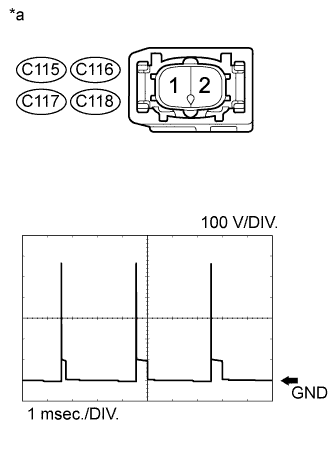
Text in Illustration *a Front view of wire harness connector
(to Injector Assembly)
Disconnect the injector assembly connectors for all cylinders.
Note
If only the injector assembly connector of the malfunctioning cylinder is disconnected, the engine will start and there will be rough idling. Therefore, disconnect all injector assembly connectors before inspecting the waveform.
-
Check the waveform of the injector assembly connectors using an oscilloscope.
OK Tester Connection Condition Specified Condition C115-1 - C115-2 Cranking Voltage increases by 50 V or more C116-1 - C116-2 Cranking Voltage increases by 50 V or more C117-1 - C117-2 Cranking Voltage increases by 50 V or more C118-1 - C118-2 Cranking Voltage increases by 50 V or more
NG
CHECK HARNESS AND CONNECTOR (FUEL INJECTOR - INJECTOR DRIVER) Click here
OK
-
-
REPLACE FUEL INJECTOR (RELEVANT CYLINDER)
-
Replace the injector assembly of the cylinder relevant to the DTC Click here.
Note
-
When replacing the injector assembly for a cylinder, always be sure to use a new injection pipe.
-
Follow the procedure in the repair manual and temporarily install the injection pipes and nozzle leakage pipe, and then correctly position the injector assemblies. After that, tighten parts according to the torque specifications.
-
If the installation procedure is not performed correctly, injector assemblies may become out of position, which may cause the injector assemblies to deteriorate, resulting in malfunctions.
-
If an injector assembly deteriorates and malfunctions, other problems such as knocking, rough idle, etc. may occur.
-
If an injector assembly becomes out of position, it is possible that the seal between the injector assembly and injection pipe may become incomplete, resulting in a fuel leak.
-
NEXT
-
-
BLEED AIR FROM FUEL SYSTEM
-
Bleed the air from the fuel system Click here.
NEXT
-
-
REGISTER INJECTOR COMPENSATION CODE AND PERFORM PILOT QUANTITY LEARNING
-
Register the injector compensation code Click here.
-
Perform the fuel injector pilot quantity learning Click here.
NEXT
CONFIRM WHETHER MALFUNCTION HAS BEEN SUCCESSFULLY REPAIRED Click here
NEXT
-
-
REPLACE ECM
-
Replace the ECM Click here.
NEXT
CONFIRM WHETHER MALFUNCTION HAS BEEN SUCCESSFULLY REPAIRED Click here
-
-
CHECK HARNESS AND CONNECTOR (FUEL INJECTOR - INJECTOR DRIVER)
-
Disconnect the fuel injector connectors.
-
Disconnect the injector driver connectors.
-
Measure the resistance according to the value(s) in the table below.
Standard Resistance (Check for Open) Tester Connection Condition Specified Condition C115-1 - C122-1 (IJ1+) Always Below 1 Ω C115-2 - C122-4 (IJ1-) Always Below 1 Ω C116-1 - C122-3 (IJ2+) Always Below 1 Ω C116-2 - C122-6 (IJ2-) Always Below 1 Ω C117-1 - C121-1 (IJ3+) Always Below 1 Ω C117-2 - C121-3 (IJ3-) Always Below 1 Ω C118-1 - C122-2 (IJ4+) Always Below 1 Ω C118-2 - C122-5 (IJ4-) Always Below 1 Ω Standard Resistance (Check for Short) Tester Connection Condition Specified Condition C115-1 or C122-1 (IJ1+) - Body ground Always 10 kΩ or higher C115-2 or C112-4 (IJ1-) - Body ground Always 10 kΩ or higher C116-1 or C122-3 (IJ2+) - Body ground Always 10 kΩ or higher C116-2 or C122-6 (IJ2-) - Body ground Always 10 kΩ or higher C117-1 or C121-1 (IJ3+) - Body ground Always 10 kΩ or higher C117-2 or C121-3 (IJ3-) - Body ground Always 10 kΩ or higher C118-1 or C122-2 (IJ4+) - Body ground Always 10 kΩ or higher C118-2 or C122-5 (IJ4-) - Body ground Always 10 kΩ or higher -
Reconnect the fuel injector connectors.
-
Reconnect the injector driver connectors.
NG
REPAIR OR REPLACE HARNESS OR CONNECTOR Click here
OK
-
-
REPLACE INJECTOR DRIVER
-
Replace the injector driver Click here.
NEXT
CONFIRM WHETHER MALFUNCTION HAS BEEN SUCCESSFULLY REPAIRED Click here
-
-
REPAIR OR REPLACE HARNESS OR CONNECTOR
-
Repair or replace the harness or connector.
NEXT
-
-
CONFIRM WHETHER MALFUNCTION HAS BEEN SUCCESSFULLY REPAIRED
-
Connect the intelligent tester to the DLC3.
-
Clear the DTCs Click here.
-
Turn the engine switch off for 30 seconds or more.
-
Start the engine and idle it for 10 seconds.
-
Enter the following menus: Powertrain / Engine and ECT / DTC.
-
Confirm that the DTC is not output again.
NEXT 
END
-