| DTC Code | DTC Name |
|---|---|
| P2120 | Throttle / Pedal Position Sensor / Switch "D" Circuit |
| P2122 | Throttle / Pedal Position Sensor / Switch "D" Circuit Low Input |
| P2123 | Throttle / Pedal Position Sensor / Switch "D" Circuit High Input |
| P2125 | Throttle / Pedal Position Sensor / Switch "E" Circuit |
| P2127 | Throttle / Pedal Position Sensor / Switch "E" Circuit Low Input |
| P2128 | Throttle / Pedal Position Sensor / Switch "E" Circuit High Input |
| P2138 | Throttle / Pedal Position Sensor / Switch "D" / "E" Voltage Correlation |
DESCRIPTION
-
This is the repair procedure for the accelerator pedal position sensor.
-
This electrical throttle system does not use a throttle cable.
-
This accelerator pedal position sensor is a non-contact type.
The accelerator pedal position sensor is mounted on the accelerator pedal and detects the opening angle of the accelerator pedal. Since this sensor is electronically controlled with Hall-effect elements, accurate control and reliability can be obtained. It has 2 sensors to detect the accelerator position and a malfunction of the accelerator pedal position sensor.
In the accelerator pedal position sensor, the voltage applied to pedal terminals VPA and VPA2 of the ECM changes between 0 V and 5 V in proportion to the opening angle of the accelerator pedal. The VPA is a signal to indicate the actual accelerator pedal opening angle which is used for the engine control, and the VPA2 is a signal to indicate information about the opening angle which is used for detecting malfunctions. The ECM judges the current opening angle of the accelerator pedal using signals from terminals VPA and VPA2, and the ECM controls the throttle motor based on these signals.
| DTC Detection Drive Pattern | DTC Detection Condition | Trouble Area |
|---|---|---|
| Ignition switch ON
|
Condition (a) continues for 0.5 seconds (1 trip detection logic): (a) VPA is less than 0.4 V and VPA2 is more than 0.97 deg, or VPA is more than 4.8 V. |
|
| DTC Detection Drive Pattern | DTC Detection Condition | Trouble Area |
|---|---|---|
| Ignition switch ON
|
Condition (a) and (b) continue for 0.5 seconds (1 trip detection logic): (a) VPA is less than 0.4 V. (b) VPA2 is more than 0.97 deg. |
|
| DTC Detection Drive Pattern | DTC Detection Condition | Trouble Area |
|---|---|---|
| Ignition switch ON
|
Condition (a) continues for 2.0 seconds (1 trip detection logic): (a) VPA is more than 4.8 V. |
|
| DTC Detection Drive Pattern | DTC Detection Condition | Trouble Area |
|---|---|---|
| Ignition switch ON
|
Condition (a) continues for 0.5 seconds (1 trip detection logic): (a) VPA2 is less than 1.2 V and VPA is more than 2.7 deg, or VPA2 is more than 4.8 V and VPA is more than 0.4 V but less than 3.45 V. |
|
| DTC Detection Drive Pattern | DTC Detection Condition | Trouble Area |
|---|---|---|
| Ignition switch ON
|
Condition (a) and (b) continue for 0.5 seconds (1 trip detection logic): (a) VPA2 is less than 1.2 V. (b) VPA2 is more than 2.7 deg. |
|
| DTC Detection Drive Pattern | DTC Detection Condition | Trouble Area |
|---|---|---|
| Ignition switch ON
|
Conditions (a) and (b) continue for 2.0 seconds (1 trip detection logic): (a) VPA2 is more than 4.8 V. (b) VPA is more than 0.4 V but less than 3.45 V. |
|
| DTC Detection Drive Pattern | DTC Detection Condition | Trouble Area |
|---|---|---|
| Ignition switch ON
|
Condition (a) or (b) continues for 2.0 seconds (1 trip detection logic): (a) The difference between VPA and VPA2 is less than 0.02 V. (b) VPA is less than 0.4 V and VPA2 is less than 1.2 V. |
|
| DTC No. | Data List |
|---|---|
| P2120 |
|
| P2122 | |
| P2123 | |
| P2125 | |
| P2127 | |
| P2128 | |
| P2138 |
When DTC P2120, P2122, P2123, P2125, P2127, P2128 and/or P2138 is stored, check the output voltage of the accelerator pedal position sensor by entering the following menus: Powertrain / Engine / Data List / Accel Sensor Out No.1 and Accel Sensor Out No.2.
| Trouble Area | Accelerator Pedal Position Expressed as Voltage Output | |||
|---|---|---|---|---|
| Accelerator Pedal Released | Accelerator Pedal Depressed | |||
| Accel Sensor Out No.1 | Accel Sensor Out No.2 | Accel Sensor Out No.1 | Accel Sensor Out No.2 | |
| VC circuit open | 0 to 0.2 V | 0 to 0.2 V | 0 to 0.2 V | 0 to 0.2 V |
| VPA circuit open or ground short | 0 to 0.2 V | 1.2 to 2.0 V | 0 to 0.2 V | 3.4 to 5.0 V |
| VPA2 circuit open or ground short | 0.5 to 1.1 V | 0 to 0.2 V | 2.9 to 3.6 V | 0 to 0.2 V |
| EPA circuit open | 4.5 to 5.0 V | 4.5 to 5.0 V | 4.5 to 5.0 V | 4.5 to 5.0 V |
INSPECTION PROCEDURE
After replacing the ECM, the new ECM needs registration (Click here) and initialization (Click here).
Read freeze frame data using the intelligent tester. Freeze frame data records the engine condition when malfunctions are detected. When troubleshooting, freeze frame data can help determine if the vehicle was moving or stationary, if the engine was warmed up or not, and other data from the time the malfunction occurred.
PROCEDURE
- Click here
READ VALUE USING INTELLIGENT TESTER (ACCELERATOR PEDAL POSITION)
-
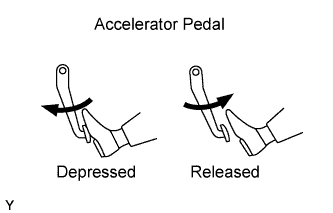
Connect the intelligent tester to the DLC3.
-
Turn the ignition switch to ON and turn the tester on.
-
Enter the following menus: Powertrain / Engine / Data List / Accel Sens. No.1 Volt % and Accel Sens. No.2 Volt %.
-
Read the values.
Standard Accelerator Pedal Accel Sens. No.1 Volt % Accel Sens. No.2 Volt % Released 10 to 22% 24 to 40% Depressed 52 to 90% 68 to 99% Table 9. Result Result Proceed to NG A OK B
-
- Click here
CHECK HARNESS AND CONNECTOR (ACCELERATOR PEDAL POSITION SENSOR - ECM)
-
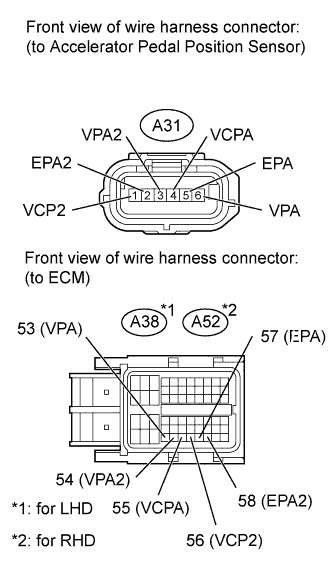
Disconnect the accelerator pedal position sensor connector.
-
Disconnect the ECM connector.
-
Measure the resistance according to the value(s) in the table below.
Standard Resistance (Check for Open) Table 10. for LHD Tester Connection Condition Specified Condition A31-1 (VCP2) - A38-56 (VCP2) Always Below 1 Ω A31-2 (EPA2) - A38-58 (EPA2) Always Below 1 Ω A31-3 (VPA2) - A38-54 (VPA2) Always Below 1 Ω A31-4 (VCPA) - A38-55 (VCPA) Always Below 1 Ω A31-5 (EPA) - A38-57 (EPA) Always Below 1 Ω A31-6 (VPA) - A38-53 (VPA) Always Below 1 Ω Table 11. for RHD Tester Connection Condition Specified Condition A31-1 (VCP2) - A52-56 (VCP2) Always Below 1 Ω A31-2 (EPA2) - A52-58 (EPA2) Always Below 1 Ω A31-3 (VPA2) - A52-54 (VPA2) Always Below 1 Ω A31-4 (VCPA) - A52-55 (VCPA) Always Below 1 Ω A31-5 (EPA) - A52-57 (EPA) Always Below 1 Ω A31-6 (VPA) - A52-53 (VPA) Always Below 1 Ω Standard Resistance (Check for Short) Table 12. for LHD Tester Connection Condition Specified Condition A31-1 (VCP2) or A38-56 (VCP2) - Body ground Always 10 kΩ or higher A31-2 (EPA2) or A38-58 (EPA2) - Body ground Always 10 kΩ or higher A31-3 (VPA2) or A38-54 (VPA2) - Body ground Always 10 kΩ or higher A31-4 (VCPA) or A38-55 (VCPA) - Body ground Always 10 kΩ or higher A31-5 (EPA) or A38-57 (EPA) - Body ground Always 10 kΩ or higher A31-6 (VPA) or A38-53 (VPA) - Body ground Always 10 kΩ or higher Table 13. for RHD Tester Connection Condition Specified Condition A31-1 (VCP2) or A52-56 (VCP2) - Body ground Always 10 kΩ or higher A31-2 (EPA2) or A52-58 (EPA2) - Body ground Always 10 kΩ or higher A31-3 (VPA2) or A52-54 (VPA2) - Body ground Always 10 kΩ or higher A31-4 (VCPA) or A52-55 (VCPA) - Body ground Always 10 kΩ or higher A31-5 (EPA) or A52-57 (EPA) - Body ground Always 10 kΩ or higher A31-6 (VPA) or A52-53 (VPA) - Body ground Always 10 kΩ or higher
- OKClick here
- NGClick here
-
- Click here
INSPECT ECM TERMINAL VOLTAGE (VCPA AND VCP2 TERMINALS)
-
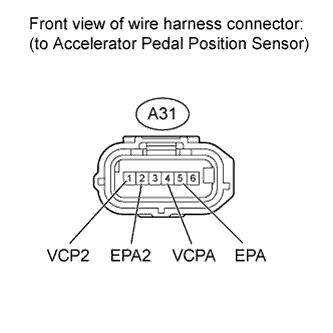
Disconnect the accelerator pedal position sensor connector.
-
Measure the voltage according to the value(s) in the table below.
Standard Voltage Tester Connection Switch Condition Specified Condition A31-4 (VCPA) - A31-5 (EPA) Ignition switch ON 4.5 to 5.5 V A31-1 (VCP2) - A31-2 (EPA2) Ignition switch ON 4.5 to 5.5 V
- OKClick here
- NGClick here
-
- Click here
REPLACE ACCELERATOR PEDAL ROD ASSEMBLY
-
Replace the accelerator pedal rod assembly (Click here).
- NEXTClick here
-
- Click here
CHECK IF OUTPUT DTC RECURS
-
Connect the intelligent tester to the DLC3.
-
Clear the DTC (Click here).
-
Turn the ignition switch off.
-
Turn the ignition switch to ON.
-
Fully close the accelerator pedal for 3 seconds, then hold it partway open for 3 seconds, then fully open it for 3 seconds.
-
Read the DTCs.
Table 14. Result Result Proceed to P2120, P2122, P2123, P2125, P2127, P2128 and/or P2138 are output again A No output B
-
- Click here
REPLACE ECM
-
Replace the ECM (Click here).
- NEXTClick here
-
- Click here
REPAIR OR REPLACE HARNESS OR CONNECTOR
- NEXTClick here
- Click here
CONFIRM WHETHER MALFUNCTION HAS BEEN SUCCESSFULLY REPAIRED
-
Connect the intelligent tester to the DLC3.
-
Clear the DTCs (Click here).
-
Turn the ignition switch off.
-
Turn the ignition switch off and leave the vehicle for 15 seconds.
-
Turn the ignition switch to ON.
-
Fully close the accelerator pedal for 3 seconds, then hold it partway open for 3 seconds, then fully open it for 3 seconds.
-
Confirm that the DTC is not output again.
Tip:Perform the following procedure using the tester to determine whether or not the DTC judgment has been carried out.
-
Enter the following menus: Powertrain / Engine / Utility / All Readiness.
-
Input DTC P2120, P2122, P2123, P2125, P2127, P2128 and/or P2138.
-
Check that STATUS is NORMAL. If STATUS is INCOMPLETE or UNKNOWN, idle the engine.
-
- NEXTClick here
-
- Click here
END