HYDROGEN TANK ASSEMBLY REMOVAL

CAUTION / NOTICE / HINT
The necessary procedures (adjustment, calibration, initialization, or registration) that must be performed after parts are removed, installed, or replaced during the hydrogen tank assembly removal/installation are shown below.
| Replacement Part or Procedure | Necessary Procedure | Effects/Inoperative when not Performed | Link |
|---|---|---|---|
| Remove/install height control sensor RR |
|
Automatic headlight beam level control system | |
| Remove/install rear axle beam |
|
VSC malfunctioning | |
| Adjust lane departure warning camera | Lane departure alert system does not operate correctly. |
Note
When removing or installing the rear disc brake caliper assembly, if the piston of the brake caliper is pushed in, the clearance between the brake pad and rear disc will become large. In this condition, depressing the brake pedal may cause DTC C1214 (Hydraulic Control System Malfunction) to be stored, so check and clear DTCs after the procedure is complete.
CAUTION:
-
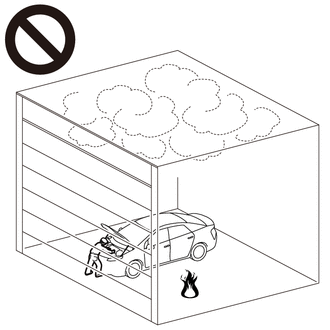
Work procedures must be performed in an area with good ventilation (airflow) where hydrogen gas will not accumulate, and flames or other things that could act as ignition sources must not be present.
-
Accumulated hydrogen gas could ignite, resulting in a serious accident.
-
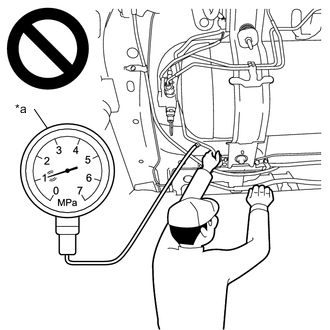
*a When inside of piping is pressurized Do not install or remove any hydrogen system components without first performing depressurization procedures.
-
The highly pressurized hydrogen gas inside the hydrogen tank assembly could blow out, resulting in a serious accident.
-
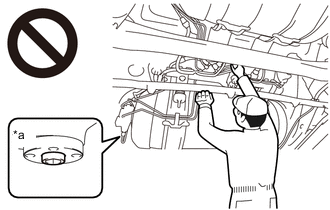
*a Manual Valve Open Do not perform depressurization procedures when the manual valve of the hydrogen tank assembly is open.
-
The highly pressurized hydrogen gas inside the hydrogen tank assembly could blow out, resulting in a serious accident.
-
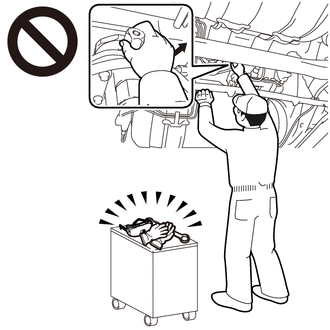
When performing depressurization, do not perform procedures by hand without wearing protective glasses and gloves.
-
The highly pressurized hydrogen gas inside the hydrogen tank assembly could blow out, resulting in a serious accident.
-
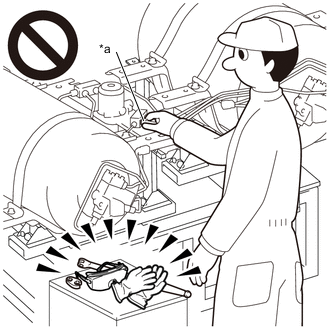
*a After depressurization procedures, the high pressure piping union nut that is loosened first After performing depressurization procedures, when first loosening the union nut of the high pressure hydrogen piping, do not loosen the union nut by hand without wearing protective glasses and gloves.
-
Even when depressurization procedures are performed, the pressurized hydrogen gas inside the high pressure hydrogen piping cannot be completely depressurized, so the highly pressurized hydrogen gas remaining in the high pressure hydrogen piping could blow out, resulting in a serious accident.
-
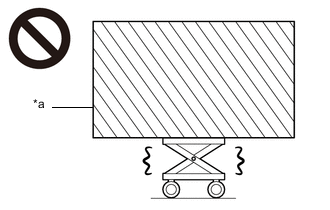
*a Heavy load exceeding the weight limits or size limits of the engine lifter Because the hydrogen tank unit is extremely heavy, make sure to follow the work procedures described in the repair manual.
-
If work is not performed according to the procedures described in the repair manual, there is a danger that the engine lifter could drop and components could fall down.
-
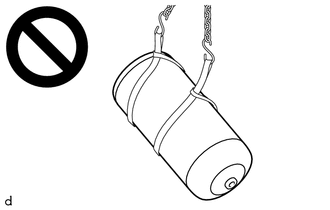
When hoisting up the hydrogen tank assembly, do not hoist it when not properly balanced.
-
The hydrogen tank assembly could fall, resulting in a serious accident.
-
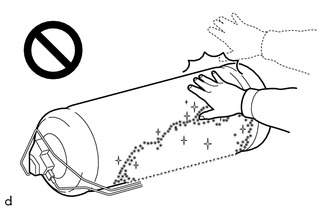
When installing or removing a compressed hydrogen gas tank immediately after discharging compressed hydrogen gas, do not touch the tank or piping if there is frost on it.
-
Touching the tank or piping while there is frost on it could result in burn-like injuries due to frostbite.
PROCEDURE
-
PRECAUTION
Note
-
After turning the power switch off, waiting time may be required before disconnecting the cable from the negative (-) auxiliary battery terminal. Therefore, make sure to read the disconnecting the cable from the negative (-) auxiliary battery terminal notices before proceeding with work.
-
Place signs [HIGH PRESSURE GAS WORK IN PROGRESS - DO NOT TOUCH!], etc. to warn other technicians to be cautious. (An example sign is included, so make a copy and use it.)
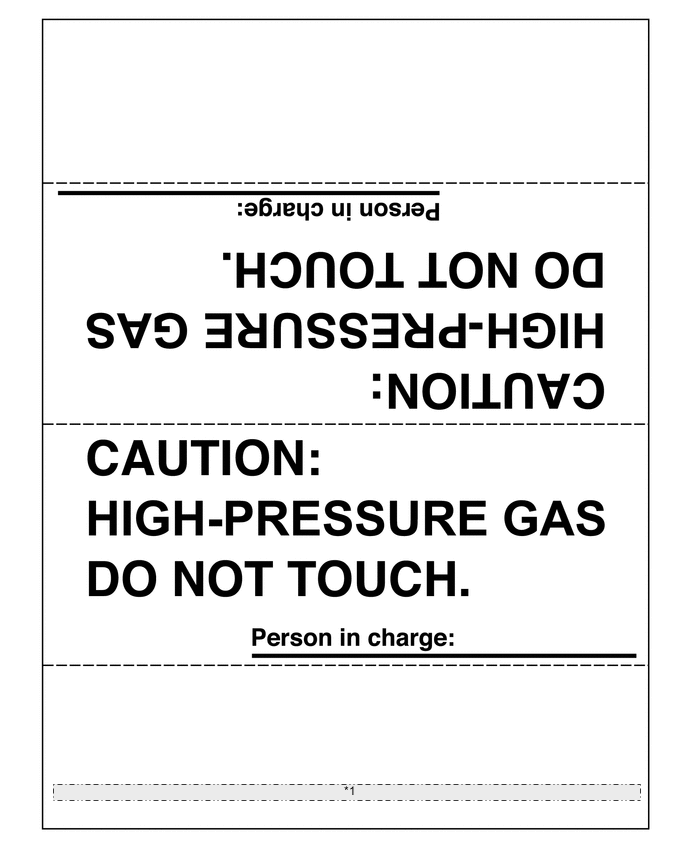
*1 Place signs [HIGH PRESSURE GAS WORK IN PROGRESS - DO NOT TOUCH!], etc. to warn other technicians to be cautious. (An example sign is included, so make a copy and use it.) -
When performing depressurization, do not open or close any parts of the hydrogen gas piping except for the following:
- Adjustment bolt of the hydrogen tank assembly manual valve
- Tank shut valve of the hydrogen tank assembly
- No. 1 hydrogen supply regulator plug
-
When installing or removing hydrogen system components (hydrogen tank assembly, high pressure hydrogen piping, hydrogen inlet receptacle, hydrogen tube joint, hydrogen tank pressure sensor or hydrogen supply regulator assembly), to prevent strain such as twisting from being applied to the high pressure hydrogen piping, use the hydrogen tank installation and removal guide tool and remove the hydrogen tank unit from the vehicle before performing procedures.
-
Even when replacing only the No. 1 hydrogen tank assembly, or only the No. 2 hydrogen tank assembly, to prevent strain from being applied to the high pressure hydrogen piping, use the tank positioning attachment of the hydrogen tank installation and removal tool, and perform positioning of the No. 1 hydrogen tank assembly and No. 2 hydrogen tank assembly.
-
Even when not removing or installing the high pressure hydrogen piping, be careful not to pull or otherwise apply strain to the high pressure hydrogen piping.
-
Do not reuse high pressure hydrogen piping after it has been removed, because the coupling portions will not maintain their airtightness.
-
When reusable parts such as the hydrogen tank assembly valve portion, hydrogen inlet receptacle, hydrogen tube joint and hydrogen supply regulator assembly have been removed, to protect the seal portions and threaded portions from damage as well as to prevent foreign matter such as dust and metal fragments from entering through openings, cover these areas with protective tape.
-
Do not use packing tape, or any other tape that will leave residue on parts, as protective tape.
-
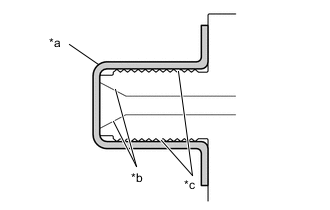
*a Protective Tape *b Seal Portion *c Threaded Portion Protect seal portions and threaded portions as shown in the illustration.
-
To protect the seal portions and threaded portions from damage or contamination by foreign matter, remove the protective tape immediately before installation.
-
When reassembling components that have been removed, make sure that there is no foreign matter adhering to the openings.
-
After installing hydrogen system components, first perform primary leak inspection with low pressure nitrogen gas, and then fill pressurized hydrogen gas at a hydrogen station to perform secondary leak inspection. When performing secondary leak inspection, the vehicle cannot be driven to the hydrogen station under its own power, so transport it using a car carrier, etc.
-
When the vehicle is parked with the power switch off, if the FC control ECU judges that the FC stack temperature will go below 0°C (32°F), it activates the FC air compressor, hydrogen pump and FC cooling water pump for a maximum of 180 seconds and drains water from the FC stack assembly. When performing inspection or repairs with the power switch off (not on (IG) or on (READY)), disconnect the cable from the negative (-) auxiliary battery terminal before performing work.
-
When frost has formed on the hydrogen tank assembly or piping, water droplets may be formed when the frost begins to melt. If water droplets enter the tank or piping, it could result in blockage of the hydrogen piping, so do not allow water droplets to enter the tank or piping.
-
-
DISCHAGE COMPRESSED HYDROGEN GAS (When replacing the hydrogen tank assembly)
-
REMOVE NO. 2 MOTOR UNDER COVER
-
REMOVE FRONT FLOOR COVER LH
-
REMOVE FRONT FLOOR COVER RH
-
REMOVE FRONT FLOOR CENTER COVER LH
-
REMOVE FRONT FLOOR CENTER COVER RH
-
REMOVE NO. 2 FLOOR UNDER COVER
-
REMOVE NO. 1 FLOOR UNDER COVER
-
REMOVE FC EXHAUST TAIL PIPE ASSEMBLY
-
REMOVE NO. 3 FC EXHAUST PIPE
-
REMOVE NO. 2 FC EXHAUST PIPE
-
PRESSURE RELEASE OPERATION
-
Prepare SST (hydrogen venting tool).
-
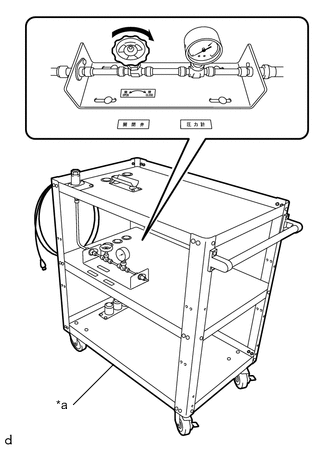
*a SST (Venting Stand) Check that the open/close valve of the SST (venting stand) is closed.
- SST
- 09404-62010 ( 09404-06010 )
-
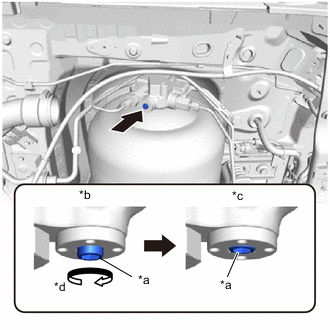
*a Adjustment Bolt *b Manual Valve Open *c Manual Valve Closed *d Clockwise Using an 8 mm hexagon socket wrench, rotate the adjustment bolt clockwise to close the manual valve of the No. 1 hydrogen tank assembly.
- Torque:
- 20 N*m { 204 kgf*cm, 15 ft.*lbf }
Note
-
The manual valve shuts off the pressure from the hydrogen tank assembly, so be careful not to damage the hexagonal portion.
-
If the hexagonal portion has been damaged, the No. 1 hydrogen tank assembly must be replaced.
-
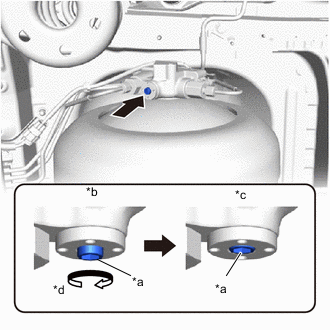
*a Adjustment Bolt *b Manual Valve Open *c Manual Valve Closed *d Clockwise Using an 8 mm hexagon socket wrench, rotate the adjustment bolt clockwise to close the manual valve of the No. 2 hydrogen tank assembly.
- Torque:
- 20 N*m { 204 kgf*cm, 15 ft.*lbf }
Note
-
The manual valve shuts off the pressure from the hydrogen tank assembly, so be careful not to damage the hexagonal portion.
-
If the hexagonal portion has been damaged, the No. 1 hydrogen tank assembly must be replaced.
-
Before starting the depressurization procedure, first check that there is no mud or other contaminant around the medium pressure leak check port of the hydrogen supply regulator assembly, and clean it as necessary.
Tech Tips
Installing the No. 1 hydrogen supply regulator plug while any foreign matter adheres to it can cause a hydrogen gas leak.
-
Make sure that the manual valves of the No. 1 hydrogen tank assembly and No. 2 hydrogen tank assembly are closed.
-
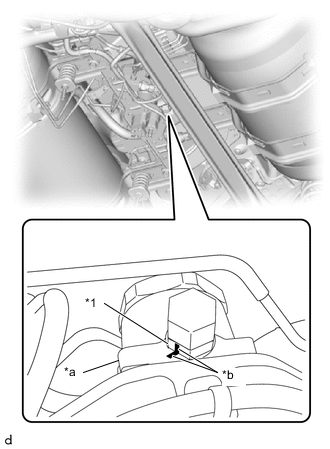
*1 Hydrogen Supply Regulator Union *a Body *b Paint Mark Apply paint marks to the hydrogen supply regulator union and the body of the hydrogen supply regulator assembly as shown in the illustration.
Tech Tips
When loosening the No. 1 hydrogen supply regulator plug, there is a possibility that the hydrogen supply regulator union could turn together with it and be loosened, so applying paint marks will enable judgment of whether the hydrogen supply regulator union has been loosened.
-
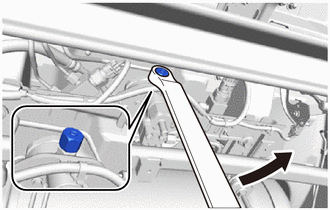
Slowly loosen the No. 1 hydrogen supply regulator plug until the hissing sound of gas escaping can be heard, then stop loosening the No. 1 hydrogen supply regulator plug and wait for the sound to stop. Repeat this procedure multiple times until the sound stops occurring, in order to depressurize the compressed hydrogen gas from the medium pressure leak check port of the hydrogen supply regulator assembly.
CAUTION:
-
Do not perform depressurization procedures when the manual valve of the hydrogen tank assembly is open.
-
The highly pressurized hydrogen gas inside the hydrogen tank assembly could blow out, resulting in a serious accident.
*a Manual Valve Open
-
When performing depressurization, do not perform procedures by hand without wearing protective glasses and gloves.
-
High pressure nitrogen gas could cause a serious accident.
Note
When performing depressurization, only loosen the No. 1 hydrogen supply regulator plug. Do not remove it.
-
-
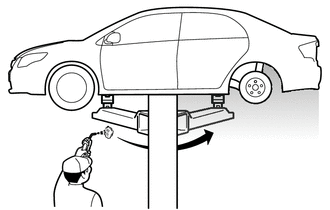
Blow compressed air at the underside of the vehicle to disperse any accumulated hydrogen gas.
-
Remove the No. 1 hydrogen supply regulator plug from the hydrogen supply regulator union.
Note
When frost has formed on the hydrogen tank assembly or piping, water droplets may be formed when the frost begins to melt. If water droplets enter the tank or piping, it could result in blockage of the hydrogen piping, so do not allow water droplets to enter the tank or piping.
-
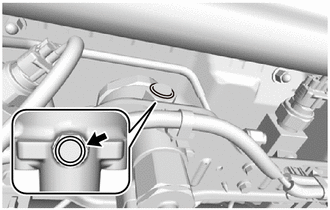
Remove the O-ring from the hydrogen supply regulator union.
-
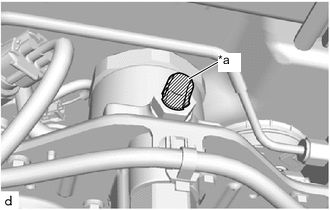
*a Protective Tape To prevent damage to the seal portions and threaded portions, and to prevent foreign matter such as dust or metal fragments from entering the openings, cover the seal portions, threaded portions, and openings of the hydrogen supply regulator union with protective tape.
-
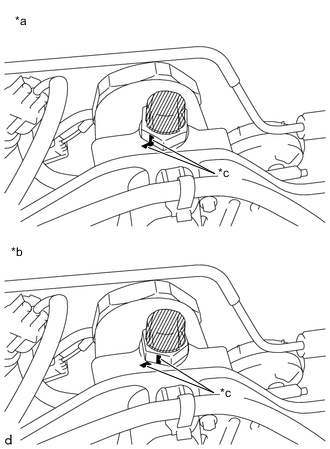
*a Correct *b Incorrect *c Paint Mark Check that the hydrogen supply regulator union has not been loosened.
Tech Tips
If the hydrogen supply regulator union has been loosened, there is the possibility of a compressed hydrogen gas leak, so it is necessary to remove the hydrogen supply regulator union and replace the O-ring with a new one.
-
Procedures for when the hydrogen supply regulator union has been loosened:
-
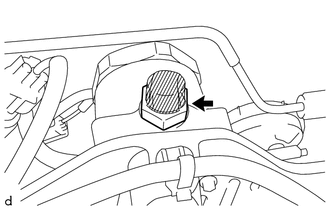
Remove the hydrogen supply regulator union.
Note
When frost has formed on the hydrogen tank assembly or piping, water droplets may be formed when the frost begins to melt. If water droplets enter the tank or piping, it could result in blockage of the hydrogen piping, so do not allow water droplets to enter the tank or piping.
-
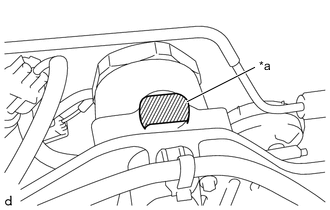
*a Protective Tape To prevent foreign matter such as dust or metal fragments from entering the openings, cover the seal portions, threaded portions, and openings of the hydrogen supply regulator union installation portion with protective tape.
-
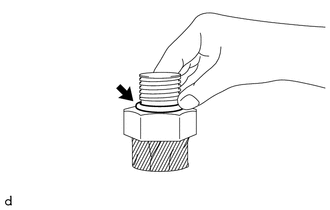
Remove the O-ring from the hydrogen supply regulator union.
Note
Perform the procedure by hand. Do not use any tools.
-
Clean and degrease the threaded portion of the hydrogen supply regulator union.
-
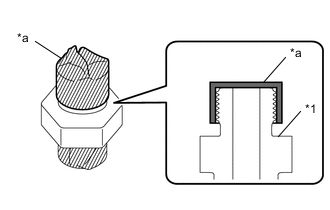
*1 Hydrogen Supply Regulator Union *a Protective Tape To prevent the O-ring from being damaged during installation, apply protective tape as shown in the illustration.
Tech Tips
Cover the hydrogen supply regulator union with protective tape so that the threaded portion and the hole cannot be seen.
-
Coat a new O-ring with TOYOTA Genuine FC Grease.
-
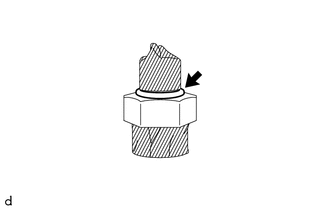
Install the O-ring to the hydrogen supply regulator union.
Note
-
Make sure not to damage the O-ring.
-
Make sure the O-ring is not twisted.
-
-
Remove the protective tape from the hydrogen supply regulator union.
Note
When frost has formed on the hydrogen tank assembly or piping, water droplets may be formed when the frost begins to melt. If water droplets enter the tank or piping, it could result in blockage of the hydrogen piping, so do not allow water droplets to enter the tank or piping.
-
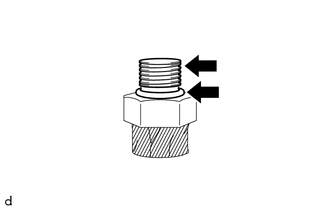
Coat the O-ring and the threaded portion of the hydrogen supply regulator union with TOYOTA Genuine FC Grease.
-
To prevent the hydrogen supply regulator union installation portion from being contaminated by dust, metal fragments, etc., do not remove the protective tape from it until immediately before performing the work.
Note
When frost has formed on the hydrogen tank assembly or piping, water droplets may be formed when the frost begins to melt. If water droplets enter the tank or piping, it could result in blockage of the hydrogen piping, so do not allow water droplets to enter the tank or piping.
-
Install the hydrogen supply regulator union.
- Torque:
- 41.5 N*m { 423 kgf*cm, 31 ft.*lbf }
Note
When installing the O-ring, make sure that it is not pinched.
-
-
To prevent damage to the seal portions and threaded portions, and to prevent foreign matter such as dust or metal fragments from entering the openings, do not remove the protective tape covering the seal portions, threaded portions, and openings of the hydrogen supply regulator union until immediately before performing work.
Note
When frost has formed on the hydrogen tank assembly or piping, water droplets may be formed when the frost begins to melt. If water droplets enter the tank or piping, it could result in blockage of the hydrogen piping, so do not allow water droplets to enter the tank or piping.
-
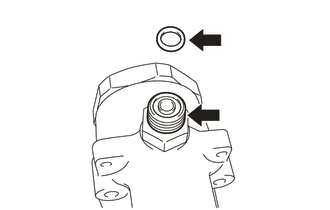
Apply TOYOTA Genuine FC Grease to a new O-ring and to the threaded portion of the hydrogen supply regulator union.
-
Install the O-ring to the hydrogen supply regulator union.
Note
During installation, make sure not to damage the O-ring.
-
Connect the SST (hydrogen venting tool).
- SST
- 09404-62010 ( 09404-06010, 09404-06020, 09404-06030, 09404-06040, 09404-06050 )
-
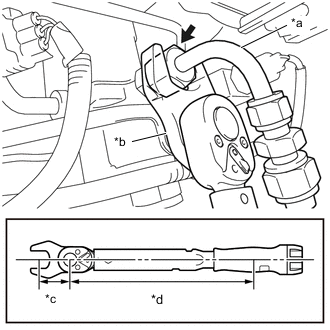
*a SST (Flexible Hose) *b SST (Open End Wrench) *c SST Fulcrum Length *d Torque Wrench Fulcrum Length Using SST (open end wrench), install the SST (flexible hose) to the hydrogen supply regulator union.
- SST
- 09922-10240
- 09404-62010 ( 09404-06020 )
- Torque:
- Specified tightening torque
- 25 N*m { 255 kgf*cm, 18 ft.*lbf }
Note
-
Make sure that the SST (flexible hose) does not interfere with any part of the vehicle.
-
If the SST (flexible hose) interferes with any part of the vehicle, protect it with a piece of cloth, etc.
Tech Tips
-
Calculate the torque wrench reading when changing the fulcrum length of the torque wrench.
-
When using SST (fulcrum length of 40 mm (1.57 in.)) + torque wrench (fulcrum length of 255 mm (10.04 in.)):
21.6 N*m (220 kgf*cm, 16 ft.*lbf)
-
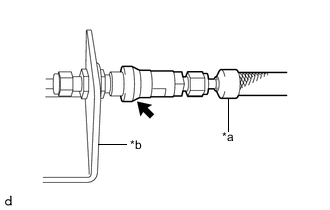
*a SST (Flexible Hose) *b SST (Venting Stand) Connect the SST (flexible hose) to the SST (Venting Stand).
- SST
- 09404-62010 ( 09404-06010, 09404-06020 )
-
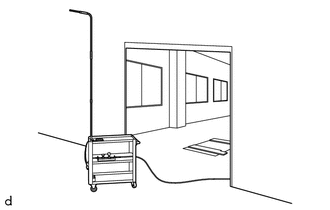
Under basic conditions
-
Set the SST (hydrogen venting tool) in an outdoor location.
Note
Take care that the compressed hydrogen gas that is discharged during the discharging procedure does not enter any indoor location.
-
-
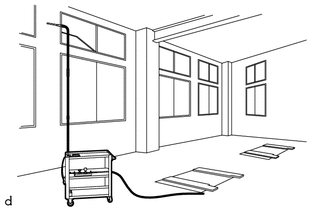
Other than basic conditions (when outdoor setup is not possible)
-
When the SST (hydrogen venting tool) will be set up indoors, locate it along a wall near a window, and with the tip of the SST (upper release pipe) outdoors.
Note
Open windows on two sides or more, and ensure that there is adequate ventilation to prevent the compressed hydrogen gas that is discharged from collecting inside.
-
-
Open the tank shut valves of the No. 1 and No. 2 hydrogen tank assemblies, and after 2 to 3 seconds, close the tank shut valves again.
CAUTION:
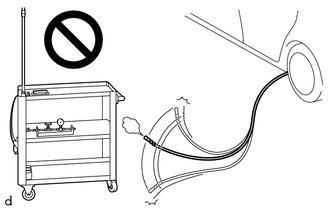
-
When opening the tank shut valve and applying pressure to the SST (hydrogen venting tool), stay away from the SST (flexible hose).
-
If the SST (flexible hose) comes off, you could be struck by the loose end of the SST (flexible hose), causing a serious accident.
Note
If the Data List item "Medium-range Hydrogen Pressure (gauge)" decreases to below 0.6 MPa (6.1 kgf/cm2, 87 psi) the tank shut valves of the No. 1 and No. 2 hydrogen tank assemblies will forcibly close.
-
-
If the tank shut valves of the No. 1 and No. 2 hydrogen tank assemblies do not open, open the tank shut valves again, and after 2 to 3 seconds, close the tank shut valves.
-
Perform preliminary leak check (using remaining piping pressure).
Tech Tips
Perform leak check using the pressure remaining upstream of the tank shut valve.
-
If there are any water droplets, etc. adhering to the measurement locations, wipe them away before performing the procedure.
Note
Performing the measurement while any water droplets, etc. are adhering could damage the hydrogen gas detector.
-
Using SST and a hydrogen gas detector, inspect for leaks in the locations shown in the illustration.
Figure 2. <Locations to Check for Leaks>
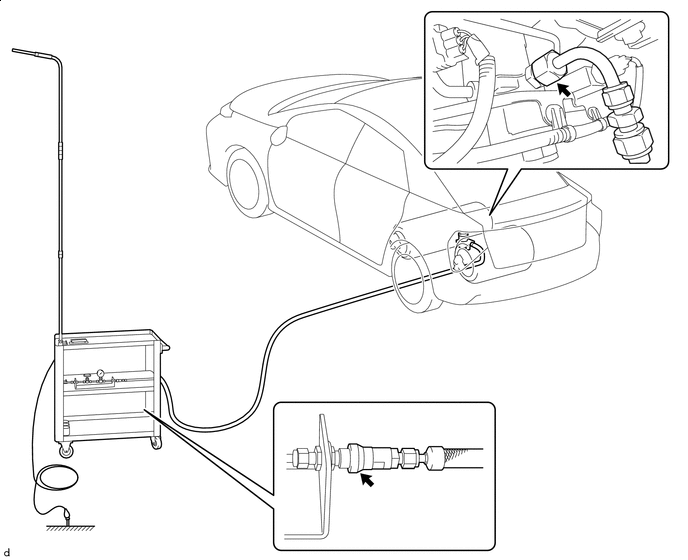

Leak Check Location - - - SST
- 09401-62010
Specified Value 300 ppm or less Note
If any values are outside the specified range, disconnect those locations that have leaks and assemble the parts again.
-
-
Using the GTS, enter the following menus: Powertrain / FC / Data List / Medium-range Hydrogen Pressure
Powertrain > FC > Data ListTester Display Medium-range Hydrogen Pressure Tech Tips
If the GTS unit setting is absolute pressure (abs), change it to gauge pressure (gauge).
-
Open the tank shut valves of the No. 1 and No. 2 hydrogen tank assemblies.
Note
If the Data List item "Medium-range Hydrogen Pressure (gauge)" decreases to below 0.6 MPa (6.1 kgf/cm2, 87 psi) the tank shut valves of the No. 1 and No. 2 hydrogen tank assemblies will forcibly close.
-
If the tank shut valves of the No. 1 and No. 2 hydrogen tank assemblies do not open, open the tank shut valves again.
-
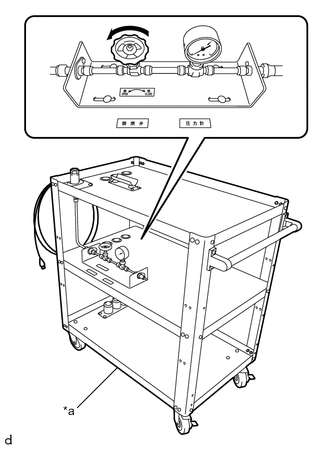
*a SST (Venting Stand) Open the open/close valve of the SST (venting stand), and depressurize compressed hydrogen gas.
- SST
- 09404-62010 ( 09404-06010 )
-
Continue to monitor the Data List, and when the value of "Medium-range Hydrogen Pressure (gauge)" becomes 0.8 MPa (8.2 kgf/cm2, 116 psi), close the open/close valve of the SST (venting stand).
Note
-
To protect the tank shut valve, make sure to first close the open/close valve of the SST (venting stand).
-
Forgetting to close the open/close valve of the SST (venting stand) and allowing the Data List item "Medium-range Hydrogen Pressure (gauge)" to decrease to below 0.6 MPa (6.1 kgf/cm2, 87 psi) will cause the tank shut valves of the No. 1 and No. 2 hydrogen tank assemblies to forcibly close.
-
-
Check that the Data List item "Medium-range Hydrogen Pressure (gauge)" and the pressure on the pressure indicator of the SST (venting stand) are less than 0.8 MPa (8.2 kgf/cm2, 116 psi).
Note
-
The pressure immediately after closing the open/close valve of the SST (venting stand) should be less than 0.8 MPa (8.2 kgf/cm2, 116 psi) for both the Data List item "Medium-range Hydrogen Pressure (gauge)" and on the pressure indicator of the SST (venting stand).
-
If either the Data List item "Medium-range Hydrogen Pressure (gauge)" or the pressure on the pressure indicator of the SST (venting stand) are 0.8 MPa (8.2 kgf/cm2, 116 psi) or greater, open the open/close valve of the SST (venting stand) and adjust the pressure.
Tech Tips
If the pressure immediately after closing the open/close valve of the SST (venting stand) is less than 0.8 MPa (8.2 kgf/cm2, 116 psi) for both the Data List item "Medium-range Hydrogen Pressure (gauge)" and on the pressure indicator of the SST (venting stand), then the pressurized hydrogen gas depressurizing procedure is complete.
-
-
Close the tank shut valves of both the No. 1 and No. 2 hydrogen tank assemblies.
-
*a SST (Venting Stand) Open the open/close valve of the SST (venting stand) and discharge the compressed hydrogen gas remaining inside the SST (flexible hose).
- SST
- 09404-62010 ( 09404-06010 )
Note
-
Do not disconnect the SST (flexible hose) while there is still pressure remaining inside it.
-
Continue discharging until the pressure gauge of the SST (Venting Stand) becomes "0".
-
Before performing the disconnection procedure, if there are any contaminants such as water droplets adhering near the medium pressure leak check port of the hydrogen supply regulator assembly, wipe them away before performing the procedure.
-
*a SST (Flexible Hose) *b SST (Venting Stand) Disconnect the SST (flexible hose) from the SST (Venting Stand).
- SST
- 09404-62010 ( 09404-06010, 09404-06020 )
-
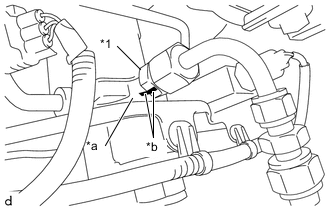
*1 Hydrogen Supply Regulator Union *a Body *b Paint Mark Apply paint marks to the hydrogen supply regulator union and the body of the hydrogen supply regulator assembly as shown in the illustration.
Tech Tips
When loosening the SST (flexible hose), there is a possibility that the hydrogen supply regulator union could turn together with it and be loosened, so applying paint marks will enable judgment of whether the hydrogen supply regulator union has been loosened.
-
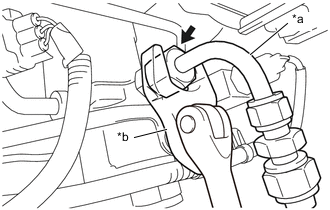
*a SST (Flexible Hose) *b SST (Open End Wrench) Using SST (open end wrench), remove the SST (flexible hose) from the hydrogen supply regulator union.
- SST
- 09922-10240
- 09404-62010 ( 09404-06020 )
-
Remove the O-ring from the hydrogen supply regulator union.
-
*a Protective Tape To prevent damage to the seal portions and threaded portions, and to prevent foreign matter such as dust or metal fragments from entering the openings, cover the seal portions, threaded portions, and openings of the hydrogen supply regulator union with protective tape.
-
*a Correct *b Incorrect *c Paint Mark Check that the hydrogen supply regulator union has not been loosened.
Tech Tips
If the hydrogen supply regulator union has been loosened, there is the possibility of a compressed hydrogen gas leak, so it is necessary to remove the hydrogen supply regulator union and replace the O-ring with a new one.
-
Procedures for when the hydrogen supply regulator union has been loosened:
-
Remove the hydrogen supply regulator union.
Note
When frost has formed on the hydrogen tank assembly or piping, water droplets may be formed when the frost begins to melt. If water droplets enter the tank or piping, it could result in blockage of the hydrogen piping, so do not allow water droplets to enter the tank or piping.
-
*a Protective Tape To prevent foreign matter such as dust or metal fragments from entering the openings, cover the seal portions, threaded portions, and openings of the hydrogen supply regulator union installation portion with protective tape.
-
Remove the O-ring from the hydrogen supply regulator union.
Note
Perform the procedure by hand. Do not use any tools.
-
Clean and degrease the threaded portion of the hydrogen supply regulator union.
-
*1 Hydrogen Supply Regulator Union *a Protective Tape To prevent the O-ring from being damaged during installation, apply protective tape as shown in the illustration.
Tech Tips
Cover the hydrogen supply regulator union with protective tape so that the threaded portion and the hole cannot be seen.
-
Coat a new O-ring with TOYOTA Genuine FC Grease.
-
Install the O-ring to the hydrogen supply regulator union.
Note
-
Make sure not to damage the O-ring.
-
Make sure the O-ring is not twisted.
-
-
Remove the protective tape from the hydrogen supply regulator union.
Note
When frost has formed on the hydrogen tank assembly or piping, water droplets may be formed when the frost begins to melt. If water droplets enter the tank or piping, it could result in blockage of the hydrogen piping, so do not allow water droplets to enter the tank or piping.
-
Coat the O-ring and the threaded portion of the hydrogen supply regulator union with TOYOTA Genuine FC Grease.
-
To prevent the hydrogen supply regulator union installation portion from being contaminated by dust, metal fragments, etc., do not remove the protective tape from it until immediately before performing the work.
Note
When frost has formed on the hydrogen tank assembly or piping, water droplets may be formed when the frost begins to melt. If water droplets enter the tank or piping, it could result in blockage of the hydrogen piping, so do not allow water droplets to enter the tank or piping.
-
Install the hydrogen supply regulator union.
- Torque:
- 41.5 N*m { 423 kgf*cm, 31 ft.*lbf }
Note
When installing the O-ring, make sure that it is not pinched.
-
-
To prevent damage to the seal portions and threaded portions, and to prevent foreign matter such as dust or metal fragments from entering the openings, do not remove the protective tape covering the seal portions, threaded portions, and openings of the hydrogen supply regulator union until immediately before performing work.
Note
When frost has formed on the hydrogen tank assembly or piping, water droplets may be formed when the frost begins to melt. If water droplets enter the tank or piping, it could result in blockage of the hydrogen piping, so do not allow water droplets to enter the tank or piping.
-
Apply TOYOTA Genuine FC Grease to a new O-ring and to the threaded portion of the hydrogen supply regulator union.
-
Install the O-ring to the hydrogen supply regulator union.
Note
During installation, make sure not to damage the O-ring.
-
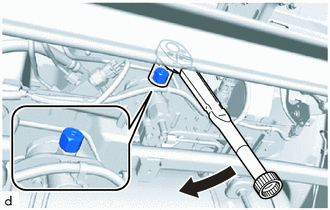
Install the No. 1 hydrogen supply regulator plug to the hydrogen supply regulator union.
- Torque:
- 25 N*m { 255 kgf*cm, 18 ft.*lbf }
-
-
DISABLE BRAKE CONTROL
-
REMOVE REAR WHEEL HOUSE FRONT PLATE LH
-
REMOVE REAR BUMPER SIDE SEAL LH
-
REMOVE REAR WHEEL HOUSE LINER LH
-
REMOVE REAR AXLE BEAM ASSEMBLY
-
SEPARATE NO. 2 PARKING BRAKE CABLE ASSEMBLY
-
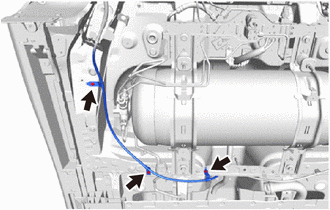
Remove the 3 bolts and separate the No. 2 parking brake cable assembly from the vehicle.
-
-
SEPARATE NO. 3 PARKING BRAKE CABLE ASSEMBLY
-
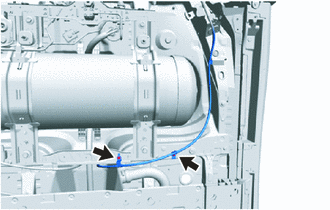
Remove the 2 bolts and separate the No. 3 parking brake cable assembly from the vehicle.
-
-
SEPARATE NO. 3 FLOOR WIRE
-
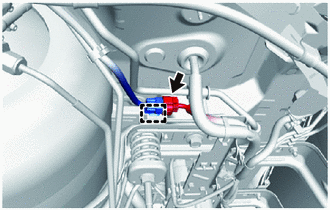
Disconnect the No. 1 hydrogen tank assembly connector.
-
Disengage the clamp and separate the No. 1 hydrogen tank assembly connector from the wire harness clamp bracket.
-
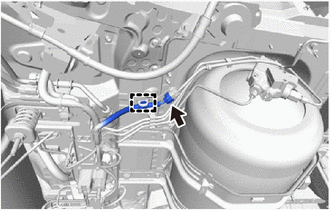
Disconnect the No. 2 hydrogen tank assembly connector.
-
Disengage the clamp and separate the No. 3 floor wire from the hydrogen tank tube clamp bracket.
-
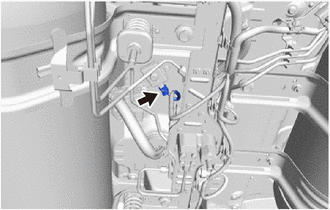
Disconnect the hydrogen detector connector.
-
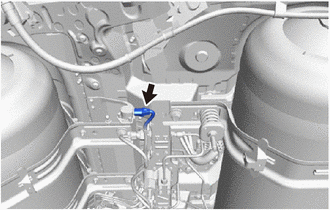
Disconnect the rear height control sensor sub-assembly connector.
-
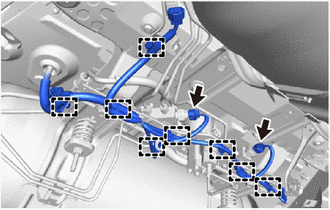
Disconnect the 2 hydrogen tank pressure sensor connectors.
-
Disengage the 8 clamps and separate the No. 3 floor wire from the front center hydrogen tank frame and wire harness clamp bracket.
-
-
SEPARATE NO. 2 HYDROGEN SUPPLY TUBE SUB-ASSEMBLY
-
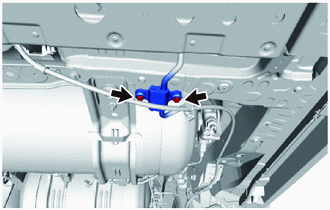
Remove the 2 bolts and separate the No. 2 hydrogen supply tube sub-assembly from the vehicle.
-
-
DISCONNECT NO. 1 HYDROGEN SUPPLY TUBE SUB-ASSEMBLY
-
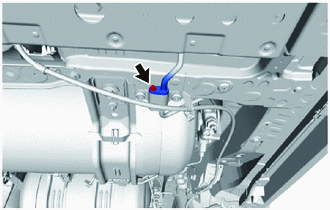
Remove the bolt and disconnect the No. 1 hydrogen supply tube sub-assembly from the No. 2 hydrogen supply tube sub-assembly.
Note
When frost has formed on the hydrogen tank assembly or piping, water droplets may be formed when the frost begins to melt. If water droplets enter the tank or piping, it could result in blockage of the hydrogen piping, so do not allow water droplets to enter the tank or piping.
-
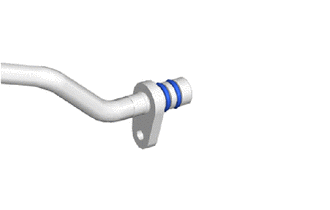
Remove the 2 O-rings from the No. 1 hydrogen supply tube sub-assembly.
-
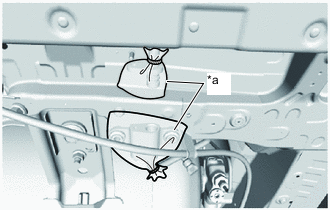
*a Plastic Bag To prevent contamination by foreign matter, cover the openings of the No. 1 hydrogen supply tube sub-assembly and No. 2 hydrogen supply tube sub-assembly with plastic bags.
-
-
REMOVE WIRING HARNESS CLAMP BRACKET
-
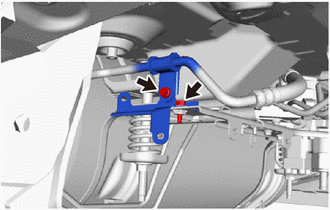
Remove the bolt and separate the No. 2 hydrogen supply tube sub-assembly from the wire harness clamp bracket.
-
Remove the bolt and wire harness clamp bracket from the front hydrogen tank frame sub-assembly LH.
-
-
SEPARATE HYDROGEN TANK TUBE CLAMP BRACKET
-
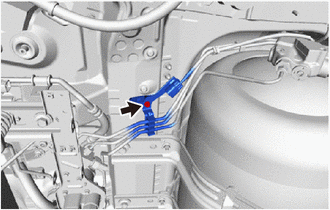
Remove the bolt and separate the hydrogen tank tube clamp bracket from the vehicle.
Note
When loosening the bolt, to prevent the high pressure hydrogen piping from rotating together and being strained, hold the hydrogen tube clamp bracket in place by hand while performing the procedure.
-
-
DISCONNECT HYDROGEN TANK TUBE ASSEMBLY
CAUTION:
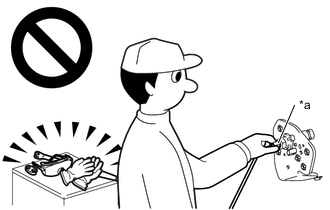
*a After depressurization procedures, the high pressure piping union nut that is loosened first.
-
After performing depressurization procedures, when first loosening the union nut of the high pressure hydrogen piping, do not loosen the union nut by hand without wearing protective glasses and gloves.
-
Even when depressurization procedures are performed, the pressurized hydrogen gas inside the high pressure hydrogen piping cannot be completely depressurized, so the highly pressurized hydrogen gas remaining in the high pressure hydrogen piping could blow out, resulting in a serious accident.
-
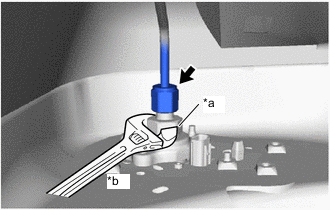
*a Adapter Portion *b Hold Using a 17 mm union nut wrench, loosen the union nut and disconnect the hydrogen tank tube assembly from the hydrogen inlet receptacle assembly.
Note
-
When frost has formed on the hydrogen tank assembly or piping, water droplets may be formed when the frost begins to melt. If water droplets enter the tank or piping, it could result in blockage of the hydrogen piping, so do not allow water droplets to enter the tank or piping.
-
While using an adjustable wrench to hold the adapter portion of the hydrogen inlet receptacle assembly in place, loosen the union nut.
-
-
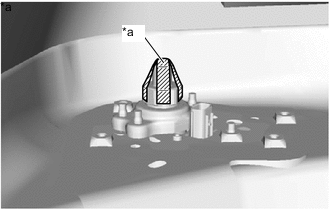
*a Protective Tape To prevent damage to the seal portions and threaded portions, and to prevent foreign matter such as dust or metal fragments from entering the openings, cover the seal portions, threaded portions, and openings of the hydrogen inlet receptacle assembly with protective tape.
Tech Tips
If the hydrogen inlet receptacle assembly will be replaced with a new one, it is not necessary to cover the seal portions, threaded portions, and openings with protective tape. However, do not remove the protective cap of the new component until immediately before installing it.
-
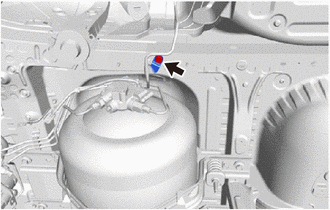
Remove the bolt and separate the bracket of the hydrogen tank tube assembly from the vehicle.
Note
When loosening the bolt, to prevent the high pressure hydrogen piping from rotating together and being strained, hold the bracket portion in place by hand while performing the procedure.
-
-
REMOVE HYDROGEN TANK UNIT
CAUTION:
-
Because the hydrogen tank unit is extremely heavy, make sure to follow the work procedures described in the repair manual.
-
If work is not performed according to the procedures described in the repair manual, there is a danger that the engine lifter could drop and components could fall down.
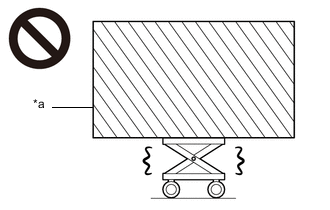
*a Heavy load exceeding the weight limits or size limits of the engine lifter
-
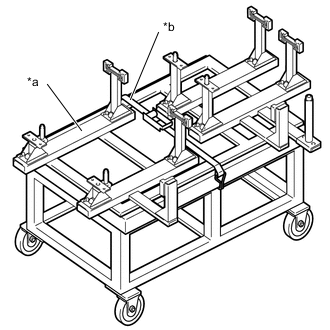
*a SST (Hydrogen Tank Stand) *b Belt Set the SST (hydrogen tank stand) on the engine lifter and secure it with the belt.
- SST
- 09403-62010 ( 09403-06010, 09403-06020, 09403-06030, 09403-06040, 09403-06050, 09403-06060, 09403-06070, 09403-06080, 09403-06090, 09403-06100, 09403-06110 )
Note
Set the SST (hydrogen tank stand) in the middle of the engine lifter and secure the center portion with the belt.
-
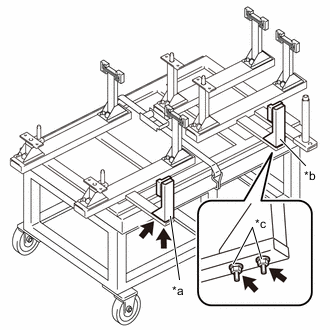
*a SST (Support No. 5) *b SST (Support No. 6) *c SST (Nut) Remove the SST (nuts) and each tank support type SST.
- SST
- 09403-62010 ( 09403-06050, 09403-06060, 09403-06090 )
-
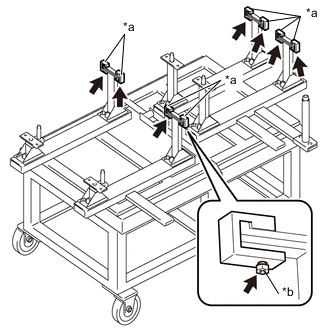
*a SST (Tank Belt Fixture) *b SST (Bolt) Remove the SST (bolts) and each SST (tank belt fixture).
- SST
- 09403-62010 ( 09403-06100, 09403-06110 )
-
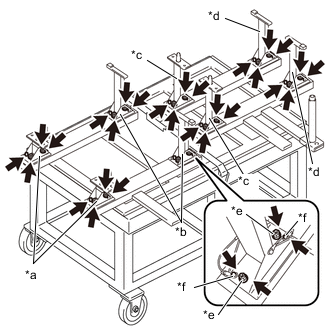
*a SST (Support No. 1) *b SST (Support No. 2) *c SST (Support No. 3) *d SST (Support No. 4) *e SST (Bolt) *f Pin For each tank support type SST, disengage the 2 pins and loosen the 2 SST (bolts).
- SST
- 09403-62010 ( 09403-06010, 09403-06020, 09403-06030, 09403-06040, 09403-06080 )
Tech Tips
This is done to align the SST (hydrogen tank stand) with the installation condition of the hydrogen tank unit on the vehicle.
-
Operate the engine lifter, and set the SST (hydrogen tank stand) against the hydrogen tank frame.
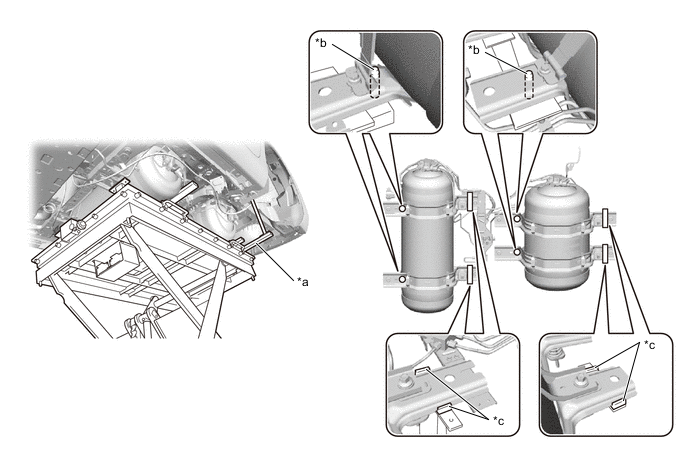
*a SST (Hydrogen Tank Stand) *b Pin *c Groove - - Note
-
Align the pins of the each tank support type SST with the pin holes of the hydrogen tank frame.
-
Align the grooves of the each tank support type SST with the tank frame.
-
-
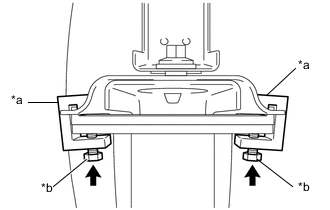
*a SST (Tank Belt Fixture) *b SST (Bolt) Using the SST (bolts), install each SST (tank belt fixture), and support the hydrogen tank frame.
- SST
- 09403-62010 ( 09403-06100, 09403-06110 )
Note
-
If the hydrogen tank unit is removed from the vehicle without attaching each SST (tank belt fixture), the hydrogen tank frame will spring back because of the spring force and the installation positions of parts will be misaligned.
-
Do not remove any of the tank frame installation bolts until each SST (tank belt fixture) are installed.
Tech Tips
If it is difficult to install each SST (tank belt fixture), loosen the tank frame installation bolts to a position where the tank frame support attachments can be installed.
-
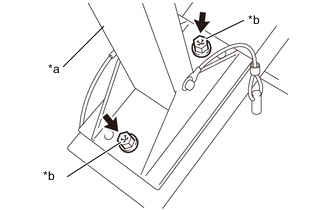
*a SST (Support No. 1, Support No. 2, Support No. 3 and Support No. 4) *b SST (Bolt) Tighten the SST (bolts) of each tank support type SST.
- SST
- 09403-62010 ( 09403-06010, 09403-06020, 09403-06030, 09403-06040, 09403-06080 )
-
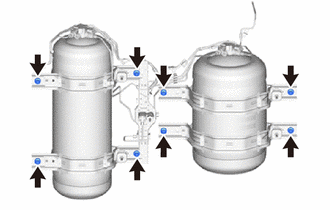
Remove the 8 bolts.
-
Operate the engine lifter and slowly remove the hydrogen tank unit from the vehicle.
Note
Make sure the hydrogen tank assembly and high pressure hydrogen piping do not interfere with the vehicle body or surrounding components.
-
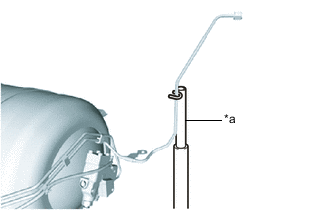
*a SST (Support No. 7) Support the hydrogen tank tube assembly with the SST (support No. 7).
Note
-
To prevent deformation of the hydrogen tank tube assembly, make sure the hydrogen tank tube assembly does not come off of the SST (support No. 7).
-
To prevent deformation of the hydrogen tank tube assembly, make sure that your body does not catch on it.
-
-
-
REMOVE NO. 2 HYDROGEN SUPPLY TUBE SUB-ASSEMBLY
-
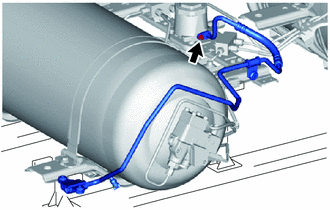
Remove the bolt and No. 2 hydrogen supply tube sub-assembly from the hydrogen supply regulator assembly.
Note
When frost has formed on the hydrogen tank assembly or piping, water droplets may be formed when the frost begins to melt. If water droplets enter the tank or piping, it could result in blockage of the hydrogen piping, so do not allow water droplets to enter the tank or piping.
-
Remove the 2 O-rings from the No. 2 hydrogen supply tube sub-assembly.
-
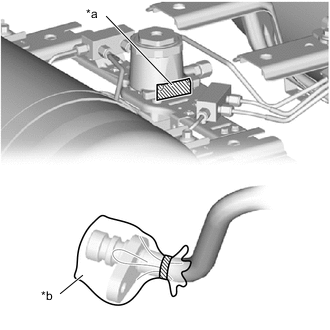
*a Protective Tape *b Plastic Bag To prevent contamination by foreign matter, cover the openings of the hydrogen supply regulator assembly with protective tape.
Tech Tips
When the hydrogen supply regular assembly will be replaced with a new one, it is not necessary to protect the openings with protective tape.
-
To prevent contamination by foreign matter, cover the connecting portions of the hydrogen supply tube sub-assembly with plastic bags.
Tech Tips
When the No. 2 hydrogen supply tube sub-assembly will be replaced with a new one, it is not necessary to protect the openings with plastic bags.
-
-
REMOVE WIRE HARNESS CLAMP
-
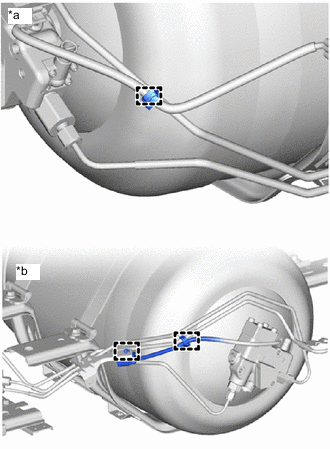
*a No. 1 Hydrogen Tank Assembly Side *b No. 2 Hydrogen Tank Assembly Side No. 1 Hydrogen Tank Assembly Side:
-
Disengage the clamp and remove the wire harness clamp from the wire harness of the No. 1 hydrogen tank assembly and No. 4 hydrogen tube sub-assembly.
-
-
No. 2 Hydrogen Tank Assembly Side:
-
Disengage the clamp and separate the No. 2 hydrogen tank assembly connector from the hydrogen tank tube clamp bracket.
-
Disengage the clamp and remove the wire harness clamp from the wire harness of the No. 2 hydrogen tank assembly and hydrogen tube sub-assembly.
-
-
-
REMOVE HYDROGEN TANK TUBE CLAMP BRACKET
-
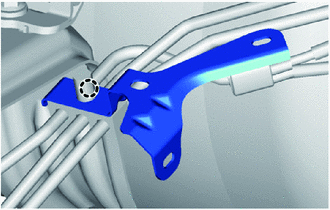
Disengage the claw and remove the hydrogen tank tube clamp bracket from the No. 1 fuel tube clamp.
Note
-
When there is high pressure hydrogen piping that will not be replaced, be careful not to damage or deform it.
-
If the pipe protector material of the high pressure hydrogen piping is damaged so that the internal pipe itself becomes visible, replace the high pressure hydrogen piping with a new one.
-
-
-
REMOVE NO. 1 FUEL TUBE CLAMP
-
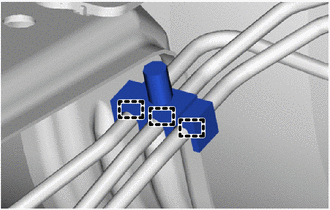
Disengage the 3 clamps and remove the No. 1 fuel tube clamp from the hydrogen tank tube assembly,No. 3 hydrogen tank tube and No. 5 hydrogen tank tube.
Note
-
When there is high pressure hydrogen piping that will not be replaced, be careful not to damage or deform it.
-
If the pipe protector material of the high pressure hydrogen piping is damaged so that the internal pipe itself becomes visible, replace the high pressure hydrogen piping with a new one.
-
The No. 1 fuel tube clamp cannot be reused.
-
-
-
REMOVE FUEL TUBE GROMMET
-
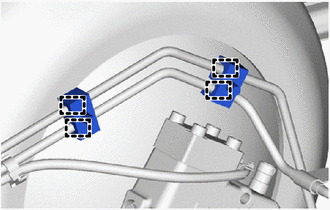
Disengage the 2 clamps and remove the 2 fuel tube grommets from the hydrogen tank tube assembly and No. 3 hydrogen tank tube.
Note
-
When there is high pressure hydrogen piping that will not be replaced, be careful not to damage or deform it.
-
If the pipe protector material of the high pressure hydrogen piping is damaged so that the internal pipe itself becomes visible, replace the high pressure hydrogen piping with a new one.
-
The fuel tube grommet cannot be reused.
-
-
-
REMOVE HYDROGEN TANK TUBE ASSEMBLY
-
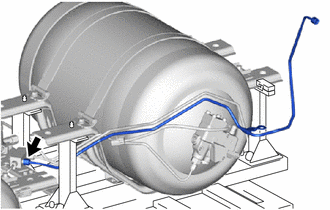
Using a 17 mm union nut wrench, loosen the union nut and remove the hydrogen tank tube assembly from the hydrogen tank tube joint.
Note
-
When frost has formed on the hydrogen tank assembly or piping, water droplets may be formed when the frost begins to melt. If water droplets enter the tank or piping, it could result in blockage of the hydrogen piping, so do not allow water droplets to enter the tank or piping.
-
A hydrogen tank tube assembly that has been removed cannot be reused.
-
-
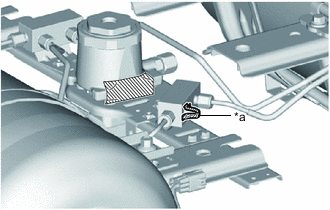
*a Protective Tape To prevent damage to the seal portions and threaded portions, and to prevent foreign matter such as dust or metal fragments from entering the openings, cover the seal portions, threaded portions, and openings of the hydrogen tank tube joint with protective tape.
Tech Tips
When replacing the hydrogen tank tube joint with a new one, it is not necessary to protect the seal portions and thread portions with protective tape.
-
-
REMOVE NO. 3 HYDROGEN TANK TUBE
-
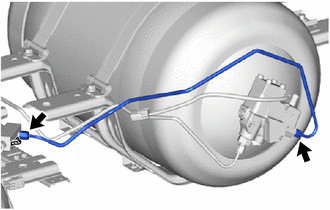
Using a 17 mm union nut wrench, loosen the 2 union nuts and remove the No. 3 hydrogen tank tube from the No. 2 hydrogen tank assembly and hydrogen tank tube joint.
Note
-
When frost has formed on the hydrogen tank assembly or piping, water droplets may be formed when the frost begins to melt. If water droplets enter the tank or piping, it could result in blockage of the hydrogen piping, so do not allow water droplets to enter the tank or piping.
-
A No. 3 hydrogen tank tube that has been removed cannot be reused.
-
-
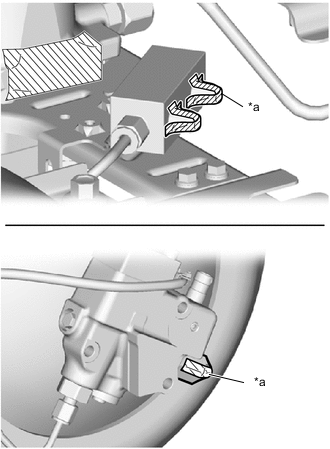
*a Protective Tape To prevent damage to the seal portions and threaded portions, and to prevent foreign matter such as dust or metal fragments from entering the openings, cover the seal portions, threaded portions, and openings of the No. 2 hydrogen tank assembly and hydrogen tank tube joint with protective tape.
Tech Tips
-
If the hydrogen tank tube joint will be replaced with a new one, it is not necessary to cover the seal portions, threaded portions, and openings with protective tape.
-
If the No. 2 hydrogen tank assembly will be replaced with a new one, it is not necessary to cover the seal portions, threaded portions, and openings with protective tape.
-
-
-
REMOVE NO. 5 HYDROGEN TANK TUBE
-
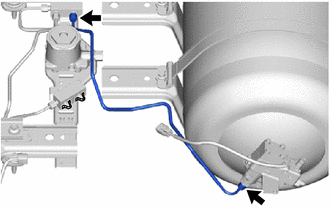
Using a 17 mm union nut wrench, loosen the 2 union nuts and remove the No. 5 hydrogen tank tube from the No. 2 hydrogen tank assembly and hydrogen tank tube joint.
Note
-
When frost has formed on the hydrogen tank assembly or piping, water droplets may be formed when the frost begins to melt. If water droplets enter the tank or piping, it could result in blockage of the hydrogen piping, so do not allow water droplets to enter the tank or piping.
-
A No. 5 hydrogen tank tube that has been removed cannot be reused.
-
-
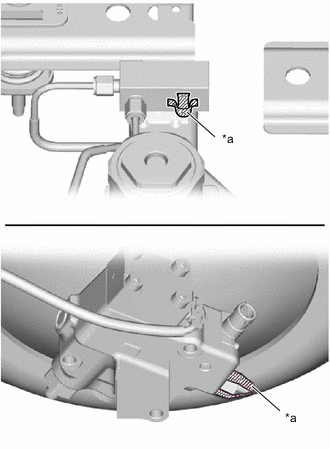
*a Protective Tape To prevent damage to the seal portions and threaded portions, and to prevent foreign matter such as dust or metal fragments from entering the openings, cover the seal portions, threaded portions, and openings of the No. 2 hydrogen tank assembly and hydrogen tank tube joint with protective tape.
Tech Tips
-
If the hydrogen tank tube joint will be replaced with a new one, it is not necessary to cover the seal portions, threaded portions, and openings with protective tape.
-
If the No. 2 hydrogen tank assembly will be replaced with a new one, it is not necessary to cover the seal portions, threaded portions, and openings with protective tape.
-
-
-
REMOVE NO. 4 HYDROGEN TANK TUBE
-
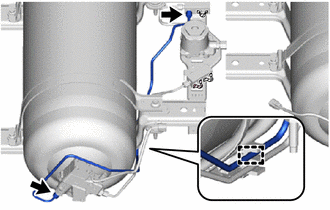
Using a 17 mm union nut wrench, loosen the 2 union nuts and disconnect the No. 4 hydrogen tank tube from the No. 1 hydrogen tank assembly and hydrogen tank tube joint.
Note
When frost has formed on the hydrogen tank assembly or piping, water droplets may be formed when the frost begins to melt. If water droplets enter the tank or piping, it could result in blockage of the hydrogen piping, so do not allow water droplets to enter the tank or piping.
-
Disengage the clamp and remove the No. 4 hydrogen tank tube from the fuel tube grommet.
Note
-
A No. 4 hydrogen tank tube that has been removed cannot be reused.
-
A fuel tube grommet for which the clamp has been disengaged cannot be reused.
-
-
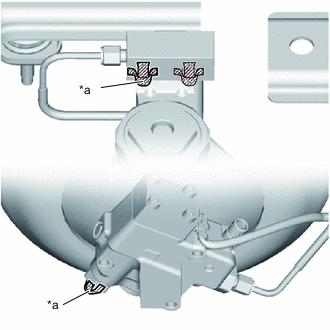
*a Protective Tape To prevent damage to the seal portions and threaded portions, and to prevent foreign matter such as dust or metal fragments from entering the openings, cover the seal portions, threaded portions, and openings of the No. 1 hydrogen tank assembly and hydrogen tank tube joint with protective tape.
Tech Tips
-
If the hydrogen tank tube joint will be replaced with a new one, it is not necessary to cover the seal portions, threaded portions, and openings with protective tape.
-
If the No. 1 hydrogen tank assembly will be replaced with a new one, it is not necessary to cover the seal portions, threaded portions, and openings with protective tape.
-
-
-
REMOVE NO. 2 HYDROGEN TANK TUBE
-
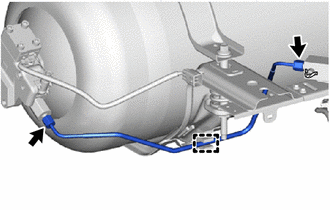
Using a 17 mm union nut wrench, loosen the 2 union nuts and disconnect the No. 2 hydrogen tank tube from the No. 1 hydrogen tank assembly and hydrogen tank tube joint.
Note
When frost has formed on the hydrogen tank assembly or piping, water droplets may be formed when the frost begins to melt. If water droplets enter the tank or piping, it could result in blockage of the hydrogen piping, so do not allow water droplets to enter the tank or piping.
-
Disengage the clamp and remove the No. 2 hydrogen tank tube from the fuel tube grommet.
Note
-
A No. 2 hydrogen tank tube that has been removed cannot be reused.
-
A fuel tube grommet for which the clamp has been disengaged cannot be reused.
-
-
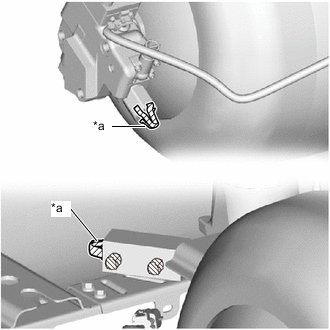
*a Protective Tape To prevent damage to the seal portions and threaded portions, and to prevent foreign matter such as dust or metal fragments from entering the openings, cover the seal portions, threaded portions, and openings of the No. 1 hydrogen tank assembly and hydrogen tank tube joint with protective tape.
Tech Tips
-
If the hydrogen tank tube joint will be replaced with a new one, it is not necessary to cover the seal portions, threaded portions, and openings with protective tape.
-
If the No. 1 hydrogen tank assembly will be replaced with a new one, it is not necessary to cover the seal portions, threaded portions, and openings with protective tape.
-
-
-
REMOVE FUEL TUBE GROMMET
-
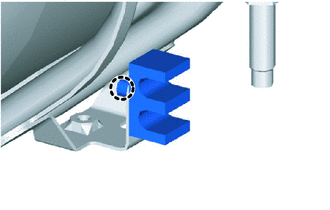
Disengage the claw and remove the fuel tube grommet from the front hydrogen tank frame sub-assembly LH.
Note
A fuel tube grommet that has been removed cannot be reused.
-
-
REMOVE NO. 2 HYDROGEN TANK ASSEMBLY
-
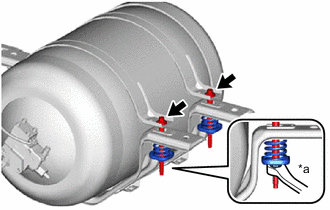
*a Hold Loosen the 2 bolts and remove the 2 rear hydrogen tank spring bolt cups and 2 compression springs.
Note
While holding the rear hydrogen tank spring bolt cup, loosen the bolt.
-
Raise Up 
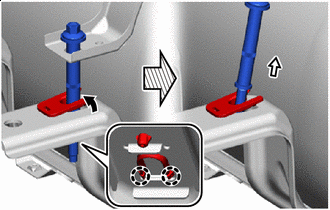
Remove Disengage the 2 claws, raise up the rear hydrogen tank frame spring bolt cushion, and remove the bolt.
Tech Tips
Use the same procedure to remove the other bolt.
-
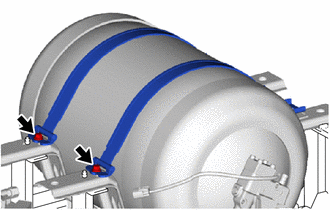
Remove the 2 bolts and 2 rear hydrogen tank band sub-assemblies from the 2 rear hydrogen tank frame sub-assemblies.
-
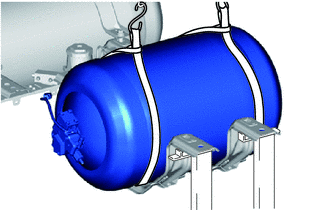
Using an engine sling device and belts, remove the No. 2 hydrogen tank assembly from the rear hydrogen tank frame sub-assembly.
CAUTION:
-
When hoisting up the hydrogen tank assembly, do not hoist it when not properly balanced.
-
The hydrogen tank assembly could fall, resulting in a serious accident.
-
-
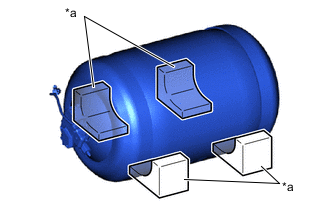
*a Wheel Chocks Place the No. 2 hydrogen tank assembly on wheel chocks or similar.
-
-
REMOVE NO. 1 HYDROGEN TANK ASSEMBLY
-
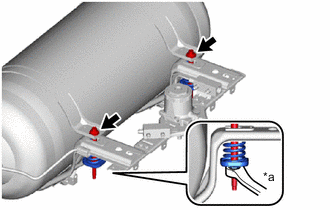
*a Hold Loosen the 2 bolts and remove the 2 front hydrogen tank spring bolt cups and 2 compression springs.
Note
While holding the front hydrogen tank spring bolt cup, loosen the bolt.
-
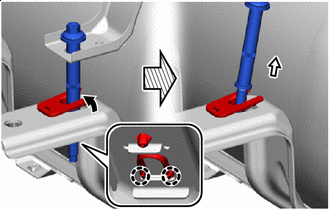
Raise Up Remove Disengage the 2 claws, raise up the rear hydrogen tank frame spring bolt cushion, and remove the bolt.
Tech Tips
Use the same procedure to remove the other bolt.
-
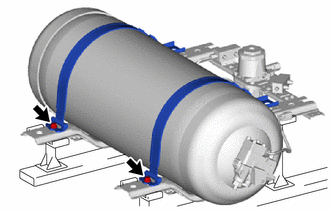
Remove the 2 bolts and 2 front hydrogen tank band sub-assemblies from the front hydrogen tank frame sub-assembly LH and front hydrogen tank frame sub-assembly RH.
-
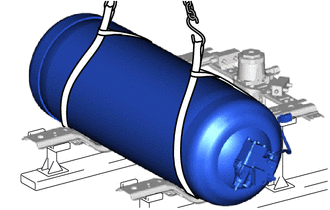
Using an engine sling device and belts, remove the No. 1 hydrogen tank assembly from the front hydrogen tank frame sub-assembly LH and front hydrogen tank frame sub-assembly RH.
CAUTION:
-
When hoisting up the hydrogen tank assembly, do not hoist it when not properly balanced.
-
The hydrogen tank assembly could fall, resulting in a serious accident.
-
-
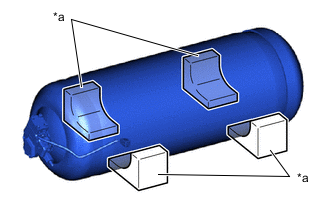
*a Wheel Chocks Place the No. 1 hydrogen tank assembly on wheel chocks or similar.
-
-
REMOVE FRONT CENTER HYDROGEN TANK FRAME
-
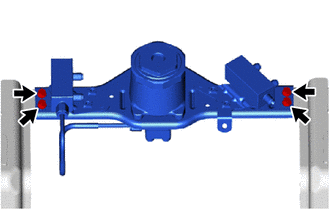
Remove the 4 bolts and front center hydrogen tank frame from the front hydrogen tank frame sub-assembly LH and front hydrogen tank frame sub-assembly RH.
-
-
REMOVE REAR HYDROGEN TANK FRAME SUB-ASSEMBLY
-
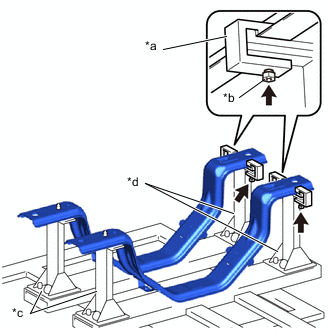
*a SST (Tank Belt Fixture) *b SST (Bolt) *c SST (Support No. 3) *d SST (Support No. 4) Remove the SST (bolts) and each SST (tank belt fixture).
- SST
- 09403-62010 ( 09403-06100, 09403-06110 )
-
Remove the 2 rear hydrogen tank frame sub-assemblies from each tank support type SST.
- SST
- 09403-62010 ( 09403-06030, 09403-06040 )
-
-
REMOVE FRONT HYDROGEN TANK FRAME SUB-ASSEMBLY LH
-
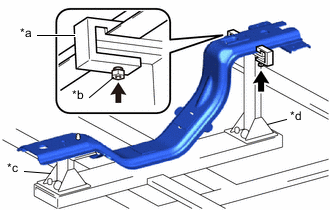
*a SST (Tank Belt Fixture) *b SST (Bolt) *c SST (Support No. 1) *d SST (Support No. 2) Remove the SST (bolts) and each SST (tank belt fixture).
- SST
- 09403-62010 ( 09403-06100, 09403-06110 )
-
Remove the front hydrogen tank frame sub-assembly LH from each tank support type SST.
- SST
- 09403-62010 ( 09403-06010, 09403-06020 )
-
-
REMOVE FRONT HYDROGEN TANK FRAME SUB-ASSEMBLY RH
-
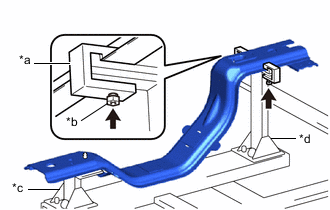
*a SST (Tank Belt Fixture) *b SST (Bolt) *c SST (Support No. 1) *d SST (Support No. 2) Remove the SST (bolts) and each SST (tank belt fixture).
- SST
- 09403-62010 ( 09403-06100, 09403-06110 )
-
Remove the front hydrogen tank frame sub-assembly LH from each tank support type SST.
- SST
- 09403-62010 ( 09403-06010, 09403-06020 )
-
-
REMOVE REAR HYDROGEN TANK FRAME SEAT
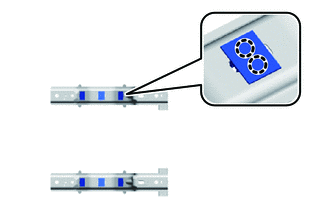
Tech Tips
This procedure is only performed when the rear hydrogen tank frame seat is being replaced.
-
Disengage the 2 claws and remove the rear hydrogen tank frame seat from the rear hydrogen tank frame sub-assembly.
Tech Tips
Use the same procedure to remove the other rear hydrogen tank frame seats.
-
-
REMOVE FRONT HYDROGEN TANK FRAME SEAT
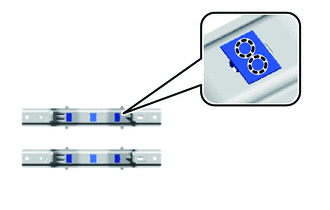
Tech Tips
This procedure is only performed when the front hydrogen tank frame seat is being replaced.
-
Disengage the 2 claws and remove the front hydrogen tank frame seat from the front hydrogen tank frame sub-assembly LH and front hydrogen tank frame sub-assembly RH.
Tech Tips
Use the same procedure to remove the other front hydrogen tank frame seats.
-
-
REMOVE REAR HYDROGEN TANK FRAME SPRING BOLT CUSHION
Tech Tips
This procedure is only performed when the rear hydrogen tank frame spring bolt cushion is being replaced.
-
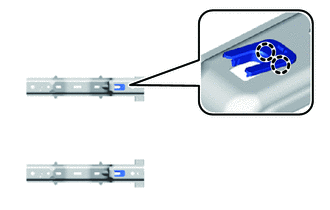
Disengage the 2 claws and remove the rear hydrogen tank frame spring bolt cushion from the rear hydrogen tank frame sub-assembly.
Tech Tips
Use the same procedure to remove the other rear hydrogen tank frame spring bolt cushions.
-
-
REMOVE FRONT HYDROGEN TANK FRAME SPRING BOLT CUSHION
Tech Tips
This procedure is only performed when the front hydrogen tank frame spring bolt cushion is being replaced.
-
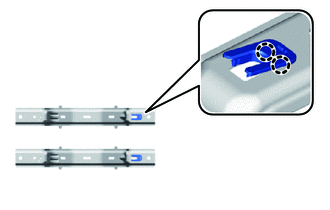
Disengage the 2 claws and remove the front hydrogen tank frame spring bolt cushion from the front hydrogen tank frame sub-assembly LH and front hydrogen tank frame sub-assembly RH.
Tech Tips
Use the same procedure to remove the other front hydrogen tank frame spring bolt cushions.
-