FC BOOST CONTROL SYSTEM, Diagnostic DTC:P1D1D-450
| DTC Code | DTC Name |
|---|---|
| P1D1D-450 | FVH (FC Converter Output Voltage)/Over Voltage |
DESCRIPTION
Refer to high voltage system diagram for the System Description.
The FC converter assembly increases the FC stack voltage up to approximately DC650 V. Then the inverter converts the high-voltage direct current of the FC converter into alternating current and drives the motor.
The FC boost control ECU detects high voltage before boosting (FVL) and high voltage after boosting (FVH) using the voltage sensor, which is located inside the FC converter assembly. The FC boost control ECU controls the operation of the FC converter assembly based on the voltage before and after boosting, and controls the FC stack current and voltage to become the target values.
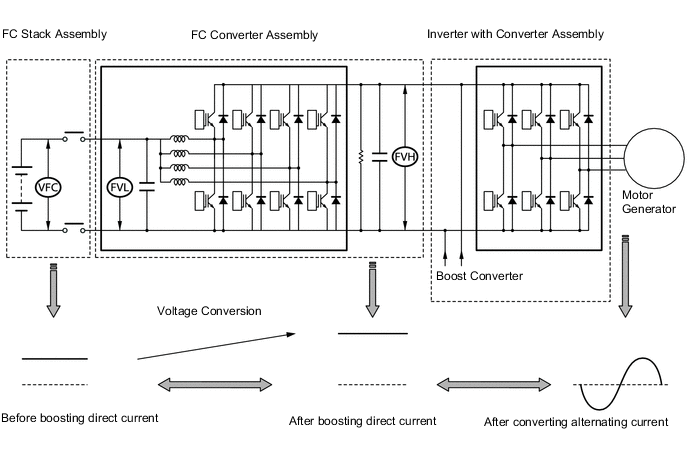
If an over voltage occurs in the motor inverter or FC air compressor motor inverter, the FC boost control ECU detects a malfunction.
| DTC No. | Detection Item | DTC Detection Condition | Trouble Area | Warning Indicate |
|---|---|---|---|---|
| P1D1D-450 | FVH (FC Converter Output Voltage)/Over Voltage | The FC converter output voltage (FVH) is detected to be too high. (Overvoltage) (1 trip detection logic) |
|
Master Warning Light: Comes on |
| DTC No. | Data List |
|---|---|
| P1D1D-450 |
|
Whether there are malfunctions in the system can be determined by checking the above Data List items.
WIRING DIAGRAM
Refer to the wiring diagram for the motor resolver and FC air compressor resolver circuit.
Refer to the wiring diagram for the high-voltage circuit.
Refer to the wiring diagram for the inverter low-voltage circuit.
Refer to the wiring diagram for the FC boost converter low-voltage circuit.
CAUTION / NOTICE / HINT
CAUTION:
-
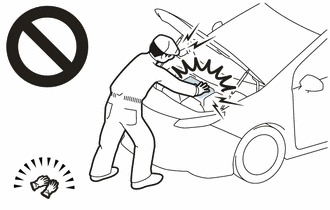
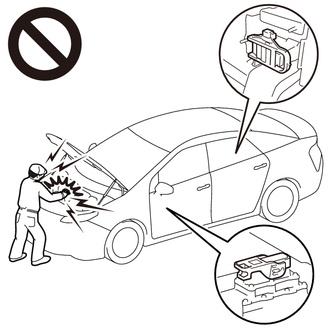
Before the following operations are conducted, take precautions to prevent electric shock by turning the power switch off, wearing insulated gloves, and removing the service plug grips from both FC stack assembly and EV battery.
-
Inspecting the high-voltage system
-
Disconnecting the low voltage connector of the inverter with converter assembly
-
Disconnecting the low voltage connector of the EV battery
-
Disconnecting the low voltage connector of the FC stack assembly
-
Disconnecting the low voltage connector of the FC converter assembly
Tech Tips
No removal order is specified for the service plug grips of the FC stack assembly and EV battery.
-
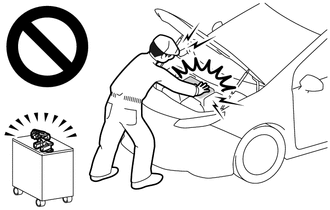
After removing the service plug grip from the EV battery, put it in your pocket to prevent other technicians from accidentally reconnecting it while you are working on the high-voltage system. After removing the service grip from the FC stack assembly, store it in a safe location and use the "HIGH-VOLTAGE, DO NOT TOUCH" sign to notify other technicians that you are working on the high-voltage system.
-
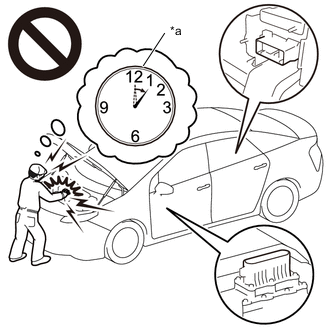
*a Without waiting for 10 minutes After removal of the service plug grips of both FC stack assembly and EV battery, wait for at least 10 minutes before touching the high-voltage connectors and terminals. After waiting for 10 minutes, check the voltage at the terminals in the inspection point in the inverter with converter assembly. The voltage should be 0 V before beginning work.
Tech Tips
At least 10 minutes are necessary to discharge the high-voltage capacitors inside the inverter with converter assembly and FC stack assembly.
Note
-
When reinstalling the service plug grip to the FC stack assembly or the EV battery, slide the lever of the service plug until the letters "UNLOCK" are completely hidden, and insert it firmly.
-
When the vehicle is parked with the power switch off, if the FC control ECU judges that the FC stack temperature will go below 0°C (32°F), it activates the FC air compressor, hydrogen pump and FC cooling water pump for a maximum of 180 seconds and drains water from the FC stack assembly. When performing inspection or repairs with the power switch off (not on (IG) or on (READY)), disconnect the cable from the negative (-) auxiliary battery terminal before performing work (If the auxiliary battery voltage is needed to conduct inspection, warm up the FC system beforehand).
-
After turning the power switch off, waiting time may be required before disconnecting the cable from the negative (-) auxiliary battery terminal. Therefore, make sure to read the disconnecting the cable from the negative (-) auxiliary battery terminal notices before proceeding with work.
Tech Tips
After the repair, clear the DTCs and perform the following procedure to check that DTCs are not output.
-
Drive the vehicle in a city area under the vehicle and driving conditions based on the recorded freeze frame data for approximately 10 minutes.
PROCEDURE
-
CHECK DTC OUTPUT (FCDC)
-
Connect the GTS to the DLC3.
-
Turn the power switch on (IG).
-
Turn the GTS on.
-
Enter the following menus: Powertrain / FCDC / Trouble Codes.
Powertrain > FCDC > Trouble Codes -
Check for DTCs.
Result Result Proceed to "DTC P1D1D-450 only is output" or "DTCs except the ones in the table below are also output" A Any of the following DTCs are also output B Malfunction Content Relevant DTC Microcomputer malfunction P060B-450 Internal Control Module A/D Processing Performance P2511-450 FCDC CPU Circuit Intermittent No Continuity Power source circuit malfunction P1D9F-450 Internal Control Module Voltage (+26V Power Source) P1DBF-450 Internal Control Module Voltage (5V Power Source) Sensor and actuator circuit malfunction P1D1E-450 FC Converter Output Voltage Sensor Circuit Low P1D1F-450 FC Converter Output Voltage Sensor Circuit High P1D23-450 FC Converter Input Voltage Sensor Circuit High P1D31-450 U Phase Reactor Current Sensor Circuit (Offset) P1D32-450 U Phase Reactor Current Sensor Circuit Low P1D33-450 U Phase Reactor Current Sensor Circuit High P1D36-450 V Phase Reactor Current Sensor Circuit (Offset) P1D37-450 V Phase Reactor Current Sensor Circuit Low P1D38-450 V Phase Reactor Current Sensor Circuit High P1D3B-450 W Phase Reactor Current Sensor Circuit (Offset) P1D3C-450 W Phase Reactor Current Sensor Circuit Low P1D3D-450 W Phase Reactor Current Sensor Circuit High P1D41-450 X Phase Reactor Current Sensor Circuit (Offset) P1D42-450 X Phase Reactor Current Sensor Circuit Low P1D43-450 X Phase Reactor Current Sensor Circuit High P1D4C-450 V Phase IGBT Temperature Sensor Circuit Low P1D4F-450 Total Reactor Current/FC Current Correlation P1D62-450 V Phase Reactor Temperature Sensor Circuit Low P1DE0-450 U Phase Output Diode Circuit P1DE1-450 V Phase Output Diode Circuit P1DE2-450 W Phase Output Diode Circuit P1DE3-450 X Phase Output Diode Circuit System malfunction P1D06-450 U Phase IPM Overcurrent P1D07-450 V Phase IPM Overcurrent P1D08-450 W Phase IPM Overcurrent P1D09-450 X Phase IPM Overcurrent P1D0A-450 U Phase IPM Overheat P1D0B-450 V Phase IPM Overheat P1D0C-450 W Phase IPM Overheat P1D0D-450 X Phase IPM Overheat P1D0E-450 FVH (FC Converter Output Voltage)/VH Voltage Correlation P1D0F-450 FVC (Cell Monitor Voltage)/FVL (FC Converter Input Voltage) Correlation P1D10-450 U Phase IPM Circuit P1D13-450 V Phase IPM Circuit P1D16-450 W Phase IPM Circuit P1D19-450 X Phase IPM Circuit P1D20-450 FVL (FC Converter Input Voltage) Low Voltage/Sensor Circuit P1D21-450 FVL (FC Converter Input Voltage)/Low Voltage P1DDA-450 U Phase Reactor Current Degradation P1DDB-450 V Phase Reactor Current Degradation P1DDC-450 W Phase Reactor Current Degradation P1DDD-450 X Phase Reactor Current Degradation Tech Tips
-
DTC P1D1D-450 may be output as a result of the malfunction indicated by the DTCs above.
-
The chart above is listed in inspection order of priority.
-
Check DTCs that are output at the same time by following the listed order. (The main cause of the malfunction can be determined without performing unnecessary inspections.)
-
-
Turn the power switch off.
B 
GO TO DTC CHART (FC BOOST CONTROL SYSTEM) Click here
A 
-
-
CHECK DTC OUTPUT (EV)
-
Connect the GTS to the DLC3.
-
Turn the power switch on (IG).
-
Turn the GTS on.
-
Enter the following menus: Powertrain / EV / Trouble Codes.
Powertrain > EV > Trouble Codes -
Check for DTCs.
Result Result Proceed to "EV related DTCs are not output" or "DTCs except the ones in the table below are output" A Any of the following DTCs are output B Malfunction Content Relevant DTC Microcomputer malfunction P0A1B-168, 192, 193, 198, 661, 786, 794, 795, 796 Drive Motor "A" Control Module P0A1D (all INF codes)*1 EV Control Module P1D8F (all INF codes)*1 FC Air Compressor Motor "A" Control Module Power source circuit malfunction P0A1B-163, 164, 511, 512 Drive Motor "A" Control Module Sensor and actuator circuit malfunction P0A3F-243 Drive Motor "A" Position Sensor Circuit P0A40-500 Drive Motor "A" Position Sensor Circuit Range / Performance P0A41-245 Drive Motor "A" Position Sensor Circuit Low P1D75-450 FC Air Compressor Motor "A" Position Sensor Circuit P1D76-450 FC Air Compressor Motor "A" Position Sensor Circuit Range/Performance P1D77-450 FC Air Compressor Motor "A" Position Sensor Circuit Low P0A60 (all INF codes)*1 Drive Motor "A" Phase V Current P0A63 (all INF codes)*1 Drive Motor "A" Phase W Current P1D80 (all INF codes)*1 FC Air Compressor Motor "A" Phase V Current P1D81 (all INF codes)*1 FC Air Compressor Motor "A" Phase W Current P0A93-346 Inverter Cooling System Performance P0C73-776 Motor Electronics Coolant Pump "A" Control Performance P314A-828 Inverter Coolant Pump Speed Signal System malfunction P0ADB-227 Battery Positive Contactor Control Circuit Low P0ADC-226 Battery Positive Contactor Control Circuit High P0ADF-229 Battery Negative Contactor Control Circuit Low P0AE0-228 Battery Negative Contactor Control Circuit High P3004-803 High Voltage Power Resource P0A78-113, 128, 266, 267, 279, 284, 286, 287, 306, 503, 504, 505, 506, 586, 806, 807, 808 Drive Motor "A" Inverter Performance P1D82-459, 460, 461, 462, 463, 464, 465, 466, 467, 468, 469 FC Air Compressor Motor Inverter Circuit P0A90-509 Drive Motor "A" Performance P1D7F-472 FC Air Compressor Motor Speed Control Performance P0A94-172, 442, 547, 548, 549, 553, 554, 555, 556, 557, 585, 587, 589, 590 Boosting Converter Performance P0C76-523 EV Battery System Discharge Time Too Long P1E0D-450 FC Converter Fail Signal Circuit High Tech Tips
-
*1: If any INF codes are output for this DTC, refer to the corresponding diagnostic procedure.
-
DTC P1D1D-450 may be output as a result of the malfunction indicated by the DTCs above.
-
The chart above is listed in inspection order of priority.
-
Check DTCs that are output at the same time by following the listed order. (The main cause of the malfunction can be determined without performing unnecessary inspections.)
-
-
Turn the power switch off.
B
GO TO DTC CHART (HYBRID CONTROL SYSTEM) Click here
A
-
-
CHECK CONNECTOR CONNECTION CONDITION (INVERTER WITH CONVERTER ASSEMBLY CONNECTOR)
Result Result Proceed to OK A NG (The connector is not connected securely) B NG (The terminals are not making secure contact or are deformed, or water or foreign matter exists in the connector) C CAUTION:
Be sure to wear insulated gloves.
-
Check that the service plug grip is not installed to FC stack assembly and EV battery.
Note
After removing the service plug grip, do not turn the power switch on (READY), unless instructed by the repair manual because this may cause a malfunction.
-
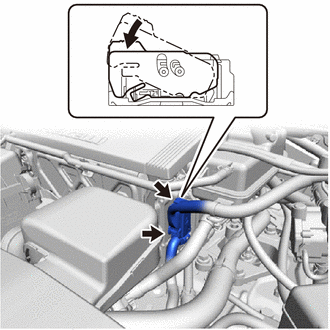
Check the connection condition of the low voltage connector of the inverter with converter assembly and the contact pressure of each terminal. Check the terminals for deformation, and check the connector for water ingress and foreign matter.
Note
Before disconnecting the connector, confirm that it is properly connected by checking that the locking claws are engaged and that the connector does not pull out.
OK - The connector is connected securely. - The terminals are not deformed and are connected securely. - No water or foreign matter in the connector. Result Result Proceed to OK A NG (The connector is not connected securely.) B NG (The terminals are not making secure contact or are deformed, or water or foreign matter exists in the connector.) C
B
CONNECT SECURELY
C
REPAIR OR REPLACE HARNESS OR CONNECTOR
A
-
-
CHECK FC AIR COMPRESSOR MOTOR RESOLVER
Tech Tips
If the "FC Air Compressor Resolver Circuit" inspection results are normal, perform the next step.
Result Proceed to NEXT
NEXT
-
CHECK MOTOR RESOLVER CIRCUIT
Tech Tips
If the "Motor Resolver Circuit" inspection results are normal, perform the next step.
Result Proceed to NEXT
NEXT
-
CHECK FC AIR COMPRESSOR HIGH-VOLTAGE CIRCUIT
Tech Tips
If the "FC Air Compressor High-voltage Circuit" inspection results are normal, perform the next step.
Result Proceed to NEXT
NEXT
-
CHECK MOTOR HIGH-VOLTAGE CIRCUIT
Tech Tips
If the "Motor High-voltage Circuit" inspection results are normal, perform the next step.
Result Proceed to NEXT
NEXT
-
CHECK EV BATTERY HIGH-VOLTAGE LINE CIRCUIT
Tech Tips
If the "EV Battery High-voltage Line Circuit" inspection results are normal, perform the next step.
Result Proceed to NEXT
NEXT
-
CHECK INVERTER LOW-VOLTAGE CIRCUIT
Tech Tips
If the "Inverter Low-voltage Circuit" inspection results are normal, perform the next step.
Result Proceed to NEXT
NEXT
-
CHECK CONNECTOR CONNECTION CONDITION (FC CONVERTER ASSEMBLY CONNECTOR)
Result Result Proceed to OK A NG (The connector is not connected securely) B NG (The terminals are not making secure contact or are deformed, or water or foreign matter exists in the connector) C CAUTION:
Be sure to wear insulated gloves.
-
Check that the service plug grip is not installed to FC stack assembly and EV battery.
Note
After removing the service plug grip, do not turn the power switch on (READY), unless instructed by the repair manual because this may cause a malfunction.
-
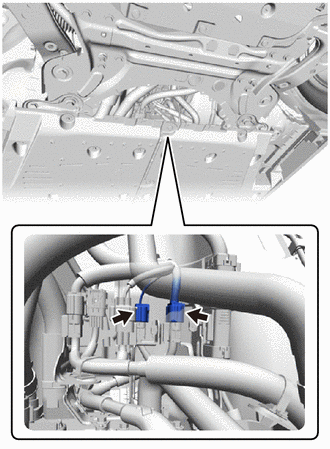
Check the connection condition of the FC converter assembly connector and the contact pressure of each terminal. Check the terminals for deformation, and check the connector for water ingress and foreign matter.
Note
Before disconnecting the connector, confirm that it is properly connected by checking that the locking claws are engaged and that the connector does not pull out.
OK - The connector is connected securely. - The terminals are not deformed and are connected securely. - No water or foreign matter in the connector. Result Result Proceed to OK A NG (The connector is not connected securely) B NG (The terminals are not making secure contact or are deformed, or water or foreign matter exists in the connector) C
B
CONNECT SECURELY
C
REPAIR OR REPLACE HARNESS OR CONNECTOR
A
-
-
CHECK FC STACK SERVICE PLUG GRIP (CONNECTION CONDITION)
CAUTION:
Be sure to wear insulated gloves.
-
Visually check the connection of the FC stack service plug grip to the FC stack assembly. Remove the FC stack service plug grip and check for contamination.
OK Dirt or foreign matter has not entered the connectors, and there is no evidence of contamination. Result Proceed to OK NG
NG
REPLACE FC STACK SERVICE PLUG GRIP Click here
OK
-
-
INSPECT FC STACK SERVICE PLUG GRIP
Result Proceed to OK NG
NG
REPLACE FC STACK SERVICE PLUG GRIP Click here
OK
-
CHECK INVERTER WITH CONVERTER ASSEMBLY (FC CONVERTER POWER OUTLET CABLE CONNECTION CONDITION)
Result Result Proceed to The terminals are connected securely and there are no contact problems There are no arc marks A The terminals are not connected securely and there is a contact problem There are arc marks B The terminals are connected securely and there are no contact problems There are arc marks The terminals are not connected securely and there is a contact problem There are no arc marks C CAUTION:
Be sure to wear insulated gloves.
-
Check that the service plug grip is not installed to FC stack assembly and EV battery.
Note
After removing the service plug grip, do not turn the power switch on (READY), unless instructed by the repair manual because this may cause a malfunction.
-
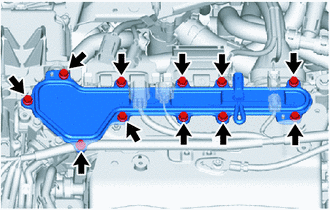
Remove the inverter terminal cover from the inverter with converter assembly.
Tech Tips
Make sure that no foreign matter, coolant or water has entered the inverter assembly with converter.
Confirm that the inverter coolant volume has not increased.
-
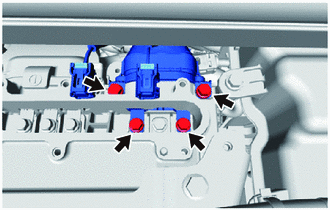
Check that the bolts for the FC converter power outlet cable are tightened to the specified torque, the FC converter power outlet cable is connected securely, and there are no contact problems.
Specified Condition T = 8.0 N*m (82 kgf*cm, 71 in.*lbf) -
Disconnect the FC converter power outlet cable from the inverter with converter assembly.
-
Check for arc marks at the terminals for the FC converter power outlet cable.
Result Result Proceed to The terminals are connected securely and there are no contact problems There are no arc marks A The terminals are not connected securely and there is a contact problem There are arc marks B The terminals are connected securely and there are no contact problems There are arc marks The terminals are not connected securely and there is a contact problem There are no arc marks C -
Reconnect the FC converter power outlet cable to the inverter with converter assembly.
-
Install the inverter terminal cover to the inverter with converter assembly.
B
REPLACE MALFUNCTIONING PARTS
C
CONNECT SECURELY
A
-
-
CHECK FC CONVERTER ASSEMBLY (FC CONVERTER POWER OUTLET CABLE CONNECTION CONDITION)
Result Result Proceed to The terminals are connected securely and there are no contact problems There are no arc marks A The terminals are not connected securely and there is a contact problem There are arc marks B The terminals are connected securely and there are no contact problems There are arc marks The terminals are not connected securely and there is a contact problem There are no arc marks C CAUTION:
Be sure to wear insulated gloves.
-
Check that the service plug grip is not installed to FC stack assembly and EV battery.
Note
After removing the service plug grip, do not turn the power switch on (READY), unless instructed by the repair manual because this may cause a malfunction.
-
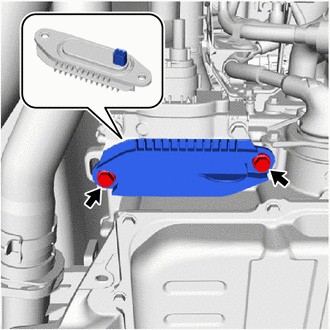
Remove the front FC converter service hole cover from the FC converter assembly.
-
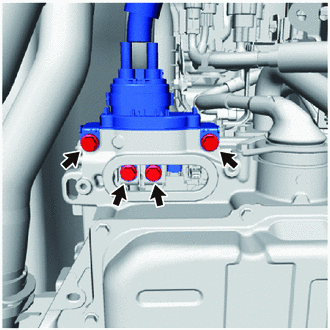
Check that the bolts for the FC converter power outlet cable are tightened to the specified torque, the FC converter power outlet cable is connected securely, and there are no contact problems.
Specified Condition T = 8.0 N*m (82 kgf*cm, 71 in.*lbf) -
Disconnect the FC converter power outlet cable from the FC converter assembly.
-
Check for arc marks at the terminals for the FC converter power outlet cable.
Result Result Proceed to The terminals are connected securely and there are no contact problems There are no arc marks A The terminals are not connected securely and there is a contact problem There are arc marks B The terminals are connected securely and there are no contact problems There are arc marks The terminals are not connected securely and there is a contact problem There are no arc marks C -
Reconnect the FC converter power outlet cable to the FC converter assembly.
-
Install the front FC converter service hole cover to the FC converter assembly.
B
REPLACE MALFUNCTIONING PARTS
C
CONNECT SECURELY
A
-
-
INSPECT FC CONVERTER POWER OUTLET CABLE
Result Proceed to OK NG CAUTION:
Be sure to wear insulated gloves.
-
Check that the service plug grip is not installed to FC stack assembly and EV battery.
Note
After removing the service plug grip, do not turn the power switch on (READY), unless instructed by the repair manual because this may cause a malfunction.
-
Remove the inverter terminal cover from the inverter with converter assembly.
-
Disconnect the FC converter power outlet cable from the inverter with converter assembly.
-
Remove the front FC converter service hole cover from the FC converter assembly.
-
Disconnect the FC converter power outlet cable from the FC converter assembly.
-
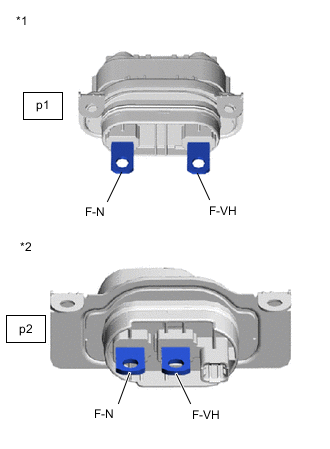
*1 FC Converter Power Outlet Cable
(Inverter with Converter Assembly Side Connector)
*2 FC Converter Power Outlet Cable
(FC Converter Assembly Side Connector)
Measure the resistance according to the value(s) in the table below.
Standard Resistance Tester Connection Switch Condition Specified Condition p1-1 (F-N) - p2-1 (F-N) Power switch off Below 1 Ω p1-2 (F-VH) - p2-2 (F-VH) Power switch off Below 1 Ω Result Proceed to OK NG -
Reconnect the FC converter power outlet cable.
-
Install the front FC converter service hole cover to the FC converter assembly.
-
Install the inverter terminal cover to the inverter with converter assembly.
NG
REPLACE FC CONVERTER POWER OUTLET CABLE Click here
OK
-
-
REPLACE INVERTER WITH CONVERTER ASSEMBLY
Result Proceed to NEXT
NEXT
-
CLEAR DTC
-
Connect the GTS to the DLC3.
-
Turn the power switch on (IG).
-
Turn the GTS on.
-
Enter the following menus: Powertrain / FCDC / Trouble Codes.
Powertrain > FCDC > Clear DTCs -
Clear the DTCs.
Result Proceed to NEXT -
Turn the power switch off and wait for 3 minutes or more.
NEXT
-
-
CHECK DTC OUTPUT (FCDC)
-
Turn the power switch on (READY).
-
Drive the vehicle in a city area under the vehicle and driving conditions based on the recorded freeze frame data for approximately 10 minutes.
CAUTION:
When performing the confirmation driving pattern, obey all speed limits and traffic laws.
-
Connect the GTS to the DLC3.
-
Turn the power switch on (IG).
-
Turn the GTS on.
-
Enter the following menus: Powertrain / FCDC / Trouble Codes.
Powertrain > FCDC > Trouble Codes -
Check for DTCs.
Result Result Proceed to DTC P1D1D-450 is output A DTCs are not output B -
Turn the power switch off.
A
REPLACE FC CONVERTER ASSEMBLY Click here
B
END
-