SFI SYSTEM(w/ Canister Pump Module), Diagnostic DTC:P042000
| DTC Code | DTC Name |
|---|---|
| P042000 | Catalyst System Efficiency Below Threshold Bank 1 |
MONITOR DESCRIPTION
The ECM uses sensors mounted in front of and behind the Three-Way Catalytic Converter (TWC) to monitor its efficiency.
The first sensor, the air fuel ratio sensor, sends pre-catalyst information to the ECM. The second sensor, the heated oxygen sensor, sends post-catalyst information to the ECM.
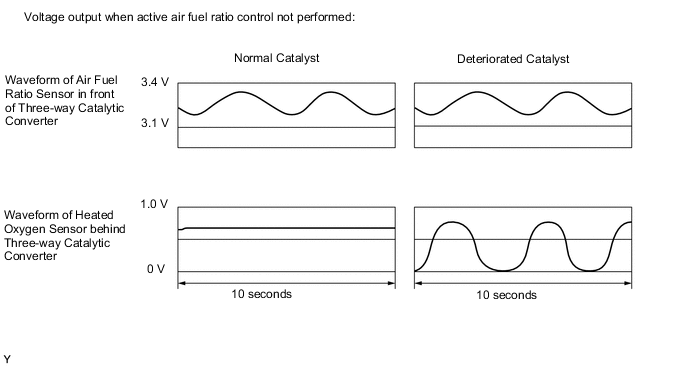
In order to detect any deterioration in the three-way catalytic converter, the ECM calculates the oxygen storage capacity of the three-way catalytic converter. This calculation is based on the voltage output of the heated oxygen sensor while performing active air fuel ratio control.
The oxygen storage capacity value is an indication of the oxygen storage capacity of the three-way catalytic converter. When the vehicle is being driven with a warm engine, active air fuel ratio control is performed for approximately 30 seconds. When it is performed, the ECM deliberately sets the air fuel ratio to lean or rich levels. If the cycle of the waveform for the heated oxygen sensor is long, the oxygen storage capacity is great. There is a direct correlation between the heated oxygen sensor and the oxygen storage capacity of the three-way catalytic converter.
The ECM uses the oxygen storage capacity value to determine the state of the three-way catalytic converter. If any deterioration has occurred, the ECM illuminates the MIL and stored the DTC.
This system determines the deterioration of the entire catalyst system (including the front and rear catalysts), by using the oxygen storage capacity value of the front catalyst, that is more sensitive than the rear catalyst, as the representative value. Therefore, be sure to replace the front and rear catalysts together when catalyst replacement is necessary.
| DTC No. | Detection Item | DTC Detection Condition | Trouble Area | MIL | Memory | Note |
|---|---|---|---|---|---|---|
| P042000 | Catalyst System Efficiency Below Threshold Bank 1 | The oxygen storage capacity value is less than the standard value under active air fuel ratio control (1 trip detection logic). |
|
Comes on | DTC stored | SAE: P0420 |
CATALYST LOCATION
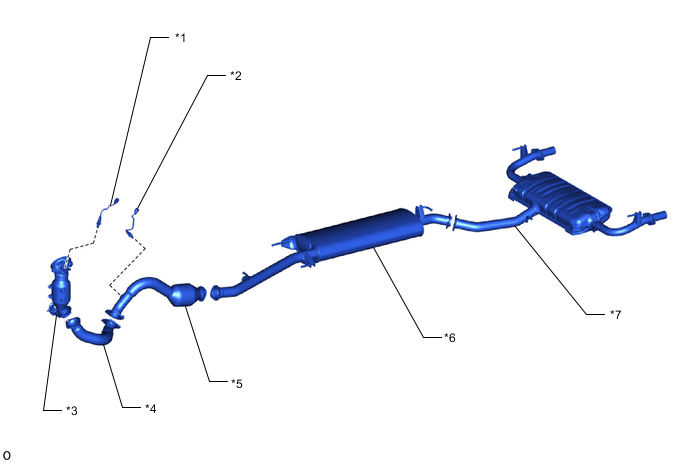
| *1 | Air Fuel Ratio Sensor (Sensor 1) | *2 | Heated Oxygen Sensor (Sensor 2) |
| *3 | Exhaust Manifold Converter Sub-assembly (TWC: Front Catalyst) |
*4 | Front Exhaust Pipe Sub-assembly |
| *5 | Front No. 2 Exhaust Pipe Sub-assembly (TWC: Rear Catalyst) |
*6 | Center Exhaust Pipe Assembly |
| *7 | Tail Exhaust Pipe Assembly | - | - |
Note
Replace the exhaust manifold converter sub-assembly (*3) and the front No. 2 exhaust pipe sub-assembly (*5) together when catalyst replacement is necessary. (Excluding air fuel ratio sensor *1 and heated oxygen sensor *2)
MONITOR STRATEGY
| Required Sensors/Components (Main) | Air fuel ratio sensor Heated oxygen sensor |
| Required Sensors/Components (Related) | Intake air temperature sensor (Built into mass air flow meter sub-assembly) Mass air flow meter sub-assembly Crankshaft position sensor Engine coolant temperature sensor |
| Frequency of Operation | Once per driving cycle |
TYPICAL ENABLING CONDITIONS
| Battery voltage | 11 V or higher |
| Intake air temperature (for mass air flow meter sub-assembly) | -10°C (14°F) or higher |
| Engine coolant temperature | 75°C (167°F) or higher |
| Atmospheric pressure | 76 kPa(abs) [11.02 psi(abs)] or higher |
| Idling | Off |
| Engine speed | Less than 3200 rpm |
| Air fuel ratio sensor status | Activated |
| Fuel system status | Closed loop |
| Engine load | 10% or higher, and less than 140% |
| Shift position | 4th or higher |
| All of the following conditions are met | - |
| Mass air flow rate | 4.0 to 25 gm/sec. |
| Front catalyst temperature (estimated) | 520°C (968°F) to 800°C (1472°F) |
| Rear catalyst temperature (estimated) | 250°C (572°F) to 700°C (1292°F) |
CONFIRMATION DRIVING PATTERN
Tech Tips
-
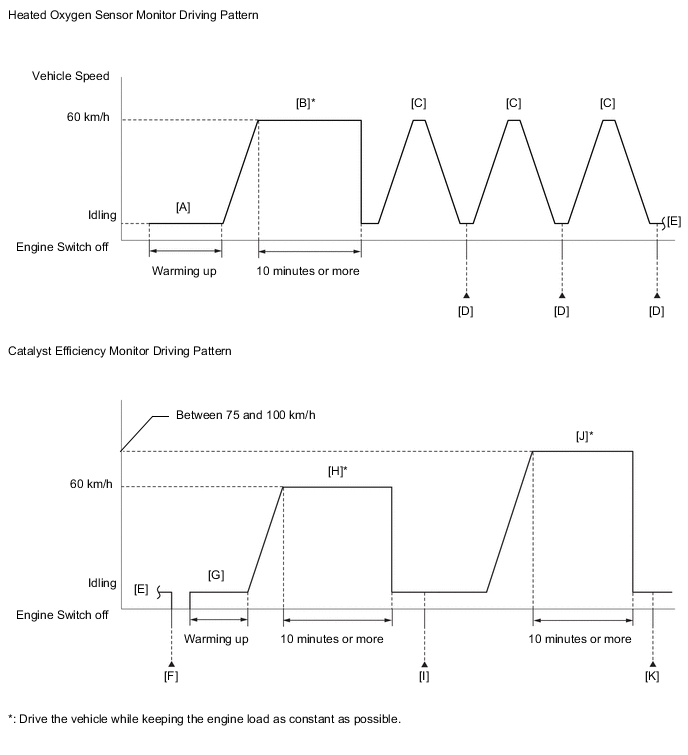
It is necessary that the response of the heated oxygen sensor is normal in order to confirm DTC P042000. Therefore, perform the driving pattern for the heated oxygen sensor monitor before performing the drive pattern for the catalyst efficiency monitor.
-
Performing this confirmation driving pattern will activate the catalyst efficiency monitor. This is very useful for verifying the completion of a repair.
-
Connect the GTS to the DLC3.
-
Turn the engine switch on (IG).
-
Turn the GTS on.
-
Clear the DTCs (even if no DTCs are stored, perform the clear DTC procedure).
-
Turn the engine switch off and wait for at least 30 seconds.
-
Turn the engine switch on (IG) and turn the GTS on.
-
Start the engine and warm it up until the engine coolant temperature is 75°C (167°F) or higher [A].
-
Drive the vehicle at approximately 60 km/h (37 mph) for 10 minutes or more [B].
CAUTION:
When performing the confirmation driving pattern, obey all speed limits and traffic laws.
Tech Tips
Drive the vehicle while keeping the engine load as constant as possible.
-
With the shift lever in M, drive the vehicle at 60 km/h (37 mph), and then decelerate the vehicle by releasing the accelerator pedal for 5 seconds or more to perform the fuel-cut [C].
CAUTION:
When performing the confirmation driving pattern, obey all speed limits and traffic laws.
-
Turn the engine switch off and wait for at least 30 seconds [F].
-
Turn the engine switch on (IG) and turn the GTS on.
-
Start the engine and warm it up until the engine coolant temperature is 75°C (167°F) or higher [G].
-
Drive the vehicle at approximately 60 km/h (37 mph) for 10 minutes or more [H].
CAUTION:
When performing the confirmation driving pattern, obey all speed limits and traffic laws.
Tech Tips
Drive the vehicle while keeping the engine load as constant as possible.
-
Enter the following menus: Powertrain / Engine / Trouble Codes [I].
-
Check if any DTCs are stored.
-
Drive the vehicle at a speed between 75 and 100 km/h (47 and 62 mph) for 10 minutes or more [J].
CAUTION:
When performing the confirmation driving pattern, obey all speed limits and traffic laws.
Tech Tips
Drive the vehicle while keeping the engine load as constant as possible.
-
Enter the following menus: Powertrain / Engine / Trouble Codes [K].
-
Check if any DTCs are stored.
CONDITIONING FOR SENSOR TESTING
Tech Tips
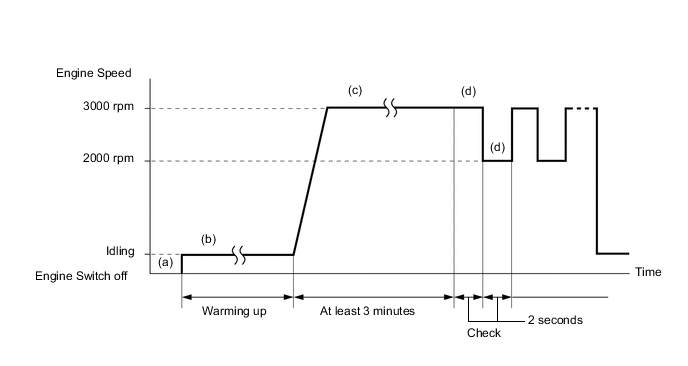
Perform the operation with the engine speeds and time durations described below prior to checking the waveforms of the air fuel ratio and heated oxygen sensors. This is to activate the sensors sufficiently to obtain appropriate inspection results.
-
(a) Connect the GTS to the DLC3.
-
(b) Start the engine and warm it up with all the accessories switched off until the engine coolant temperature stabilizes.
-
(c) Run the engine at an engine speed of between 2500 rpm and 3000 rpm for at least 3 minutes.
-
(d) While running the engine at 3000 rpm for 2 seconds, and then 2000 rpm for 2 seconds, check the waveforms of the air fuel ratio and heated oxygen sensors using the GTS.
Tech Tips
-
If the voltage output of either the air fuel ratio or heated oxygen sensor does not fluctuate, or there is a noise in the waveform of either sensor, the sensor may be malfunctioning.
-
If the voltage outputs of both the sensors remain lean or rich, the air fuel ratio may be extremely lean or rich. In such cases, perform the Control the Injection Volume Active Test using the GTS.
-
If the Three-way Catalytic Converter (TWC) has deteriorated, the heated oxygen sensor (located behind the Three-way Catalytic Converter [TWC]) voltage output fluctuates up and down frequently, even under normal driving conditions (active air fuel ratio control is not performed).
CAUTION / NOTICE / HINT
Tech Tips
-
If a malfunction cannot be found when troubleshooting DTC P042000, a lean or rich abnormality may be the cause. Perform troubleshooting by following the procedure for P017100 (System Too Lean) and P017200 (System Too Rich).
-
Sensor 1 refers to the sensor closest to the engine assembly.
-
Sensor 2 refers to the sensor farthest away from the engine assembly.
-
Read freeze frame data using the GTS. The ECM records vehicle and driving condition information as freeze frame data the moment a DTC is stored. When troubleshooting, freeze frame data can help determine if the vehicle was moving or stationary, if the engine was warmed up or not, if the air fuel ratio was lean or rich, and other data from the time the malfunction occurred.
PROCEDURE
-
CHECK ANY OTHER DTCS OUTPUT (IN ADDITION TO DTC P042000)
-
Connect the GTS to the DLC3.
-
Turn the engine switch on (IG).
-
Turn the GTS on.
-
Enter the following menus: Powertrain / Engine / Trouble Codes.
-
Read the DTCs.
Powertrain > Engine > Trouble CodesResult Result Proceed to DTC P042000 is output A DTC P042000 and other DTCs are output B Tech Tips
If any DTCs other than P042000 are output, troubleshoot those DTCs first.
B 
GO TO DTC CHART Click here
A 
-
-
PERFORM ACTIVE TEST USING GTS (CONTROL THE INJECTION VOLUME FOR A/F SENSOR)
-
Connect the GTS to the DLC3.
-
Start the engine and warm it up.
-
Turn the GTS on.
-
Run the engine at an engine speed of 2500 rpm for approximately 90 seconds.
-
Enter the following menus: Powertrain / Engine / Active Test / Control the Injection Volume for A/F Sensor / Data List / A/F (O2) Sensor Voltage B1S1 and O2 Sensor Voltage B1S2.
Powertrain > Engine > Active TestActive Test Display Control the Injection Volume for A/F Sensor Data List Display A/F (O2) Sensor Voltage B1S1 O2 Sensor Voltage B1S2 -
Perform the Active Test operation with the engine idling (press the RIGHT or LEFT button to change the fuel injection volume).
-
Monitor the voltage outputs of the air fuel ratio sensor and heated oxygen sensor (A/F (O2) Sensor Voltage B1S1 and O2 Sensor Voltage B1S2) displayed on the GTS.
Tech Tips
-
Change the fuel injection volume within the range of -12.5% and +12.5%.
-
Each sensor reacts in accordance with increases and decreases in the fuel injection volume.
-
The air fuel ratio sensor has an output delay of a few seconds and the heated oxygen sensor has a maximum output delay of approximately 20 seconds.
-
If the sensor output voltage does not change (almost no reaction) while performing the Active Test, the sensor may be malfunctioning.
Standard GTS Display
(Sensor)
Injection Volume Status Voltage A/F (O2) Sensor Voltage B1S1
(Air fuel ratio)
+12.5% Rich Below 3.1 V -12.5% Lean Higher than 3.4 V O2 Sensor Voltage B1S2
(Heated oxygen)
+12.5% Rich Higher than 0.55 V -12.5% Lean Below 0.4 V Result Status A/F (O2) Sensor Voltage B1S1 Status O2 Sensor Voltage B1S2 Actual air fuel ratio, air fuel ratio sensor and heated oxygen sensor condition Main Suspected Trouble Area Proceed to Lean/Rich Lean/Rich Normal
-
Three-way catalytic converter
-
Gas leak from exhaust system
A Lean Lean/Rich Air fuel ratio sensor malfunction
-
Air fuel ratio sensor
B Rich Lean/Rich Air fuel ratio sensor malfunction
-
Air fuel ratio sensor
Lean/Rich Lean Heated oxygen sensor malfunction
-
Heated oxygen sensor
-
Gas leak from exhaust system
C Lean/Rich Rich Heated oxygen sensor malfunction
-
Heated oxygen sensor
-
Gas leak from exhaust system
Lean Lean Actual air fuel ratio lean
-
Extremely rich or lean actual air fuel ratio
-
Gas leak from exhaust system
D Rich Rich Actual air fuel ratio rich
-
Extremely rich or lean actual air fuel ratio
-
Gas leak from exhaust system
Lean: During Control the Injection Volume, the air fuel ratio sensor output voltage (A/F (O2) Sensor Voltage B1S1) is consistently higher than 3.4 V, and the heated oxygen sensor output voltage (O2 Sensor Voltage B1S2) is consistently below 0.4 V.
Rich: During Control the Injection Volume, the A/F (O2) Sensor Voltage B1S1 is consistently below 3.1 V, and the O2 Sensor Voltage B1S2 is consistently higher than 0.55 V.
Lean/Rich: During Control the Injection Volume of the Active Test, the output voltage of the air fuel ratio sensor and heated oxygen sensor alternate correctly.
-
B 
REPLACE AIR FUEL RATIO SENSOR Click here
C
CHECK FOR EXHAUST GAS LEAK Click here
D
CHECK FOR EXHAUST GAS LEAK Click here
A
-
-
CHECK FOR EXHAUST GAS LEAK
-
Check for exhaust gas leaks.
OK No gas leaks. Result Proceed to OK NG
NG
REPAIR OR REPLACE EXHAUST GAS LEAK POINT Click here
OK
-
-
REPLACE EXHAUST MANIFOLD CONVERTER SUB-ASSEMBLY (TWC: FRONT CATALYST) AND FRONT NO. 2 EXHAUST PIPE SUB-ASSEMBLY (TWC: REAR CATALYST)
Note
Replace the exhaust manifold converter sub-assembly (TWC: Front catalyst) and the front No. 2 exhaust pipe sub-assembly (TWC: Rear catalyst) together when catalyst replacement is necessary.
Tech Tips
Confirm the replacement parts, referring to the illustration in the Catalyst Location.
-
Replace the exhaust manifold converter sub-assembly (TWC: Front catalyst).
-
Replace the front No. 2 exhaust pipe sub-assembly (TWC: Rear catalyst).
Result Proceed to NEXT
NEXT
END
-
-
REPAIR OR REPLACE EXHAUST GAS LEAK POINT
-
Repair or replace exhaust gas leak point.
Tech Tips
Perform "Inspection After Repair" after repairing or replacing the exhaust system.
Result Proceed to NEXT
NEXT
-
-
CHECK WHETHER DTC OUTPUT RECURS (DTC P042000)
-
Connect the GTS to the DLC3.
-
Turn the engine switch on (IG).
-
Turn the GTS on.
-
Clear the DTCs.
Powertrain > Engine > Clear DTCs -
Turn the engine switch off and wait for at least 30 seconds.
-
Turn the engine switch on (IG).
-
Turn the GTS on.
-
Start the engine.
-
Drive the vehicle in accordance with the driving pattern described in Confirmation Driving Pattern.
-
Enter the following menus: Powertrain / Engine / Trouble Codes.
-
Read the DTCs.
Powertrain > Engine > Trouble CodesResult Result Proceed to DTC P042000 is output A DTC is not output
(No pending DTCs output)
B
B
END
A
-
-
REPLACE EXHAUST MANIFOLD CONVERTER SUB-ASSEMBLY (TWC: FRONT CATALYST) AND FRONT NO. 2 EXHAUST PIPE SUB-ASSEMBLY (TWC: REAR CATALYST)
Note
Replace the exhaust manifold converter sub-assembly (TWC: Front catalyst) and the front No. 2 exhaust pipe sub-assembly (TWC: Rear catalyst) together when catalyst replacement is necessary.
Tech Tips
Confirm the replacement parts, referring to the illustration in the Catalyst Location.
-
Replace the exhaust manifold converter sub-assembly (TWC: Front catalyst).
-
Replace the front No. 2 exhaust pipe sub-assembly (TWC: Rear catalyst).
Result Proceed to NEXT
NEXT
END
-
-
REPLACE AIR FUEL RATIO SENSOR
-
Replace the air fuel ratio sensor.
Result Proceed to NEXT
NEXT
GO TO STEP 6 Click here
-
-
CHECK FOR EXHAUST GAS LEAK
-
Check for exhaust gas leaks.
OK No gas leaks. Result Proceed to OK NG
NG
GO TO STEP 5 Click here
OK
-
-
REPLACE HEATED OXYGEN SENSOR
-
Replace the heated oxygen sensor.
Result Proceed to NEXT
NEXT
GO TO STEP 6 Click here
-
-
CHECK FOR EXHAUST GAS LEAK
-
Check the exhaust gas leaks.
OK No gas leaks. Result Proceed to OK NG
NG
GO TO STEP 5 Click here
OK
-
-
CHECK CAUSE OF EXTREMELY RICH OR LEAN ACTUAL AIR FUEL RATIO
-
Check the cause of extremely rich or lean actual air fuel ratio, referring to the DTC P017100 Procedure.
Result Proceed to NEXT
NEXT
GO TO STEP 6 Click here
-