ELECTRONICALLY CONTROLLED BRAKE SYSTEM, Diagnostic DTC:C1202/68
| DTC Code | DTC Name |
|---|---|
| C1202/68 | Master Reservoir Level Malfunction |
DESCRIPTION
When a fluid level drop in the master cylinder reservoir is detected, the signal is input to the skid control ECU.
If the DTC for the fluid level drop is memorized, the warning will be canceled and the DTC will not be stored when the fluid level returns to normal.
| DTC Code | INF Code | DTC Detection Condition | Trouble Area |
|---|---|---|---|
| C1202/68 | 371 | An open is detected in the switch signal circuit for 2 seconds or more. |
|
| ↑ | - | The reservoir level remains low. |
|
WIRING DIAGRAM

CAUTION / NOTICE / HINT
Note
When replacing the brake booster with master cylinder (skid control ECU), perform initialization and calibration of the linear solenoid valve Click here.
Tech Tips
When releasing the parking brake, chock the wheels for safety.
PROCEDURE
-
CHECK BRAKE FLUID LEVEL
-
Check that the brake fluid level is sufficient.
OK Brake fluid level is sufficient. Tech Tips
If the fluid level is low, check for fluid leaks, and repair as necessary.
-
Check for brake fluid leaks (Connection between the brake booster pump, brake master cylinder reservoir and brake booster with master cylinder, and the brake booster with master cylinder and wheel cylinders).
Tech Tips
If no leaks exist, add and adjust fluid using the intelligent tester Click here.
-
Check that the trouble code is not output again Click here.
-
-
Check that there are no leaks from the connections between the brake booster pump and brake booster with master cylinder.
Tech Tips
As a visual check is very difficult, perform the check with the following procedure.
-
Bleed the air from the brake systems Click here.
-
Connect the intelligent tester to the DLC3.
-
Turn the power switch on (IG).
-
Select the Data List on the intelligent tester Click here.
ABS/VSC/TRC Tester Display Measurement Item/Range Normal Condition Diagnostic Note Accumulator Sensor Accumulator pressure sensor / Min.: 0 V, Max.: 5 V Specified value: 2.9 to 4.2 V When brake fluid is stored in the accumulator: Accumulator pressure changes in accordance with volume of fluid stored in the accumulator -
Wait for 30 seconds without depressing the brake pedal.
-
Check that the accumulator pressure sensor output values change is within the specified range.
OK Accumulator pressure sensor output values change is within 0.55 V.
-
NG 
CHECK AND REPAIR BRAKE FLUID LEAKS OR ADD FLUID
OK 
-
-
INSPECT BRAKE FLUID LEVEL WARNING SWITCH
-
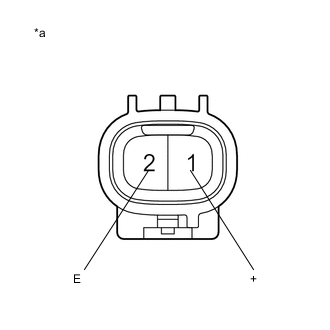
Text in Illustration *a Component without harness connected
(Brake Fluid Level Warning Switch)
Turn the power switch off.
-
Remove the reservoir filler cap and strainer.
-
Make sure that there is no looseness at the locking part and the connecting part of the connector.
-
Disconnect the brake fluid level warning switch connector.
-
Measure the resistance according to the value(s) in the table below.
Tech Tips
A float is located inside the reservoir. Its position changes according to the level of brake fluid.
Standard Resistance Tester Connection Switch Condition Specified Condition 1 (+) - 2 (E) Brake fluid level warning switch OFF (Float up) 1.84 to 2.16 kΩ 1 (+) - 2 (E) Brake fluid level warning switch ON (Float down) Below 1 Ω Result Result Proceed to OK A NG (for LHD) B NG (for RHD) C
B
REPLACE BRAKE MASTER CYLINDER RESERVOIR (BRAKE FLUID LEVEL WARNING SWITCH) Click here
C
REPLACE BRAKE MASTER CYLINDER RESERVOIR (BRAKE FLUID LEVEL WARNING SWITCH) Click here
A
-
-
CHECK HARNESS AND CONNECTOR (SKID CONTROL ECU - BRAKE FLUID LEVEL WARNING SWITCH)
-
Make sure that there is no looseness at the locking part and the connecting part of the connector.
-
Disconnect the skid control ECU connector.
-
Measure the resistance according to the value(s) in the table below.
Standard Resistance Tester Connection Condition Specified Condition A61-36 (LBL) - A31-1 (+) Always Below 1 Ω A61-36 (LBL) - Body ground Always 10 kΩ or higher A31-2 (E) - Body ground Always Below 1 Ω
NG
REPAIR OR REPLACE HARNESS OR CONNECTOR
OK
-
-
INSPECT SKID CONTROL ECU (SWITCH INPUT)
-
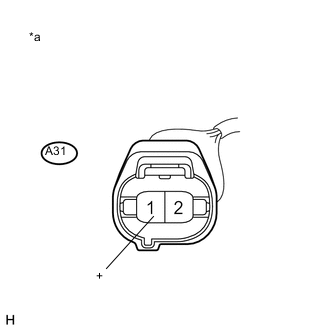
Text in Illustration *a Front view of wire harness connector
(to Brake Fluid Level Warning Switch)
Reconnect the skid control ECU connector.
-
Turn the power switch on (IG).
-
Measure the voltage according to the value(s) in the table below.
Standard Voltage Tester Connection Switch Condition Specified Condition A31-1 (+) - Body ground Power switch on (IG) 11 to 14 V Result Result Proceed to OK A NG (for LHD) B NG (for RHD) C
B
REPLACE BRAKE BOOSTER WITH MASTER CYLINDER Click here
C
REPLACE BRAKE BOOSTER WITH MASTER CYLINDER Click here
A
-
-
CHECK BRAKE DISC
-
Turn the power switch off.
-
Reconnect the brake fluid level warning switch connector.
-
Disconnect the brake pedal stroke sensor connector.
-
Perform a road test according to Freeze Frame Data or customer problem analysis. Check the brake line pressure vibration caused due to uneven wear of the disc according to brake pedal vibration.
OK Brake pedal does not vibrate during braking. Tech Tips
-
An unevenly worn disc may vibrate the caliper piston and cause fluctuations in brake line pressure, triggering a malfunction detection condition.
-
The brake pedal does not kick back due to wheel cylinder piston vibration during electronically controlled brake system control.
-
If the brake pedal stroke sensor connector is disconnected, the fail-safe function will prohibit electronically controlled brake system control.
-
The Active Test does not prohibit electronically controlled brake system control when driving the vehicle, so disconnect the stroke sensor connector before continuing with inspection.
-
Disc uneven wear can be checked by measuring the disc thickness variation (See page for front, or Click here for rear).
-
NG
REPLACE BRAKE DISC
OK
-
-
RECONFIRM DTC
-
Reconnect the brake pedal stroke sensor connector.
-
Clear the DTCs Click here.
-
Turn the power switch on (READY).
-
Perform a road test.
-
Check if the same DTC is recorded Click here.
Result Result Proceed to DTC (C1202/68) is not output A DTC (C1202/68) is output (for LHD) B DTC (C1202/68) is output (for RHD) C Tech Tips
If troubleshooting has been carried out according to Problem Symptoms Table, refer back to the table and proceed to the next step Click here.
A
CHECK FOR INTERMITTENT PROBLEMS Click here
B
REPLACE BRAKE BOOSTER WITH MASTER CYLINDER Click here
C
REPLACE BRAKE BOOSTER WITH MASTER CYLINDER Click here
-