FUEL SYSTEM ON-VEHICLE INSPECTION

-
CHECK FUEL PUMP OPERATION AND INSPECT FOR FUEL LEAK
-
Connect the intelligent tester to the DLC3.
-
Turn the ignition switch to ON.
Note
Do not start the engine.
-
Turn the intelligent tester on.
-
Enter the following menus: Powertrain / Engine and ECT / Active Test / Control the Fuel Pump / Speed.
-
-
Check fuel pump operation.
-
Check for pressure in the fuel inlet tube from the fuel line. Check that the sound of fuel flowing in the fuel tank assembly can be heard.
If there is no sound, check the integration relay, fuel pump, ECM and wiring connector.
-
-
Check for fuel leaks.
-
Check that there are no fuel leaks after performing maintenance anywhere on the system.
If there are fuel leaks, repair or replace parts as necessary.
-
-
-
CHECK FUEL PRESSURE
-
Check that the battery positive voltage is above 12 V.
-
Discharge the fuel system pressure Click here.
-
Disconnect the cable from the negative (-) battery terminal.
Note
-
After turning the ignition switch off, waiting time may be required before disconnecting the cable from the battery terminal. Therefore, make sure to read the disconnecting the cable from the battery terminal notice before proceeding with work Click here.
-
When disconnecting the cable, some systems need to be initialized after the cable is reconnected Click here.
-
-
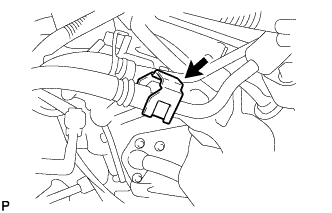
Pinch and pull the No. 1 fuel hose (fuel tube connector) to disconnect it from the fuel pressure pulsation damper assembly.
CAUTION:
-
Always read the precautions Click here before disconnecting the fuel tube connector (quick type).
-
The fuel tube may spray fuel as a result of pressure that remains in it. Do not allow fuel to be sprayed in the engine compartment.
-
-
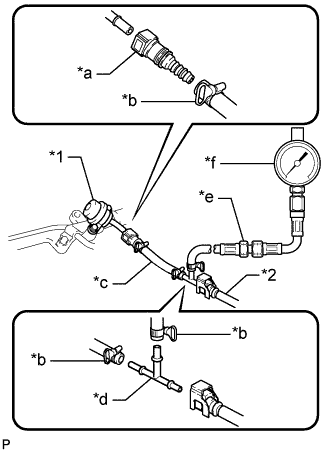
Text in Illustration *1 Fuel Pressure Pulsation Damper Assembly *2 No. 1 Fuel Hose *a SST (Fuel Tube Connector) *b SST (Hose Band) *c SST (Hose) *d SST (T-Joint) *e SST (Hose Joint) *f SST (Pressure Gauge) Install SST (pressure gauge) as shown in the illustration.
- SST
- 09268-45101 ( 09268-41250, 09268-41260, 09268-41280, 09268-41500, 09268-41700, 95336-08070 )
-
Wipe off any gasoline.
-
Reconnect the negative (-) battery cable.
-
Operate the fuel pump.
-
Connect the intelligent tester to the DLC3.
-
Turn the ignition switch to ON.
Note
Do not start the engine.
-
Turn the intelligent tester on.
-
Enter the following menus: Powertrain / Engine and ECT / Active Test / Control the Fuel Pump / Speed.
-
-
Measure the fuel pressure.
Standard fuel pressure 281 to 287 kPa (2.87 to 2.93 kgf/cm2, 40.8 to 41.7 psi) If the pressure is higher than the specification, replace the fuel pressure regulator assembly.
If the pressure is lower than the specification, check the fuel hoses and connections, fuel pump, fuel filter assembly and fuel pressure regulator assembly.
-
Start the engine.
-
Measure the fuel pressure.
Standard fuel pressure 281 to 287 kPa (2.87 to 2.93 kgf/cm2, 40.8 to 41.7 psi) If the pressure is not as specified, check the fuel pump, fuel pressure regulator assembly and/or fuel injector assemblies.
-
Stop the engine.
-
Check that the fuel pressure remains as specified for 5 minutes after the engine has stopped.
Standard fuel pressure 147 kPa (1.5 kgf/cm2, 21 psi) or more If the pressure is not as specified, check the fuel pump, fuel pressure regulator assembly and/or fuel injector assemblies.
-
After checking the fuel pressure, disconnect the negative (-) battery cable and carefully remove SST and the fuel tube connector to prevent gasoline from spraying.
-
Reconnect the No. 1 fuel hose (fuel tube connector) to the fuel pressure pulsation damper assembly.
-
-
INSPECT FOR FUEL LEAK
-
Check that there are no fuel leaks after performing maintenance anywhere on the fuel system.
If there are fuel leaks, repair or replace parts as necessary.
-