ENGINE ASSEMBLY INSTALLATION

CAUTION:
As the engine assembly with transaxle is extremely heavy, the engine lifter may suddenly drop if the instructions listed in the repair manual are not followed. Therefore, always follow the instructions listed in the repair manual when performing this procedure.
-
INSTALL ENGINE OIL LEVEL SENSOR
-
Install the engine oil level sensor with the 4 bolts.
- Torque:
- 7.0 N*m { 71 kgf*cm, 52 in.*lbf }
-
-
INSTALL FRONT NO. 1 ENGINE MOUNTING BRACKET LH
Tech Tips
Perform this procedure only when replacement of the No. 1 engine mounting bracket LH is necessary.
-
Install the front No. 1 engine mounting bracket LH with the 4 bolts to the cylinder block.
- Torque:
- 51 N*m { 520 kgf*cm, 38 ft.*lbf }
-
-
INSTALL FRONT NO. 1 ENGINE MOUNTING BRACKET RH
Tech Tips
Perform this procedure only when replacement of the No. 1 engine mounting bracket RH is necessary.
-
Install the front No. 1 engine mounting bracket RH with the 4 bolts to the cylinder block.
- Torque:
- 51 N*m { 520 kgf*cm, 38 ft.*lbf }
-
-
INSTALL ENGINE COOLANT TEMPERATURE SENSOR
-
Install a new gasket onto the engine coolant temperature sensor.
-
Using a 19 mm deep socket wrench, install the engine coolant temperature sensor.
- Torque:
- 20 N*m { 200 kgf*cm, 14 ft.*lbf }
-
Connect the engine coolant temperature sensor connector.
-
-
INSTALL KNOCK CONTROL SENSOR
-
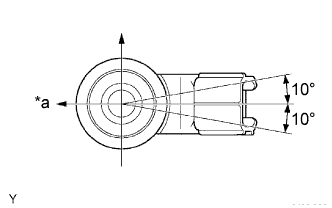
Text in Illustration *a Front Install the knock control sensor with the bolt as shown in the illustration.
- Torque:
- 20 N*m { 204 kgf*cm, 15 ft.*lbf }
-
Connect the knock control sensor connector.
-
-
INSTALL ENGINE OIL PRESSURE SWITCH ASSEMBLY
-
Apply adhesive to 2 or 3 threads of the engine oil pressure switch assembly.
Adhesive Toyota Genuine Adhesive 1344, Three Bond 1344 or equivalent Note
Do not let adhesive adhere to the oil hole.
-
Install the engine oil pressure switch assembly.
- Torque:
- 15 N*m { 153 kgf*cm, 11 ft.*lbf }
Note
Do not start the engine within 1 hour of installation.
-
-
INSTALL V-RIBBED BELT TENSIONER ASSEMBLY
-
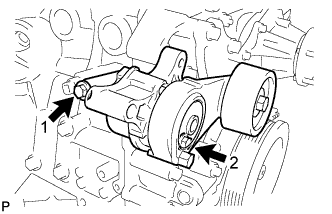
Temporarily install the V-ribbed belt tensioner assembly with the 2 bolts.
Tech Tips
-
Make sure that the V-ribbed belt tensioner assembly is in contact with the engine block.
-
Check that the bolt holes of the V-ribbed belt tensioner assembly and timing chain cover are aligned.
-
-
Install the V-ribbed belt tensioner assembly by tightening the 2 bolts in the order shown in the illustration.
- Torque:
- for bolt 1
- 40 N*m { 408 kgf*cm, 30 ft.*lbf }
- for bolt 2
- 21 N*m { 214 kgf*cm, 15 ft.*lbf }
-
-
INSTALL NO. 1 IDLER PULLEY SUB-ASSEMBLY
-
Install the No. 1 idler pulley sub-assembly, collar and pulley plate with the bolt.
- Torque:
- 43 N*m { 438 kgf*cm, 32 ft.*lbf }
Note
Check that the pulley plate and collar are assembled properly to the No. 1 idler pulley sub-assembly.
-
-
INSTALL NO. 1 COMPRESSOR MOUNTING BRACKET
-
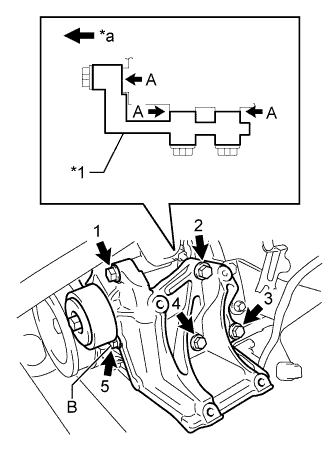
Text in Illustration *1 No. 1 Compressor Mounting Bracket *a Engine Front Temporarily install the No. 1 compressor mounting bracket with the 5 bolts.
Tech Tips
Make sure that the No. 1 compressor mounting bracket is in contact with the engine block at points A shown in the illustration.
-
Install the No. 1 compressor mounting bracket by tightening the 5 bolts in the order shown in the illustration.
- Torque:
- for bolt B
- 25 N*m { 255 kgf*cm, 18 ft.*lbf }
- except bolt B
- 45 N*m { 459 kgf*cm, 33 ft.*lbf }
Note
In order to prevent misalignment, which causes belt rattle, tightening of the bolts must be performed in the order shown.
-
-
INSTALL GENERATOR ASSEMBLY
-
Install the generator assembly with the 3 bolts.
- Torque:
- 43 N*m { 438 kgf*cm, 32 ft.*lbf }
-
Connect the wire harness clamp with the bolt.
-
Connect the wire harness to terminal B with the nut.
- Torque:
- 9.8 N*m { 100 kgf*cm, 87 in.*lbf }
-
Install the terminal cap.
-
Connect the generator connector.
-
-
INSTALL THERMOSTAT
-
Install a new gasket to the thermostat.
-
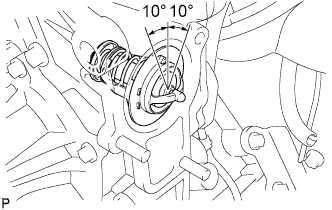
Install the thermostat with the jiggle valve upward.
Tech Tips
The jiggle valve may be set within 10° of either side of the prescribed position.
-
-
INSTALL WATER INLET
-
Install a new gasket and connect the water inlet with the bolt and 2 nuts.
- Torque:
- 28 N*m { 286 kgf*cm, 21 ft.*lbf }
-
-
INSTALL NO. 1 WATER BY-PASS PIPE
-
Install a new gasket and the No. 1 water by-pass pipe with the 2 nuts and bolt.
- Torque:
- 18 N*m { 178 kgf*cm, 13 ft.*lbf }
-
-
INSTALL FAN PULLEY
-
Install the fan spacer and fan pulley with the 4 nuts.
- Torque:
- 25 N*m { 255 kgf*cm, 18 ft.*lbf }
-
-
INSTALL EXHAUST MANIFOLD
-
Install a new gasket and the exhaust manifold with 8 new nuts.
- Torque:
- 36 N*m { 367 kgf*cm, 27 ft.*lbf }
-
-
INSTALL AIR SWITCHING VALVE ASSEMBLY
-
Install the air switching valve assembly with 2 new nuts.
- Torque:
- 20 N*m { 204 kgf*cm, 15 ft.*lbf }
-
Connect the air switching valve connector.
-
-
INSTALL NO. 4 INTAKE PIPE
-
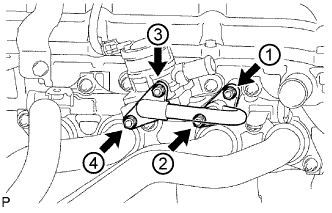
Install 2 new gaskets and the No. 4 intake pipe with 4 new nuts in the order shown in the illustration. Tighten the nuts labeled 1 and 3 to the torque specification again.
- Torque:
- 20 N*m { 204 kgf*cm, 15 ft.*lbf }
-
Check that the nuts are tightened to the torque specification.
Note
Tightening the nuts only once is not enough to tighten them to the torque specification.
-
-
INSTALL NO. 1 EXHAUST MANIFOLD HEAT INSULATOR
-
Install the No. 1 exhaust manifold heat insulator with the 4 bolts.
- Torque:
- 12 N*m { 122 kgf*cm, 9 ft.*lbf }
-
-
INSTALL FUEL INJECTOR ASSEMBLY
-
Apply a light coat of gasoline or spindle oil to new O-rings and install them to the injector spacers.
Note
Make sure that the O-rings are installed between the parts correctly.
-
Install the 4 injector spacers to the cylinder head sub-assembly.
-
Apply a light coat of gasoline or spindle oil to new O-rings, and then install one onto each fuel injector assembly.
-
Apply a light coat of gasoline or spindle oil to the contact surfaces of the fuel delivery pipe sub-assembly and the O-ring of the fuel injector assembly.
-
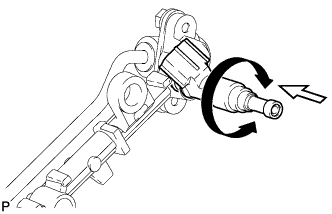
Apply a light coat of gasoline or spindle oil to the O-ring again, and then install the fuel injector assembly into the fuel delivery pipe sub-assembly by turning it right and left.
Text in Illustration 
Turn 
Push Note
-
Be careful not to twist the O-ring.
-
After installing the fuel injector assembly, check that it turns smoothly. If not, reinstall it with a new O-ring.
-
-
-
INSTALL FUEL DELIVERY PIPE SUB-ASSEMBLY
-
Install 4 new injector vibration insulators to the cylinder head sub-assembly.
-
Install the 2 No. 1 delivery pipe spacers to the cylinder head sub-assembly.
-
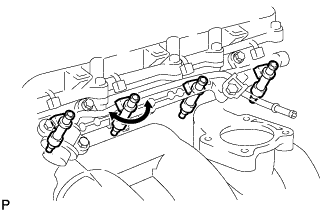
Temporarily install the fuel delivery pipe sub-assembly together with the 4 fuel injector assemblies with the 2 bolts.
Note
-
Do not drop the fuel injector assembly when installing the fuel delivery pipe sub-assembly.
-
Make sure that the fuel injector assembly turns smoothly.
-
-
Tighten the 2 bolts.
- Torque:
- 12 N*m { 122 kgf*cm, 9 ft.*lbf }
-
Apply a light coat of gasoline or spindle oil to a new O-ring.
-
Install the fuel pressure pulsation damper assembly with the 2 bolts.
- Torque:
- 8.5 N*m { 87 kgf*cm, 75 in.*lbf }
-
Connect the 4 fuel injector connectors.
-
Connect the No. 2 fuel hose to the fuel pressure regulator assembly, and slide the clamp to secure the hose.
-
Connect the vacuum hose to the fuel pressure regulator assembly.
-
-
INSTALL SPARK PLUG
-
Using a 16 mm spark plug wrench, install the 4 spark plugs.
- Torque:
- 18 N*m { 184 kgf*cm, 13 ft.*lbf }
-
-
INSTALL IGNITION COIL ASSEMBLY
-
Install the ignition coils with the bolts.
- Torque:
- 9.0 N*m { 92 kgf*cm, 80 in.*lbf }
-
-
INSTALL INTAKE MANIFOLD
-
Install a new gasket onto the intake manifold.
-
Install the intake manifold with the 5 bolts and 2 nuts.
- Torque:
- 25 N*m { 255 kgf*cm, 18 ft.*lbf }
-
Install the bolt and wire harness bracket to the intake manifold.
- Torque:
- 8.0 N*m { 82 kgf*cm, 71 in.*lbf }
-
Connect the vacuum hose to the intake manifold, and slide the clamp to secure the hose.
-
Connect the No. 3 PCV hose to the intake manifold, and slide the clamp to secure the hose.
-
Attach the 2 wire harness clamps to the wire harness bracket.
-
Connect the purge line hose to the vacuum switching valve, and slide the clamp to secure the hose.
-
Connect the vacuum switching valve connector.
-
-
INSTALL THROTTLE WITH MOTOR BODY ASSEMBLY
-
Install a new gasket onto the intake manifold.
Tech Tips
Align the protrusion of the gasket with the groove of the intake manifold.
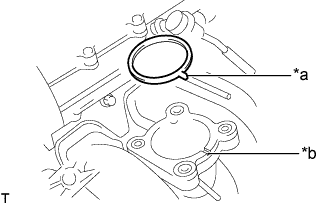
Text in Illustration *a Protrusion *b Groove -
Install the throttle body assembly with the 4 bolts.
- Torque:
- 9.0 N*m { 92 kgf*cm, 80 in.*lbf }
-
Connect the No. 2 water by-pass hose to the throttle body assembly, and slide the clamp to secure the hose.
-
Connect the water by-pass hose to the throttle body assembly, and slide the clamp to secure the hose.
-
Connect the throttle motor connector.
-
-
INSTALL PCV PIPE
-
Install the PCV pipe with the bolt.
- Torque:
- 18 N*m { 184 kgf*cm, 13 ft.*lbf }
-
-
INSTALL ENGINE HANGER
-
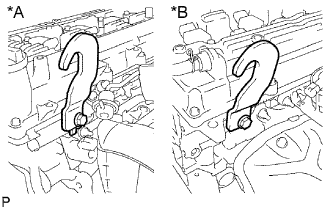
Text in Illustration *A LH Side *B RH Side Install the 2 engine hangers with the 2 bolts.
- Torque:
- 42 N*m { 428 kgf*cm, 31 ft.*lbf }
Tech Tips
Engine Hangers 12281-75040 Bolt 91552-A1020 Note
Use new 2 bolts for the 2 engine hangers.
-
-
REMOVE ENGINE FROM ENGINE STAND
Note
-
Pay attention to the angle of the sling device as the engine assembly or engine hangers may be damaged or deformed if the angle is incorrect.
-
With the exception of installing the engine assembly to an engine stand or removing the engine assembly from an engine stand, do not perform any work on the engine while it is suspended, as doing so is dangerous.
-
Attach a sling device and hang the engine with a chain block.
-
Lift the engine and remove it from the engine stand.
-
-
FIX ENGINE ASSEMBLY
-
Using wooden blocks or plate lift attachments, set the engine on a flat surface.
Note
-
Place wooden blocks or plate lift attachments so that the engine is level.
-
Never install attachments to the oil pan of the engine assembly or transmission as doing so may deform the oil pan.
-
Perform this step while supporting the engine assembly using a sling device and chain block.
-
-
-
INSTALL ENGINE WIRE
-
Install the engine wire to the engine assembly.
-
-
INSTALL FRONT SUSPENSION CROSSMEMBER SUB-ASSEMBLY
-
Install the engine assembly to the crossmember sub-assembly.
-
Connect the engine mounting insulator with the 4 bolts.
- Torque:
- 55 N*m { 561 kgf*cm, 41 ft.*lbf }
-
-
INSTALL REAR END PLATE
-
Install the rear end plate with the bolt.
- Torque:
- 18 N*m { 184 kgf*cm, 13 ft.*lbf }
-
Connect the No. 1 water by-pass pipe to the rear end plate with the bolt.
- Torque:
- 18 N*m { 178 kgf*cm, 13 ft.*lbf }
-
-
INSTALL DRIVE PLATE AND RING GEAR SUB-ASSEMBLY
-
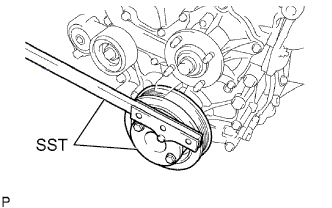
Using SST, hold the crankshaft.
- SST
- 09213-54015 ( 91651-60855 )
- 09330-00021
-
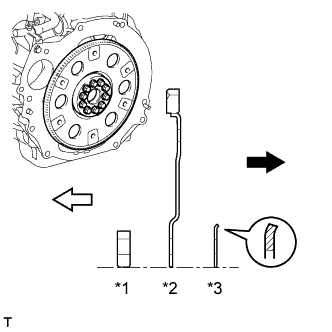
Text in Illustration *1 Front Drive Plate Spacer (Reversible) *2 Drive Plate and Ring Gear Sub-assembly *3 Rear Drive Plate Spacer Transmission Side Engine Side Install the front drive plate spacer, drive plate and ring gear sub-assembly and rear drive plate spacer to the crankshaft.
Tech Tips
-
The front drive plate spacer is reversible.
-
As the rear drive plate spacer and drive plate and ring gear sub-assembly are not reversible, be sure to install it so that it is facing in the direction shown in the illustration.
-
-
Clean the bolts and bolt holes.
-
Apply adhesive to 2 or 3 threads at the end of each of the 10 bolts.
Adhesive Toyota Genuine Adhesive 1324, Three Bond 1324 or equivalent -
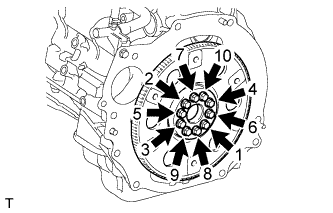
Install and uniformly tighten the 10 bolts in several steps in the sequence shown in the illustration.
- Torque:
- 74 N*m { 755 kgf*cm, 55 ft.*lbf }
Note
Do not start the engine for at least an hour after installing the drive plate and ring gear sub-assembly.
-
-
INSTALL AUTOMATIC TRANSMISSION ASSEMBLY
-
INSTALL STARTER ASSEMBLY
-
Install the starter assembly with the 2 bolts.
- Torque:
- 37 N*m { 377 kgf*cm, 27 ft.*lbf }
-
Connect the wire harness with the nut.
- Torque:
- 9.8 N*m { 100 kgf*cm, 87 in.*lbf }
-
Install the terminal cap.
-
Connect the starter connector.
-
Connect the wire harness with the bolt.
- Torque:
- 25 N*m { 250 kgf*cm, 18 ft.*lbf }
-
Install the wire harness bracket with the bolt.
- Torque:
- 25 N*m { 250 kgf*cm, 18 ft.*lbf }
-
Attach the wire harness clamp to the wire harness bracket.
-
-
INSTALL ENGINE ASSEMBLY WITH TRANSMISSION
-
Place the engine on an engine lifter.
Tech Tips
Place the engine on wooden blocks or equivalent so that the engine is level.
-
Operate the engine lifter and install the engine to the vehicle.
CAUTION:
Do not raise the engine more than necessary. If the engine is raised excessively, the vehicle may also be lifted up.
Note
-
Make sure that the engine is clear of all wiring and hoses.
-
While raising the engine into the vehicle, do not allow it to contact the vehicle.
-
-
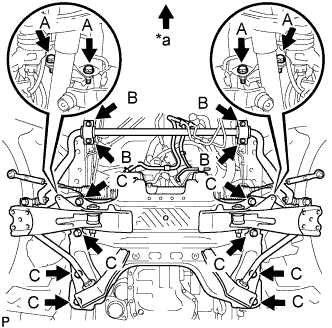
Text in Illustration *a Front Side Install the stabilizer bracket and 16 bolts of the front suspension crossmember.
- Torque:
- for bolt A
- 39 N*m { 398 kgf*cm, 29 ft.*lbf }
- for bolt B
- 36 N*m { 367 kgf*cm, 27 ft.*lbf }
- for bolt C
- 150 N*m { 1530 kgf*cm, 111 ft.*lbf }
-
Connect the rear engine mount.
- Torque:
- 98 N*m { 999 kgf*cm, 72 ft.*lbf }
Note
Be sure to tighten the nut side.
-
Remove the engine lifter slowly.
-
Remove the 2 bolts and 2 engine hangers.
-
-
CONNECT STEERING TORQUE SHAFT ASSEMBLY
-
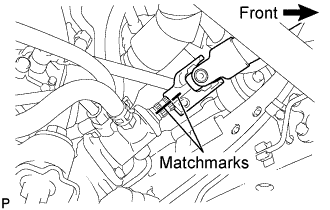
Align the matchmarks on the steering torque shaft assembly and the power steering link assembly.
-
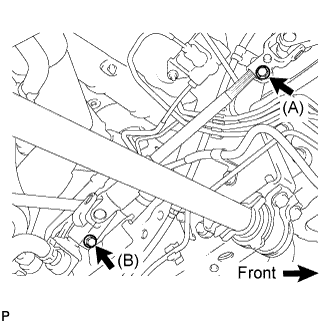
Install bolt (B) and tighten the 2 bolts.
- Torque:
- 35 N*m { 360 kgf*cm, 26 ft.*lbf }
-
-
CONNECT OIL COOLER HOSE
-
Connect the inlet oil cooler hose and outlet oil cooler hose to the oil cooler tube, and slide the 2 clamps to secure the hose.
-
-
CONNECT TRANSMISSION CONTROL CABLE ASSEMBLY
-
Connect the transmission control shift cable assembly with a new clip and nut.
- Torque:
- 15 N*m { 148 kgf*cm, 11 ft.*lbf }
-
-
INSTALL TRANSMISSION OIL FILLER TUBE SUB-ASSEMBLY
-
Coat a new O-ring with ATF, and install it to the transmission oil filler tube sub-assembly.
-
Install the transmission oil filler tube sub-assembly with the 2 bolts.
- Torque:
- 12 N*m { 122 kgf*cm, 9 ft.*lbf }
-
Install the oil level dipstick.
-
-
CONNECT FRONT SHOCK ABSORBER ASSEMBLY LH
-
CONNECT FRONT SHOCK ABSORBER ASSEMBLY RH
Tech Tips
Use the same procedure described for the LH side.
-
CONNECT FRONT SUSPENSION SUB-ASSEMBLY UPPER LH
-
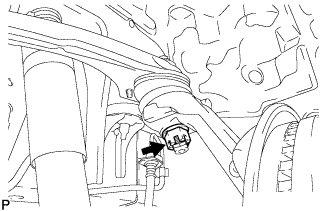
Connect the front suspension upper arm to the steering knuckle with the nut.
- Torque:
- 113 N*m { 1,150 kgf*cm, 83 ft.*lbf }
-
Install a new cotter pin.
Note
-
If the holes for the cotter pin are not aligned, tighten the nut up to 60°.
-
Do not damage the ball joint dust cover.
-
-
-
CONNECT FRONT SUSPENSION SUB-ASSEMBLY UPPER RH
Tech Tips
Use the same procedure described for the LH side.
-
INSTALL FRONT DISC BRAKE CALIPER ASSEMBLY LH
-
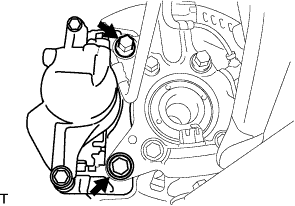
Install the brake caliper assembly to the steering knuckle with the 2 bolts.
- Torque:
- 123 N*m { 1,250 kgf*cm, 91 ft.*lbf }
-
-
INSTALL FRONT DISC BRAKE CALIPER ASSEMBLY RH
Tech Tips
Use the same procedure described for the LH side.
-
INSTALL FRONT SPEED SENSOR LH
-
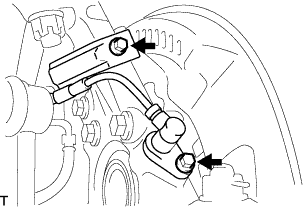
Install the speed sensor to the steering knuckle with the 2 bolts.
- Torque:
- 8.5 N*m { 87 kgf*cm, 75 in.*lbf }
Note
-
Prevent foreign matter from adhering to the speed sensor.
-
Be careful not to damage the speed sensor.
-
Do not twist the sensor wire when installing the speed sensor.
-
-
INSTALL FRONT SPEED SENSOR RH
Tech Tips
Use the same procedure described for the LH side.
-
INSTALL PROPELLER SHAFT ASSEMBLY
-
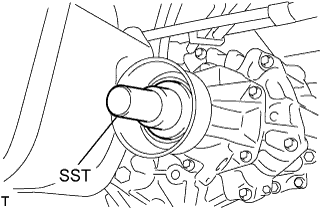
Remove the SST from the extension housing.
-
Install the propeller shaft assembly in the extension housing.
-
Align the matchmarks on the propeller shaft flange and differential flange.
-
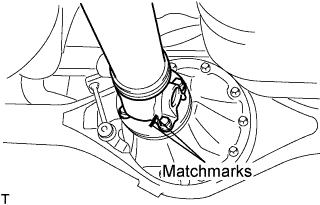
Install the propeller shaft assembly with the 4 nuts, 4 bolts and 4 washers.
- Torque:
- 74 N*m { 755 kgf*cm, 54 ft.*lbf }
-
-
INSTALL FRONT EXHAUST PIPE ASSEMBLY
-
Inspect the compression spring.
-
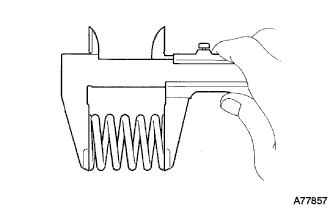
Using vernier calipers, measure the free length of the compression springs.
Minimum length 40.5 mm (1.59 in.) Tech Tips
If the free length is less than the minimum, replace the compression spring.
-
-
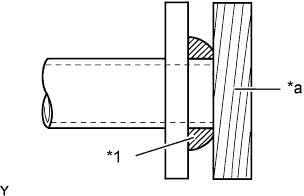
Text in Illustration *1 Gasket *a Wooden Block Install the gasket.
-
Fully insert 2 new gaskets to the exhaust manifold and front exhaust pipe assembly by hand.
-
Using a wooden block, uniformly strike the gasket so that the gasket and exhaust manifold and front exhaust pipe assembly are properly fit.
Note
-
Be careful with the installation direction of the gasket.
-
Do not reuse the gasket.
-
Do not damage the gasket.
-
To ensure a proper seal, do not use the front exhaust pipe assembly to force the gasket onto the exhaust manifold.
-
To ensure a proper seal, do not use the tail exhaust pipe assembly to force the gasket onto the front exhaust pipe assembly.
-
-
-
Connect the No. 4 exhaust pipe support to install the front exhaust pipe assembly.
-
Temporarily install the 4 compression springs and 4 bolts to the front exhaust pipe assembly.
-
Tighten the 4 bolts.
- Torque:
- 43 N*m { 438 kgf*cm, 32 ft.*lbf }
Note
After installation, check that the clearance is almost the same at any point between the flanges of the exhaust manifold, tail exhaust pipe assembly and front exhaust pipe assembly.
-
-
CONNECT ENGINE WIRE
-
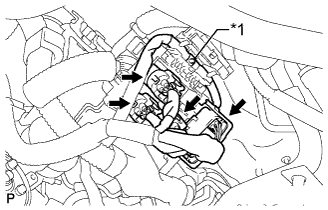
Text in Illustration *1 Nut Install the nut and connect the 4 connectors as shown in the illustration.
-
Connect the starter connector Click here.
-
Connect the generator connector Click here.
-
Connect the clamps of the engine wire and ground cable.
-
Connect the connectors of the ECM.
-
Connect the wire harness support of the ECM.
-
-
INSTALL COMPRESSOR AND MAGNETIC CLUTCH
-
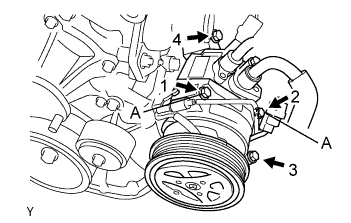
Temporarily install the bolt A to connect the compressor and magnetic clutch.
-
Connect the compressor and magnetic clutch completely by tightening the 4 bolts in the order shown in the illustration.
- Torque:
- 25 N*m { 250 kgf*cm, 18 ft.*lbf }
Note
In order to prevent misalignment, which causes belt rattle, tightening of the bolts must be performed in the order shown.
-
Connect the compressor and magnetic clutch connector.
-
-
INSTALL ENGINE OIL LEVEL DIPSTICK GUIDE
-
Install a new O-ring and the engine oil level dipstick guide with the bolt to the front No. 1 engine mounting bracket LH.
- Torque:
- 20 N*m { 204 kgf*cm, 15 ft.*lbf }
-
-
INSTALL ENGINE OIL LEVEL DIPSTICK
-
CONNECT VANE PUMP ASSEMBLY
-
Connect the vane pump assembly with the 2 bolts.
- Torque:
- 21 N*m { 214 kgf*cm, 15 ft.*lbf }
-
Connect the oil pressure switch connector.
-
-
CONNECT NO. 2 FUEL HOSE
-
Connect the No. 2 fuel hose to the fuel delivery pipe sub-assembly Click here.
-
-
CONNECT NO. 1 FUEL HOSE
-
Connect the No. 1 fuel hose to the fuel pressure pulsation damper assembly Click here.
-
-
CONNECT NO. 5 AIR HOSE
-
Connect the No. 5 air hose to the air switching valve assembly, and slide the clamp to secure the hose.
-
-
INSTALL INTAKE AIR CONNECTOR
-
Temporarily install the intake air connector to the throttle body assembly.
-
Connect the vacuum hose to the intake air connector.
-
Connect the No. 2 PCV hose to the cylinder head cover sub-assembly, and slide the clamp to secure the hose.
-
Install the intake air connector with the 2 bolts.
- Torque:
- 8.0 N*m { 82 kgf*cm, 71 in.*lbf }
-
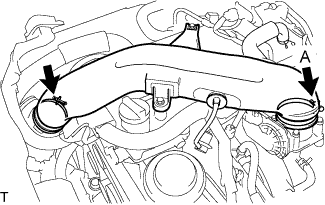
Tighten the 2 hose clamps.
- Torque:
- for clamp A
- 5.0 N*m { 51 kgf*cm, 44 in.*lbf }
-
-
CONNECT UNION TO CONNECTOR TUBE HOSE
-
Connect the union to connector tube hose to the intake manifold, and slide the clamp to secure the hose.
-
-
CONNECT FUEL VAPOR FEED HOSE ASSEMBLY
-
Connect the fuel vapor feed hose assembly to the purge VSV, and slide the clamp to secure the hose.
-
-
CONNECT OUTLET HEATER WATER HOSE B
-
Connect the outlet heater water hose B to the heater unit, and slide the clamp to secure the hose.
-
-
CONNECT INLET HEATER WATER HOSE A
-
Connect the inlet heater water hose A to the heater unit, and slide the clamp to secure the hose.
-
-
CONNECT NO. 2 RADIATOR HOSE
-
Connect the No. 2 radiator hose to the No. 1 radiator pipe, and slide the clamp to secure the hose.
-
-
CONNECT NO. 4 RADIATOR HOSE
-
Connect the No. 4 radiator hose to the engine, and slide the clamp to secure the hose.
-
-
INSTALL FAN AND GENERATOR V BELT
-
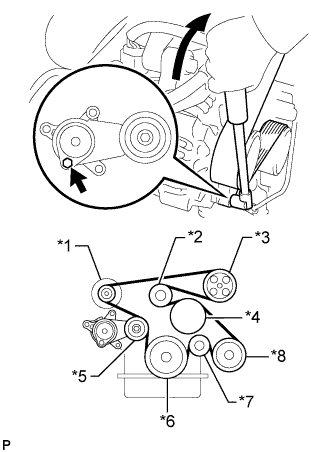
Text in Illustration *1 Generator *2 No. 1 Idler Pulley *3 Vane Pump *4 Fan Pulley *5 Tensioner Pulley *6 Crankshaft Pulley *7 Idler Pulley *8 Cooler Compressor Install the fan and generator V belt to all the pulleys except the V-ribbed belt tensioner pulley.
-
Use the hexagon-shaped part indicated by the arrow in the illustration to move the tensioner pulley downward, and then install the fan and generator V belt to the tensioner pulley.
Note
-
The backside of the fan and generator V belt should face the tensioner pulley.
-
Check that the fan and generator V belt is properly installed to each pulley.
-
-
-
INSPECT FAN AND GENERATOR V BELT
-
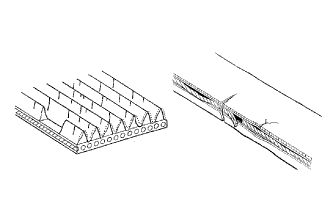
Check the belt for wear, cracks or other signs of damage.
If any of the following defects is found, replace the fan and generator V belt.
-
The belt is cracked.
-
The belt is worn out to the extent that the cords are exposed.
-
The belt has chunks missing from the ribs.
-
-
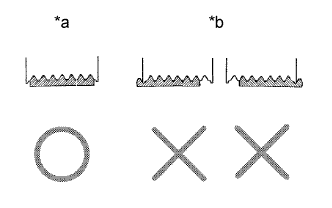
Text in Illustration *a CORRECT *b INCORRECT Check that the belt fits properly in the ribbed grooves.
Tech Tips
Check with your hand to confirm that the belt has not slipped out of the grooves on the bottom of the pulley. If it has slipped out, replace the fan and generator V belt. Install a new fan and generator V belt correctly.
-
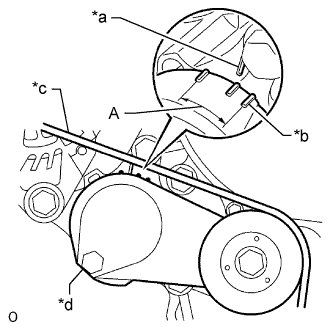
Text in Illustration *a Bracket Side Indicator *b Arm Side Indicator *c Fan and Generator V Belt *d V-ribbed belt tensioner assembly Check that the tensioner indicator mark is within range A shown in the illustration.
If the mark is not within range A, replace the fan and generator V belt.
Tech Tips
If a new belt has been installed, check that the tensioner indicator mark is within range A.
-
-
INSTALL ENGINE SERVICE HOLE SUB COVER SUB-ASSEMBLY
-
Install the engine service hole cover sub-assembly with the 5 bolts.
- Torque:
- 13 N*m { 133 kgf*cm, 10 ft.*lbf }
-
-
INSTALL FRONT DOOR SCUFF PLATE
-
INSTALL FRONT SEAT ASSEMBLY RH
-
CONNECT CABLE TO NEGATIVE BATTERY TERMINAL
Note
When disconnecting the cable, some systems need to be initialized after the cable is reconnected Click here.
-
ADD ENGINE OIL
-
Add new engine oil.
Standard Oil Grade Oil Grade Oil Viscosity (SAE) API grade SL "energy-conserving", SM "energy-conserving", SN "resource-conserving" or ILSAC multigrade engine oil
-
0W-20
-
5W-20
-
5W-30
-
10W-30
API grade SL, SM or SN multigrade engine oil
-
15W-40
-
20W-50
Standard Capacity Item Capacity Drain and refill without oil filter change 5.0 liters (5.3 US qts, 4.4 Imp. qts) Drain and refill with oil filter change 5.5 liters (5.8 US qts, 4.8 Imp. qts) Dry fill 6.0 liters (6.3 US qts, 5.3 Imp. qts) -
-
Install the oil filler cap.
-
-
ADD ENGINE COOLANT
-
Tighten the radiator drain cock plug by hand.
-
Tighten the cylinder block water drain cock plug.
- Torque:
- 13 N*m { 130 kgf*cm, 9 ft.*lbf }
-
Fill the radiator reservoir assembly with engine coolant to the top of the inlet.
Standard Capacity 11.2 liters (11.8 US qts, 9.9 Imp. qts) Note
Never use water as a substitute for engine coolant.
Tech Tips
TOYOTA vehicles are filled with TOYOTA SLLC at the factory. In order to avoid damage to the engine cooling system and other technical problems, only use TOYOTA SLLC or similar high quality ethylene glycol based non-silicate, non-amine, non-nitrite, non-borate coolant with long-life hybrid organic acid technology (coolant with long-life hybrid organic acid technology is a combination of low phosphates and organic acids).
-
Remove the 2-way that is located near the throttle body assembly.
-
When air is bleed and the engine coolant drains out, install the 2-way.
-
Add coolant through the radiator reservoir assembly filler opening until the coolant reaches the B line and install the radiator reservoir cap sub-assembly. [*1]
-
Warm up the engine until the thermostat opens. While the thermostat is open, circulate the coolant for several minutes. [*2]
CAUTION:
-
Wear protective gloves.
-
Be careful as the radiator hoses are hot.
-
Keep your hands away from the radiator fans.
Note
-
Immediately after starting the engine, if the radiator reservoir assembly does not have any engine coolant, perform the following: 1) stop the engine, 2) wait until the engine coolant has cooled down, and 3) add engine coolant.
-
Do not start the engine when there is no engine coolant in the radiator reservoir assembly.
-
Make sure that the needle does not show an abnormally high temperature.
-
If there is not enough engine coolant, the engine may overheat.
Tech Tips
-
Press the No. 2 and No. 3 radiator hoses several times by hand, and then check the level of the engine coolant.
-
The thermostat open timing can be confirmed by pressing the No. 3 radiator hose by hand, and checking when the engine coolant starts to flow inside the hose.
-
-
Stop the engine, and wait until the engine coolant cools down to ambient temperature. [*3]
-
Check the engine coolant level in the radiator reservoir assembly. [*4]
Tech Tips
-
If the engine coolant level is below the LOW line, repeat steps *1 through *4.
-
If the engine coolant level is above the FULL line, drain engine coolant until the engine coolant level is between the FULL and LOW line.
-
-
-
INSPECT FOR FUEL LEAK
-
Check that there are no fuel leaks after performing maintenance anywhere on the fuel system.
If there are fuel leaks, repair or replace parts as necessary.
-
-
INSPECT FOR OIL LEAK
-
Start the engine. Make sure that there are no oil leaks from the areas that were worked on.
-
-
CHECK AUTOMATIC TRANSMISSION FLUID LEVEL
Tech Tips
-
Drive the vehicle so that the engine and transmission are at the normal operating temperature.
ATF temperature 70 to 80°C (158 to 176°F) -
The ATF temperature can be checked with the intelligent tester.
Enter the following menus: Powertrain / Engine and ECT / Data List / A/T Oil Temperature 3.
-
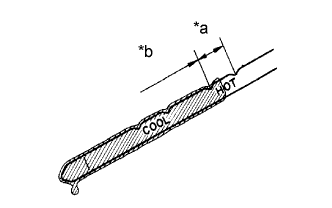
Text in Illustration *a OK *b Add Park the vehicle on a level surface and set the parking brake.
-
With the engine idling and the brake pedal depressed, move the shift lever to all positions from P to L, and then return it to P.
-
Pull out the dipstick and wipe it clean.
-
Fully push the dipstick back into the pipe.
-
Pull the dipstick out and check that the fluid level is in the HOT range.
If there are leaks, it is necessary to repair or replace O-rings, seal packing, oil seals, plugs or other parts.
-
-
INSPECT FOR COOLANT LEAKS
CAUTION:
Do not remove the radiator reservoir cap sub-assembly while the engine and radiator are still hot. Pressurized, hot engine coolant and steam may be released and cause serious burns.
-
Remove the radiator reservoir cap sub-assembly.
-
Fill the radiator reservoir assembly with engine coolant, and then attach a radiator cap tester.
-
Warm up the engine.
-
Using the radiator cap tester, increase the pressure inside the radiator to 137 kPa (1.4 kgf/cm2, 20 psi), and then check that the pressure does not drop.
If the pressure drops, check the hoses, radiator assembly and engine water pump assembly for leakage.
If there are no signs or traces of external engine coolant leakage, check the heater core, cylinder block assembly and cylinder head sub-assembly.
-
Install the radiator reservoir cap sub-assembly.
-
-
ADJUST SHIFT LEVER POSITION
-
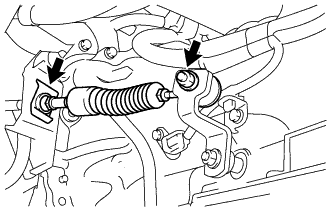
Remove a clip, nut, and disconnect between the control shaft lever to transmission control cable assembly from the control shaft lever and transmission control cable bracket No. 1.
-
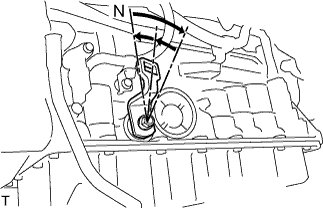
Turn the control shaft lever until stop to a clockwise direction, return the control shaft lever 2 notches to N position.
-
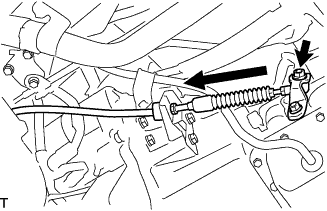
Set the shift lever to N position while holding the shift lever lightly toward the R position side and install it.
- Torque:
- 15 N*m { 150 kgf*cm, 11 ft.*lbf }
-
Inspect the operation condition and work.
-
-
INSPECT SHIFT LEVER POSITION
-
When shifting from P position only with ignition switch ON and depress the break pedal.
-
Make sure that the shifting lever moves smoothly and can be moderately operated.
-
When starting engine, make sure that the vehicle moves forward when shifting from N to D position and moves reward when shifting R position.
-
-
INSPECT FOR EXHAUST GAS LEAK
-
ADJUST FRONT WHEEL ALIGNMENT
-
INSTALL NO. 1 ENGINE UNDER COVER
-
Install the No. 1 engine under cover with the 4 bolts.
- Torque:
- 13 N*m { 133 kgf*cm, 10 ft.*lbf }
-
-
INSPECT IGNITION TIMING
-
Warm up and stop the engine.
Note
A warmed up engine should have an engine coolant temperature of over 80°C (176°F), have an engine oil temperature of 60°C (140°F), and the engine speed should be stabilized.
-
When using the intelligent tester:
-
Connect the intelligent tester to the DLC3.
-
Start the engine and idle it.
-
Turn the intelligent tester main switch on.
-
Enter the following menus:
Powertrain / Engine and ECT / Data List / IGN Advance
Standard ignition timing 5 to 15° BTDC at idle Note
When checking the ignition timing, the transmission should be in neutral or park.
Tech Tips
Refer to the intelligent tester operator's manual for further detail.
-
-
When not using the intelligent tester:
-
Connect the tester probe of a timing light to the wire of the ignition coil connector for the No.4 cylinder.
Note
-
Use a timing light that detects primary signals.
-
After checking, be sure to wrap the wire harness with tape.
-
-
Start the engine and idle it.
-
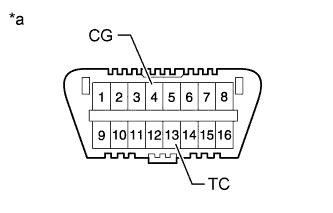
Using SST, connect terminals 13 (TC) and 4 (CG) of the DLC3.
- SST
- 09843-18040
Text in Illustration *a Front view of DLC3 Note
-
Confirm the terminal numbers before connecting them. Connecting the wrong terminals can damage the engine.
-
When checking the ignition timing, the transmission should be in neutral or park.
Tech Tips
-
-
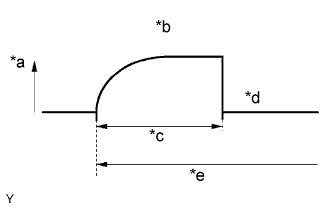
After connecting terminals (TC and CG), engine speed changes to approximately 1000 to 1500 rpm for 5 seconds, and then returns to idle speed. This is because the ECM checks that the ISC (idle speed control system) operates properly.
-
Perform the inspection of the ignition timing after engine speed is returned to idle speed.
Text in Illustration *a Engine Speed *b Approx. 1000 to 1500 rpm *c 5 sec. *d Idle Speed *e Connect Terminals TC and CG -
Inspect the ignition timing
Standard ignition timing 3 to 7° BTDC at idle -
Disconnect terminals 13 (TC) and 4 (CG) of the DLC3.
-
Inspect the ignition timing
Standard ignition timing 5 to 15° BTDC at idle -
Check that the ignition timing advances immediately when the engine speed is increased.
-
Turn the ignition switch off.
-
Remove the timing light.
-
-
-
INSPECT ENGINE IDLE SPEED
-
Warm up and stop the engine.
-
When using the intelligent tester:
-
Connect the intelligent tester to the DLC3.
Tech Tips
Refer to the intelligent tester operator's manual for further details.
-
Start the engine and idle it.
-
Turn the intelligent tester main switch on.
-
Enter the following menus:
Powertrain / Engine and ECT / Data List / Engine SPD
Idle speed 650 to 750 rpm Note
-
When checking the idle speed, the transmission should be in the neutral position.
-
Switch off all accessories and air conditioning before connecting the intelligent tester.
-
-
Turn the ignition switch off.
-
Disconnect the intelligent tester from the DLC3.
-
-
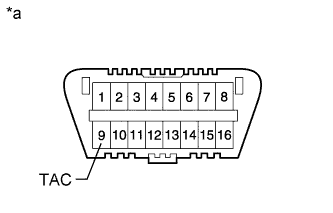
Text in Illustration *a Front view of DLC3 When not using the intelligent tester:
-
Install SST to terminal 9 (TAC) of DLC3, and then connect a tachometer.
- SST
- 09843-18030
Note
Confirm the terminal numbers before connecting them. Connecting the wrong terminals can damage the engine.
-
Start the engine and idle it.
-
Inspect the engine idling speed.
Idle speed 650 to 750 rpm -
Turn the ignition switch off.
-
Disconnect the tachometer.
-
Remove SST from terminal 9 (TAC).
-
-
-
INSPECT CO/HC
-
Start and warm up the engine.
-
Run the engine at 2500 rpm for approximately 180 seconds.
-
Insert the CO/HC meter testing probe at least 40 cm (1.31 ft.) into the tailpipe while idling.
-
Immediately check the CO/HC concentration at idle and at 2500 rpm.
Tech Tips
-
When performing the 2-mode (2500 rpm and idle) test, follow the measurement order prescribed by the applicable local regulations.
-
If the CO/HC concentration does not comply with regulations, troubleshoot in the order given below.
-
-
If the CO/HC concentration is not as specified, perform troubleshooting in the order given below.
-
Check the air fuel ratio sensor Click here and heated oxygen sensor Click here operation.
-
See the table below for possible causes, and then inspect and repair the applicable causes if necessary.
CO HC Problems Causes Normal High Rough idle
-
Faulty ignitions:
-
Incorrect timing
-
Fouled, shorted or improperly gapped plugs
-
Incorrect valve clearance
-
Leaks in intake and exhaust valves
-
Leaks in cylinders
Low High Rough idle
(Fluctuating HC reading)
-
Vacuum leaks:
-
PCV hoses
-
Intake manifold
-
Throttle body
-
Brake booster line
-
Lean mixture causing misfire
High High Rough idle
(Black smoke from exhaust)
-
Restricted air filter
-
Plugged PCV valve
-
Faulty SFI systems:
-
Faulty pressure regulator
-
Defective engine coolant temperature sensor
-
Defective mass air flow meter
-
Faulty ECM
-
Faulty injectors
-
Faulty throttle body
-
-
-
-
CHECK FUNCTION OF THROTTLE BODY
Note
-
Be sure to perform this procedure after reassembling the throttle body assembly or removing and reinstalling any throttle body component.
-
Perform the following procedure after replacing the ECM, throttle body assembly or any throttle body components. The following procedure should also be performed if the throttle body is cleaned.
-
Be sure to perform this procedure after reconnecting the battery cable or replacing the ECM.
-
Disconnect the EFI No. 2 fuse and ETCS fuse at the same time. Wait at least 60 seconds and reconnect the fuses.
-
Turn the ignition switch to ON without operating the accelerator pedal.
Note
If the accelerator pedal is operated, perform the above steps again.
-
Connect the intelligent tester to the DLC3 and clear the DTCs Click here.
-
Start the engine and check that the MIL is not illuminated. After the engine is warmed up, check that the idle speed is within the specified range when the A/C is switched off.
Standard Condition Engine Idle Speed A/C switched off 650 to 750 rpm Note
-
Be sure to perform this step with all accessories off.
-
Make sure that the shift lever is in N or P.
-
-
Enter the following menus: Powertrain / Engine and ECT / Data List / All Data / Throttle Sensor Position. Fully depress the accelerator pedal and check that the value is 60% or more.
-
Perform a road test and confirm that there are no abnormalities.
-
-
INSPECT ABS SENSOR SIGNAL
-
PERFORM INITIALIZATION