CAMSHAFT INSTALLATION

-
INSTALL CAMSHAFT TIMING GEAR ASSEMBLY
-
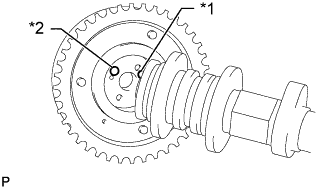
Text in Illustration *1 Straight Pin *2 Pin Hole Align the pin hole and straight pin and install the camshaft timing gear assembly to the camshaft.
-
Lightly press the gear against the camshaft and turn the gear. Push further at the position where the pin enters the groove.
Note
Be sure not to turn the camshaft timing gear assembly in the retard direction (the right angle).
-
Check that there is no gap between the camshaft timing gear and the flange of the camshaft.
Note
-
Since the thrust clearance of the camshaft is small, the camshaft must be kept level while it is being removed. If the camshaft is not kept level, the portion of the cylinder head receiving the shaft thrust may crack or be damaged, causing the camshaft to seize or break.
-
Be sure not to remove the other 3 bolts. If removing the bolts, exchange the camshaft timing gear assembly.
-
-
With the camshaft timing gear assembly fixed in place, install the flange bolt.
- Torque:
- 78 N*m { 795 kgf*cm, 58 ft.*lbf }
-
Check that the camshaft timing gear assembly can move in the retard direction (the right angle), and is locked at the most retarded position.
-
-
INSTALL VALVE LASH ADJUSTER ASSEMBLY
-
Inspect each valve lash adjuster assembly before installing it Click here.
-
Install the 16 valve lash adjuster assemblies to the cylinder head sub-assembly.
Note
Install each valve lash adjuster assembly to the same place it was removed from.
-
-
INSTALL NO. 1 VALVE ROCKER ARM SUB-ASSEMBLY
-
Apply clean engine oil to the valve lash adjuster assembly tips and valve stem cap surfaces.
-
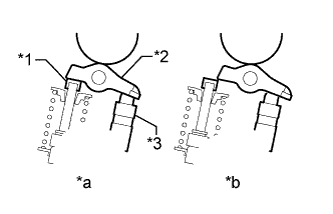
Text in Illustration *1 Valve Stem Cap *2 Valve Rocker Arm *3 Valve Lash Adjuster *a CORRECT *b INCORRECT Install the 16 No. 1 valve rocker arm sub-assemblies as shown in the illustration.
Note
Install the valve stem cap, valve lash adjuster assembly and No. 1 valve rocker arm sub-assembly to the same places they were removed from.
-
-
INSTALL CAMSHAFT
-
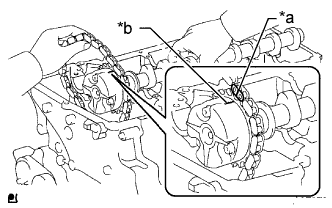
Apply clean engine oil to the camshaft cams and cylinder head journals.
-
Install the timing chain to the camshaft timing gear assembly with the paint mark of the link aligned with the timing mark of the camshaft timing gear assembly.
Text in Illustration *a Paint Mark *b Timing Mark -
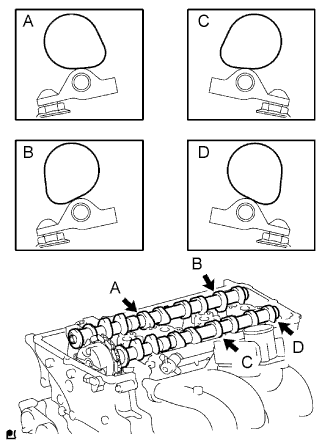
Text in Illustration *1 Valve Stem Cap *2 Valve Rocker Arm *3 Valve Lash Adjuster *a CORRECT *b INCORRECT Position the 2 camshafts as shown in the illustration.
Note
-
Align the paint mark and timing mark before positioning the camshaft.
-
Before and after positioning the camshaft and No. 2 camshaft, check that the rocker arm is firmly set on the lash adjuster.
-
-
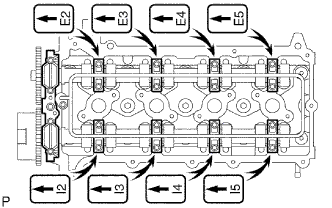
Temporarily install the No. 1 camshaft bearing cap.
-
Confirm the location for each camshaft bearing cap and install each one to the proper location.
-
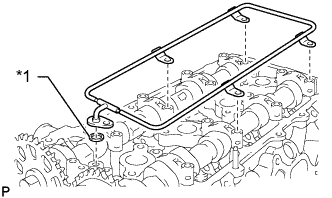
Text in Illustration *1 O-Ring Install a new O-ring to the No. 1 camshaft bearing cap.
-
Temporarily install the oil delivery pipe.
-
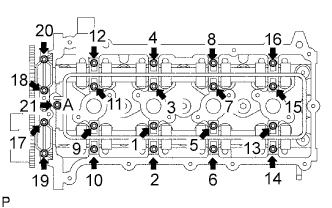
Install the 21 bolts and tighten them in the order shown in the illustration.
- Torque:
- for bolt A
- 12 N*m { 122 kgf*cm, 9 ft.*lbf }
- except bolt A
- 16 N*m { 158 kgf*cm, 11 ft.*lbf }
-
-
INSTALL CAMSHAFT TIMING GEAR OR SPROCKET
-
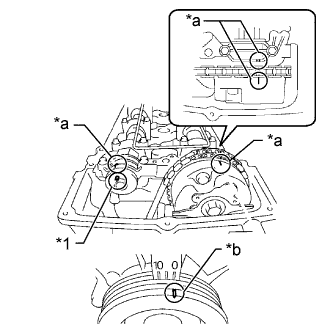
Text in Illustration *1 Knock Pin *a Timing Mark *b Groove Rotate the camshaft so that the camshaft timing mark and No. 2 camshaft knock pin are as shown in the illustration.
-
Turn the crankshaft pulley and align its groove with the "0" timing mark of the timing chain cover.
-
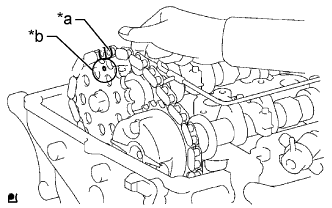
Text in Illustration *a Paint Mark *b Timing Mark Install the timing chain to the camshaft timing gear or sprocket with the paint mark aligned with the timing marks on the camshaft timing gear or sprocket.
-
Align the No. 2 camshaft knock pin and camshaft timing gear or sprocket pin hole. Then install the camshaft timing gear or sprocket to the No. 2 camshaft.
Note
If the knock pin and pin hole are difficult to align, slightly rotate the No. 2 camshaft back and forth using the hexagonal part of the camshaft. Then attempt alignment again.
-
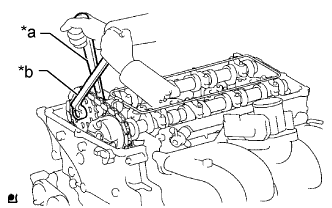
Text in Illustration *a Hold *b Tighten Hold the camshaft with a wrench and tighten the camshaft timing gear or sprocket bolt.
- Torque:
- 78 N*m { 795 kgf*cm, 58 ft.*lbf }
-
Remove the hexagon wrench from the chain tensioner.
-
Apply adhesive to 2 or 3 threads of the timing chain cover plug.
Adhesive Toyota Genuine Adhesive 1324, Three Bond 1324 or equivalent Note
Remove any oil from the bolt hole.
-
Using a 10 mm socket hexagon wrench, install the timing chain cover plug.
- Torque:
- 17 N*m { 169 kgf*cm, 12 ft.*lbf }
-
-
INSTALL TIMING CHAIN GUIDE
-
Install a new O-ring and the timing chain guide with the 2 bolts.
- Torque:
- 10 N*m { 102 kgf*cm, 7 ft.*lbf }
-
-
INSTALL CYLINDER HEAD COVER SUB-ASSEMBLY
-
Install a new cylinder head cover gasket and new No. 2 cylinder head cover gasket to the cylinder head cover sub-assembly.
-
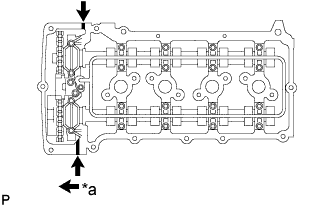
Text in Illustration *a Seal Packing Apply seal packing as shown in the illustration.
Seal packing Toyota Genuine Seal Packing Black, Three Bond 1207B or equivalent Note
-
Remove any oil from the contact surface.
-
Install the cylinder head cover sub-assembly within 3 minutes after applying seal packing.
-
Do not start the engine for at least 4 hours after installing.
-
-
Temporarily install the cylinder head cover sub-assembly with the 19 bolts and 2 nuts.
-
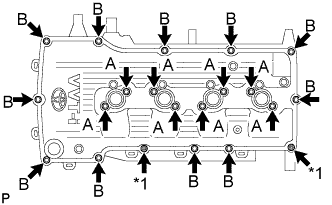
Text in Illustration *1 Nut Tighten the bolts (A) shown in the illustration.
- Torque:
- 9.0 N*m { 92 kgf*cm, 80 in.*lbf }
-
Tighten the bolts (B) shown in the illustration.
- Torque:
- 9.0 N*m { 92 kgf*cm, 80 in.*lbf }
Tech Tips
Make sure the tightening torque of bolts (A).
-
-
CONNECT PCV HOSE
-
Connect the PCV hose to the PCV valve sub-assembly, and slide the clamp to secure the hose.
-
-
INSTALL IGNITION COIL ASSEMBLY
-
Install the ignition coils with the bolts.
- Torque:
- 9.0 N*m { 92 kgf*cm, 80 in.*lbf }
-
-
INSTALL INTAKE AIR CONNECTOR
-
Temporarily install the intake air connector to the throttle body assembly.
-
Connect the vacuum hose to the intake air connector.
-
Connect the No. 2 PCV hose to the cylinder head cover sub-assembly, and slide the clamp to secure the hose.
-
Install the intake air connector with the 2 bolts.
- Torque:
- 8.0 N*m { 82 kgf*cm, 71 in.*lbf }
-
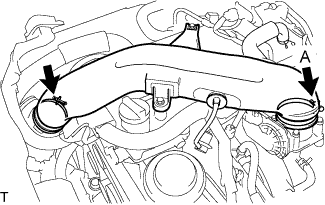
Tighten the 2 hose clamps.
- Torque:
- for clamp A
- 5.0 N*m { 51 kgf*cm, 44 in.*lbf }
-
-
INSTALL FAN AND GENERATOR V BELT
-
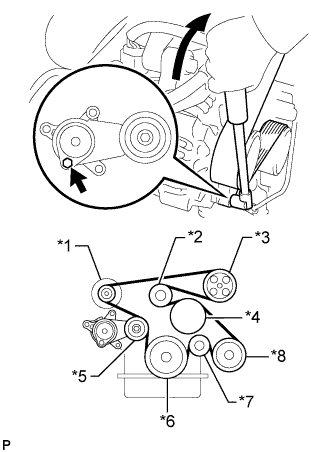
Text in Illustration *1 Generator *2 No. 1 Idler Pulley *3 Vane Pump *4 Fan Pulley *5 Tensioner Pulley *6 Crankshaft Pulley *7 Idler Pulley *8 Cooler Compressor Install the fan and generator V belt to all the pulleys except the V-ribbed belt tensioner pulley.
-
Use the hexagon-shaped part indicated by the arrow in the illustration to move the tensioner pulley downward, and then install the fan and generator V belt to the tensioner pulley.
Note
-
The backside of the fan and generator V belt should face the tensioner pulley.
-
Check that the fan and generator V belt is properly installed to each pulley.
-
-
-
INSTALL ENGINE SERVICE HOLE SUB COVER SUB-ASSEMBLY
-
Install the engine service hole cover sub-assembly with the 5 bolts.
- Torque:
- 13 N*m { 133 kgf*cm, 10 ft.*lbf }
-
-
INSTALL FRONT DOOR SCUFF PLATE RH
-
INSTALL FRONT SEAT ASSEMBLY RH
-
CONNECT CABLE TO NEGATIVE BATTERY TERMINAL
Note
When disconnecting the cable, some systems need to be initialized after the cable is reconnected Click here.
-
INSPECT FOR OIL LEAK
-
Start the engine. Make sure that there are no oil leaks from the areas that were worked on.
-
-
INSPECT ENGINE OIL LEVEL
-
Warm up the engine, stop the engine and wait 5 minutes.
-
Check that the oil level is between the dipstick low level mark and full level mark.
If the level is low, check for leakage and add oil up to the full level mark.
Note
Do not fill with engine oil above the full level mark.
Tech Tips
A certain amount of engine oil will be consumed while driving. In the following situations, oil consumption may increase, and engine oil may need to be refilled in between oil maintenance intervals.
-
When the engine is new, for example directly after purchasing the vehicle or after replacing the engine.
-
If low quality oil or oil of an inappropriate viscosity is used.
-
When driving at high engine speed or with a heavy load, (when towing, or), when driving while accelerating or decelerating frequently.
-
When leaving the idling for a long time, or when driving frequently through heavy traffic.
When judging the amount of oil consumption, keep in mind that the oil may have become diluted, making it difficult to judge the true level accurately.
-
-
-
INSPECT FOR COOLANT LEAKS
CAUTION:
Do not remove the radiator reservoir cap sub-assembly while the engine and radiator are still hot. Pressurized, hot engine coolant and steam may be released and cause serious burns.
-
Remove the radiator reservoir cap sub-assembly.
-
Fill the radiator reservoir assembly with engine coolant, and then attach a radiator cap tester.
-
Warm up the engine.
-
Using the radiator cap tester, increase the pressure inside the radiator to 137 kPa (1.4 kgf/cm2, 20 psi), and then check that the pressure does not drop.
If the pressure drops, check the hoses, radiator assembly and engine water pump assembly for leakage.
If there are no signs or traces of external engine coolant leakage, check the heater core, cylinder block assembly and cylinder head sub-assembly.
-
Install the radiator reservoir cap sub-assembly.
-
-
INSPECT IGNITION TIMING
-
Warm up and stop the engine.
Note
A warmed up engine should have an engine coolant temperature of over 80°C (176°F), have an engine oil temperature of 60°C (140°F), and the engine speed should be stabilized.
-
When using the intelligent tester:
-
Connect the intelligent tester to the DLC3.
-
Start the engine and idle it.
-
Turn the intelligent tester main switch on.
-
Enter the following menus:
Powertrain / Engine and ECT / Data List / IGN Advance
Standard ignition timing 5 to 15° BTDC at idle Note
When checking the ignition timing, the transmission should be in neutral or park.
Tech Tips
Refer to the intelligent tester operator's manual for further detail.
-
-
When not using the intelligent tester:
-
Connect the tester probe of a timing light to the wire of the ignition coil connector for the No.4 cylinder.
Note
-
Use a timing light that detects primary signals.
-
After checking, be sure to wrap the wire harness with tape.
-
-
Start the engine and idle it.
-
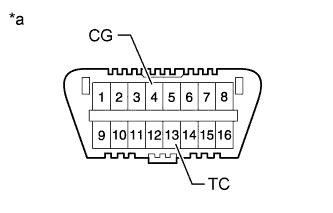
Using SST, connect terminals 13 (TC) and 4 (CG) of the DLC3.
- SST
- 09843-18040
Text in Illustration *a Front view of DLC3 Note
-
Confirm the terminal numbers before connecting them. Connecting the wrong terminals can damage the engine.
-
When checking the ignition timing, the transmission should be in neutral or park.
Tech Tips
-
-
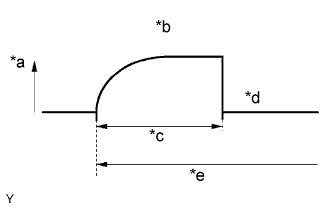
After connecting terminals (TC and CG), engine speed changes to approximately 1000 to 1500 rpm for 5 seconds, and then returns to idle speed. This is because the ECM checks that the ISC (idle speed control system) operates properly.
-
Perform the inspection of the ignition timing after engine speed is returned to idle speed.
Text in Illustration *a Engine Speed *b Approx. 1000 to 1500 rpm *c 5 sec. *d Idle Speed *e Connect Terminals TC and CG -
Inspect the ignition timing
Standard ignition timing 3 to 7° BTDC at idle -
Disconnect terminals 13 (TC) and 4 (CG) of the DLC3.
-
Inspect the ignition timing
Standard ignition timing 5 to 15° BTDC at idle -
Check that the ignition timing advances immediately when the engine speed is increased.
-
Turn the ignition switch off.
-
Remove the timing light.
-
-
-
INSPECT ENGINE IDLE SPEED
-
Warm up and stop the engine.
-
When using the intelligent tester:
-
Connect the intelligent tester to the DLC3.
Tech Tips
Refer to the intelligent tester operator's manual for further details.
-
Start the engine and idle it.
-
Turn the intelligent tester main switch on.
-
Enter the following menus:
Powertrain / Engine and ECT / Data List / Engine SPD
Idle speed 650 to 750 rpm Note
-
When checking the idle speed, the transmission should be in the neutral position.
-
Switch off all accessories and air conditioning before connecting the intelligent tester.
-
-
Turn the ignition switch off.
-
Disconnect the intelligent tester from the DLC3.
-
-
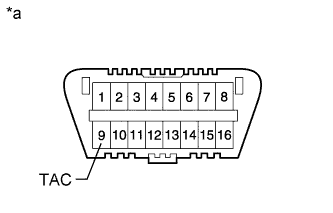
Text in Illustration *a Front view of DLC3 When not using the intelligent tester:
-
Install SST to terminal 9 (TAC) of DLC3, and then connect a tachometer.
- SST
- 09843-18030
Note
Confirm the terminal numbers before connecting them. Connecting the wrong terminals can damage the engine.
-
Start the engine and idle it.
-
Inspect the engine idling speed.
Idle speed 650 to 750 rpm -
Turn the ignition switch off.
-
Disconnect the tachometer.
-
Remove SST from terminal 9 (TAC).
-
-
-
INSPECT CO/HC
-
Start and warm up the engine.
-
Run the engine at 2500 rpm for approximately 180 seconds.
-
Insert the CO/HC meter testing probe at least 40 cm (1.31 ft.) into the tailpipe while idling.
-
Immediately check the CO/HC concentration at idle and at 2500 rpm.
Tech Tips
-
When performing the 2-mode (2500 rpm and idle) test, follow the measurement order prescribed by the applicable local regulations.
-
If the CO/HC concentration does not comply with regulations, troubleshoot in the order given below.
-
-
If the CO/HC concentration is not as specified, perform troubleshooting in the order given below.
-
Check the air fuel ratio sensor Click here and heated oxygen sensor Click here operation.
-
See the table below for possible causes, and then inspect and repair the applicable causes if necessary.
CO HC Problems Causes Normal High Rough idle
-
Faulty ignitions:
-
Incorrect timing
-
Fouled, shorted or improperly gapped plugs
-
Incorrect valve clearance
-
Leaks in intake and exhaust valves
-
Leaks in cylinders
Low High Rough idle
(Fluctuating HC reading)
-
Vacuum leaks:
-
PCV hoses
-
Intake manifold
-
Throttle body
-
Brake booster line
-
Lean mixture causing misfire
High High Rough idle
(Black smoke from exhaust)
-
Restricted air filter
-
Plugged PCV valve
-
Faulty SFI systems:
-
Faulty pressure regulator
-
Defective engine coolant temperature sensor
-
Defective mass air flow meter
-
Faulty ECM
-
Faulty injectors
-
Faulty throttle body
-
-
-