IGNITION SYSTEM ON-VEHICLE INSPECTION
PROCEDURE
-
PERFORM SPARK TEST
CAUTION:
-
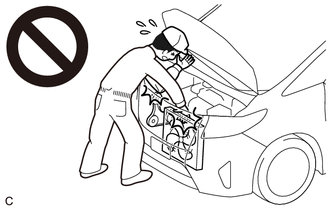
When working near the engine room while the engine has started or the power source mode is ignition switch to ON (IG), do not touch the fan and generator V belt or rotating components such as the fan, etc.
-
Touching the fan and generator V belt or rotating components such as the fan, etc. could result in your hand or clothing getting caught and pulled in.
-
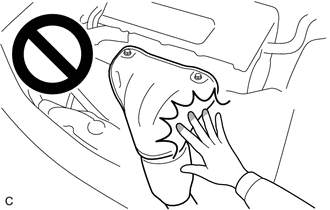
When the engine is hot, do not touch high-temperature areas such as the engine or exhaust manifold.
-
Touching high-temperature areas such as the engine and exhaust manifold could result in burns.
-
Check for DTCs.
Note
If any DTCs are present, perform troubleshooting in accordance with the procedure for each DTC.
-
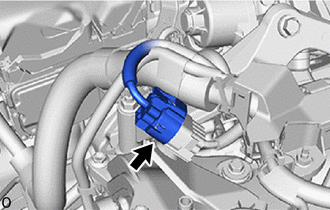
Disconnect the engine wire connector.
Note
Perform this step in order to stop fuel injection to prevent damage to the catalyst due to unburned fuel.
-
Remove the 4 No. 1 ignition coils and 4 spark plugs.
Note
If the No. 1 ignition coil or spark plug has been struck or dropped, replace it.
Tech Tips
Arrange the removed parts in the correct order.
-
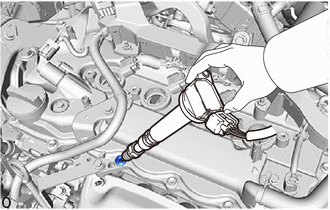
Install the spark plug to the No. 1 ignition coil, and then connect the No. 1 ignition coil connector.
-
Ground the spark plug.
-
Check that spark occurs at each spark plug while the engine is being cranked.
Note
-
Be sure to ground the spark plugs when checking them.
-
Do not crank the engine for more than 2 seconds.
- For vehicles with a cranking hold function, turn the ignition switch off during cranking to stop cranking.
-
Perform spark tests for all cylinders.
-
If the No. 1 ignition coil or spark plug has been struck or dropped, replace it.
Tech Tips
If spark does not occur, perform the following procedure.
-
-
Connect the engine wire connector.
-
Install the 4 spark plugs and 4 No. 1 ignition coils.
Note
If a No. 1 ignition coil or spark plug has been struck or dropped, replace it.
Tech Tips
Install the same parts to their original positions.
-
Check for DTCs.
-
Clear the DTCs.
-
-
INSPECT NO. 1 IGNITION COIL AND SPARK TEST
CAUTION:
-
When working near the engine room while the engine has started or the power source mode is ignition switch to ON (IG), do not touch the fan and generator V belt or rotating components such as the fan, etc.
-
Touching the fan and generator V belt or rotating components such as the fan, etc. could result in your hand or clothing getting caught and pulled in.
-
When the engine is hot, do not touch high-temperature areas such as the engine or exhaust manifold.
-
Touching high-temperature areas such as the engine and exhaust manifold could result in burns.
Tech Tips
Perform "Inspection After Repair" after replacing a No. 1 ignition coil or spark plug.
-
Check that the No. 1 ignition coil connector is securely connected.
Result Result Action OK Go to next step NG Connect securely -
Perform a spark test on each No. 1 ignition coil.
-
Replace the No. 1 ignition coil with a known good one.
-
Perform the spark test again.
Result Result Action OK Replace ignition coil assembly
NG Go to next step Note
If a No. 1 ignition coil assembly or spark plug has been struck or dropped, replace it.
-
-
Perform a spark test on each spark plug.
-
Replace the spark plug with a known good one.
-
Perform the spark test again.
Result Result Action OK Replace spark plug
NG Inspect ignition system
Note
If a No. 1 ignition coil assembly or spark plug has been struck or dropped, replace it.
-
-
Install the 4 spark plugs and 4 No. 1 ignition coils.
Note
If a No. 1 ignition coil assembly or spark plug has been struck or dropped, replace it.
Tech Tips
Install the same parts to their original positions.
-
Check for DTCs.
-
Clear the DTCs.
-
-
CHECK SPARK PLUG
CAUTION:
-
When working near the engine room while the engine has started or the power source mode is ignition switch to ON (IG), do not touch the fan and generator V belt or rotating components such as the fan, etc.
-
Touching the fan and generator V belt or rotating components such as the fan, etc. could result in your hand or clothing getting caught and pulled in.
-
When the engine is hot, do not touch high-temperature areas such as the engine or exhaust manifold.
-
Touching high-temperature areas such as the engine and exhaust manifold could result in burns.
Note
-
Be careful not to damage the iridium tip or platinum tip of the spark plug.
-
Check the iridium tip visually as it is easily damaged.
-
Never attempt to adjust the electrode gap of a used spark plug.
-
If the spark plug is extremely dirty with oil, etc., replace it.
-
Replace a spark plug if it is damaged at all.
-
When installing a new spark plug, do not remove the protective cap from the spark plug tip until just before installing the spark plug to the engine.
-
If the spark plug has been struck or dropped, replace it.
-
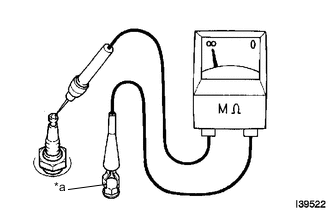
*a Body Ground Check the electrode.
-
Using a megohmmeter, measure the insulation resistance.
Standard Insulation Resistance Tester Connection Condition Specified Condition Spark plug (terminal part) - Body ground Always 10 MΩ or higher Tech Tips
If a megohmmeter is not available, perform the following simple inspection instead.
-
-
Alternative inspection method.
-
Start the engine.
Note
Do not perform this step when any of the following DTCs are output: P030000, P030027, P030085, P030100, P030200, P030300, P030400 (Cylinder Misfire Detected).
-
Quickly accelerate the engine to 4000 rpm 5 times.
Note
Do not perform this step when any of the following DTCs are output: P030000, P030027, P030085, P030100, P030200, P030300, P030400 (Cylinder Misfire Detected).
-
Remove the spark plug.
-
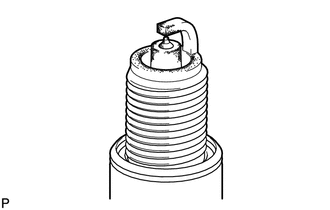
Visually check the spark plug.
Tech Tips
If the electrode is dry, the spark plug is functioning properly. If the electrode is damp, proceed to the next step.
-
-
Check the spark plug for any damage to its threads and insulator.
If there is any damage, replace the spark plug.
Recommended Spark Plug Manufacturer Spark Plug Type DENSO FC16HR-Q8 -
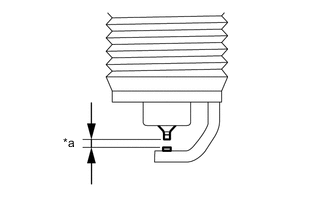
*a Spark Plug Electrode Gap Check the spark plug electrode gap.
Maximum Electrode Gap for Used Spark Plug 1.2 mm (0.0472 in.) Note
Never attempt to adjust the electrode gap of a used spark plug.
If the electrode gap is more than the maximum, replace the spark plug.
Standard Electrode Gap for New Spark Plug 0.7 to 0.8 mm (0.0276 to 0.0315 in.) -
Install the spark plug.
-
-
PERFORM INITIALIZATION
-
Perform "Inspection After Repair" after replacing a No. 1 ignition coil or spark plug.
-