PEDESTRIAN PROTECTION SYSTEM, Diagnostic DTC:B16A2, B16A3

| DTC Code | DTC Name |
|---|---|
| B16A2 | Lost Communication with Pedestrian Protection Sensor Bus RH |
| B16A3 | Pedestrian Protection Sensor Bus Initialization Incomplete (RH) |
DESCRIPTION
The pedestrian detection sensor RH circuit consists of the pedestrian detection ECU assembly and pedestrian protection sensor RH.
The pedestrian protection sensor RH detects impacts to the vehicle and sends signals to the pedestrian detection ECU assembly to determine if the pop up hood should be deployed.
These DTCs are stored when a malfunction is detected in the pedestrian detection sensor RH circuit.
| DTC No. | Detection Item | DTC Detection Condition | Trouble Area | Warning Indicate | Test Mode / Check Mode |
|---|---|---|---|---|---|
| B16A2 | Lost Communication with Pedestrian Protection Sensor Bus RH | One of the following conditions is met:
|
|
Comes on | Not applicable |
| B16A3 | Pedestrian Protection Sensor Bus Initialization Incomplete (RH) | One of the following conditions is met:
|
|
Comes on | Not applicable |
WIRING DIAGRAM
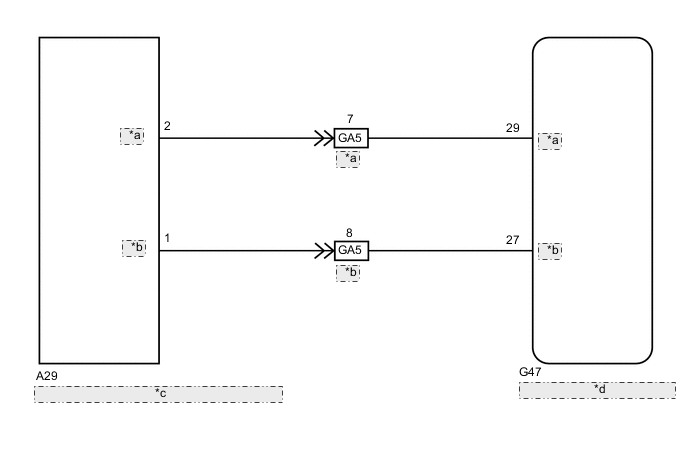
| *a | PSR+ |
| *b | PSR- |
| *c | Pedestrian Detection Chamber Assembly (Pedestrian Protection Sensor RH) |
| *d | Pedestrian Detection ECU Assembly |
CAUTION / NOTICE / HINT
Note
-
After turning the power switch off, waiting time may be required before disconnecting the cable from the negative (-) auxiliary battery terminal. Therefore, make sure to read the disconnecting the cable from the negative (-) auxiliary battery terminal notices before proceeding with work.
-
When disconnecting the cable from the negative (-) auxiliary battery terminal while performing repairs, some systems need to be initialized after the cable is reconnected.
PROCEDURE
-
CHECK CONNECTION OF CONNECTORS
-
Turn the power switch off.
-
Disconnect the cable from the negative (-) auxiliary battery terminal, and wait for at least 90 seconds.
-
Check that the connectors are properly connected to the pedestrian detection ECU assembly and pedestrian detection chamber assembly (pedestrian protection sensor RH).
OK The connectors are properly connected. Result Proceed to OK NG
NG 
CONNECT CONNECTORS PROPERLY
OK 
-
-
CHECK CONNECTORS
-
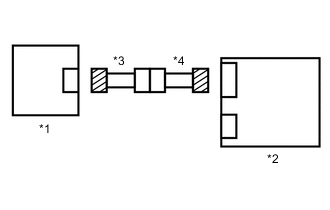
*1 Pedestrian Detection Chamber Assembly (Pedestrian Protection Sensor RH) *2 Pedestrian Detection ECU Assembly *3 Engine Room Main Wire *4 Instrument Panel Wire Disconnect the connectors from the pedestrian detection ECU assembly and pedestrian detection chamber assembly (pedestrian protection sensor RH).
-
Check that the connectors (on the pedestrian detection ECU assembly side and pedestrian detection sensor RH side) are not damaged.
OK The connectors are not deformed or damaged. Result Proceed to OK NG
NG
REPLACE ENGINE ROOM MAIN WIRE OR INSTRUMENT PANEL WIRE
OK
-
-
CHECK PEDESTRIAN PROTECTION SENSOR RH CIRCUIT
-
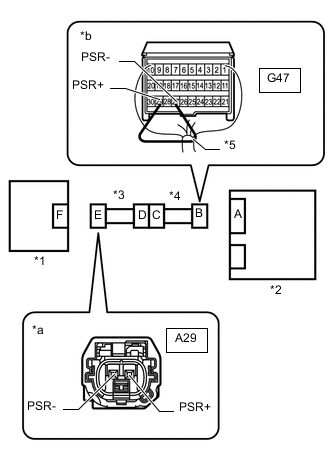
*1 Pedestrian Detection Chamber Assembly (Pedestrian Protection Sensor RH) *2 Pedestrian Detection ECU Assembly *3 Engine Room Main Wire *4 Instrument Panel Wire *5 Service Wire *a Front view of wire harness connector
(to Pedestrian Detection Chamber Assembly [Pedestrian Protection Sensor RH])
*b Rear view of wire harness connector
(to Pedestrian Detection ECU Assembly)
Connect the cable to the negative (-) auxiliary battery terminal, and wait for at least 2 seconds.
-
Turn the power switch on (IG).
-
Measure the voltage according to the value(s) in the table below.
Standard Voltage Tester Connection Switch Condition Specified Condition A29-2 (PSR+) - Body ground Power switch on (IG) Below 1 V A29-1 (PSR-) - Body ground Power switch on (IG) Below 1 V -
Turn the power switch off.
-
Disconnect the cable from the negative (-) auxiliary battery terminal, and wait for at least 90 seconds.
-
Using a service wire, connect terminals 29 (PSR+) and 27 (PSR-) of connector B.
Note
Do not forcibly insert the service wire into the terminals of the connector when connecting a service wire.
-
Measure the resistance according to the value(s) in the table below.
Standard Resistance Tester Connection Condition Specified Condition A29-2 (PSR+) - A29-1 (PSR-) Always Below 1 Ω -
Disconnect the service wire from connector B.
-
Measure the resistance according to the value(s) in the table below.
Standard Resistance Tester Connection Condition Specified Condition A29-2 (PSR+) - A29-1 (PSR-) Always 1 MΩ or higher A29-2 (PSR+) - Body ground Always 1 MΩ or higher A29-1 (PSR-) - Body ground Always 1 MΩ or higher Result Proceed to OK NG
NG 
CHECK INSTRUMENT PANEL WIRE Click here
OK
-
-
CHECK PEDESTRIAN DETECTION CHAMBER ASSEMBLY (PEDESTRIAN PROTECTION SENSOR RH)
-
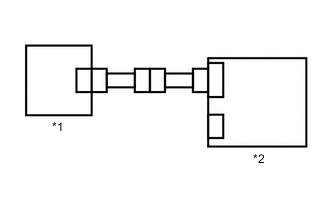
*1 Pedestrian Detection Chamber Assembly (Pedestrian Protection Sensor RH) *2 Pedestrian Detection ECU Assembly Connect the connectors to the pedestrian detection ECU assembly.
-
Replace the pedestrian detection chamber assembly with a new one.
-
Connect the cable to the negative (-) auxiliary battery terminal, and wait for at least 2 seconds.
-
Turn the power switch on (IG), and wait for at least 60 seconds.
-
Clear the DTCs stored in memory.
Body Electrical > Pedestrian Protection > Clear DTCs -
Turn the power switch off.
-
Turn the power switch on (IG), and wait for at least 60 seconds.
-
Check for DTCs.
Body Electrical > Pedestrian Protection > Trouble CodesResult Result Proceed to DTCs B16A2 and B16A3 are not output A DTC B16A2 or B16A3 is output B Tech Tips
Codes other than B16A2 and B16A3 may be output at this time, but they are not related to this check.
-
Turn the power switch off.
-
Disconnect the cable from the negative (-) auxiliary battery terminal, and wait for at least 90 seconds.
A
END (PEDESTRIAN DETECTION CHAMBER ASSEMBLY [PEDESTRIAN PROTECTION SENSOR RH] WAS DEFECTIVE)
B
REPLACE PEDESTRIAN DETECTION ECU ASSEMBLY Click here
-
-
CHECK INSTRUMENT PANEL WIRE
-
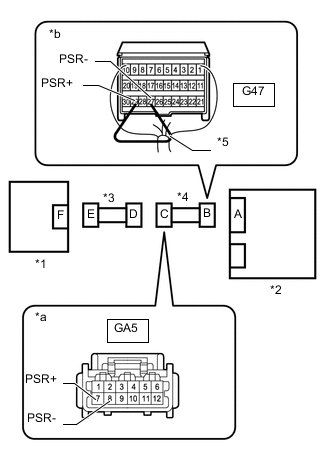
*1 Pedestrian Detection Chamber Assembly (Pedestrian Protection Sensor RH) *2 Pedestrian Detection ECU Assembly *3 Engine Room Main Wire *4 Instrument Panel Wire *5 Service Wire *a Front view of wire harness connector
(to Engine Room Main Wire)
*b Rear view of wire harness connector
(to Pedestrian Detection ECU Assembly)
Disconnect the instrument panel wire connector from the engine room main wire.
-
Connect the cable to the negative (-) auxiliary battery terminal, and wait for at least 2 seconds.
-
Turn the power switch on (IG).
-
Measure the voltage according to the value(s) in the table below.
Standard Voltage Tester Connection Switch Condition Specified Condition GA 5-7 (PSR+) - Body ground Power switch on (IG) Below 1 V GA 5-8 (PSR-) - Body ground Power switch on (IG) Below 1 V -
Turn the power switch off.
-
Disconnect the cable from the negative (-) auxiliary battery terminal, and wait for at least 90 seconds.
-
Using a service wire, connect terminals 29 (PSR+) and 27 (PSR-) of connector B.
Note
Do not forcibly insert the service wire into the terminals of the connector when connecting a service wire.
-
Measure the resistance according to the value(s) in the table below.
Standard Resistance Tester Connection Condition Specified Condition GA 5-7 (PSR+) - GA 5-8 (PSR-) Always Below 1 Ω -
Disconnect the service wire from connector B.
-
Measure the resistance according to the value(s) in the table below.
Standard Resistance Tester Connection Condition Specified Condition GA 5-7 (PSR+) - GA 5-8 (PSR-) Always 1 MΩ or higher GA 5-7 (PSR+) - Body ground Always 1 MΩ or higher GA 5-8 (PSR-) - Body ground Always 1 MΩ or higher Result Proceed to OK NG
OK
REPLACE ENGINE ROOM MAIN WIRE
NG
REPLACE INSTRUMENT PANEL WIRE
-