Click here
-
CAUTION:
Failure to carry out service procedures in the correct sequence could cause pedestrian protection system parts to unexpectedly deploy and possibly lead to serious injuries. Furthermore, if a mistake is made when servicing pedestrian protection system parts, they may fail to operate when required. Before performing servicing (including installation/removal, inspection and replacement of parts), be sure to read the following precautions.
-
Furthermore, if a mistake is made when servicing pedestrian protection system parts, they may fail to operate when required. Before performing servicing (including installation/removal, inspection and replacement of parts), be sure to read the following precautions.
-
Pedestrian detection ECU assembly
-
Pedestrian detection chamber assembly
-
Pop up hood lifter assembly
-
No. 2 pop up hood lifter assembly
-
-
-
PRECAUTION FOR DISCONNECTING CABLE FROM NEGATIVE AUXILIARY BATTERY TERMINAL
-
When troubleshooting the SRS, always check for DTCs before disconnecting the cable from the negative (-) auxiliary battery terminal.
-
After turning the power switch off, disconnect the cable from the negative (-) auxiliary battery terminal.
Note:
-
After turning the power switch off, waiting time may be required before disconnecting the cable from the negative (-) auxiliary battery terminal. Therefore, make sure to read the disconnecting the cable from the negative (-) auxiliary battery terminal notices before proceeding with work.
-
When disconnecting the cable from the negative (-) auxiliary battery terminal while performing repairs, some systems need to be initialized after the cable is reconnected.
-
-
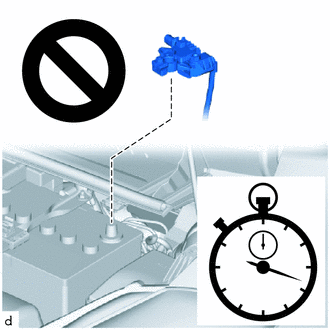
Work must be started at least 90 seconds after the power switch is turned off and the cable is disconnected from the negative (-) auxiliary battery terminal.
CAUTION:The SRS is equipped with a back-up power source. If work is started within 90 seconds of disconnecting the cable from the negative (-) auxiliary battery terminal, the pedestrian protection system parts may deploy.
-
When the cable is disconnected from the negative (-) auxiliary battery terminal, the memory of various systems will be cleared. Because of this, be sure to make a record of the contents memorized in each system before starting work. When work is finished, adjust each system to its previous state.
-
-
GENERAL PRECAUTION
-
Never disassemble or attempt to repair any of the pedestrian protection system parts.
-
If any of the pedestrian protection system parts are dropped, or if any cracks, dents or other defects are found, replace them with new parts.
-
Never use pedestrian protection system parts from another vehicle. When replacing parts, use new parts.
-
Do not expose any of the pedestrian protection system parts directly to high temperatures or flames.
-
If the vehicle has been involved in a minor collision where the pop up hood lifter assembly did not deploy, the pedestrian protection system parts should be inspected before further use of the vehicle.
-
Do not apply grease, detergent, oil or water to the pedestrian protection system parts. If applied, immediately wipe it off with a dry cloth.
-
When deploying or storing the pedestrian protection system parts, avoid places with a high temperature (ambient temperature of 115°C [239°F] or higher) and high humidity, and keep them away from electrical noise.
-
When disposing of the vehicle or an SRS part by itself, deploy it using SST before disposal.
CAUTION: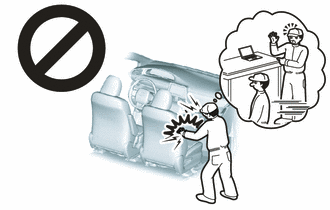
Dispose of the pop up hood lifters according to the disposal procedures for each pop up hood lifter.
-
Pop up hood lifter assembly
-
No. 2 pop up hood lifter assembly
-
-
Never measure the resistance of the pop up hood lifter assembly.
CAUTION:
The pop up hood lifter assembly may deploy due to the tester input.
-
Use a voltmeter/ohmmeter with high impedance (minimum = 10 kΩ) for troubleshooting electrical circuits.
-
Be sure to check the pop up hood lifter assembly multi-information display after checking, removing and installing, or replacing the pedestrian detection chamber assembly.
-
-
PRECAUTION FOR POP UP HOOD LIFTER ASSEMBLY AND NO. 2 POP UP HOOD LIFTER ASSEMBLY
-
Always place a removed pop up hood lifter with the extended section facing upward.
CAUTION:Placing the pop up hood lifter assembly and No. 2 pop up hood lifter assembly with the extended portion facing downward could cause a serious accident if the pop up hood lifter deploys.
-
When storing the pop up hood lifter assembly and No. 2 pop up hood lifter assembly, do not place objects on top of them or pile up the pop up hood lifter assemblies.
-
-
PRECAUTION FOR PEDESTRIAN DETECTION CHAMBER ASSEMBLY AND FRONT BUMPER ENERGY ABSORBER
-
When the SRS parts are deployed (including when only a pretensioner or pop up hood lifter assembly operates) due to a collision, be sure to replace all sensors in the vehicle body deformed areas (anywhere in need of repair) and pedestrian detection ECU assembly.
-
Replace sensors with new ones even if they are not in the vehicle body deformed areas (anywhere in need of repair) when the vehicle body has been subjected to a large collision and if there are any defects as mentioned below.
-
The defects are as follows:
-
Cracks in the sensor housing
-
Dents in the sensor housing
-
Chips in the sensor housing
-
Cracks or other damage to the connector
-
Damage to the serial number
-
-
-
When removing and installing the pop up hood sensor and pedestrian detection ECU assembly connectors, be sure to perform work with the sensors installed to the vehicle.
-
Do not use a sensor if dropped during operation.
-
Do not use a sensor if subjected to any strong impact.
-
Never disassemble or attempt to repair any of the pedestrian protection system parts.
-
Disconnect and reconnect the connector while supporting the pedestrian detection chamber assembly.
-
The front bumper energy absorber is part of the pedestrian detection chamber assembly. Therefore, if there are any signs it has been subjected to a strong impact or is deformed, do not use it.
-
-
PRECAUTION FOR WIRE HARNESS AND CONNECTOR
-
All wire harnesses except unexposed harnesses in the engine compartment are colored yellow.
-
As special connectors are used, be careful when handling them.
-
-
WHEN SERVICING DAMAGED VEHICLE
-
If the engine hood lock is released after the pop up hood lifter is deployed, the engine hood could be lifted up considerably more than usual.
-
Before using an electric welder on the vehicle, remove the pop up hood lifter assembly.
-
Before performing repairs, remove the pedestrian detection chamber assembly if any impact is likely to be applied to them during repairs.
-
Do not expose the pedestrian detection chamber assembly to high temperatures.
-
As the pop up hood lifter assembly is very hot after being deployed, ensure that all the surrounding wire harnesses and connectors are not damaged.
-
-
CONDITIONS WHEN INSPECTION OF PEDESTRIAN PROTECTION SYSTEM IS NECESSARY
-
When the vehicle is damaged in a collision even when the pop up hood lifter assembly is not deployed.
-
When SRS system and pedestrian protection system DTCs are output.
-
When there are signs of damage or deformation to the front bumper.
-
When any of the airbags or pop up hood lifter assemblies deploy.
-