HYBRID CONTROL SYSTEM, Diagnostic DTC:P1CCC96
| DTC Code | DTC Name |
|---|---|
| P1CCC96 | DC/DC Converter Enable Component Internal Failure |
DESCRIPTION
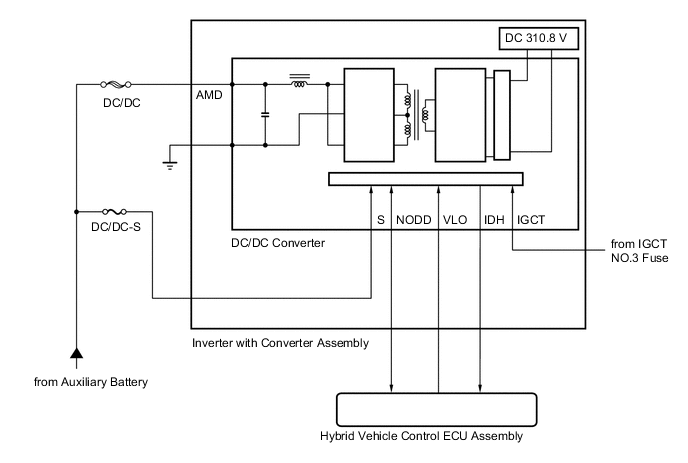
The DC/DC converter converts the DC 310.8 V of the HV battery into DC 12 V in order to supply power to areas such as the vehicle lighting system, audio system and various ECUs. Additionally, it charges the auxiliary battery.
A transistor bridge circuit initially converts DC 310.8 V into alternating current, and a transformer lowers the voltage.
The DC/DC converter controls the output voltage in order to keep a constant voltage at the terminals of the auxiliary battery.
Then, it is rectified and smoothed (into direct current) and converted into DC 12 V.
The motor generator control ECU sends a signal to the DC/DC converter to prohibit its control and receives signals indicating a normal or abnormal condition of the 12 V charging system via the NODD signal line.
If the DC/DC converter malfunctions, the vehicle will become inoperative. Therefore, the motor generator control ECU monitors the operation of the DC/DC converter and detects malfunctions.
This DTC is stored when the DC/DC converter circuit has a malfunction or its operation is prohibited by a fail-safe function, or the auxiliary battery voltage drops to 11 V or less with the power switch on (READY).
If a DC/DC converter malfunction occurs, DC/DC converter malfunction signals are sent from the DC/DC converter to the MG ECU via the NODD signal line.
This DTC may also be stored if a malfunction of the inverter cooling system (blockage, water pump malfunction, etc.) or a high-voltage insulation malfunction occurs.
| DTC No. | Detection Item | DTC Detection Condition | Trouble Area | MIL | Warning Indicate |
|---|---|---|---|---|---|
| P1CCC96 | DC/DC Converter Enable Component Internal Failure | Either of the following conditions is met:
(1 trip detection logic) |
|
Does not come on | Master Warning Light: Comes on |
Tech Tips
*: If the DC/DC converter is malfunctioning, its operation and charging will be stopped and the auxiliary battery voltage will drop.
WIRING DIAGRAM
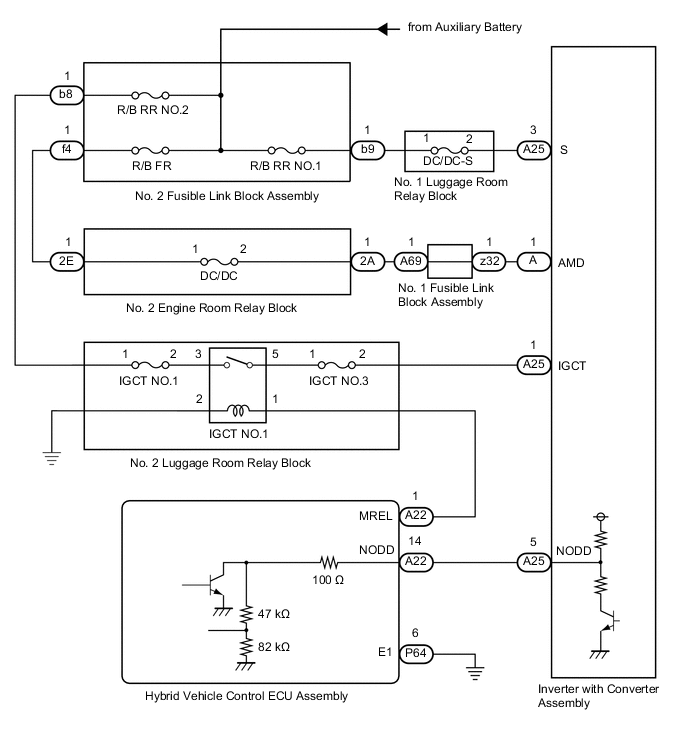
Refer to the wiring diagram for the Generator High-voltage Circuit.
Refer to the wiring diagram for the Motor High-voltage Circuit.
CAUTION / NOTICE / HINT
CAUTION:
-
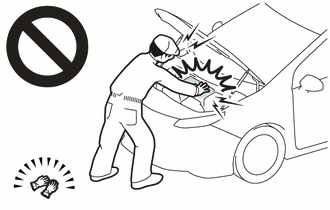
Before the following operations are conducted, take precautions to prevent electric shock by turning the power switch off, wearing insulated gloves, and removing the service plug grip from HV battery.
-
Inspecting the high-voltage system
-
Disconnecting the low voltage connector of the inverter with converter assembly
-
Disconnecting the low voltage connector of the HV battery
-
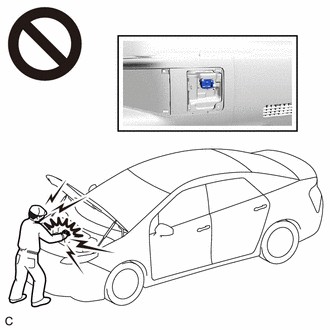
To prevent electric shock, make sure to remove the service plug grip to cut off the high voltage circuit before servicing the vehicle.
-
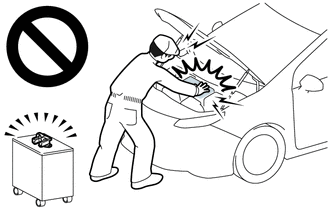
After removing the service plug grip from the HV battery, put it in your pocket to prevent other technicians from accidentally reconnecting it while you are working on the high-voltage system.
-
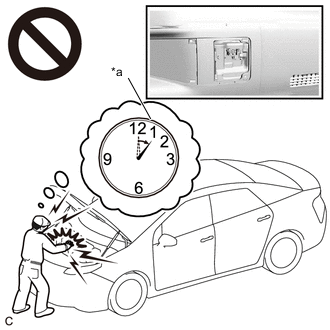
*a Without waiting for 10 minutes After removing the service plug grip, wait for at least 10 minutes before touching any of the high-voltage connectors or terminals. After waiting for 10 minutes, check the voltage at the terminals in the inspection point in the inverter with converter assembly. The voltage should be 0 V before beginning work.
Tech Tips
Waiting for at least 10 minutes is required to discharge the high-voltage capacitor inside the inverter with converter assembly.
Note
After turning the power switch off, waiting time may be required before disconnecting the cable from the negative (-) auxiliary battery terminal. Therefore, make sure to read the disconnecting the cable from the negative (-) auxiliary battery terminal notices before proceeding with work.
Tech Tips
-
After repair, clear the DTCs, turn the power switch off and wait for 30 seconds or more and perform the following procedure to confirm that the auxiliary battery low voltage indicated by this DTC has been repaired.
-
Wait for 2 minutes with park (P) selected, the power switch on (READY) and the following conditions met, then confirm that Data List item "BATT Voltage (Hybrid control system)" is between 13.0 and 15.0 V.
(If charging is not performed and the electrical load increases, +B voltage may not be steady and will gradually drop.)
-
Headlight switch is in the HI position.
-
A/C blower fan switch is in the HI position.
-
Window defogger switch is turned on.
-
By performing the following procedure, the DC/DC converter function can be checked.
-
Connect the AC/DC 400 A probe to the positive (+) auxiliary battery cable.
-
Turn the power switch on (READY) and leave the vehicle as is until the electric current flowing to the auxiliary battery becomes 10 A or less.
-
Turn the power switch on (READY) and turn the headlight switch and A/C blower fan switch to the HI position and the window defogger on.
-
Confirm that the current drawn from the auxiliary battery is 0 A or lower and the auxiliary battery voltage is between 13.0 and 15.0 V.
-
This DTC may be also stored when a part other than the DC/DC converter is malfunctioning or depending on user operation.
-
If this vehicle is used to jump start another vehicle with a discharged battery, a fuse may blow due to overcurrent or the DC/DC converter self-protection may be activated. Also, if this vehicle is jump started by a vehicle with a 24 V battery, the same malfunction may occur and this DTC may be stored. (The suspended DC/DC converter control will return to normal by clearing the DTCs and turning the power switch off.)
-
Confirm that high electrical load equipment such as a high-capacitance audio device or electric kettle is used in the vehicle. (A fuse of the auxiliary battery may be blown due to overcurrent.)
-
If the DC/DC converter is malfunctioning, the auxiliary battery cannot be charged. Therefore, once the power switch is turned off, it may be impossible to turn it on (READY) again if the auxiliary battery is completely discharged. In this case, charge the auxiliary battery. Be careful as charging is not performed during the inspection.
-
If the power switch turns off immediately after it is turned on (READY), the auxiliary battery voltage may be low. Charge the auxiliary battery.
PROCEDURE
-
CHECK DTC OUTPUT
-
Connect the GTS to the DLC3.
-
Turn the power switch on (IG).
-
Enter the following menus: Powertrain / Hybrid Control and Motor Generator / Trouble Codes.
-
Check for DTCs.
Powertrain > Hybrid Control > Trouble Codes
Powertrain > Motor Generator > Trouble CodesResult Result Proceed to P1CCC96 only is output, or DTCs except the ones in the table below are also output. A DTCs of hybrid control system in the table below are output. B DTCs of motor generator control system in the table below are output. C Table 1 Malfunction Content System Relevant DTC Insulation Malfunction Hybrid control system P1C7C49 Hybrid/EV Battery Voltage System Isolation (A/C Area) Internal Electronic Failure P1C7D49 Hybrid/EV Battery Voltage System Isolation (Hybrid/EV Battery Area) Internal Electronic Failure P1C7E49 Hybrid/EV Battery Voltage System Isolation (Transaxle Area) Internal Electronic Failure P1C7F49 Hybrid/EV Battery Voltage System Isolation (Direct Current Area) Internal Electronic Failure High Voltage Circuit Malfunction Hybrid control system P0AA649 Hybrid/EV Battery Voltage System Isolation Internal Electronic Failure P0AD911 Hybrid/EV Battery Positive Contactor Circuit Short to Ground P0ADD11 Hybrid/EV Battery Negative Contactor Circuit Short to Ground P0AE411 Hybrid/EV Battery Precharge Contactor Circuit Short to Ground P1C8449 High Voltage Power Resource Circuit Short during Ready ON P300449 High Voltage Power Resource Circuit Short during Pre-Charge Table 2 Malfunction Content System Relevant DTC System malfunction Hybrid control system P0A9300 Inverter "A" Cooling System Performance P0C7396 Motor Electronics Coolant Pump "A" Component Internal Failure P314A31 Motor Electronics Coolant Pump "A" No Signal Motor generator control system P0E5717 DC/DC Converter Voltage Sensor "A" (VL) Circuit Voltage Above Threshold Tech Tips
P1CCC96 may be output as a result of the malfunction indicated by the DTCs above.
-
The chart above is listed in inspection order of priority.
-
Check DTCs that are output at the same time by following the listed order. (The main cause of the malfunction can be determined without performing unnecessary inspections.)
-
-
Turn the power switch off.
B 
GO TO DTC CHART (HYBRID CONTROL SYSTEM) Click here
C
GO TO DTC CHART (MOTOR GENERATOR CONTROL SYSTEM) Click here
A 
-
-
CHECK FUSE (DC/DC-S)
-
Remove the DC/DC-S fuse from the No. 1 luggage room relay block.
-
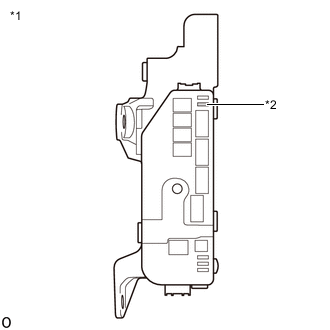
*1 No. 1 Luggage Room Relay Block *2 DC/DC-S Fuse Measure the resistance according to the value(s) in the table below.
Standard Resistance Tester Connection Condition Specified Condition DC/DC fuse terminal 1 - 2 Always Below 1 Ω -
Install the DC/DC-S fuse.
Result Proceed to OK NG
NG 
CHECK HARNESS AND CONNECTOR (INVERTER WITH CONVERTER ASSEMBLY - NO. 1 LUGGAGE ROOM RELAY BLOCK) Click here
OK
-
-
CHECK CONNECTOR CONNECTION CONDITION (HYBRID VEHICLE CONTROL ECU ASSEMBLY CONNECTOR)
Result Proceed to OK NG
-
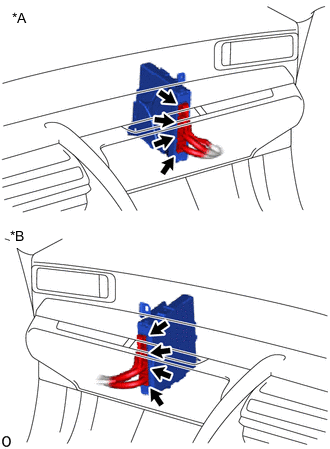
*A for LHD *B for RHD Check the connector connections and contact pressure of the relevant terminals for the hybrid vehicle control ECU assembly connectors.
OK The connectors are connected securely and there are no contact pressure problems. Result Proceed to OK NG
NG
CONNECT SECURELY
OK
-
-
CHECK AMD TERMINAL CONNECTION CONDITION (INVERTER WITH CONVERTER ASSEMBLY CONNECTOR)
Result Result Proceed to OK A NG (The connector is not connected securely.) B NG (The terminals are not making secure contact or are deformed, or water or foreign matter exists in the connector.) C CAUTION:
Be sure to wear insulated gloves.
-
Check that the service plug grip is not installed.
Note
After removing the service plug grip, do not turn the power switch on (READY), unless instructed by the repair manual because this may cause a malfunction.
-
Check the connection condition of the low voltage connectors of the inverter with converter assembly and the contact pressure of each terminal. Check the terminals for deformation, and the connector for water and foreign matter.
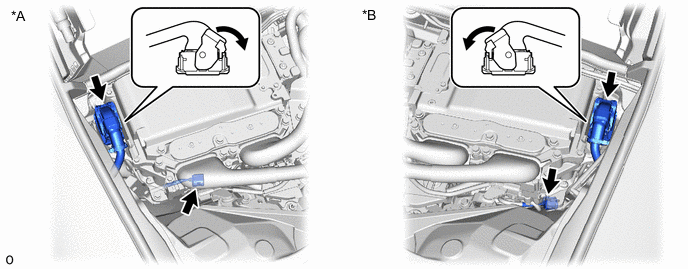
*A for LHD *B for RHD Note
Before disconnecting the connector, confirm that it is properly connected by checking that the claws of the lock levers are engaged and that the connector cannot be pulled off.
OK - The connector is connected securely. - The terminals are not deformed and are connected securely. - No water or foreign matter in the connector. Result Result Proceed to OK A NG (The connector is not connected securely.) B NG (The terminals are not making secure contact or are deformed, or water or foreign matter exists in the connector.) C Tech Tips
When connecting the connector, connect it with the lock levers raised. Rotate each lock lever downward and make sure that the connector is securely connected. When a lock lever is fully lowered, a click will be heard as its claw engages. After the click is heard, pull up on the connector to confirm that it is securely connected.
B
CONNECT SECURELY
C
REPAIR OR REPLACE HARNESS OR CONNECTOR
A
-
-
CHECK FUSIBLE LINK BLOCK ASSEMBLY (DC/DC)
-
Check the fusible link block assembly (DC/DC) for improper installation.
OK The fusible link block assembly is installed securely. -
Remove the fusible link block assembly from the No. 2 engine room relay block.
-
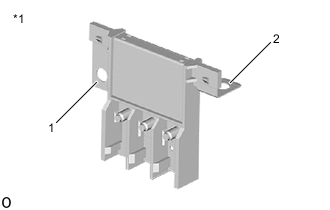
*1 Fusible Link Block Assembly Measure the resistance according to the value(s) in the table below.
Standard Resistance Tester Connection Condition Specified Condition Fusible link block assembly terminal 1 - 2 Always Below 1 Ω -
Install the fusible link block assembly.
Result Proceed to OK NG
NG
REPLACE FUSIBLE LINK BLOCK ASSEMBLY (DC/DC)
OK
-
-
CHECK AMD TERMINAL VOLTAGE (NO. 1 FUSIBLE LINK BLOCK ASSEMBLY SIDE)
CAUTION:
Be sure to wear insulated gloves.
-
Connect the cable to the negative (-) auxiliary battery terminal.
-
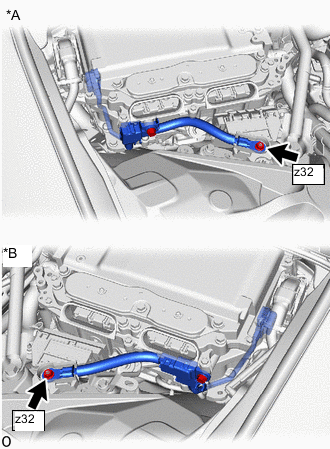
*A for LHD *B for RHD Measure the voltage according to the value(s) in the table below.
Standard Voltage Tester Connection Condition Specified Condition z32-1 (AMD) - Body ground Power switch off Same as auxiliary battery voltage -
Disconnect the cable from the negative (-) auxiliary battery terminal.
Result Proceed to OK NG
NG
REPAIR OR REPLACE HARNESS OR CONNECTOR
OK
-
-
CHECK AMD TERMINAL CONNECTION CONDITION
CAUTION:
Be sure to wear insulated gloves.
-
Check that the service plug grip is not installed.
Note
After removing the service plug grip, do not turn the power switch on (READY), unless instructed by the repair manual because this may cause a malfunction.
-
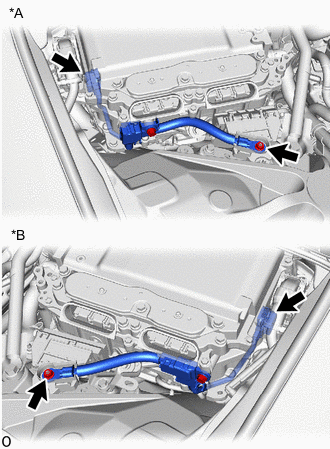
*A for LHD *B for RHD Check that the bolt for the AMD terminal (inverter with converter assembly side and No. 1 fusible link block assembly side) is tightened to the specified torque, the AMD terminal (inverter with converter assembly side and No. 1 fusible link block assembly side) is connected securely, and there is no contact problem.
Torque T = 18.0 N*m (184 kgf*cm, 13 ft.*lbf) (Inverter with converter assembly side) T = 8.0 N*m (82 kgf*cm, 71 in.*lbf) (No. 1 fusible link block assembly side) Result Result Proceed to There are no arc marks. The terminal is connected securely and there are no contact problems. A There are no arc marks. The terminal is not connected securely and there is a contact problem. B There are arc marks. - C
B
CONNECT SECURELY
C
REPLACE MALFUNCTIONING PARTS
A
-
-
CHECK INVERTER BUS-BAR PLATE SUB-ASSEMBLY
CAUTION:
Be sure to wear insulated gloves.
-
Check that the service plug grip is not installed.
Note
After removing the service plug grip, do not turn the power switch on (READY), unless instructed by the repair manual because this may cause a malfunction.
-
Remove the inverter bus-bar plate sub-assembly from the AMD terminal (inverter with converter assembly side and No. 1 fusible link block assembly side).
-
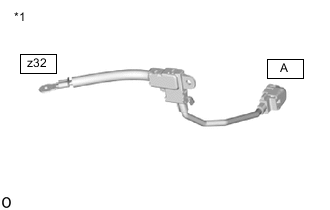
*1 Inverter Bus-bar Plate Sub-assembly Measure the resistance according to the value(s) in the table below.
Standard Resistance Tester Connection Condition Specified Condition A-1 (AMD) - z32-1 Always Below 1 Ω -
Install the inverter bus-bar plate sub-assembly.
Result Proceed to OK NG
NG
REPLACE INVERTER BUS-BAR PLATE SUB-ASSEMBLY Click here
OK
-
-
CHECK HARNESS AND CONNECTOR (INVERTER WITH CONVERTER ASSEMBLY - DC/DC-S FUSE)
CAUTION:
Be sure to wear insulated gloves.
-
Check that the service plug grip is not installed.
Note
After removing the service plug grip, do not turn the power switch on (READY), unless instructed by the repair manual because this may cause a malfunction.
-
Disconnect the inverter with converter assembly connector.
-
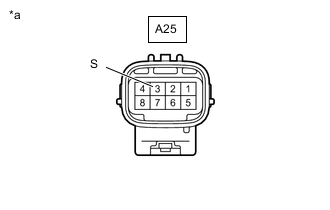
*a Front view of wire harness connector
(to Inverter with Converter Assembly)
Measure the voltage according to the value(s) in the table below.
Standard Voltage Tester Connection Condition Specified Condition A25-3 (S) - Body ground Always Same as auxiliary battery voltage -
Reconnect the inverter with converter assembly connector.
Result Proceed to OK NG
NG
REPAIR OR REPLACE HARNESS OR CONNECTOR
OK
-
-
CHECK HARNESS AND CONNECTOR (RESISTANCE VALUE OF NODD INSIDE HYBRID VEHICLE CONTROL ECU ASSEMBLY)
CAUTION:
Be sure to wear insulated gloves.
-
Check that the service plug grip is not installed.
Note
After removing the service plug grip, do not turn the power switch on (READY), unless instructed by the repair manual because this may cause a malfunction.
-
Disconnect the inverter with converter assembly connector.
-
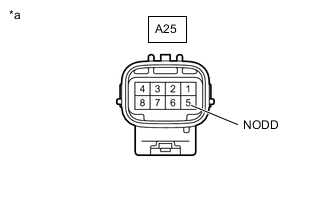
*a Front view of wire harness connector
(to Inverter with Converter Assembly)
Measure the resistance according to the value(s) in the table below.
Standard Resistance Tester Connection Condition Specified Condition A25-5 (NODD) - Body ground Power switch off 110 to 150 kΩ -
Reconnect the inverter with converter assembly connector.
Result Proceed to OK NG
NG
INSPECT HYBRID VEHICLE CONTROL ECU ASSEMBLY (RESISTANCE VALUE OF NODD INSIDE HYBRID VEHICLE CONTROL ECU ASSEMBLY) Click here
OK
-
-
CHECK COOLING SYSTEM
Result Proceed to NEXT
NEXT
-
CHECK DC/DC CONVERTER FUNCTION
Tech Tips
The current at the AMD terminal cannot be measured directly because of space limitations. Measure the current flowing at the auxiliary battery instead.
-
Connect the AC/DC 400 A probe of the tester to the positive (+) auxiliary battery cable.
-
Install the service plug grip.
-
Connect the cable to the negative (-) auxiliary battery terminal.
-
Turn the power switch on (READY) and leave the vehicle as it is until the electric current flowing to the auxiliary battery becomes 10 A or less.
Tech Tips
If the power switch turns off immediately after it is turned on (READY), auxiliary battery voltage may be low. Recharge the auxiliary battery and perform this procedure again.
-
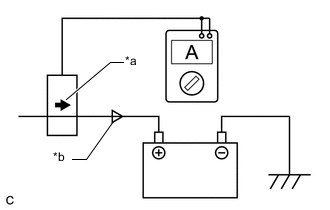
*a Probe Direction *b Current Flowing to Auxiliary Battery 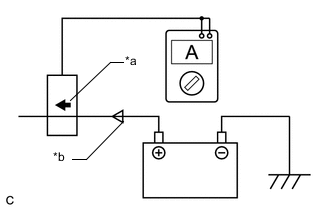
*a Probe Direction *b Current Flowing from Auxiliary Battery Measure the current flowing from the auxiliary battery with the power switch on (READY), the headlight position switch and blower motor switch in the HI position, and the rear window defogger turned on.
Standard Current Item Condition Specified Condition Current flowing from auxiliary battery Power switch on (READY)
(The headlight position switch and blower motor switch are in the HI position, and the rear window defogger is turned on.)
0 A or less
(no current from auxiliary battery)
-
Measure the voltage according to the value(s) in the table below.
Standard Voltage Item Condition Specified Condition Auxiliary battery voltage Power switch on (READY)
(The headlight position switch and blower motor switch are in the HI position, and the rear window defogger is turned on.)
12.5 to 15 V -
Turn the power switch off.
Result Proceed to OK NG
OK
REPLACE INVERTER WITH CONVERTER ASSEMBLY Click here
NG
CHECK HIGH VOLTAGE INSULATION Click here
-
-
INSPECT HYBRID VEHICLE CONTROL ECU ASSEMBLY (RESISTANCE VALUE OF NODD INSIDE HYBRID VEHICLE CONTROL ECU ASSEMBLY)
-
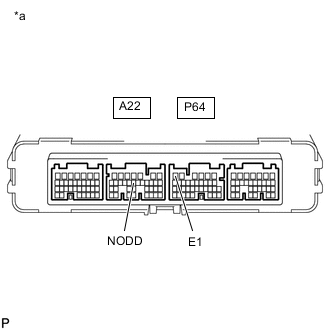
*a Component without harness connected
(Hybrid Vehicle Control ECU Assembly)
Disconnect all the connectors from the hybrid vehicle control ECU assembly.
-
Measure the resistance according to the value(s) in the table below.
Standard Resistance Tester Connection Condition Specified Condition A22-14 (NODD) - P64-6 (E1) Power switch off 110 to 150 kΩ -
Connect the hybrid vehicle control ECU assembly connectors.
Result Proceed to OK NG
OK
REPAIR OR REPLACE HARNESS OR CONNECTOR
NG
REPLACE HYBRID VEHICLE CONTROL ECU ASSEMBLY Click here
-
-
CHECK HIGH VOLTAGE INSULATION
CAUTION:
Be sure to wear insulated gloves.
-
Check that the service plug grip is not installed.
Note
After removing the service plug grip, do not turn the power switch on (READY), unless instructed by the repair manual because this may cause a malfunction.
-
Remove the inverter terminal cover from the inverter with converter assembly.
-
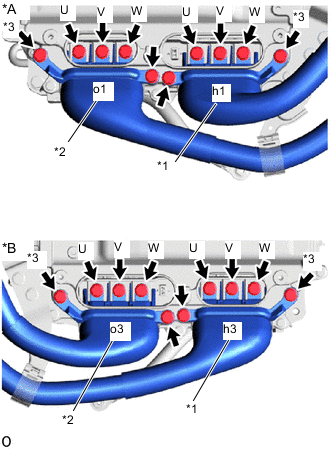
*A for LHD *B for RHD *1 Motor Cable *2 Generator Cable *3 Shield Ground Using a megohmmeter set to 500 V, measure the insulation resistance according to the value(s) in the table below.
Note
Be sure to set the megohmmeter to 500 V when performing this test. Using a setting higher than 500 V can result in damage to the component being inspected.
Standard Resistance for LHD Tester Connection Condition Specified Condition o1-1 (U) - Body ground and shield ground Power switch off 10 MΩ or higher o1-2 (V) - Body ground and shield ground Power switch off 10 MΩ or higher o1-3 (W) - Body ground and shield ground Power switch off 10 MΩ or higher h1-1 (U) - Body ground and shield ground Power switch off 10 MΩ or higher h1-2 (V) - Body ground and shield ground Power switch off 10 MΩ or higher h1-3 (W) - Body ground and shield ground Power switch off 10 MΩ or higher for RHD Tester Connection Condition Specified Condition o3-1 (W) - Body ground and shield ground Power switch off 10 MΩ or higher o3-2 (V) - Body ground and shield ground Power switch off 10 MΩ or higher o3-3 (U) - Body ground and shield ground Power switch off 10 MΩ or higher h3-1 (W) - Body ground and shield ground Power switch off 10 MΩ or higher h3-2 (V) - Body ground and shield ground Power switch off 10 MΩ or higher h3-3 (U) - Body ground and shield ground Power switch off 10 MΩ or higher Tech Tips
Perform this inspection while the motor cable are connected.
-
Install the inverter terminal cover to the inverter with converter assembly.
Result Proceed to OK NG
OK
REPLACE INVERTER WITH CONVERTER ASSEMBLY Click here
NG
CHECK GENERATOR HIGH-VOLTAGE CIRCUIT Click here
-
-
CHECK HARNESS AND CONNECTOR (INVERTER WITH CONVERTER ASSEMBLY - NO. 1 LUGGAGE ROOM RELAY BLOCK)
CAUTION:
Be sure to wear insulated gloves.
-
Check that the service plug grip is not installed.
Note
After removing the service plug grip, do not turn the power switch on (READY), unless instructed by the repair manual because this may cause a malfunction.
-
Disconnect the inverter with converter assembly connector.
-
Remove the DC/DC-S fuse from the No. 1 luggage room relay block.
-
Measure the resistance according to the value(s) in the table below.
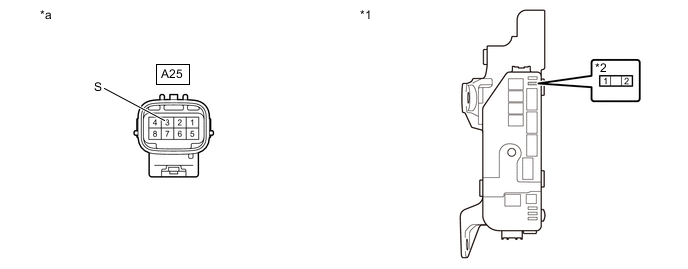
*1 No. 1 Luggage Room Relay Block *2 DC/DC-S Fuse *a Front view of wire harness connector
(to Inverter with Converter Assembly)
- - Standard Resistance Tester Connection Condition Specified Condition A25-3 (S) or 2 (DC/DC-S fuse) - Body ground and other terminals Power switch off 10 kΩ or higher -
Install the DC/DC-S fuse.
-
Reconnect the inverter with converter assembly connector.
Result Proceed to OK NG
NG
REPAIR OR REPLACE HARNESS OR CONNECTOR Click here
OK
-
-
REPLACE INVERTER WITH CONVERTER ASSEMBLY
Result Proceed to NEXT
NEXT
REPLACE FUSE (DC/DC-S)
-
CHECK GENERATOR HIGH-VOLTAGE CIRCUIT
Result Proceed to NEXT
NEXT
-
CHECK MOTOR HIGH-VOLTAGE CIRCUIT
Tech Tips
If the "Motor High-voltage Circuit" inspection results are normal, perform the next step.
Result Proceed to NEXT
NEXT
REPLACE INVERTER WITH CONVERTER ASSEMBLY Click here
-
REPAIR OR REPLACE HARNESS OR CONNECTOR
Result Proceed to NEXT
NEXT
REPLACE FUSE (DC/DC-S)