STOP AND START SYSTEM, Diagnostic DTC:P1603
| DTC Code | DTC Name |
|---|---|
| P1603 | Engine Stall History |
DESCRIPTION
If the engine stalls or engine start fails while the stop and start control is operating, DTC P1603 is stored. Using the GTS, the freeze frame data recorded the moment the DTC is stored can be read. Serviceability has been enhanced by enabling the cause of an engine stall or engine start failure which occurred while the stop and start control was operating to be checked using the freeze frame data.
| DTC No. | DTC Detection Condition | Trouble Area |
|---|---|---|
| P1603 | Both of the following conditions are met for 0.5 seconds or more (1 trip detection logic):
|
|
| Both of the following conditions are met for 0.5 seconds or more (1 trip detection logic):
|
||
| Both of the following conditions are met for 0.5 seconds or more (1 trip detection logic):
|
||
| Both of the following conditions are met for 0.5 seconds or more (1 trip detection logic):
|
||
| Both of the following conditions are met for 0.5 seconds or more (1 trip detection logic):
|
-
*1: Only when the shift lever is in D
-
*2: The mode "stalled" represents a state in which engine restart is prohibited/canceled due to a collision being detected or the engine hood being opened and restart is not preferable. In this situation, "IG" is displayed for the Data List item [Stop&Start of Eng State]. If the mode changes to "IG", engine start by stop and start control is prohibited and the engine can only be started by operating the engine switch.
-
*3: Engine stop judgment is performed to judge whether the engine is stopped completely. The engine stop and start ECU judges that the engine is stopped when it does not receive an engine speed signal (NE signal) from the ECM for 0.6 seconds or more.
-
*4: The engine stop and start ECU stores DTC P0335.
WIRING DIAGRAM
-
Refer to Engine Hood Courtesy Switch Circuit Click here.
-
Refer to DTC P0617 Click here.
CAUTION / NOTICE / HINT
Note
-
Before replacing the engine stop and start ECU, read the number of starter operations and write it into a new engine stop and start ECU Click here.
-
After replacing the starter assembly, perform initialization of the number of starter operations stored in the engine stop and start ECU Click here.
-
When the starter assembly is replaced, "ST relay" and "ST NO. 2 relay" must be also replaced.
-
After replacing the engine stop and start ECU or air conditioning amplifier assembly, reset and perform learning of the air conditioning information in the engine stop and start ECU Click here.
-
After replacing the engine stop and start ECU or airbag sensor assembly, clear and calibrate the deceleration sensor zero point in the engine stop and start ECU Click here.
-
Inspect the fuses for circuits related to this system before performing the following inspection procedure.
Tech Tips
-
If other DTCs are output, perform troubleshooting for this DTC first.
-
Unlike other DTCs that are stored due to a malfunction in parts, circuits or systems, DTC P1603 allows determination of a malfunctioning part according to problem symptoms and the freeze frame data related to a problem recognized by the customer. As this DTC may be stored due to an operation by the customer, it is not necessary to service the vehicle unless the customer recognized a problem. Clear DTCs and return the vehicle to the customer.
-
Using the GTS, read the freeze frame data before troubleshooting. System condition information is recorded as freeze frame data the moment a DTC is stored. This information can be useful when troubleshooting.
-
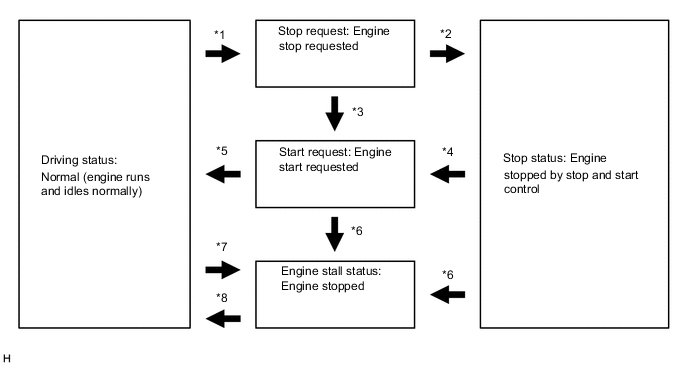
Stop and Start Control Mode Transition:
-
-
*1: Engine stop conditions are met.
-
*2: Engine stop judgment is determined.
-
*3: Engine start conditions are met before the engine is judged as stopped.
-
*4: Engine start conditions are met.
-
*5: Engine determined to be started (engine speed reaches a specified rpm).
-
*6: Collision detected or engine hood opened and mode changed to "stalled".
-
*7: 0.6 seconds elapse after engine stop judgment is established.
-
*8: Engine is started using the engine switch.
PROCEDURE
-
CHECK DTC OUTPUT (SFI SYSTEM)
-
Connect the GTS to the DLC3.
-
Turn the engine switch on (IG).
-
Turn the GTS on.
-
Enter the following menus: Powertrain / Engine / Trouble Codes
-
Read the DTCs.
Result Result Proceed to SFI system DTCs are not output A SFI system starting malfunction circuit DTC is output and starter assembly does not operate SFI system starting malfunction circuit DTC is output and starter assembly operates B DTCs other than SFI system starting malfunction circuit DTC are output
-
According to the display on the GTS, check the freeze frame data item [Cranking Time] in the sets of freeze frame data.
-
If the value of [Cranking Time] is approximately 3 seconds, the stop and start control system or starter system may be malfunctioning.
-
If the value of [Cranking Time] is small (approximately 0.5 seconds or less: the minimum value varies depending on the model), the SFI system may be malfunctioning.
-
The Data List item [Cranking Time] indicates the length of time starter operation is requested by the engine stop and start ECU. If the engine speed exceeds the specified value, the engine stop and start ECU cancels its start request.
-
B 
GO TO SFI SYSTEM Click here
A 
-
-
CHECK FREEZE FRAME DATA
Note
The freeze frame data is cleared when DTCs are cleared. Be sure to make a note of necessary data in advance.
Tech Tips
Using the time-series freeze frame data, confirm the freeze frame data recorded the moment the DTC was stored and after the DTC was stored. This information can be useful when troubleshooting.
-
According to the prompts on the GTS screen, read the time-series freeze frame data to confirm the vehicle conditions when an engine stall occurred while the stop and start control was operating.
-
Check the freeze frame data for engine stall history and engine start failure.
Result GTS Display Result Proceed to Engine Stall History during S&S (Hood Open) Yes A Engine Stall History during S&S (Collision or Battery Low) Yes B Engine Stall History during Engine Starting (Collision) Yes Engine Start Fail Yes C
B 
CHECK VEHICLE CONDITION (COLLISION HISTORY) Click here
C
CHECK HARNESS AND CONNECTOR (ENGINE STOP AND START ECU - ST, ST NO. 2 RELAY) Click here
A
-
-
READ VALUE USING GTS (HOOD COURTESY SWITCH)
Note
Before performing this step, check that the engine hood can be opened by pulling the hood lock control cable.
-
Connect the GTS to the DLC3.
-
Turn the engine switch on (IG).
-
Turn the GTS on.
-
Enter the following menus: Powertrain / Stop and Start / Data List / Hood Courtesy Switch.
-
According to the display on the GTS, read the Data List.
OK GTS Display Condition Normal Condition Hood Courtesy Switch Engine hood is closed ON Engine hood is open OFF Result Result Proceed to NG A OK B
B
USE SIMULATION METHOD TO CHECK Click here
A
-
-
INSPECT HOOD LOCK ASSEMBLY (ENGINE HOOD COURTESY SWITCH)
-
Remove the engine hood courtesy switch (hood lock assembly) Click here.
-
Inspect the engine hood courtesy switch (hood lock assembly) Click here.
NG
REPLACE HOOD LOCK ASSEMBLY Click here
OK
-
-
CHECK HARNESS AND CONNECTOR (ENGINE HOOD COURTESY SWITCH (HOOD LOCK ASSEMBLY) - BODY GROUND)
-
Disconnect the A2 engine hood courtesy switch (hood lock assembly) connector.
-
Measure the resistance according to the value(s) in the table below.
Standard Resistance Tester Connection Condition Specified Condition A2-1 (E) - Body ground Always Below 1 Ω
NG
REPAIR OR REPLACE HARNESS OR CONNECTOR
OK
-
-
CHECK HARNESS AND CONNECTOR (ENGINE STOP AND START ECU - ENGINE HOOD COURTESY SWITCH (HOOD LOCK ASSEMBLY))
-
Disconnect the A2 engine hood courtesy switch (hood lock assembly) connector.
-
Disconnect the A77 engine stop and start ECU connector.
-
Measure the resistance according to the value(s) in the table below.
Standard Resistance Tester Connection Condition Specified Condition A77-7 (BNT1) - A2-2 (+) Always Below 1 Ω A77-7 (BNT1) or A2-2 (+) - Body ground Always 10 kΩ or higher
OK
REPLACE ENGINE STOP AND START ECU Click here
NG
REPAIR OR REPLACE HARNESS OR CONNECTOR
-
-
CHECK VEHICLE CONDITION (COLLISION HISTORY)
-
Check if the vehicle was in a collision when the engine stalled.
Result Result Proceed to Vehicle was not in collision when engine stalled A Vehicle was in collision when engine stalled B Tech Tips
When "Engine Stall History during S&S (Collision or Battery Low)" or "Engine Stall History during Engine Starting (Collision)" is stored:
This may have been stored because the vehicle was in a collision or a collision detection signal was input while the stop and start control was operating.
A
GO TO AIRBAG SYSTEM Click here
B
END (ENGINE STALLED BECAUSE COLLISION DETECTION SIGNAL IS RECEIVE)
-
-
CHECK HARNESS AND CONNECTOR (ENGINE STOP AND START ECU - ST, ST NO. 2 RELAY)
-
Disconnect the A36 certification ECU (smart key ECU assembly) connector.
-
Disconnect the D72 park/neutral position switch assembly connector.
-
Disconnect the A75 ECM connector.
-
Disconnect the A77 engine stop and start ECU connector.
-
Remove the ST relay from engine room relay block and junction block assembly.
-
Remove the ST NO. 2 relay from engine room relay block and junction block assembly.
-
Remove the BBC NO. 1 fuse from engine room relay block and junction block assembly.
-
Remove the BBC NO. 2 fuse from engine room relay block and junction block assembly.
-
Measure the resistance according to the value(s) in the table below.
Standard Resistance Tester Connection Condition Specified Condition A77-21 (STA) - ST relay terminal 2 Always Below 1 Ω A77-23 (STA2) - ST NO. 2 relay terminal 2 Always Below 1 Ω A77-21 (STA) or ST relay terminal 2 - Body ground Always 10 kΩ or higher A77-23 (STA2) or ST NO. 2 relay terminal 2 - Body ground Always 10 kΩ or higher A76-1 (BIN2) - A77-21 (STA) Always 10 kΩ or higher A76-3 (BIN1) - A77-21 (STA) Always 10 kΩ or higher A76-1 (BIN2) - A77-23 (STA2) Always 10 kΩ or higher A76-3 (BIN1) - A77-23 (STA2) Always 10 kΩ or higher
NG
REPAIR OR REPLACE HARNESS OR CONNECTOR
OK
-
-
CHECK HARNESS AND CONNECTOR (ST, ST NO. 2 RELAY - BODY GROUND)
-
Remove the ST relay from engine room relay block and junction block assembly.
-
Remove the ST NO. 2 relay from engine room relay block and junction block assembly.
-
Measure the resistance according to the value(s) in the table below.
Standard Resistance Tester Connection Condition Specified Condition ST relay terminal 1 - Body ground Always Below 1 Ω ST NO. 2 relay terminal 1 - Body ground Always Below 1 Ω
NG
REPAIR OR REPLACE HARNESS OR CONNECTOR
OK
-
-
CHECK HARNESS AND CONNECTOR (ST, ST NO. 2 RELAY - BATTERY)
-
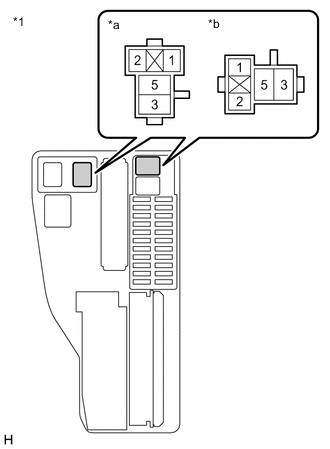
Text in Illustration *1 Engine Room Relay Block and Junction Block Assembly *a ST Relay Terminal *b ST NO. 2 Relay Terminal Remove the ST relay from engine room relay block and junction block assembly.
-
Remove the ST NO. 2 relay from engine room relay block and junction block assembly.
-
Measure the voltage according to the value(s) in the table below.
Standard Voltage Tester Connection Condition Specified Condition ST relay terminal 5 - Body ground Always 9.5 to 14 V ST NO. 2 relay terminal 5 - Body ground Always 9.5 to 14 V
NG
REPAIR OR REPLACE HARNESS OR CONNECTOR
OK
-
-
CHECK HARNESS AND CONNECTOR (STARTER ASSEMBLY - BATTERY)
-
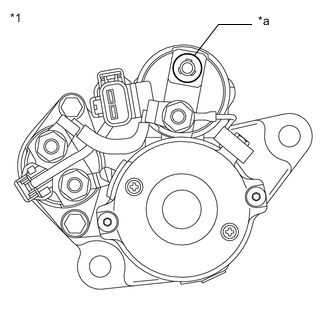
Text in Illustration *1 Starter Assembly *a F3-1 (B) Measure the voltage according to the value(s) in the table below.
Standard Voltage Tester Connection Condition Specified Condition F3-1 (B) - Body ground Always 9.5 to 14 V Note
Before performing this step, check that the starter assembly connector F3 is not disconnected or loose.
NG
REPAIR OR REPLACE HARNESS OR CONNECTOR
OK
-
-
CHECK HARNESS AND CONNECTOR (STARTER ASSEMBLY - ST, ST NO. 2 RELAY)
-
Remove the ST relay from engine room relay block and junction block assembly.
-
Remove the ST NO. 2 relay from engine room relay block and junction block assembly.
-
Disconnect the D83 starter assembly connector.
-
Measure the resistance according to the value(s) in the table below.
Standard Resistance Tester Connection Condition Specified Condition ST relay terminal 3 - D83-2 (SL1) Always Below 1 Ω ST NO. 2 relay terminal 3 - D83-1 (SL2) Always Below 1 Ω
NG
REPAIR OR REPLACE HARNESS OR CONNECTOR
OK
-
-
INSPECT ST, ST NO. 2 RELAY
-
Inspect the ST relay Click here.
-
Inspect the ST NO. 2 relay Click here.
NG
REPLACE RELAY (ST, ST NO. 2 RELAY)
OK
-
-
INSPECT STARTER ASSEMBLY
-
Inspect the starter assembly Click here.
OK
REPLACE ENGINE STOP AND START ECU Click here
NG
REPLACE STARTER ASSEMBLY Click here
-