BRAKE CONTROL SYSTEM
-
OUTLINE
-
The following brake control systems are provided: Anti-lock Brake System (ABS), Electronic Brake force Distribution (EBD), Brake Assist, Traction Control (TRC), Vehicle Stability Control (VSC), Trailer Sway Control (TSC), VSC and Cooperative Control with EPS*1 or VSC+*2, Hill-start Assist Control, Brake Hold, Emergency Brake Signal and Trailer Sway Control.
*1: Models for general countries
*2: Models for Europe
-
-
MAIN FEATURES
-
Vehicle Dynamics Integrated Management (VDIM)
-
Vehicle Dynamics Integrated Management (VDIM) is the integration of control systems such as brake control, drive force control and steering control.
-
The ABS, TRC and VSC systems which are typically independent of one another have been integrated by VDIM. Furthermore, VDIM cooperates with steering control to enhance performance when accelerating, cornering and stopping.
-
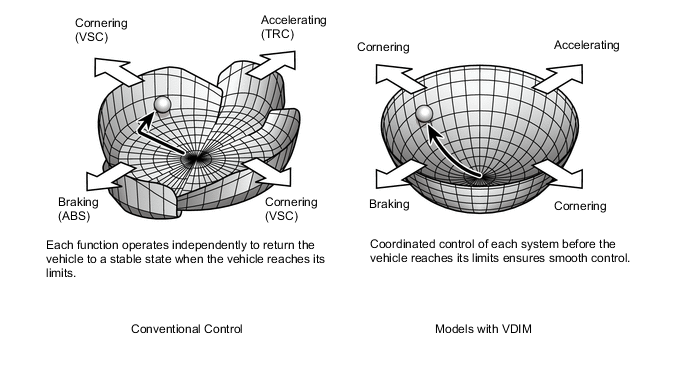
Compared to previous control systems which only operated when the vehicle reaches its limits, by performing control before the vehicle reaches its limits, smooth control and excellent vehicle stability is achieved.
Figure 1. Comparison of Systems
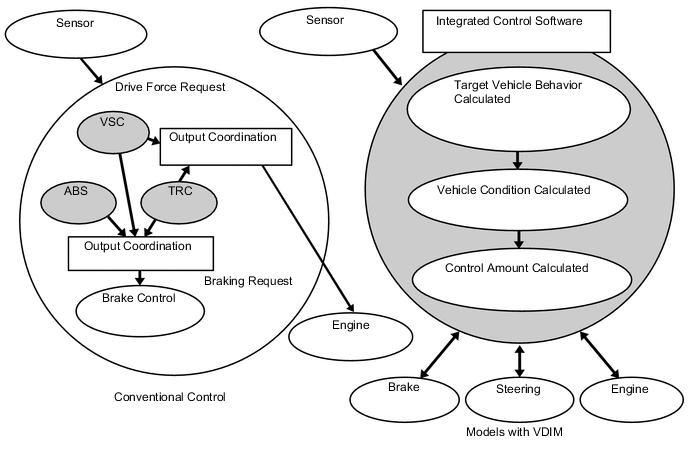
Figure 2. Comparison of Control
VDIM Outline Driving Condition Control Outline Braking When Driving Straight The ABS and EBD systems maintain steering performance, and the brake assist function generates increased brake force during emergency braking. Also, steering cooperative control limits deviation when braking on a split friction road. Braking When Cornering The ABS, EBD and VSC systems provide seamless control of brake fluid pressure and operate before the vehicle reaches its limits. This reduces the tendency for the vehicle to understeer or oversteer and the tendency for the rear wheels to lock up due to the shift in load from the rear wheels to the front wheels. Not Braking or Accelerating When Cornering The VSC system and drive force control reduce the tendency of the vehicle to understeer or oversteer. Also, steering cooperative control limits the front wheels from being turned beyond their limits. Accelerating When Cornering The TRC and VSC systems along with steering cooperative control reduce oversteer due to wheel spin. Accelerating When Driving Straight The TRC system and drive force control ensure smooth start-off and straight line stability, while steering cooperative control limits deviation when accelerating on a split friction road.
-
-
-
PRECAUTION
-
ABS
-
The ABS system cannot increase the performance limit of the tires. Always drive safely and be aware of the vehicle speed and distance to other vehicles.
-
Any non-standard components such as non-standard tires that are installed may have a negative effect on the ABS function.
-
When braking using ABS, the braking distance may be longer than vehicles without ABS in the following conditions:
-
When driving on a dirt road or a road covered with fresh snow
-
When using tire chains
-
When driving over a joint in the road surface
-
When driving on a rough road such as an unpaved or stone-paved road
-
-
-
Brake Assist
-
Brake assist cannot increase the performance limit of the fundamental brake system. Always drive safely and be aware of the vehicle speed and distance to other vehicles.
-
-
TRC, VSC
-
The TRC and VSC systems ensure traction and vehicle stability. Do not disable the TRC or VSC functions unless necessary.
-
The TRC and VSC systems cannot increase the performance limit of the tires. Always drive the vehicle carefully in conditions in which drive wheel traction or vehicle stability may be lost.
-
-
Hill-start Assist Control
-
Hill-start assist control is not intended to keep the vehicle stationary on a hill for a prolonged period. As hill-start assist control only prevents the vehicle from rolling backwards for 2 seconds after the brake pedal is released, perform start-off within this period.
-
When hill-start assist control is operating and the engine switch (push start switch) is turned off, hill-start assist control will be canceled without warning.
-
Hill-start assist control prevents the vehicle from rolling backwards by controlling the brake force to the 4 wheels. However, the vehicle may not remain stationary when on an extremely steep slope or a low friction surface such as ice.
-
-
Brake Hold
-
Brake hold is not intended to keep the vehicle parked for a prolonged period, such as the parking brake is designed to do.
-
When brake hold is operating and the engine switch (push start switch) is turned off, hill-start assist control will be canceled without warning.
-
If brake hold does not operate even though the vehicle is stopped, firmly depress the brake pedal. If brake hold still does not operate, check the operating conditions.
-
It may not be possible for brake hold to keep the vehicle stationary on a steep or slippery road.
-
-