TIRE AND WHEEL SYSTEM INSPECTION
PROCEDURE
INSPECT TIRES
Check the tires for wear and proper inflation pressure.
Cold Tire Inflation Pressure
Tire Size
Front/Rear
For driving at under 160 km/h (100 mph)
For driving at over 160 km/h (100 mph)
195/65R15 91H
230 kPa (2.3 kgf/cm2, 33 psi)
240 kPa (2.4 kgf/cm2, 35 psi)
260 kPa (2.6 kgf/cm2, 38 psi)
270 kPa (2.7 kgf/cm2, 39 psi)
205/55R16 91V
215/45R17 87W
225/45R17 91W
230 kPa (2.3 kgf/cm2, 33 psi)
260 kPa (2.6 kgf/cm2, 38 psi)
Note:For 195/65R15 91H tires, 2 different values of pressure are available. Refer to the tire pressure label before adjusting the tire inflation pressure.
-
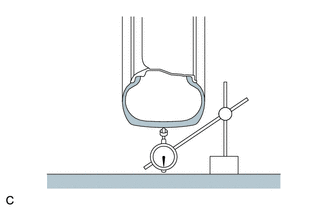
Using a dial indicator, check the runout of the tires.
Maximum tire runout
1.4 mm (0.0551 in.)
ROTATE TIRES
-
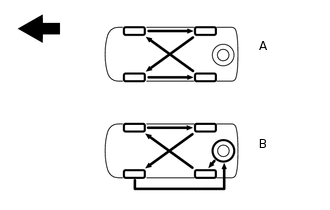

Front
If the spare tire uses a different type of wheel from the other tires, rotate the tires as shown by (A) in the illustration. If the spare tire has the same type of wheel as the other tires, rotate the tires, including the spare tire, as shown by (B) in the illustration.
103 N*m
1050 kgf*cm
76 ft.*lbf
-
INSPECT AND ADJUST WHEEL BALANCE
Inspect and adjust the off-the-car balance.
Steel wheel:
Maximum imbalance
8.0 g (0.0176 lb)
-
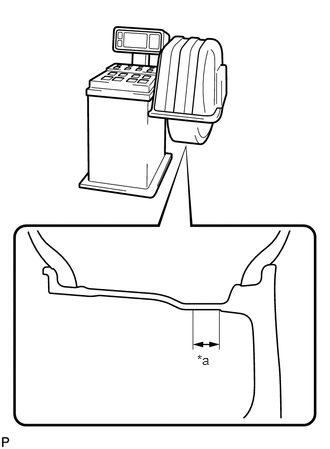
*a
25 mm (0.984 in.)
Others (Non-steel wheel):
Maximum imbalance
8.0 g (0.0176 lb)
Note:Use a cleaning detergent to remove dirt, oil and water from the surface where the balance weight is to be adhered.
Do not touch the adhesive surface of the balance weight.
Adhere a stick-on type balance weight to the flat surface*a shown in the illustration.
Push the balance weight with your finger to securely adhere it to the desired position.
Do not reuse balance weights.
Tip:Use clip-on type balance weights for the inner side, and stick-on type balance weights for the outer side.
If the tires vibrate even after the off-the-car balance adjustment, adjust the wheel balance with on-the-car balancing as necessary.
INSPECT FRONT AXLE HUB
INSPECT REAR AXLE HUB
for Double Wishbone Type Suspension:Click here
for Torsion Beam Type Suspension:Click here