AIRBAG SYSTEM
-
FUNCTION OF MAIN COMPONENTS
-
The main components of the airbag system have the following functions:
Component Function Airbag Sensor Assembly
-
In the event of a frontal collision, the airbag sensor assembly receives the signal from either of the front airbag sensors or main sensor built into the airbag sensor assembly. The airbag sensor assembly receives the signal via its judgment circuit and also receives another signal from the safing sensor built into the airbag sensor assembly. After receiving signals from the safing sensor and at least one of the front airbag sensors, the airbag sensor assembly determines whether the driver airbag, front passenger airbag, driver knee airbag*1, front passenger knee airbag*2 and curtain shield airbags*5 should be deployed, and the front seat belt pretensioners and rear seat belt pretensioners*6 should be activated. The airbag sensor assembly also diagnosis system malfunctions.
-
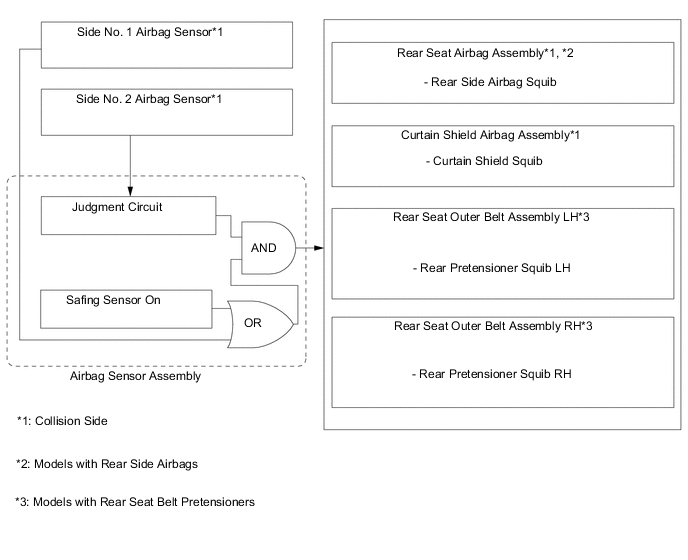
In the event of a side or rear side collision, the airbag sensor assembly receives signals from the door side airbag sensor, side No. 1 airbag sensor or side No. 2 airbag sensor. The airbag sensor assembly receives the door side airbag sensor, side No. 1 airbag sensor or side No. 2 airbag sensor signal via its judgment circuit and also receives another signal from the side No. 1 airbag sensor or the safing sensor built into the airbag sensor assembly. After receiving signals from at least one of the side sensors and either of the safing sensors (side No. 1 airbag sensor or safing sensor built into the airbag sensor assembly), the airbag sensor assembly determines whether the front seat airbag, rear seat airbag*4 and curtain shield airbag should be deployed, and the front seat belt pretensioners and rear seat belt pretensioners*6 should be activated. The airbag sensor assembly also diagnosis system malfunctions.*3
-
Sends the collision detection signal to the ECM through the Controller Area Network (CAN) to operate fuel pump control.
-
Sends the collision detection signal to the main body ECU (multiplex network body ECU) to operate the collision door lock release function.
-
Sends the brake control request signal to the skid control ECU through the Controller Area Network (CAN) to operate the secondary collision brake.*8
Horn Button Assembly Used as supplements to the seat belts to help reduce impact to the occupants. Instrument Panel Passenger Airbag without Door Assembly Lower No. 1 Instrument Panel Airbag Assembly*1 Lower No. 2 Instrument Panel Airbag Assembly*2 Front Seat Airbag Assembly LH/RH*3 Rear Seat Airbag Assembly LH/RH*4 Curtain Shield Airbag Assembly LH/RH*5 Spiral Cable Sub-assembly Transmits ignition signals from the airbag sensor assembly to the SRS driver airbag. Front Airbag Sensor LH/RH Based on the deceleration of the vehicle during a frontal collision, distortion is created in the sensor and is converted into an electrical signal. Door Side Airbag Sensor LH/RH*3 Detects deformation of the front doors during a side collision using the pressure sensor and sends signals for the airbag sensor assembly to determine if deployment of SRS components is necessary. Side No. 1 Airbag Sensor LH/RH*3 Based on the deceleration of the vehicle during a side or rear side collision, distortion is created in the sensor and is converted into an electrical signal. Side No. 2 Airbag Sensor LH/RH*3 Based on the deceleration of the vehicle during a rear side collision, distortion is created in the sensor and is converted into an electrical signal. Front Seat Outer Belt Assembly LH/RH Used to help reduce impact to the occupants. Rear Seat Outer Belt Assembly LH/RH*6 Seat Position Airbag Sensor*7 Detects the slide position of the driver seat. Driver Seat Belt Buckle Switch (Front Seat Inner Belt Assembly LH)*7 Detects if the driver seat belt is fastened. Front Passenger Seat Belt Buckle Switch (Front Seat Inner Belt Assembly RH)*7 Detects if the front passenger seat belt is fastened. Occupant Detection ECU*7 Judges whether the front passenger seat is occupied based on signals from the 2 occupant classification sensors and the front passenger seat belt buckle switch. Front Occupant Classification Sensor LH*7 The sensors are strain gauge type sensors that send signals to the occupant detection ECU in accordance with the weight of the occupant. Rear Occupant Classification Sensor LH*7 ECM Receives the collision detection signal from the airbag sensor assembly and stops to the fuel pump. Main Body ECU (Multiplex Network Body ECU) Receives the collision detection signal from the airbag sensor assembly and operates the collision door lock release function. Brake Actuator Assembly*8 Skid Control ECU Receives the brake control request signal from the airbag sensor assembly, and sends brake control signals to the brake actuator to reduce damage of the secondary collision. Combination Meter Assembly SRS Warning Light Turns on to alert the driver when the airbag sensor assembly detects a malfunction in the airbag system. Multi-information Display Displays a warning message to inform the driver of a malfunction in the airbag system. Master Warning Light Turns on to alert the driver when the airbag sensor assembly detects a malfunction in the airbag system. Buzzer Sounds to warn the driver of a malfunction in the airbag system. Telltale Light Assembly*7 AIRBAG OFF Indicator Light The AIRBAG ON/OFF indicator lights inform the driver whether the occupant detection ECU puts the instrument panel passenger airbag without door assembly, front seat airbag assembly RH, lower No. 2 instrument panel airbag assembly and front seat outer belt assembly RH into an active state or inactive state. AIRBAG ON Indicator Light Network Gateway ECU Relays the signal between the CAN communication. *1: Models with driver knee airbag
*2: Models with front passenger knee airbag
*3: Models with front side airbags
*4: Models with rear side airbags
*5: Models with curtain shield airbags
*6: Models with rear seat belt pretensioners
*7: Destination package for South Korea
*8: Models with secondary collision brake system
-
-
-
SYSTEM CONTROL
-
Airbag for Frontal Collision
-
There are 6 airbags which deploy in the event of a frontal collision: the horn button assembly, instrument panel passenger airbag without door assembly, lower No. 1 instrument panel airbag assembly*1, lower No. 2 instrument panel airbag assembly*2 and curtain shield airbag assemblies*3. These airbags deploy simultaneously. The horn button assembly and instrument panel passenger airbag without door assembly use dual-stage control*4. In addition, each front pretensioner contained in a front seat outer belt assembly, and each rear pretensioner contained in a rear seat outer belt assembly*5 are also activated.
*1: Models with driver knee airbag
*2: Models with front passenger knee airbag
*3: Models with curtain shield airbags
*4: Destination package for South Korea
*5: Models with rear seat belt pretensioners
-
The airbag sensor assembly detects the information in the table below from various sources in order to activate the dual-stage control.*
*: Destination package for South Korea
Airbag Information Source Driver Extent of Impact
-
Front Airbag Sensor LH or RH
-
Airbag Sensor Assembly
Driver Seat Position* Seat Position Airbag Sensor Seat Belt Condition* Driver Seat Belt Buckle Switch (Front Seat Inner Belt Assembly LH) (Non-contact Type) Front Passenger Extent of Impact
-
Front Airbag Sensor LH or RH
-
Airbag Sensor Assembly
Occupant Classification* 2 Occupant Classification Sensors
(Connected to the airbag sensor assembly through the occupant detection ECU.)
Seat Belt Condition* Front Passenger Seat Belt Buckle Switch (Front Seat Inner Belt Assembly RH) (Non-contact Type)
(Connected to the airbag sensor assembly through the occupant detection ECU.)
*: Destination package for South Korea
-
-
For a frontal collision, if a front airbag sensor detects an impact, it informs the airbag sensor assembly. The airbag sensor assembly causes the horn button assembly, instrument panel passenger airbag without door assembly, lower No. 1 instrument panel airbag assembly*1, lower No. 2 instrument panel airbag assembly*2 and curtain shield airbag assemblies*3 to deploy. Additionally, the airbag sensor assembly activates the seat belt pretensioners for the driver, front passenger and rear passengers*4.
*1: Models with driver knee airbag
*2: Models with front passenger knee airbag
*3: Models with curtain shield airbags
*4: Models with rear seat belt pretensioners
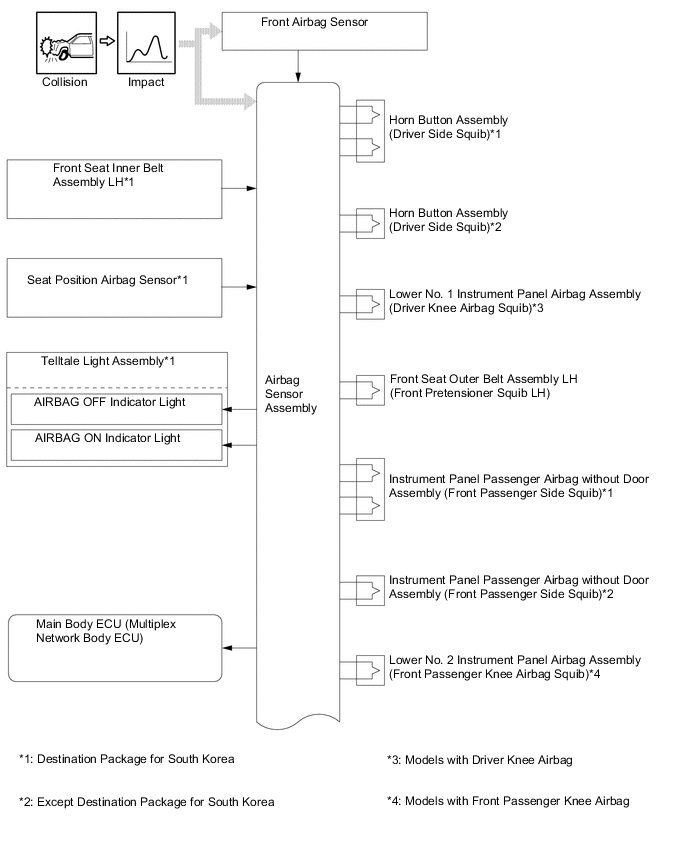
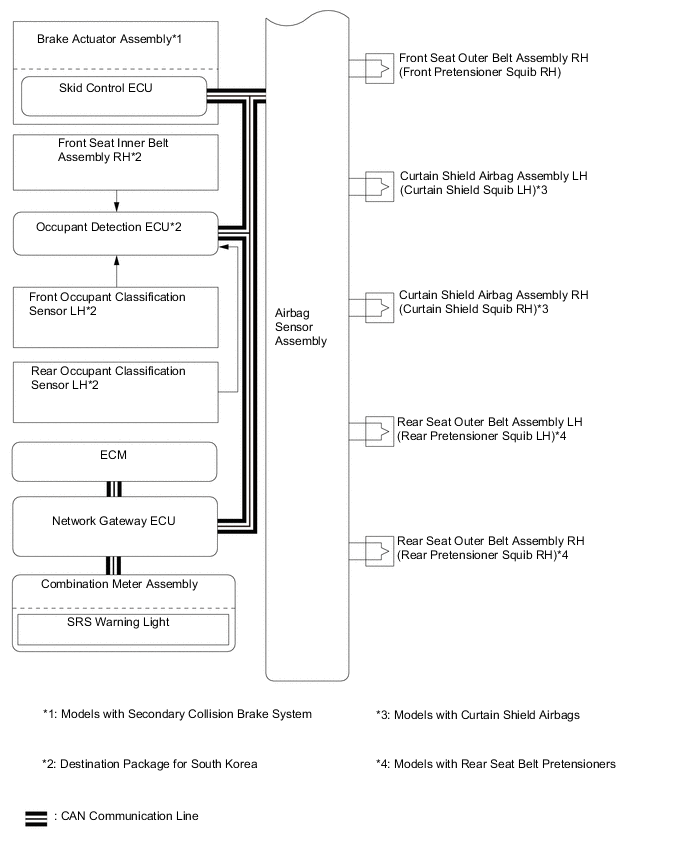
-
Deceleration sensors used for the airbag system are installed on various parts on the vehicle and calculate the deceleration (or acceleration) rate of each part during a collision.
-
Depending on the situation, the airbag sensor assembly sends a deployment signal to each airbag and pretensioner based on the information from each sensor.
-
Frontal collision signals are produced based on the information from the airbag sensor assembly and front airbag sensors. Frontal collision signals are used to deploy all the airbags except all the side airbags and activate all the pretensioners as indicated in the table below.
Figure 1. Frontal Collision
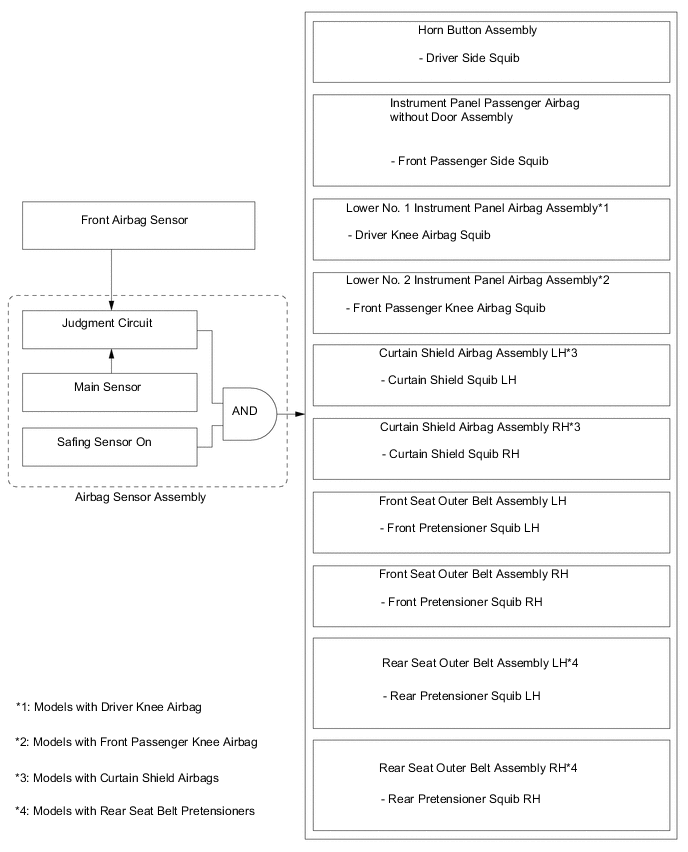
-
-
Airbag for Side/Rear Side Collision (Models with Front Side Airbags)
-
There are 3 airbags which deploy in the event of a severe side collision: the front seat airbag assembly, rear seat airbag assembly*1 and curtain shield airbag assembly. These airbags deploy simultaneously. Additionally, at the same time, the front seat belt pretensioners and rear seat belt pretensioners*2 are also activated.
*1: Models with rear side airbags
*2: Models with rear seat belt pretensioners
-
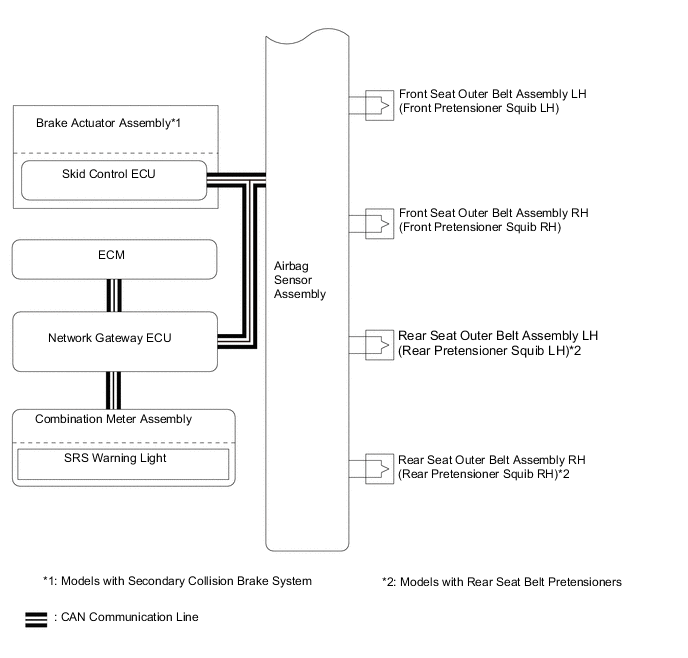
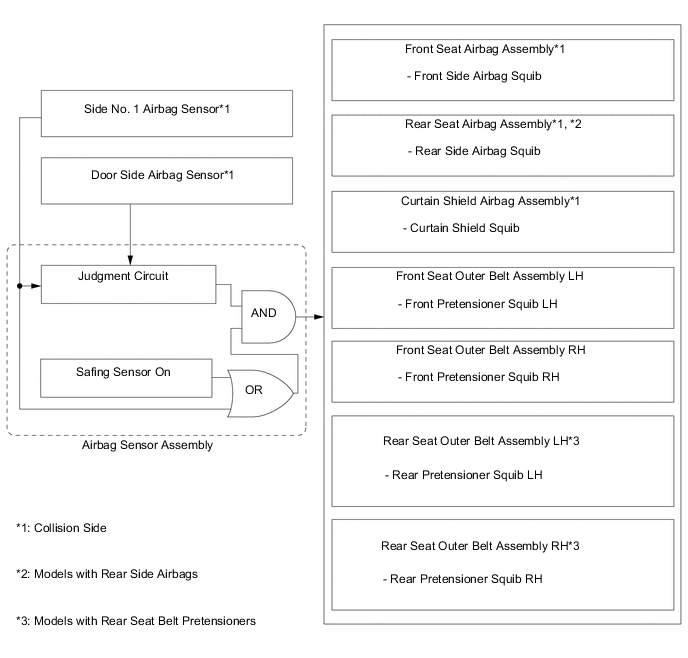
For a side collision, if the door side airbag sensor and side No. 1 airbag sensor detect an impact, they inform the airbag sensor assembly, and the airbag sensor assembly causes the front seat airbag assembly, rear seat airbag assembly*1 and curtain shield airbag assembly to deploy simultaneously, and activate the front seat belt pretensioners and rear seat belt pretensioners*2.
*1: Models with rear side airbags
*2: Models with rear seat belt pretensioners
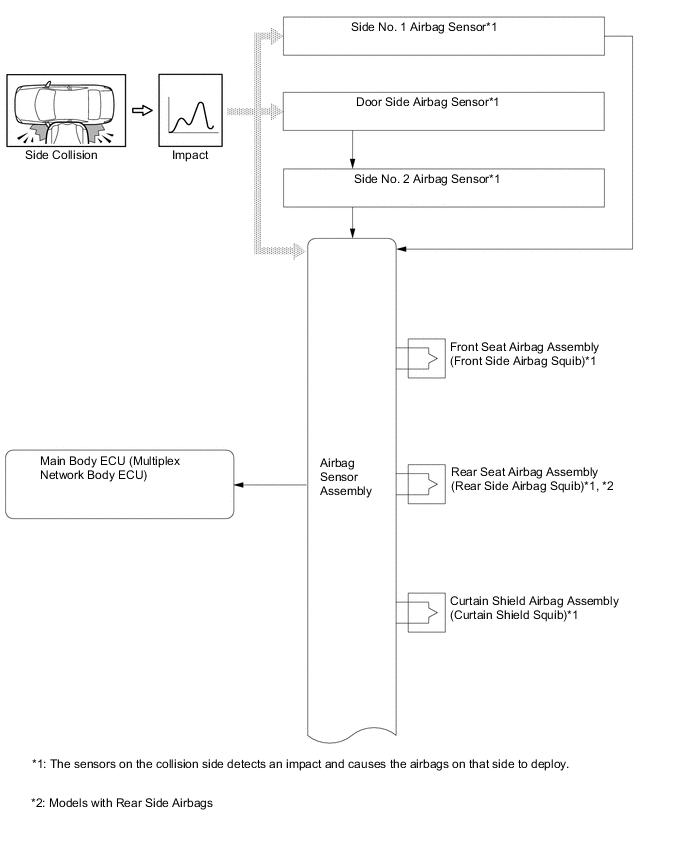
-
The front seat airbag assembly, rear seat airbag assembly*1 and curtain shield airbag assembly are deployed and each front pretensioner in a front seat outer belt assembly and each rear pretensioner in a rear seat outer belt assembly*2 are activated based on signals from the door side airbag sensor, side No. 1 airbag sensor and airbag sensor assembly.
*1: Models with rear side airbags
*2: Models with rear seat belt pretensioners
Figure 2. Side Collision
-
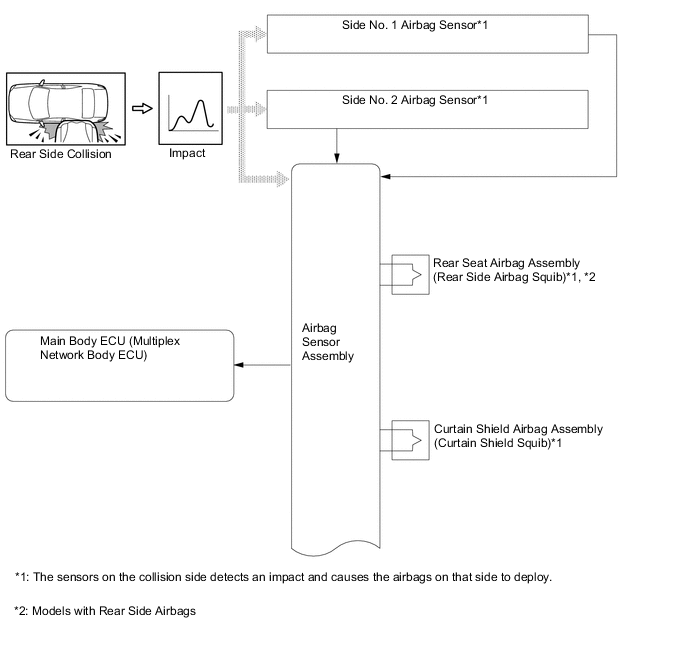
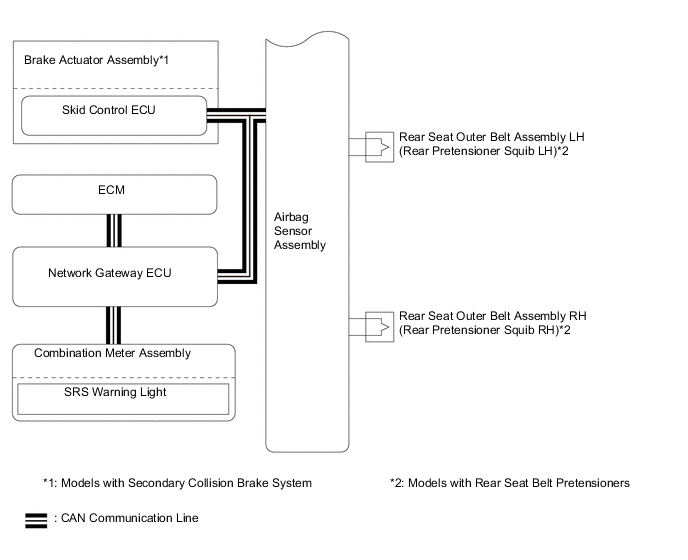
For a rear side collision, if the side No. 2 airbag sensor and side No. 1 airbag sensor detect an impact, they inform the airbag sensor assembly, and the airbag sensor assembly causes the rear seat airbag assembly*1 and curtain shield airbag assembly to deploy simultaneously, and activate the rear seat belt pretensioners*2.
*1: Models with rear side airbags
*2: Models with rear seat belt pretensioners
-
The rear seat airbag assembly*1 and curtain shield airbag assembly are deployed and each rear pretensioner in a rear seat outer belt assembly*2 are activated based on signals from the side No. 2 airbag sensor, side No. 1 airbag sensor and airbag sensor assembly.
*1: Models with rear side airbags
*2: Models with rear seat belt pretensioners
Figure 3. Rear Side Collision
-
-
Primary Check Illumination Control
-
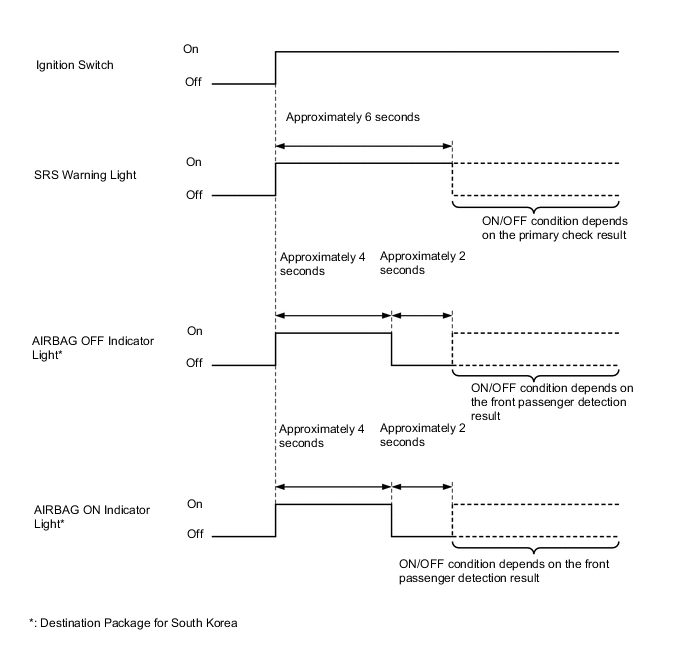
After the ignition switch is turned to ON, the airbag sensor assembly illuminates the SRS warning light in the combination meter assembly for approximately 6 seconds and conducts the primary check. During the primary check, the ignition of airbags is prohibited and a diagnosis of the airbag sensor assembly is performed. If a malfunction is detected during the primary check, the SRS warning light will remain on even after 6 seconds have elapsed.
-
After the ignition switch is turned to ON, the airbag sensor assembly operates the AIRBAG ON/OFF indicator lights as shown below to check for an open in the indicator light circuits.
-
-
-
FAIL-SAFE
-
If the airbag sensor assembly detects a malfunction in the airbag system, the airbag sensor assembly illuminates the SRS warning light and master warning light, displays the warning message on the multi-information display and sounds the buzzer to alert the driver of the malfunction.
-
-
DIAGNOSIS
-
If the airbag sensor assembly detects a malfunction in the airbag system, the airbag sensor assembly stores the malfunction data in memory as Diagnostic Trouble Codes (DTCs).
-
The airbag sensor assembly outputs malfunction data and 5-digit Diagnostic Trouble Codes (DTCs) to the Global TechStream (GTS).
-
The 5-digit DTCs can be read by connecting the Global TechStream (GTS) to the DLC3. For details, refer to the Repair Manual.
-
If the SRS airbags deploy, the airbag sensor assembly will turn on the SRS warning light. However, unlike an ordinary malfunction, a DTC will not be stored. The SRS warning light cannot be manually turned off. It is necessary to replace the airbag sensor assembly with a new one.
-