CYLINDER HEAD DISASSEMBLY

PROCEDURE
-
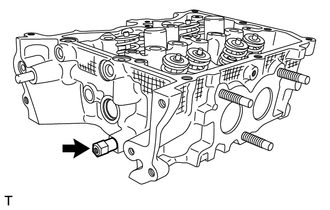
REMOVE CHAIN COVER MOUNT BOLT
-
Remove the chain cover mount bolt.
-
-
REMOVE STUD BOLT
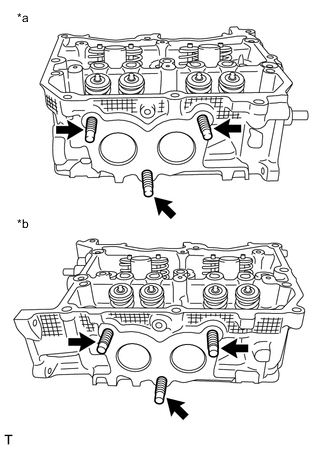
Text in Illustration *a for Bank 1 *b for Bank 2 Tech Tips
If any of the stud bolts is deformed or the threads are damaged, replace it.
-
Remove the 6 stud bolts from the cylinder heads.
-
-
REMOVE INTAKE VALVE
Note
Place a cloth, etc. to avoid scratching the mating surface of the cylinder head during servicing.
Tech Tips
-
Mark each part to prevent confusion.
-
Arrange the removed parts in the correct order.
-
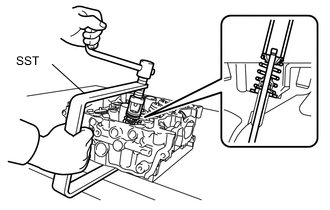
Using SST, compress the spring and remove the valve spring retainer locks.
- SST
- 09202-70020 ( 09202-00010, 09202-01010, 09202-01020 )
-
Remove the valve, valve spring retainer, valve spring and valve spring seat.
-
-
REMOVE EXHAUST VALVE
CAUTION:
-
The exhaust valve is encapsulated with metallic sodium. The metallic sodium is a strong alkaline and prone to cause a serious chemical reaction. Therefore, extra caution is required when handling or disposing the exhaust valve.
-
Never disassemble the exhaust valve. The metallic sodium may cause blindness if it gets into your eyes, or cause a burn injury if it comes into contact with your skin or any heat source.
-
If the exhaust valve is damaged, after removing the valve, submerge and neutralize it in water. For normal disposal, follow the procedure for disposal of metal parts.
Note
Place a cloth, etc. to avoid scratching the mating surface of the cylinder head during servicing.
Tech Tips
-
Mark each part to prevent confusion.
-
Arrange the removed parts in the correct order.
-
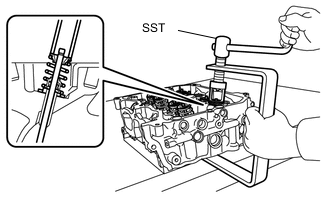
Using SST, compress the spring and remove the valve spring retainer locks.
- SST
- 09202-70020 ( 09202-00010, 09202-01010, 09202-01020 )
-
Remove the valve, valve spring retainer, valve spring and valve spring seat.
-
-
REMOVE VALVE STEM OIL SEAL
-
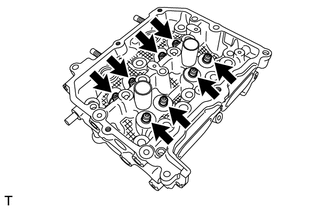
Remove the 8 valve stem oil seals.
Note
-
Place a cloth, etc. to avoid scratching the mating surface of the cylinder head during servicing.
-
Be careful not to damage the valve guide bushes and cylinder head.
-
-
-
DISPOSE OF EXHAUST VALVE
CAUTION:
-
The exhaust valve is encapsulated with metallic sodium. The metallic sodium is a strong alkaline and prone to cause a serious chemical reaction. Therefore, extra caution is required when handling or disposing the exhaust valve.
-
Never disassemble the exhaust valve. The metallic sodium may cause blindness if it gets into your eyes, or cause a burn injury if it comes into contact with your skin or any heat source.
-
If the exhaust valve is damaged, after removing the valve, submerge and neutralize it in water. For normal disposal, follow the procedure for disposal of metal parts as shown below:
-
Wear gloves and then remove the damaged valve from the cylinder head.
-
Place a large container (bucket or other container) in a well-ventilated area and fill it with water. (at least 10 liters).
-
Place the damaged valve inside the container to submerge it under water.
CAUTION:
-
Step at least 2 to 3 m away from the container, to avoid any serious chemical reaction.
-
Keep any fire sparks or fire sources away from this container because hydrogen gas will be emitted from the chemical reaction.
-
-
After the chemical reaction has completed (approximately 4 to 5 hours), using large pliers or similar tool, carefully remove the valve from the container without having any liquid contacting your skin, and then dispose of it according to the same procedures that are provided for other parts.
-
The liquid where the valve was submerged is now strong alkaline due to the chemical reaction and therefore, dispose of it according to all applicable government and local regulations.
CAUTION:
Be careful not to let the liquid contact your skin. Should it contact your skin, immediately rinse it with plenty of water.
-