ENTRY AND START SYSTEM(for Start Function) Engine does not Start
DESCRIPTION
When the electrical key transmitter sub-assembly is in the vehicle and the engine switch is pressed, the certification ECU (smart key ECU assembly) receives a signal and changes the power source mode. In addition, when the shift lever is in P or N*1 and the brake pedal*1 or clutch pedal*2 is depressed, the engine can be started by pressing the engine switch.
-
*1: for Automatic Transmission
-
*2: for Manual Transmission
| Problem Symptom | Data List Item | Active Test Item |
|---|---|---|
| Engine does not start |
Power Source Control
Entry&Start
Starting Control |
- |
-
*: for Automatic Transmission
Tech Tips
If the brake pedal*1 or clutch pedal*2 is repeatedly depressed while the engine is stopped, the brake booster pressure is released and the force required to depress the brake pedal*1 or clutch pedal*2 to illuminate the stop lights increases.
-
*1: for Automatic Transmission
-
*2: for Manual Transmission
CAUTION / NOTICE / HINT
Note
-
When using the GTS with the engine switch off, connect the GTS to the DLC3 and turn a courtesy light switch on and off at intervals of 1.5 seconds or less until communication between the GTS and the vehicle begins. Then select the Model Code "KEY REGIST" under manual mode and enter the following menus: Body Electrical / Entry&Start(CAN). While using the GTS, periodically turn a courtesy light switch on and off at intervals of 1.5 seconds or less to maintain communication between the GTS and the vehicle.
-
The entry and start system (for Start Function) uses a multiplex communication system (LIN communication system) and the CAN communication system. Inspect the communication function by following How to Proceed with Troubleshooting Click here. Troubleshoot the entry and start system (for Start Function) after confirming that the communication systems are functioning properly.
-
If the entry and start system is disabled through the customize function, enable the system before performing troubleshooting.
-
Before replacing the certification ECU (smart key ECU assembly), electrical key transmitter sub-assembly or steering lock ECU (steering lock actuator assembly), refer to the entry and start system (for Entry Function) precaution.
-
Inspect the fuses of circuits related to this system before performing the following procedure.
-
If the steering lock ECU (steering lock actuator assembly) is replaced, be sure to confirm that the steering is unlocked by turning the steering wheel to the left and right before starting the engine. If the steering is locked for any reason, open and close a door with the engine switch off, and then unlock the steering by pressing the engine switch. This prevents the engine from starting while the steering is locked.
-
After completing repairs, confirm that the problem does not occur.
Tech Tips
-
When the certification ECU (smart key ECU assembly) is replaced with a new one and the cable is connected to the negative (-) battery terminal, the power source mode changes to on (IG).
-
When the battery cable is disconnected and reconnected, the power source returns to the mode it was in before the battery cable was disconnected.
-
The certification ECU (smart key ECU assembly) stores the operation history of the entry and start system and it can be read using the GTS.
Body Electrical > Entry&Start > Utility
| Tester Display |
|---|
| Operation History |
| Parameter Name | Content |
|---|---|
| Operating Engine Switch / Key RF Signal Interference | When the engine switch was operated, the electrical key transmitter sub-assembly could not be confirmed due to wave interference. Therefore, the output frequency was switched to the other channel (changed from channel 1 to channel 2 or from channel 2 to channel 1). If the cause of the malfunction has not been stored but any devices that can cause wave interference in the cabin have been removed and the room oscillator successfully recognizes the key, the possibility of wave interference is high. |
| Parameter Name | Content |
|---|---|
| Operating Power Switch/brake or clutch no signal | While it became the engine switch on (IG) twice repeatedly, there was not Brake signal when engine switch was pushed. (Then, warning alarm was sounded) |
| Parameter Name | Content |
|---|---|
| Operating Power Switch/brake or clutch no signal | While it became the engine switch on (IG) twice repeatedly, there was not Clutch signal when engine switch was pushed. (Then, warning alarm was sounded) |
| Parameter Name | Content |
|---|---|
| Operating Power Switch/ Indoor oscillator LF Signal Interference | When the engine switch was operated, the room oscillator could not be confirmed due to wave interference. Therefore, the output frequency was switched to the other channel (changed from channel 1 to channel 2 or from channel 2 to channel 1). If the cause of the malfunction has not been stored but any devices that can cause wave interference in the cabin have been removed and the room oscillator successfully recognizes the key, the possibility of wave interference is high. |
| Brake or Clutch Switch/Indoor oscillator LF Signal Interference | When the brake switch was operated, the room oscillator could not be confirmed due to wave interference. Therefore, the output frequency was switched to the other channel (changed from channel 1 to channel 2 or from channel 2 to channel 1). If the cause of the malfunction has not been stored but any devices that can cause wave interference in the cabin have been removed and the room oscillator successfully recognizes the key, the possibility of wave interference is high. |
| Parameter Name | Content |
|---|---|
| Operating Power Switch/ Indoor oscillator LF Signal Interference | When the engine switch was operated, the room oscillator could not be confirmed due to wave interference. Therefore, the output frequency was switched to the other channel (changed from channel 1 to channel 2 or from channel 2 to channel 1). If the cause of the malfunction has not been stored but any devices that can cause wave interference in the cabin have been removed and the room oscillator successfully recognizes the key, the possibility of wave interference is high. |
| Brake or Clutch Switch/Indoor oscillator LF Signal Interference | When the clutch switch was operated, the room oscillator could not be confirmed due to wave interference. Therefore, the output frequency was switched to the other channel (changed from channel 1 to channel 2 or from channel 2 to channel 1). If the cause of the malfunction has not been stored but any devices that can cause wave interference in the cabin have been removed and the room oscillator successfully recognizes the key, the possibility of wave interference is high. |
| Parameter Name | Content |
|---|---|
| Operating Power Switch/steering lock detection | Engine did not start because steering is lock status when engine switch was pushed. |
PROCEDURE
-
CHECK TRANSMITTER BATTERY
-
Check the transmitter battery level of the electrical key transmitter sub-assembly that was checked first.
-
Press and hold the lock switch of the transmitter for 5 seconds and check the number of times that the transmitter LED illuminates.
Tech Tips
-
The electrical key transmitter sub-assembly sends voltage information to the certification ECU (smart key ECU assembly) when it is being used. The certification ECU (smart key ECU assembly) displays "Yes" for the "Key Low Battery" item of the Data List when this voltage information indicates 2.2 V or less.
-
Even if the transmitter battery is depleted, it is still possible to start the engine by holding the electrical key transmitter sub-assembly near the engine switch, depressing the brake pedal and pressing the engine switch.
-
Result Result Proceed to Transmitter LED illuminates 3 times or more when switch is pressed and held A Transmitter LED does not illuminate when switch is pressed and held B Transmitter LED illuminates once or twice but not a third time C -
B 
INSPECT TRANSMITTER BATTERY Click here
C 
REPLACE TRANSMITTER BATTERY Click here
A 
-
-
READ VALUE USING GTS (KEY LOW BATTERY)
-
Connect the GTS to the DLC3.
-
Turn the engine switch on (IG).
-
Turn the GTS on.
-
Enter the following menus: Body Electrical / Entry&Start / Data List.
-
According to the display on the GTS, read the Data List.
Body Electrical > Entry&Start > Data ListTester Display Measurement Item Range Normal Condition Diagnostic Note Key Low Battery Transmitter battery depleted Yes or No Yes: Transmitter battery depleted
No: Transmitter battery not depleted
The electrical key transmitter sub-assembly sends voltage information to the certification ECU (smart key ECU assembly) when it is transmitting. The certification ECU (smart key ECU assembly) displays "Yes" for the "Key Low Battery" item of the Data List when this voltage information indicates 2.2 V or less.
This Data List item should be checked when the electrical key transmitter sub-assembly is at room temperature (example: at -20°C (-4°F), "Yes" may be displayed even if the transmitter battery is new).
Body Electrical > Entry&Start > Data ListTester Display Key Low Battery OK "No" is displayed in the Data List. Result Proceed to OK NG
NG
REPLACE TRANSMITTER BATTERY Click here
OK
-
-
CHECK FOR DTC
-
Using the GTS, check for certification ECU (smart key ECU assembly) DTCs.
Body Electrical > Entry&Start > Trouble Codes
Body Electrical > Starting Control > Trouble Codes
Body Electrical > Power Source Control > Trouble CodesResult Result Proceed to DTCs are not output A Entry and start system (for Start Function) DTCs are output B
B
GO TO DIAGNOSTIC TROUBLE CODE CHART
A
-
-
CHECK ENGINE CRANK
-
Get into the vehicle while carrying the electrical key transmitter.
-
for Automatic Transmission
Move the shift lever to P.
-
Depress the brake pedal*1 or clutch pedal*2.
-
*1: for Automatic Transmission
-
*2: for Manual Transmission
-
-
Press the engine switch and check that the engine cranks.
Result Result Proceed to Engine cranks, but there is no initial combustion or engine is difficult to start A Engine does not cranks B
A
GO TO IMMOBILISER SYSTEM Click here
B
-
-
CHECK ENGINE SWITCH CONDITION
-
Get into the vehicle while carrying an electrical key transmitter sub-assembly.
-
for Automatic Transmission
Move the shift lever to P.
-
With the brake pedal*1 or clutch pedal*2 released, check that pressing the engine switch causes the power source mode to change.
-
*1: for Automatic Transmission
-
*2: for Manual Transmission
Result Result Proceed to Off → on (ACC) → on (IG) → off A Power source mode does not change to on (ACC) and on (IG) B Power source mode changes to on (IG) but not to on (ACC) C Power source mode changes to on (ACC) but not to on (IG) D -
B
GO TO POWER SOURCE MODE DOES NOT CHANGE TO ON (IG AND ACC) Click here
C
GO TO POWER SOURCE MODE DOES NOT CHANGE TO ON (IG) Click here
D
GO TO POWER SOURCE MODE DOES NOT CHANGE TO ON (ACC) Click here
A
-
-
READ VALUE USING GTS (STOP LIGHT SWITCH1, NEUTRAL SW/ CLUTCH SW)
-
for Automatic Transmission
-
Connect the GTS to the DLC3.
-
Turn the engine switch on (IG).
-
Turn the GTS on.
-
Enter the following menus: Body Electrical / Power Source Control / Data List.
-
According to the display on the GTS, read the Data List.
Body Electrical > Power Source Control > Data ListTester Display Measurement Item Range Normal Condition Diagnostic Note Stop Light Switch1 State of brake pedal ON or OFF ON: Brake pedal depressed
OFF: Brake pedal released
-
Use this item to determine whether the stop light switch is malfunctioning.
-
The engine cannot be started when this item is "OFF".
-
When this item is malfunctioning, the engine can be started by pressing and holding the engine switch for a certain period of time.
Body Electrical > Power Source Control > Data ListTester Display Stop Light Switch1 OK The item in the Data List changes when the brake pedal is depressed and released. -
-
-
for Manual Transmission
-
Connect the GTS to the DLC3.
-
Turn the engine switch on (IG).
-
Turn the GTS on.
-
Enter the following menus: Body Electrical / Power Source Control / Data List.
-
According to the display on the GTS, read the Data List.
Body Electrical > Power Source Control > Data ListTester Display Measurement Item Range Normal Condition Diagnostic Note Neutral SW/ Clutch SW State of clutch pedal ON or OFF ON: Clutch pedal depressed
OFF: Clutch pedal released
-
Use this item to help determine if the clutch position switch is malfunctioning.
-
The engine cannot be started when this item is "OFF".
Body Electrical > Power Source Control > Data ListTester Display Neutral SW/ Clutch SW OK The item in the Data List changes when the clutch pedal is depressed and released. -
Result Proceed to OK (for Automatic Transmission) OK (for Manual Transmission) NG (for Automatic Transmission) NG (for Manual Transmission) -
OK (for Manual Transmission)
GO TO STEP 8 Click here
NG (for Automatic Transmission)
INSPECT STOP LIGHT SWITCH ASSEMBLY Click here
NG (for Manual Transmission)
INSPECT CLUTCH START SWITCH ASSEMBLY Click here
OK (for Automatic Transmission)
-
-
READ VALUE USING GTS (NEUTRAL SW/ CLUTCH SW, SHIFT POSITION P OR N)
-
Connect the GTS to the DLC3.
-
Turn the engine switch on (IG).
-
Turn the GTS on.
-
Enter the following menus: Body Electrical / Power Source Control or Starting Control / Data List.
-
According to the display on the GTS, read the Data List.
Body Electrical > Power Source Control > Data ListTester Display Measurement Item Range Normal Condition Diagnostic Note Neutral SW/ Clutch SW Shift position (P and N) ON or OFF ON: Shift lever in P or N
OFF: Shift lever not in P or N
-
Use this item to determine whether the park/neutral start switch assembly is malfunctioning.
-
When the engine cannot be started due to a park/neutral start switch assembly malfunction, "OFF" is displayed.
Body Electrical > Power Source Control > Data ListTester Display Neutral SW/ Clutch SW
Body Electrical > Starting Control > Data ListTester Display Measurement Item Range Normal Condition Diagnostic Note Shift Position P or N Park/neutral position switch status ON or OFF ON: Shift lever in P or N
OFF: Shift lever in any position other than P or N
When malfunctioning, the engine will not crank.
Body Electrical > Starting Control > Data ListTester Display Shift Position P or N OK The item in the Data List changes according to the shift position. Result Proceed to OK NG -
NG
INSPECT PARK/NEUTRAL POSITION SWITCH ASSEMBLY Click here
OK
-
-
READ VALUE USING GTS (STARTER REQUEST SIGNAL)
-
Connect the GTS to the DLC3.
-
Turn the engine switch on (IG).
-
Turn the GTS on.
-
Enter the following menus: Body Electrical / Power Source Control / Data List.
-
According to the display on the GTS, read the Data List.
Body Electrical > Power Source Control > Data ListTester Display Measurement Item Range Normal Condition Diagnostic Note Starter Request Signal Engine start request signal status ON or OFF
-
ON: With the shift lever in P and the brake pedal depressed, the engine switch is pressed and held
-
OFF: After approximately 1 second has elapsed, the engine switch is released
for Automatic Transmission
-
ON: With the clutch pedal depressed, the engine switch is pressed and held
-
OFF: After approximately 1 second has elapsed, the engine switch is released
for Manual Transmission
-
When the engine cannot be started due to a start request signal malfunction, OFF is displayed.
-
When the engine switch is pressed, the duration of time that ON is displayed will be extremely short. As such, the engine switch needs to be pressed and held for a certain amount of time.
Body Electrical > Power Source Control > Data ListTester Display Starter Request Signal Note
Check that the key warning light is illuminated in green on the combination meter assembly, and then press the engine switch.
OK The display changes in response to the operation of the engine switch. Result Proceed to OK NG -
NG
CHECK STEERING LOCK SYSTEM Click here
OK
-
-
READ VALUE USING GTS (STARTER SW)
-
Connect the GTS to the DLC3.
-
Turn the engine switch on (IG).
-
Turn the GTS on.
-
Enter the following menus: Body Electrical / Starting Control / Data List.
-
Get into the vehicle while carrying the electrical key transmitter sub-assembly, move the shift lever to P*1, press the engine switch while depressing the brake pedal*1 or clutch pedal*2 and confirm that the Data List item changes.
-
*1: for Automatic Transmission
-
*2: for Manual Transmission
Body Electrical > Starting Control > Data ListTester Display Measurement Item Range Normal Condition Diagnostic Note Starter SW Starter operation request ON or OFF ON: Starter operation requested
OFF: Starter operation not requested
When malfunctioning, the engine will not crank.
Body Electrical > Starting Control > Data ListTester Display Starter SW OK The Data List item changes. Result Proceed to OK NG -
NG
REPLACE CERTIFICATION ECU (SMART KEY ECU ASSEMBLY)
OK
-
-
READ VALUE USING GTS (STARTER RELAY)
-
Connect the GTS to the DLC3.
-
Turn the engine switch on (IG).
-
Turn the GTS on.
-
Enter the following menus: Body Electrical / Starting Control / Data List.
-
According to the display on the GTS, read the Data List.
Body Electrical > Starting Control > Data ListTester Display Measurement Item Range Normal Condition Diagnostic Note Starter Relay Starter relay voltage monitor ON or OFF ON: ST NO. 1 relay on
OFF: ST NO. 1 relay off
OFF is displayed when the engine cannot crank.
Body Electrical > Starting Control > Data ListTester Display Starter Relay Result Proceed to OK NG
NG
INSPECT ST NO. 1 RELAY Click here
OK
-
-
CHECK CONNECTOR CONNECTION CONDITION
-
Disconnect the G69 and G70 certification ECU (smart key ECU assembly) connectors.
-
Connect the G69 and G70 certification ECU (smart key ECU assembly) connectors.
-
Press the engine switch and check that the engine starts.
OK Engine starts. Result Proceed to OK NG
OK
CONNECT SECURELY
NG
REPLACE CERTIFICATION ECU (SMART KEY ECU ASSEMBLY)
-
-
INSPECT PARK/NEUTRAL POSITION SWITCH ASSEMBLY
-
Remove the park/neutral position switch assembly.
for AC60E: Click here
for AC60F: Click here
-
Inspect the park/neutral position switch assembly.
for AC60E: Click here
for AC60F: Click here
Result Proceed to OK NG
NG
REPLACE PARK/NEUTRAL POSITION SWITCH ASSEMBLY for AC60E: Click here
REPLACE PARK/NEUTRAL POSITION SWITCH ASSEMBLY for AC60F: Click hereOK
-
-
CHECK HARNESS AND CONNECTOR (CERTIFICATION ECU (SMART KEY ECU ASSEMBLY) - PARK/NEUTRAL POSITION SWITCH ASSEMBLY)
-
Disconnect the G70 certification ECU (smart key ECU assembly) connector.
-
Disconnect the C24 park/neutral position switch assembly connector.
-
Disconnect the C53*1, G85*2, C15*3 or G84*4 ECM connector.
-
*1: for 2TR-FE
-
*2: for 1GD-FTV, 2GD-FTV
-
*3: for 1GR-FE
-
*4: for 2KD-FTV
-
-
Measure the resistance according to the value(s) in the table below.
Standard Resistance Tester Connection Condition Specified Condition G70-16 (STAR) - C24-4 (B) Always Below 1 Ω G70-16 (STAR) or C24-4 (B) - Body ground Always 10 kΩ or higher Result Proceed to OK NG
OK
REPLACE CERTIFICATION ECU (SMART KEY ECU ASSEMBLY)
NG
REPAIR OR REPLACE HARNESS OR CONNECTOR
-
-
INSPECT ST NO. 1 RELAY
-
Remove the ST NO. 1 relay.
-
Inspect the ST NO. 1 relay.
for 2KD-FTV: Click here
for 1GD-FTV: Click here
for 2GD-FTV: Click here
for 1GR-FE: Click here
for 2TR-FE: Click here
Result Proceed to OK NG
NG
REPLACE ST NO. 1 RELAY
OK
-
-
CHECK HARNESS AND CONNECTOR (CERTIFICATION ECU (SMART KEY ECU ASSEMBLY) - BODY GROUND)
-
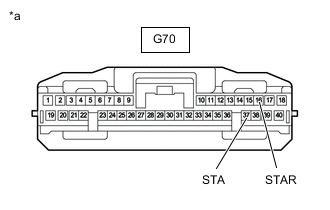
*a Front view of wire harness connector
(to Certification ECU (Smart Key ECU Assembly))
Disconnect the G70 certification ECU (smart key ECU assembly) connector.
-
Disconnect the C53*1, G85*2, C15 and G88*3 or G84*4 ECM connector.
-
*1: for 2TR-FE
-
*2: for 1GD-FTV, 2GD-FTV
-
*3: for 1GR-FE
-
*4: for 2KD-FTV
-
-
w/ Engine Stop and Start Syatem
Disconnect the G126 engine stop and start ECU connector.
-
for Automatic Transmission
Move the shift lever to P or N.
-
for Manual Transmission
Clutch pedal depressed.
-
Measure the resistance according to the value(s) in the table below.
Standard Resistance Tester Connection Condition Specified Condition G70-16 (STAR) - Body ground 20°C (68°F) 93.75 to 136.36 Ω G70-37 (STA) - Body ground Result Proceed to OK NG (for Automatic Transmission) NG (for Manual Transmission)
NG (for Automatic Transmission)
CHECK HARNESS AND CONNECTOR (CERTIFICATION ECU (SMART KEY ECU ASSEMBLY) - PARK/NEUTRAL POSITION SWITCH) Click here
NG (for Manual Transmission)
CHECK HARNESS AND CONNECTOR (CERTIFICATION ECU (SMART KEY ECU ASSEMBLY) - CLUTCH START SWITCH ASSEMBLY) Click here
OK
-
-
INSPECT STARTER ASSEMBLY
-
Remove the starter assembly.
for 2KD-FTV (for 2.0 kW Type): Click here
for 2KD-FTV (for 2.2 kW Type): Click here
for 2KD-FTV (for BOSCH Made): Click here
for 1GD-FTV (for 2.0 kW Type): Click here
for 1GD-FTV (for 2.2 kW Type): Click here
for 1GD-FTV (for BOSCH Made): Click here
for 2GD-FTV (for 2.0 kW Type): Click here
for 2GD-FTV (for 2.2 kW Type): Click here
for 2GD-FTV (for 2.7 kW Type): Click here
for 2GD-FTV (w/ Stop And Start System): Click here
for 2GD-FTV (for BOSCH Made): Click here
for 1GR-FE: Click here
for 2TR-FE (for 2.0 kW Type): Click here
for 2TR-FE (except 2.0 kW Type): Click here
for 2TR-FE (for BOSCH Made): Click here
-
Inspect the starter assembly.
for 2KD-FTV (for 2.0 kW Type) Click here
for 2KD-FTV (for 2.2 kW Type): Click here
for 2KD-FTV (for BOSCH Made): Click here
for 1GD-FTV (for 2.0 kW Type): Click here
for 1GD-FTV (for 2.2 kW Type): Click here
for 1GD-FTV (for BOSCH Made): Click here
for 2GD-FTV (for 2.0 kW Type): Click here
for 2GD-FTV (for 2.2 kW Type): Click here
for 2GD-FTV (for 2.7 kW Type): Click here
for 2GD-FTV (w/ Stop And Start System): Click here
for 2GD-FTV (for BOSCH Made): Click here
for 1GR-FE: Click here
for 2TR-FE (for 2.0 kW Type): Click here
for 2TR-FE (except 2.0 kW Type): Click here
for 2TR-FE (for BOSCH Made): Click here
Result Proceed to OK NG
NG
REPLACE STARTER ASSEMBLY for 2KD-FTV (for 2.0 kW Type): Click here
REPLACE STARTER ASSEMBLY for 2KD-FTV (for 2.2 kW Type): Click here
REPLACE STARTER ASSEMBLY for 2KD-FTV (for BOSCH Made): Click here
REPLACE STARTER ASSEMBLY for 1GD-FTV (for 2.0 kW Type): Click here
REPLACE STARTER ASSEMBLY for 1GD-FTV (for 2.2 kW Type): Click here
REPLACE STARTER ASSEMBLY for 1GD-FTV (for BOSCH Made): Click here
REPLACE STARTER ASSEMBLY for 2GD-FTV (for 2.0 kW Type): Click here
REPLACE STARTER ASSEMBLY for 2GD-FTV (for 2.2 kW Type): Click here
REPLACE STARTER ASSEMBLY for 2GD-FTV (for 2.7 kW Type): Click here
REPLACE STARTER ASSEMBLY for 2GD-FTV (w/ Stop And Start System): Click here
REPLACE STARTER ASSEMBLY for 2GD-FTV (for BOSCH Made): Click here
REPLACE STARTER ASSEMBLY for 1GR-FE: Click here
REPLACE STARTER ASSEMBLY for 2TR-FE (for 2.0 kW Type): Click here
REPLACE STARTER ASSEMBLY for 2TR-FE (except 2.0 kW Type): Click here
REPLACE STARTER ASSEMBLY for 2TR-FE (for BOSCH Made): Click hereOK
-
-
CHECK HARNESS AND CONNECTOR (BATTERY - STARTER AND ST NO. 1 RELAY)
-
Remove the starter assembly from the vehicle to perform an inspection.
for 2KD-FTV (for 2.0 kW Type): Click here
for 2KD-FTV (for 2.2 kW Type): Click here
for 2KD-FTV (for BOSCH Made): Click here
for 1GD-FTV (for 2.0 kW Type): Click here
for 1GD-FTV (for 2.2 kW Type): Click here
for 1GD-FTV (for BOSCH Made): Click here
for 2GD-FTV (for 2.0 kW Type): Click here
for 2GD-FTV (for 2.2 kW Type): Click here
for 2GD-FTV (for 2.7 kW Type): Click here
for 2GD-FTV (w/ Stop And Start System): Click here
for 2GD-FTV (for BOSCH Made): Click here
for 1GR-FE: Click here
for 2TR-FE (for 2.0 kW Type): Click here
for 2TR-FE (except 2.0 kW Type): Click here
for 2TR-FE (for BOSCH Made): Click here
-
Remove the ST NO. 1 relay.
-
Measure the voltage according to the value(s) in the table below.
Standard Voltage Tester Connection Condition Specified Condition D3-1 (B) - Body ground Always 11 to 14 V ST NO. 1 relay terminal 5 - Body ground Always 11 to 14 V -
Measure the resistance according to the value(s) in the table below.
Standard Resistance w/o Stop and Start System Tester Connection Condition Specified Condition ST NO. 1 relay terminal 3 - C32-1 (ST) Always Below 1 Ω ST NO. 1 relay terminal 3 or C32-1 (ST) - Body ground Always 10 kΩ or higher w/ Stop and Start System Tester Connection Condition Specified Condition ST NO. 1 relay terminal 3 - C141-1 (SL1) Always Below 1 Ω ST NO. 1 relay terminal 3 or C141-1 (SL1) - Body ground Always 10 kΩ or higher Result Proceed to OK NG
OK
REPLACE CERTIFICATION ECU (SMART KEY ECU ASSEMBLY)
NG
REPAIR OR REPLACE HARNESS OR CONNECTOR
-
-
INSPECT TRANSMITTER BATTERY
-
Inspect the transmitter battery.
Note
Do not wrap the lead wire around a terminal, wedge it between terminals, or solder it. The terminal may be deformed or damaged, and the transmitter battery will not be able to be installed correctly.
Result Proceed to OK NG
OK
REPLACE ELECTRICAL KEY TRANSMITTER SUB-ASSEMBLY
NG
REPLACE TRANSMITTER BATTERY Click here
-
-
INSPECT STOP LIGHT SWITCH ASSEMBLY
-
Remove the stop light switch assembly.
-
Inspect the stop light switch assembly.
Result Proceed to OK NG
NG
REPLACE STOP LIGHT SWITCH ASSEMBLY Click here
OK
-
-
CHECK HARNESS AND CONNECTOR (CERTIFICATION ECU (SMART KEY ECU ASSEMBLY) - STOP LIGHT SWITCH ASSEMBLY)
-
Disconnect the G69 certification ECU (smart key ECU assembly) connector.
-
Disconnect the A35 stop light switch assembly connector.
-
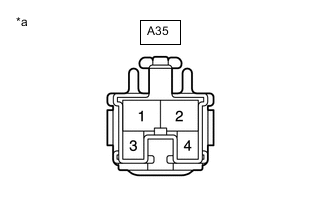
*a Front view of wire harness connector
(to Stop Light Switch Assembly)
Measure the voltage according to the value(s) in the table below.
Standard Voltage Tester Connection Condition Specified Condition A35-2 - Body ground Always 11 to 14 V -
Connect the A35 stop light switch assembly connector.
-
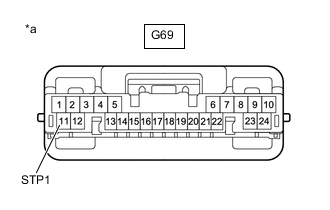
*a Front view of wire harness connector
(to Certification ECU (Smart Key ECU Assembly))
Measure the voltage according to the value(s) in the table below.
Standard Voltage Tester Connection Condition Specified Condition G69-11 (STP1) - Body ground Brake pedal released 1 V or less Brake pedal depressed 9 V or higher Result Proceed to OK NG
OK
REPLACE CERTIFICATION ECU (SMART KEY ECU ASSEMBLY)
NG
REPAIR OR REPLACE HARNESS OR CONNECTOR
-
-
CHECK HARNESS AND CONNECTOR (CERTIFICATION ECU (SMART KEY ECU ASSEMBLY) - PARK/NEUTRAL POSITION SWITCH)
-
Disconnect the G70 certification ECU (smart key ECU assembly) connector.
-
Disconnect the C24 park/neutral position switch connector.
-
Disconnect the C53*1, G85*2, C15*3 or G84*4 ECM connector.
-
*1: for 2TR-FE
-
*2: for 1GD-FTV, 2GD-FTV
-
*3: for 1GR-FE
-
*4: for 2KD-FTV
-
-
w/ Engine Stop and Start Syatem
Disconnect the G126 engine stop and start ECU connector.
-
Measure the resistance according to the value(s) in the table below.
Standard Resistance Tester Connection Condition Specified Condition G70-16 (STAR) - C24-4 (B) Always Below 1 Ω G70-16 (STAR) or C24-4 (B) - Body ground Always 10 kΩ or higher Result Proceed to OK NG
NG
REPAIR OR REPLACE HARNESS OR CONNECTOR
OK
-
-
CHECK HARNESS AND CONNECTOR (PARK/NEUTRAL POSITION SWITCH - ST NO. 1 RELAY)
-
Disconnect the C24 park/neutral position switch connector.
-
Remove the ST NO. 1 relay.
-
Disconnect the G70 certification ECU (smart key ECU assembly) connector.
-
Disconnect the C53*1, G85*2, G88*3 or G84*4 ECM connector.
-
*1: for 2TR-FE
-
*2: for 1GD-FTV, 2GD-FTV
-
*3: for 1GR-FE
-
*4: for 2KD-FTV
-
-
w/ Engine Stop and Start Syatem
Disconnect the G126 engine stop and start ECU connector.
-
Measure the resistance according to the value(s) in the table below.
Standard Resistance Tester Connection Condition Specified Condition C24-5 (L) - ST NO. 1 relay terminal 2 Always Below 1 Ω C24-5 (L) or ST NO. 1 relay terminal 2 - Body ground Always 10 kΩ or higher Result Proceed to OK NG
NG
REPAIR OR REPLACE HARNESS OR CONNECTOR
OK
-
-
CHECK HARNESS AND CONNECTOR (CERTIFICATION ECU (SMART KEY ECU ASSEMBLY) - ST NO. 1 RELAY)
-
Disconnect the G70 certification ECU (smart key ECU assembly) connector.
-
Remove the ST NO. 1 relay.
-
Measure the resistance according to the value(s) in the table below.
Standard Resistance Tester Connection Condition Specified Condition G70-37 (STA) - ST NO. 1 relay terminal 2 Always Below 1 Ω G70-37 (STA) or ST NO. 1 relay terminal 2 - Body ground Always 10 kΩ or higher Result Proceed to OK NG
NG
REPAIR OR REPLACE HARNESS OR CONNECTOR
OK
-
-
CHECK HARNESS AND CONNECTOR (ST NO. 1 RELAY - BODY GROUND)
-
Remove the ST NO. 1 relay.
-
Measure the resistance according to the value(s) in the table below.
Standard Resistance Tester Connection Condition Specified Condition ST NO. 1 relay terminal 1 - Body ground Always Below 1 Ω Result Proceed to OK NG
NG
REPAIR OR REPLACE HARNESS OR CONNECTOR
OK
-
-
CHECK CONNECTOR CONNECTION CONDITION
-
Disconnect the G69 and G70 certification ECU (smart key ECU assembly) connectors.
-
Connect the G69 and G70 certification ECU (smart key ECU assembly) connectors.
-
Press the engine switch and check that the engine starts.
OK Engine starts. Result Proceed to OK NG
OK
CONNECT SECURELY
NG
REPLACE CERTIFICATION ECU (SMART KEY ECU ASSEMBLY)
-
-
INSPECT CLUTCH START SWITCH ASSEMBLY
-
Remove the clutch start switch assembly.
-
Inspect the clutch start switch assembly.
Result Proceed to OK NG
NG
REPLACE CLUTCH START SWITCH ASSEMBLY Click here
OK
-
-
CHECK HARNESS AND CONNECTOR (CERTIFICATION ECU (SMART KEY ECU ASSEMBLY) - CLUTCH START SWITCH ASSEMBLY)
-
Disconnect the G70 certification ECU (smart key ECU assembly) connector.
-
Disconnect the B2 clutch start switch assembly connector.
-
Disconnect the C53*1, G85*2, C15*3 or G84*4 ECM connector.
-
*1: for 2TR-FE
-
*2: for 1GD-FTV, 2GD-FTV
-
*3: for 1GR-FE
-
*4: for 2KD-FTV
-
-
w/ Engine Stop and Start Syatem
Disconnect the G126 engine stop and start ECU connector.
-
Measure the resistance according to the value(s) in the table below.
Standard Resistance Tester Connection Condition Specified Condition G70-16 (STAR) - B2-2 Always Below 1 Ω G70-16 (STAR) or B2-2 - Body ground Always 10 kΩ or higher Result Proceed to OK NG
OK
REPLACE CERTIFICATION ECU (SMART KEY ECU ASSEMBLY)
NG
REPAIR OR REPLACE HARNESS OR CONNECTOR
-
-
CHECK HARNESS AND CONNECTOR (CERTIFICATION ECU (SMART KEY ECU ASSEMBLY) - CLUTCH START SWITCH ASSEMBLY)
-
Disconnect the G70 certification ECU (smart key ECU assembly) connector.
-
Disconnect the B2 clutch start switch assembly connector.
-
Disconnect the C53*1, G85*2, C15*3 or G84*4 ECM connector.
-
*1: for 2TR-FE
-
*2: for 1GD-FTV, 2GD-FTV
-
*3: for 1GR-FE
-
*4: for 2KD-FTV
-
-
w/ Engine Stop and Start Syatem
Disconnect the G126 engine stop and start ECU connector.
-
Measure the resistance according to the value(s) in the table below.
Standard Resistance Tester Connection Condition Specified Condition G70-16 (STAR) - B2-2 Always Below 1 Ω G70-16 (STAR) or B2-2 - Body ground Always 10 kΩ or higher Result Proceed to OK NG
NG
REPAIR OR REPLACE HARNESS OR CONNECTOR
OK
-
-
CHECK HARNESS AND CONNECTOR (CLUTCH START SWITCH ASSEMBLY - ST NO. 1 RELAY)
-
Disconnect the B2 clutch start switch assembly connector.
-
Remove the ST NO. 1 relay.
-
Disconnect the G70 certification ECU (smart key ECU assembly) connector.
-
Disconnect the C53*1, G85*2, G88*3 or G84*4 ECM connector.
-
*1: for 2TR-FE
-
*2: for 1GD-FTV, 2GD-FTV
-
*3: for 1GR-FE
-
*4: for 2KD-FTV
-
-
w/ Engine Stop and Start Syatem
Disconnect the G126 engine stop and start ECU connector.
-
Measure the resistance according to the value(s) in the table below.
Standard Resistance Tester Connection Condition Specified Condition B2-1 - ST NO. 1 relay terminal 2 Always Below 1 Ω B2-1 or ST NO. 1 relay terminal 2 - Body ground Always 10 kΩ or higher Result Proceed to OK NG
NG
REPAIR OR REPLACE HARNESS OR CONNECTOR
OK
-
-
CHECK HARNESS AND CONNECTOR (CERTIFICATION ECU (SMART KEY ECU ASSEMBLY) - ST NO. 1 RELAY)
-
Disconnect the G70 certification ECU (smart key ECU assembly) connector.
-
Remove the ST NO. 1 relay.
-
Measure the resistance according to the value(s) in the table below.
Standard Resistance Tester Connection Condition Specified Condition G70-37 (STA) - ST NO. 1 relay terminal 2 Always Below 1 Ω G70-37 (STA) or ST NO. 1 relay terminal 2 - Body ground Always 10 kΩ or higher Result Proceed to OK NG
NG
REPAIR OR REPLACE HARNESS OR CONNECTOR
OK
-
-
CHECK HARNESS AND CONNECTOR (ST NO. 1 RELAY - BODY GROUND)
-
Remove the ST NO. 1 relay.
-
Measure the resistance according to the value(s) in the table below.
Standard Resistance Tester Connection Condition Specified Condition ST NO. 1 relay terminal 1 - Body ground Always Below 1 Ω Result Proceed to OK NG
NG
REPAIR OR REPLACE HARNESS OR CONNECTOR
OK
-
-
CHECK CONNECTOR CONNECTION CONDITION
-
Disconnect the G69 and G70 certification ECU (smart key ECU assembly) connectors.
-
Connect the G69 and G70 certification ECU (smart key ECU assembly) connectors.
-
Press the engine switch and check that the engine starts.
OK Engine starts. Result Proceed to OK NG
OK
CONNECT SECURELY
NG
REPLACE CERTIFICATION ECU (SMART KEY ECU ASSEMBLY)
-
-
CHECK STEERING LOCK SYSTEM
-
Check that the steering unlocks when the engine switch is turned on (ACC).
OK The steering unlocks. Result Proceed to OK NG
NG
GO TO STEERING LOCK SYSTEM (PROBLEM SYMPTOMS TABLE) Click here
OK
-
-
CHECK SECURITY INDICATOR LIGHT (IMMOBILISER SYSTEM UNSET)
-
Get into the vehicle while carrying an electrical key transmitter sub-assembly.
-
for Automatic Transmission
Move the shift lever to P.
-
Press the engine switch with the brake pedal*1 or clutch pedal*2 released and check that the security indicator light changes from blinking to off at the same time that the power source mode changes to on (ACC).
-
*1: for Automatic Transmission
-
*2: for Manual Transmission
Tech Tips
It is determined that the immobiliser function is operating correctly if the security indicator light changes from blinking to off at the same time that the power source mode changes to on (ACC).
OK Security indicator light changes from blinking to off at the same time that the power source mode changes to on (ACC). Result Proceed to OK NG -
OK
REPLACE CERTIFICATION ECU (SMART KEY ECU ASSEMBLY)
NG
GO TO IMMOBILISER SYSTEM (PROBLEM SYMPTOMS TABLE) Click here
-