ECD SYSTEM, Diagnostic DTC:P1608
| DTC Code | DTC Name |
|---|---|
| P1608 | Engine Lack of Power |
DESCRIPTION
This DTC is stored if engine output decreases due to a malfunction in the intake or exhaust system, fuel system or cooling system.
Using the GTS, the conditions present when the DTC was stored can be confirmed by referring to the freeze frame data. Freeze frame data records engine conditions when a malfunction occurs. This information can be useful when troubleshooting.
DTC No. |
Detection Item |
DTC Detection Condition |
Trouble Area |
MIL |
Memory |
|---|---|---|---|---|---|
P1608 |
Engine Lack of Power |
With the accelerator pedal fully depressed, engine output decreases for approximately 4 to 10 seconds due to a broken component in the intake or exhaust system, fuel system or cooling system or malfunction in one of those systems (1 trip detection logic). |
|
Does not come on |
DTC stored |
CAUTION / NOTICE / HINT
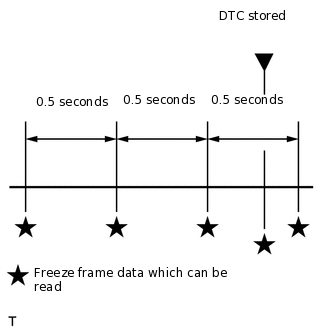
In contrast to normal malfunction diagnosis for components, circuits and systems, DTC P1608 is used to determine the malfunctioning area from the problem symptoms and freeze frame data when the user mentions problems such as engine lack of power or hesitation.
As the DTC can be stored as a result of certain user actions, even if the DTC is output, if the customer makes no mention of problems, clear the DTC without performing any troubleshooting and return the vehicle to the customer.
If any other DTCs are output, perform troubleshooting for those DTCs first.
Read freeze frame data using the GTS. Freeze frame data records the engine condition when malfunctions are detected. When troubleshooting, freeze frame data can help determine if the vehicle was moving or stationary, if the engine was warmed up or not, and other data from the time the malfunction occurred.
When confirming the freeze frame data, be sure to check all 5 sets of freeze frame data.
The fourth set of freeze frame data is the data recorded when the DTC is stored.
PROCEDURE
DTC OUTPUT (RECORD STORED DTC AND FREEZE FRAME DATA (PROCEDURE 1))
Connect the GTS to the DLC3.
Turn the ignition switch to ON and turn the GTS on.
Enter the following menus: Powertrain / Engine and ECT / Trouble Codes.
Record the stored DTCs and freeze frame data.
Powertrain > Engine > Trouble Codes
Tip:This freeze frame data shows the actual engine conditions when engine rack of power trouble occurred.
Result
Proceed to
NEXT
CHECK ANY OTHER DTCS OUTPUT (IN ADDITION TO DTC P1608)
Connect the GTS to the DLC3.
Turn the ignition switch to ON and turn the GTS on.
Enter the following menus: Powertrain / Engine and ECT / Trouble Codes.
Read the DTCs.
Powertrain > Engine > Trouble Codes
Result
Result
Proceed to
DTC P1608 is output
A
DTC P1608 and other DTCs are output
B
Tip:If any DTCs other than DTC P1608 are output, troubleshoot those DTCs first.
DETERMINE CAUSE OF PROBLEM (CHECK FREEZE FRAME DATA AND SNAPSHOT)
Determine the cause of the problem based on the freeze frame data recorded in Procedure 1.
Table 1. MAF Low Judgment of Data List Values
Problem Cause
Normal Condition
Diagnosis Note
"MAF Low" in freeze frame data is ON
Intake air volume introduced via the mass air flow meter assembly is insufficient and fuel injection volume remains suppressed
Intake system clogged
EGR valve stuck closed
Deterioration of mass air flow meter assembly (foreign matter present on sensor element etc.)
EGR fully closed learning
EGR Active Test
Table 2. Boost Pressure Low Judgment of Data List Values
Problem Cause
Normal Condition
Diagnosis Note
"Boost Pressure Low" in freeze frame data is ON
Actual boost pressure is lower than the target boost pressure and fuel injection volume remains suppressed
Intake system hose disconnected or cracked
Turbocharger sub-assembly vane stuck fully open
Manifold absolute pressure sensor
Manifold absolute pressure sensor out of range
Atmospheric pressure sensor (built into ECM)
Abnormal pressure difference between the atmospheric pressure sensor and manifold absolute pressure sensor
EGR valve stuck closed
The possible malfunctioning areas can be narrowed down by checking "MAF/Estimate MAF Ratio" when "Boost Pressure Low" in the freeze frame data is ON
Table 3. MAF/Estimate MAF Ratio Judgment of Data List Values
Problem Cause
Normal Condition
Diagnosis Note
"MAF/Estimate MAF Ratio" in freeze frame data is 1.4 or more
Air that has passed through the mass air flow meter assembly leaks, and the estimated intake air volume becomes less than the actual intake air volume.
Intake air leak due to intake pipe disconnection or leaks between the turbocharger sub-assembly and intercooler assembly or between the intercooler assembly and intake manifold.
"MAF/Estimate MAF Ratio" in freeze frame data is below 0.6
Air that has not passed through the mass air flow meter assembly is supplied to the engine, and the actual intake air volume becomes less than the estimated intake air volume.
Air entering due to intake pipe disconnection or leaks between the turbocharger sub-assembly and intercooler assembly or between the intercooler assembly and intake manifold.
Table 4. Common Rail Pressure Low Judgment of Data List Values
Problem Cause
Normal Condition
Diagnosis Note
"Common Rail Pressure Low" in freeze frame data is ON
Common rail pressure remains below the target value.
Suction control valve sticking
Fuel leak
Fuel filter element assembly clogged
Fuel pressure sensor (built into common rail assembly)
Table 5. Engine Coolant Temp High Judgment of Data List Values
Problem Cause
Normal Condition
Diagnosis Note
"Engine Coolant Temp High" in freeze frame data is ON
Coolant temperature remains high (overheating) and fuel injection volume remains suppressed.
Engine coolant leak
Radiator assembly clogged
Engine coolant temperature sensor
Engine coolant temperature sensor out of range or stuck
Fan
Cooling system including radiator assembly
Tip:Perform the next inspection if there are no problems with the above items.
Result
Proceed to
NEXT