INTAKE SYSTEM
-
CONSTRUCTION
-
The variable nozzle vane type turbocharger sub-assembly consists primarily of a turbine, nozzle vane, unison ring and actuator.
-
The variable nozzle vane type turbocharger sub-assembly drives the vacuum type actuator in accorcance with the engine condition, and controls the nozzle vane in order to achieve high engine output, low fuel consumption and low emissions.
-
The turbocharger sub-assembly is cooled by the engine oil.
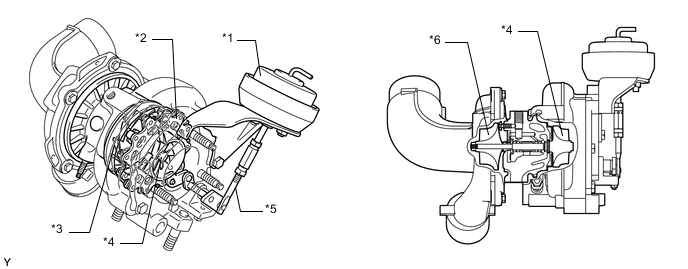
*1 Actuator *2 VGS Link Plate *3 Nozzle Vane *4 Turbine Wheel *5 Actuator Linkage *6 Impeller Wheel -
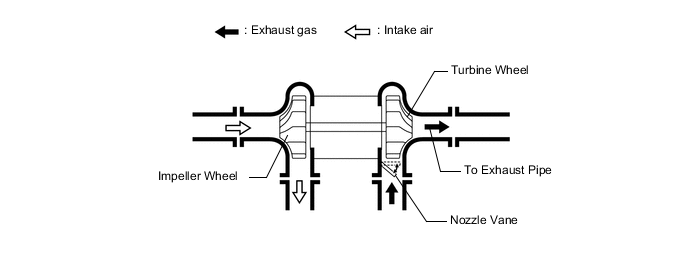
The exhaust gas from the exhaust manifold goes through the nozzle vane inside the turbocharger housing, and flows to the exhaust pipe through the turbine. The speed of the turbine (supercharging pressure) differs depending on the flow velocity of the exhaust gas going through the turbine. The flow velocity of the exhaust gas is controlled by the nozzle vane opening.
-
-
OPERATION
-
At Low Load Range or Low Speed Range
-
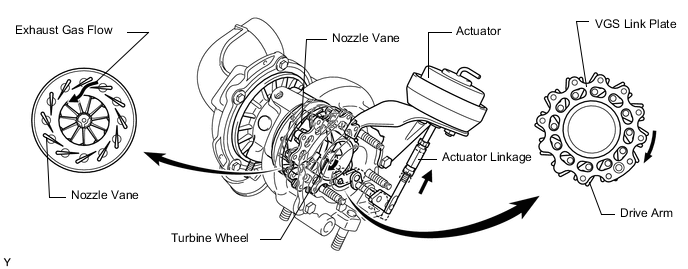
When the engine is running in a low load range or a low speed range, the actuator pulls up the actuator linkage. The actuator linkage is connected to the unison ring. At the same time, the drive arms installed in the unison ring move to change the nozzle vane angle toward closing direction. As a result, the exhaust gas travels to the turbine at a faster speed, and engine torque is improved.
-
-
At High Load Range or High Speed Range
-
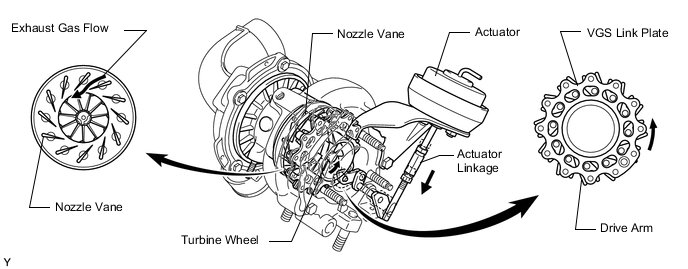
When the engine is running in a high load range or a high speed range, the actuator pulls down the actuator linkage. With this, the drive arm moves, opens the nozzle vane and holds the specified supercharging pressure. Thus, exhaust gas back pressure is lowered, and output and fuel consumption are improved.
-
-