HYBRID TRANSAXLE SYSTEM
-
FUNCTION
-
The sequential shiftmatic system enables the driver to select 6 stages of engine braking force by operating the shift lever. By controlling the engine, MG1 and MG2, this system improves the generation response of the engine braking force and acceleration response. In addition, a shift range which is lower than NORMAL mode can be selected in SPORT mode, making it possible to obtain a greater engine braking force.
-
By moving the shift lever to S, the automatic shifting mode will be switched to shift range selecting mode. By operating the shift lever, driving in the shift range selected by the driver is possible, and the accelerator pedal characteristics and acceleration response can be selected.
-
In shift range selecting mode, when low shift range is selected, the engine braking force becomes greater during deceleration and the motive force between the accelerator intermediate and fully open range becomes greater during acceleration.
Shift Range Characteristics Low Shift Range The motive force between the accelerator intermediate and fully open range is increased, improving the vehicle response to the driver's operation. High Shift Range Motive force changes in accordance with accelerator operation amount changes have been decreased more than normal, enhancing accelerator control and making it easy to maintain the vehicle speed during constant-speed cruising. Tech Tips
The sequential shiftmatic system does not indicate that maximum vehicle speed and maximum motion performance have been improved. Also, when the shift lever is moved to S, accelerator characteristics in drive mode (SPORT and ECO) are disabled.
-
An S mode position signal is output from the transmission control switch to the hybrid vehicle control ECU when the shift lever is moved from D to S. Then, the system switches to shift range selecting mode in order to enable shift range switching operation using the shift lever.
-
In shift range selecting mode, by performing a "+" (upshift) or "-" (downshift) operation using the shift lever, a shift-up signal or shift-down signal is output from the transmission control switch to the hybrid vehicle control ECU, and the shift range is changed. While using the selected shift range as the upper limit, an optimal shift point is automatically selected in accordance with driving conditions.
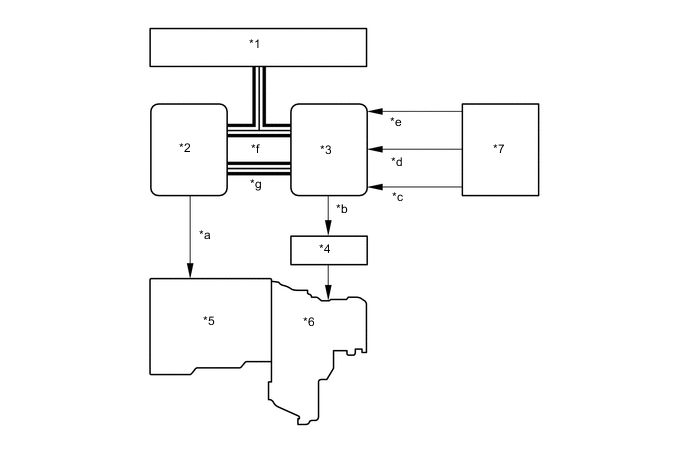
*1 Combination Meter Assembly
-
Shift Position Indicator
-
Buzzer
*2 ECM *3 Hybrid Vehicle Control ECU *4 MG ECU *5 Engine *6 Hybrid Transaxle (Hybrid Vehicle Transaxle Assembly) *7 Transmission Control Switch - - *a Engine Output Control Signal *b Motor Generator Output Control Signal *c S Mode Position Signal *d Shift-down Signal *e Shift-up Signal *f CAN (Bus 2) *g CAN (Sub Bus 15) - - -
-
Holding the shift lever to "+" (upshift) in S will change the shift range to the S6 range regardless of the current shift range (S1 to S5).
-
When downshifting at a low speed, the system may change the shift range by 2 stages or more.
-
In order to protect the transaxle, when accelerating while any range between the S1 range and the S4 range is selected in shift range selecting mode, sequential upshifts are automatically performed up to the S5 range by exceeding a predetermined vehicle speed in each shift range.
Limit Speed for Automatic Shift Range Up during Acceleration Automatic Shift Range Up during Acceleration Limit Speed (Reference) 5 → 6 - 4 → 5 167 km/h (104 mph) 3 → 4 137 km/h (86 mph) 2 → 3 92 km/h (58 mph) 1 → 2 62 km/h (39 mph) -
Upon receiving a downshifting request issued by the driver through the operation of the shift lever, this system limits the switching of the shift range if the vehicle is being driven at a speed that is higher than the limit speed, and informs the driver by sounding an alarm.
Limit Speed for Downshifting Downshifting Request Limit Speed (Reference) 6 → 5 - 5 → 4 165 km/h (103 mph) 4 → 3 135 km/h (84 mph) 3 → 2 90 km/h (56 mph) 2 → 1 60 km/h (38 mph)
-