BRAKE MASTER CYLINDER (for TSAM Made) INSTALLATION
-
CHECK AND ADJUST BRAKE BOOSTER PUSH ROD
Tech Tips
Adjust the booster push rod when the master cylinder is replaced with a new one. Adjustment is not necessary when the master cylinder is reinstalled and the booster is replaced with a new one.
-
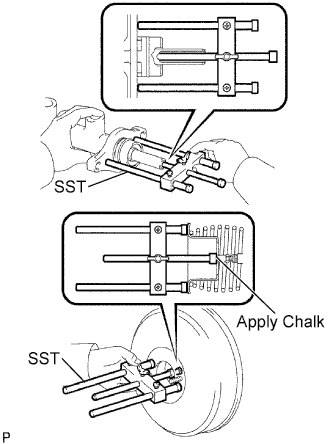
Set SST on the master cylinder and lower the rod of SST until it just touches the piston.
- SST
- 09737-00013
Tech Tips
SST 09737-00012 can also be used.
-
Apply chalk to the flat tip of the rod of SST. Turn SST upside down and measure the clearance between the brake booster push rod and SST.
Standard clearance 0 mm (0 in.) If there is clearance between the main body of SST and the shell of the brake booster, the push rod is protruding too far. If the chalk dies not stick to the tip of the brake booster push rod, the push rod protrusion is insufficient.
-
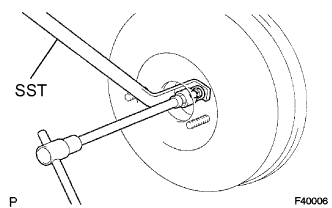
If the clearance is not as specified, adjust the length by holding the rod using SST and turning the tip of the rod using a 7 mm socket driver.
- SST
- 09737-00020
Note
Check the push rod clearance again after adjustment.
-
-
INSTALL BRAKE MASTER CYLINDER SUB-ASSEMBLY (w/ ABS)
-
Install a new O-ring to the master cylinder.
-
Install the master cylinder and bracket (with 3-way) to the booster with the 2 nuts.
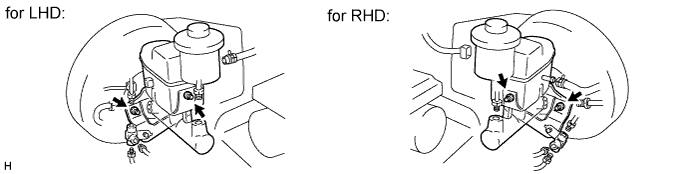
- Torque:
- 13 N*m { 127 kgf*cm, 9 ft.*lbf }
-
Using a union nut wrench, connect the 5 brake lines labeled C to the master cylinder and 3-way.
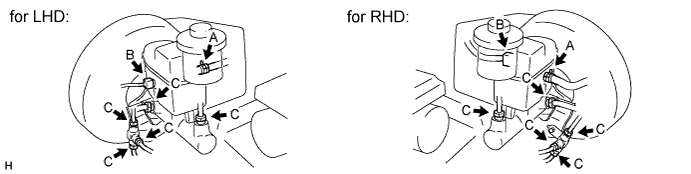
- Torque:
- 15 N*m { 155 kgf*cm, 11 ft.*lbf }
Note
Use the formula to calculate special torque values for situations where a union nut wrench is combined with a torque wrench Click here.
-
Connect the brake fluid level warning switch connector labeled B to the master cylinder.
-
for Manual Transmission:
Connect the clutch reservoir tube labeled A to the master cylinder.
-
-
INSTALL BRAKE MASTER CYLINDER SUB-ASSEMBLY (w/o ABS)
-
Install a new O-ring to the master cylinder.
-
Install the master cylinder and bracket (with 4-way) to the booster with the 2 nuts.
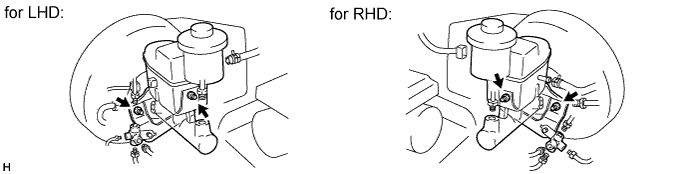
- Torque:
- 13 N*m { 127 kgf*cm, 9 ft.*lbf }
-
Using a union nut wrench, connect the 6 brake lines labeled C to the brake master cylinder and 4-way.
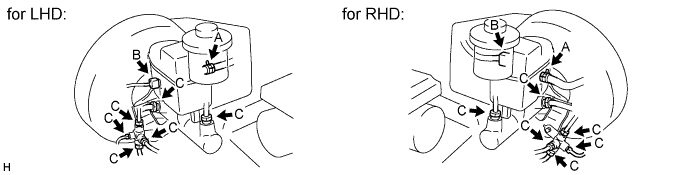
- Torque:
- 15 N*m { 155 kgf*cm, 11 ft.*lbf }
Note
Use the formula to calculate special torque values for situations where a union nut wrench is combined with a torque wrench Click here.
-
Connect the brake fluid level warning switch connector labeled B to the master cylinder.
-
for Manual Transmission:
Connect the clutch reservoir tube labeled A to the master cylinder.
-
-
FILL RESERVOIR WITH BRAKE FLUID
Fluid SAE J1704 or FMVSS No. 116 DOT 4 -
BLEED AIR FROM BRAKE MASTER CYLINDER
Tech Tips
If the master cylinder has been disassembled or if the reservoir becomes empty, bleed air from the master cylinder.
-
Using a union nut wrench, disconnect the 2 brake lines from the master cylinder.
-
Slowly depress and hold the brake pedal.
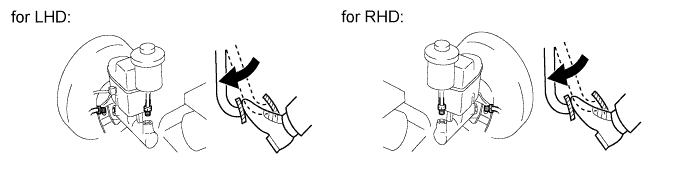
-
Cover the outer holes with your finger, and release the pedal.
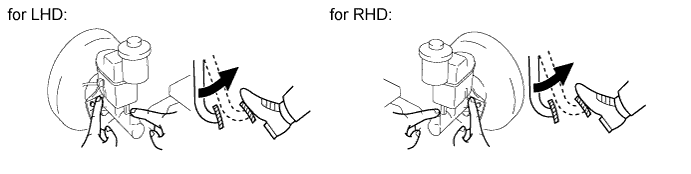
-
Repeat the 2 previous steps 3 or 4 times.
-
Using a union nut wrench, connect the 2 brake lines to the master cylinder.
- Torque:
- 15 N*m { 155 kgf*cm, 11 ft.*lbf }
Note
Use the formula to calculate special torque values for situations where a union nut wrench is combined with a torque wrench Click here.
-
-
BLEED AIR FROM BRAKE LINE
-
Remove the bleeder plug cap.
-
Connect the vinyl tube to the bleeder plugs.
-
Depress the pedal several times, and then loosen the bleeder plug with the pedal depressed.
-
When fluid stops coming out, immediately tighten the bleeder plug. Then release the pedal.
-
Repeat the 2 previous steps until all the air in the brake fluid is gone.
-
Tighten the bleeder plug.
- Torque:
- for front brake (2WD)
- 10 N*m { 102 kgf*cm, 7 ft.*lbf }
- for front brake (4WD and Pre-Runner)
- 11 N*m { 110 kgf*cm, 8 ft.*lbf }
- for rear brake (2WD)
- 11 N*m { 112 kgf*cm, 8 ft.*lbf }
- for rear brake (4WD and Pre-Runner)
- 10 N*m { 102 kgf*cm, 7 ft.*lbf }
-
Install the cap.
-
Bleed air from the brake line for each wheel by repeating the above procedures.
-
-
BLEED AIR FROM CLUTCH LINE (for Manual Transmission)
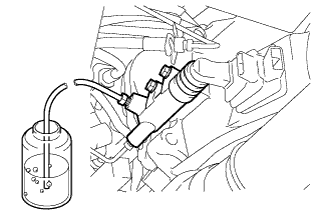
-
Remove the bleeder plug cap.
-
Connect the vinyl tube to the bleeder plug.
-
Depress the clutch pedal several times, and then loosen the bleeder plug with the pedal depressed.
-
At the point when fluid stops coming out, tighten the bleeder plug, and then release the clutch pedal.
-
Repeat the previous 2 steps until all the air in the fluid is completely bled out.
-
Tighten the bleeder plug.
- Torque:
- 11 N*m { 112 kgf*cm, 8 ft.*lbf }
-
Install the bleeder plug cap.
-
Check that all the air has been bled out of the clutch line.
-
-
CHECK BRAKE FLUID LEVEL IN RESERVOIR
-
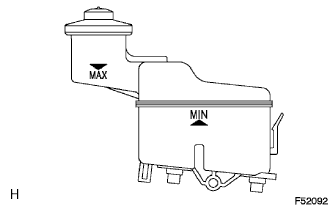
Check the fluid level.
If the brake fluid level is lower than the MIN line, check for leaks and inspect the disc brake pads. If necessary, refill the reservoir with brake fluid to the MAX line after repair or replacement.
Fluid SAE J1704 or FMVSS No. 116 DOT 4
-
-
CHECK FOR BRAKE FLUID LEAKAGE