CLUTCH SYSTEM
-
OUTLINE
-
A dry type single plate clutch, which is operated by hydraulic pressure, is used.
-
A self-adjusting type clutch cover is used on models with diesel engines.
-
A Concentric Slave Cylinder (CSC) is used in the clutch hydraulic pressure system on models with gasoline engines.
-
The clutch pedal uses a turnover mechanism to reduce clutch pedal effort.
-
The clutch system uses the clutch accumulator to reduce vibration transmitted to the clutch pedal on models with gasoline engines.
-
A clutch start system is used to ensure safety.
-
-
SPECIFICATION
Models with 1AD-FTV Engines Transaxle Type EA64 Clutch Cover Type Dry, Single Plate, Diaphragm Size 250 mm (9.84 in.) Installed Load 9300 N Clutch Disc Facing Size* 250 mm x 170 mm (9.84 in. x 6.69 in.) Master Cylinder Type Plunger Release Cylinder Type Conventional Clutch Pedal Turnover Tech Tips
*: Outer Diameter x Inner Diameter
Models with 2AD-FTV Engines Transaxle Type EA64F Clutch Cover Type Dry, Single Plate, Diaphragm Size 250 mm (9.84 in.) Installed Load 9300 N Clutch Disc Facing Size* 250 mm x 170 mm (9.84 in. x 6.69 in.) Master Cylinder Type Plunger Release Cylinder Type Conventional Clutch Pedal Turnover Tech Tips
*: Outer Diameter x Inner Diameter
Models with 2AR-FE Engines Transaxle Type EB63/EB63F Clutch Cover Type Dry, Single Plate, Diaphragm Size 229 mm (9.02 in.) Installed Load 6350 N Clutch Disc Facing Size* 229 mm x 159 mm (9.02 in. x 6.26 in.) Master Cylinder Type Plunger Release Cylinder Type Concentric Slave Cylinder (CSC) Clutch Pedal Turnover Tech Tips
*: Outer Diameter x Inner Diameter
Models with 3ZR-FE Engines Transaxle Type EB61/EB61F Clutch Cover Type Dry, Single Plate, Diaphragm Size 236 mm (9.29 in.) Installed Load 5900 N Clutch Disc Facing Size* 236 mm x 150 mm (9.29 in. x 5.91 in.) Master Cylinder Type Plunger Release Cylinder Type Concentric Slave Cylinder (CSC) Clutch Pedal Turnover Tech Tips
*: Outer Diameter x Inner Diameter
Models with 3ZR-FAE Engines Transaxle Type EB61F Clutch Cover Type Dry, Single Plate, Diaphragm Size 236 mm (9.29 in.) Installed Load 5900 N Clutch Disc Facing Size* 236 mm x 150 mm (9.29 in. x 5.91 in.) Master Cylinder Type Plunger Release Cylinder Type Concentric Slave Cylinder (CSC) Clutch Pedal Turnover Tech Tips
*: Outer Diameter x Inner Diameter
-
MAIN FEATURES
-
Self-adjusting Type Clutch Cover
-
A major difference between the self-adjusting type clutch cover and the conventional clutch cover is the support mechanism for the diaphragm spring.
-
The self-adjusting type clutch cover uses a sensor spring and an adjust ring to support the diaphragm spring.
-
The conventional type clutch cover uses pivot rings to support the diaphragm spring.
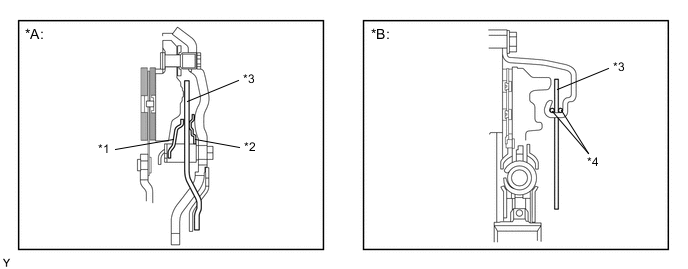
*A Self-adjusting Type *B Conventional Type *1 Sensor Spring *2 Adjust Ring *3 Diaphragm Spring *4 Pivot Ring -
-
-
Concentric Slave Cylinder (CSC)
-
The release cylinder and the release bearing have been combined into one unit. Because of this, the conventional fork and support have been discontinued and it is now possible to directly push the bearing with oil pressure, thus achieving excellent clutch operation feeling and weight reduction.
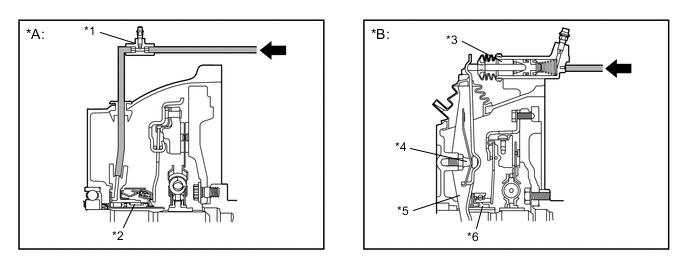
*A CSC Type *B Conventional Type *1 Bleeder *2 Clutch Release with Bearing Cylinder Assembly *3 Clutch Release Cylinder Assembly *4 Release Fork Support *5 Clutch Release Fork Sub-assembly *6 Clutch Release Bearing Assembly 
From Clutch Master Cylinder - -
-
-
-
PRECAUTION
-
Self-adjusting Type Clutch Cover and Clutch Disc
-
Make sure to replace the clutch cover whenever the clutch disc is replaced. If the clutch disc is replaced without replacing the clutch cover, a proper diaphragm spring posture cannot be attained, which could cause the clutch to slip and make it more difficult to operate the clutch.
-
-
Concentric Slave Cylinder (CSC)
-
The clutch release with bearing cylinder assembly cannot be disassembled.
-
When the transaxle is removed from the engine, the piston with seal will move to the engine side and the piston seal may be damaged by foreign matter on the sliding surface. When the transaxle is removed from the engine, replace the clutch release with bearing cylinder assembly with a new one.
-
The bolts that fasten the clutch release with bearing cylinder assembly to the transaxle are sealed. When the bolts are removed, replace them with new ones.
-
The clutch fluid should be replaced or inspected in accordance with the Maintenance Schedule and Owner's Manual.
-
-