ENGINE UNIT DETAILS
-
CONSTRUCTION
-
Cylinder Head Cover
-
The cylinder head cover is made of plastic to reduce weight and noise.
-
A baffle plate is provided on the inside of the cylinder head cover to reduce the consumption of engine oil through blow-by gas.
-
On the models compliant with EURO 5 emission regulations, a No. 2 cylinder head cover and a No. 3 cylinder head cover are used. A sound-insulating material is pasted inside the No. 2 cylinder head cover and the No. 3 cylinder head cover to insulate the operating sound of the injector assembly.
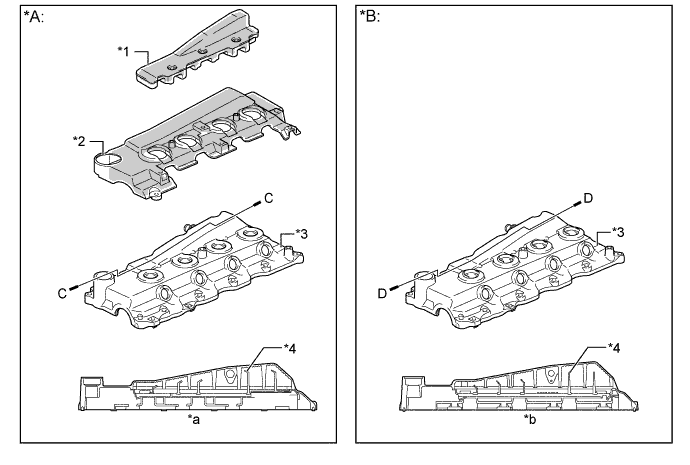
Text in Illustration *A Models Compliant with EURO 5 Emission Regulations *B Except Models Compliant with EURO 5 Emission Regulations *1 No. 3 Cylinder Head Cover *2 No. 2 Cylinder Head Cover *3 Cylinder Head Cover *4 Baffle Plate *a C - C Cross Section *b D - D Cross Section 
Sound Insulating-material - -
-
-
Cylinder Head Gasket
-
A steel-laminate type cylinder head gasket is used.
-
A shim has been provided around the cylinder bore to increase the sealing surface, thus achieving excellent sealing performance.
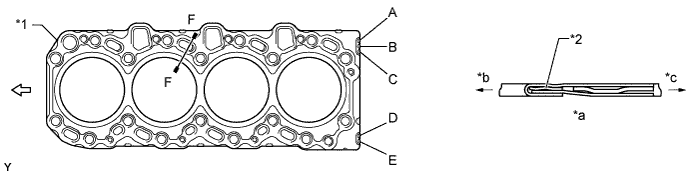
Text in Illustration *1 Cylinder Head Gasket *2 Shim *a F - F Cross Section *b Cylinder Bore Side *c Outer Side - - 
Front - - Tech Tips
There are 5 sizes of new cylinder head gaskets, marked "A", "B", "C", "D", or "E" in accordance with piston protrusion. For details, refer to the corresponding Repair Manual for this model.
-
-
Cylinder Head
-
The cylinder head is made of aluminum alloy. The injector has been located in the center of the combustion chamber in order to improve engine performance and to achieve cleaner emissions.
-
2 intake ports with different shapes have been combined to promote the mixture of fuel and air by optimizing the swirl in the cylinder.
-
A vertical 2-stage construction is used for the water jacket to improve cooling performance.
-
A glow plug is placed between the intake ports of each cylinder to ensure startability.
-
The passage for the EGR is provided in the cylinder head. By cooling the exhaust gas, it is possible to recirculate a large amount of exhaust gas.
-
The cylinder head bolt employs plastic region tightening bolts.
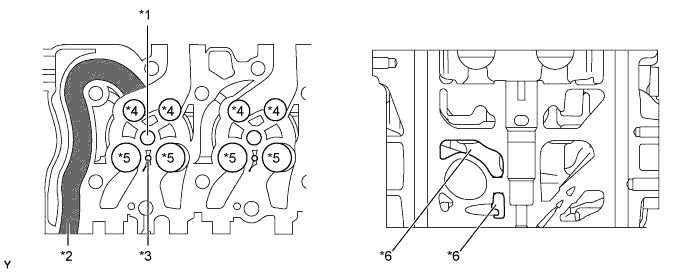
Text in Illustration *1 Injector Hole *2 EGR Passage *3 Glow Plug Hole *4 Exhaust Valve Hole *5 Intake Valve Hole *6 Water Jacket
-
-
Cylinder Block
-
The cylinder block is constructed of liner-less cast iron alloy.
-
A rib has been provided to the cylinder block to reduce engine vibration.
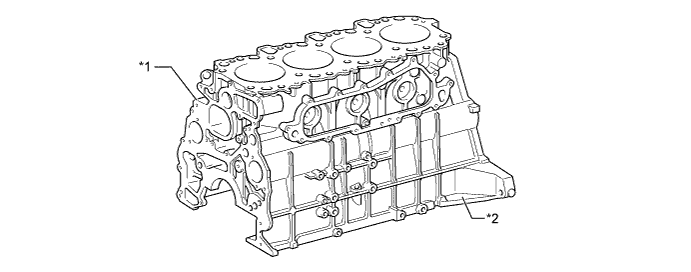
Text in Illustration *1 Cylinder Block *2 Rib
-
-
Piston
-
A piston provided with a combustion chamber is used.
-
The piston is made of aluminum alloy.
-
A cooling channel has been provided to reduce the piston temperature, and achieve high reliability.
-
The top ring groove uses a Ni-resist cast iron ring carrier to improve wear resistance.
-
On the models compliant with EURO 5 and EURO 4 emission regulations, and models non-compliant with emission regulations, a Physical Vapor Deposition (PVD) coating has been applied to the surface of the No. 1 compression ring, in order to improve its wear resistance.
-
A resin coating is applied to the piston skirt portion, to achieve reduction of friction loss.
-
On the models compliant with EURO 5 and EURO 4 emission regulations, a non-symmetrical piston skirt shape is used to achieve reduction of friction loss.
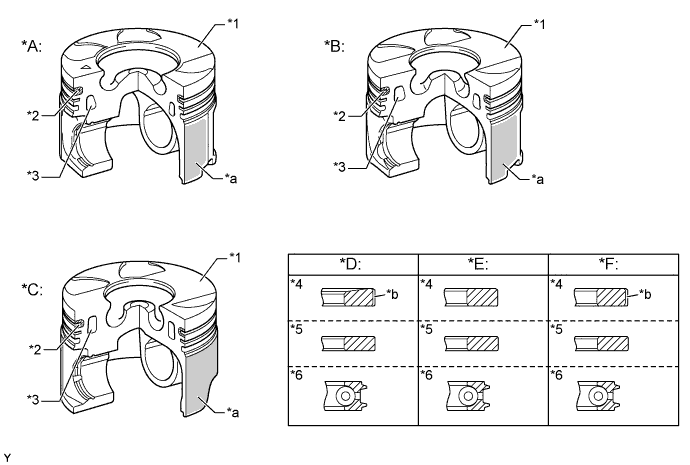
Text in Illustration *A Models Compliant with EURO 5 Emission Regulations *B Models Compliant with EURO 4 Emission Regulations *C Models Compliant with EURO 2 Emission Regulations and Models Non-compliant with Emission Regulations *D Models Compliant with EURO 5 and EURO 4 Emission Regulations *E Models Compliant with EURO 2 Emission Regulations *F Models Non-compliant with Emission Regulations *1 Piston *2 Ni-resist Cast Iron Ring Carrier *3 Cooling Channel *4 No. 1 Compression Ring *5 No. 2 Compression Ring *6 Oil Ring *a Resin Coating *b PVD Coating
-
-
Connecting Rod Sub-assembly and Connecting Rod Bearing
-
The connecting rods are made of high-strength material to ensure the proper strength.
-
Knock pins are used at the mating surfaces of the bearing caps of the connecting rod to minimize the shifting of the bearing caps during assembly.
-
Plastic region tightening bolts are used.
-
An aluminum bearing is used for the connecting rod bearings.
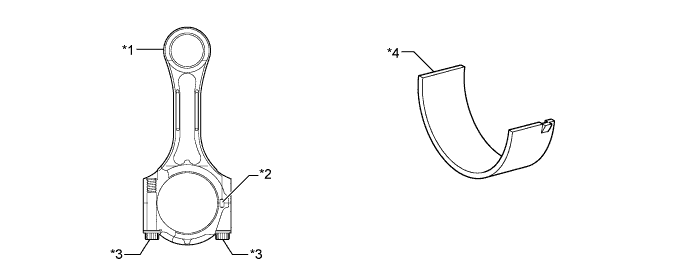
Text in Illustration *1 Connecting Rod Sub-assembly *2 Knock Pin *3 Plastic Region Tightening Bolt *4 Connecting Rod Bearing
-
-
Crankshaft and Crankshaft Bearing
-
The crankshaft has 5 journals and 8 balance weights.
-
All pin and journal fillets are treated by induction hardening to maintain adequate strength.
-
The crankshaft bearing is made of aluminum alloy.
-
The upper main bearing has an oil groove around its inside circumference.
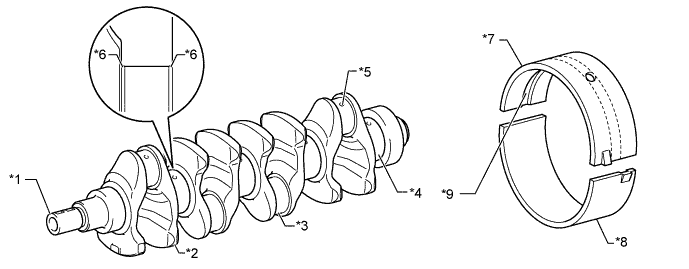
Text in Illustration *1 Crankshaft *2 Balance Weight *3 Crank Pin *4 Journal *5 Oil Hole *6 Induction Hardening *7 Upper Main Bearing *8 Lower Main Bearing *9 Oil Groove - -
-
-
Valve Mechanism
-
Each cylinder has 2 intake valves and 2 exhaust valves. Intake and exhaust efficiency is increased by means of the larger total port areas.
-
The valves are directly opened and closed by 2 camshafts.
-
The camshaft (intake camshaft) is driven by a timing belt, while the No. 2 camshaft (exhaust camshaft) is driven by gears on the camshaft (intake camshaft).
-
Small-diameter, flat-teeth gears are used for driving the No. 2 camshaft (exhaust camshaft) in order to reduce gear noise.
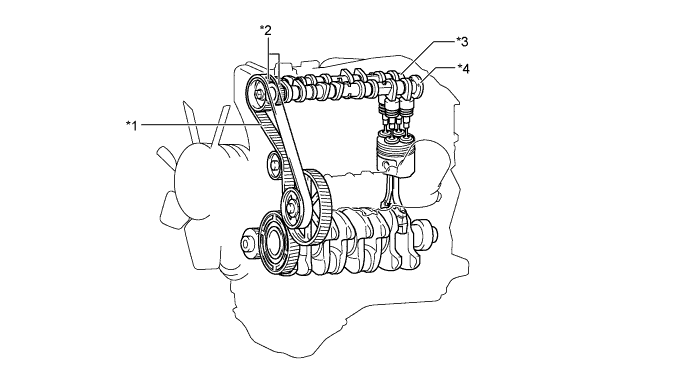
Text in Illustration *1 Timing Belt *2 Camshaft Drive Gear *3 No. 2 Camshaft (Exhaust Camshaft) *4 Camshaft (Intake Camshaft)
-
-
Camshaft
-
The cam nose has been chill-treated to increase its abrasion resistance.
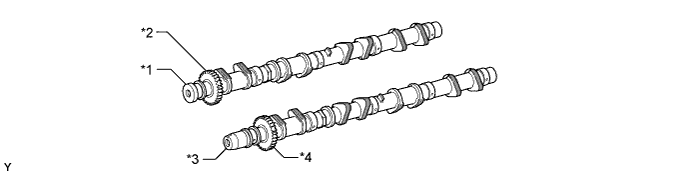
Text in Illustration *1 No. 2 Camshaft (Exhaust Camshaft) *2 Camshaft Driven Gear *3 Camshaft (Intake Camshaft) *4 Camshaft Drive Gear 
Chill-treated - -
-
-
Intake and Exhaust Valves
-
Along with the increased amount of valve lift, shimless valve lifters that provide a large cam contact surface are used.
-
The adjustment of the valve clearance is accomplished by selecting and replacing the appropriate valve lifters.
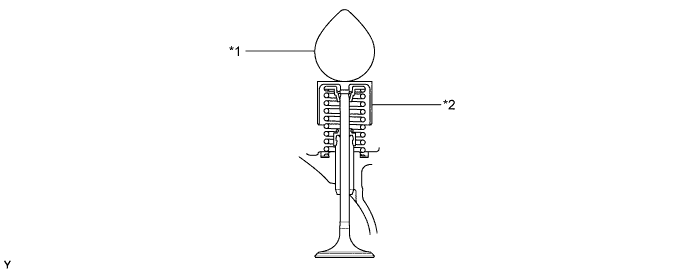
Text in Illustration *1 Camshaft *2 Valve Lifter Tech Tips
The valve lifters must be replaced when it is necessary to adjust the valve clearance. For this purpose, valve lifters with different thicknesses are available as service parts. For details, refer to the corresponding Repair Manual for this model.
-
-
Timing Gear Train
-
The supply pump, vacuum pump and oil pump are driven by the crankshaft timing gear.
-
The idle gear is constructed with a scissors gear on its front and back to reduce noise.
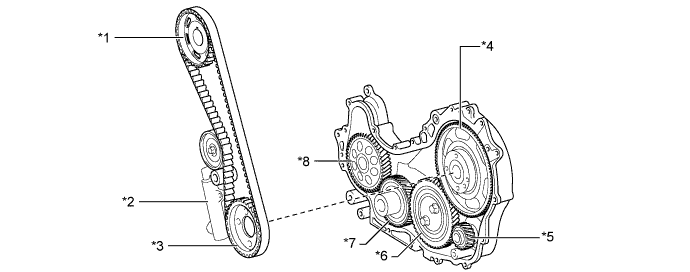
Text in Illustration *1 No. 2 Camshaft Timing Pulley *2 Automatic Tensioner *3 No. 1 Camshaft Timing Pulley *4 Supply Pump Drive Gear *5 Vacuum Pump Drive Gear *6 Idle Gear *7 Crankshaft Timing Gear *8 Oil Pump Drive Gear
-
-
V-ribbed Belt
-
Accessory components are driven by a serpentine belt consisting of a single V-ribbed belt. This reduces the overall engine length, weight and the number of engine parts.
-
An automatic tensioner eliminates the need for tension adjustment.
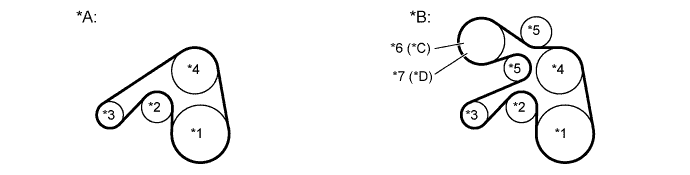
Text in Illustration *A Models without Air Conditioning System and Viscous Type Power Heater *B Models with Air Conditioning System or Viscous Type Power Heater *C Models with Air Conditioning System *D Models with Viscous Type Power Heater *1 Crankshaft Pulley *2 Idler Pulley for Automatic Tensioner *3 Generator Pulley *4 Water Pump Pulley *5 Idler Pulley *6 Air Conditioning Compressor Pulley *7 Viscous Type Power Heater Pulley - -
-
-