ENGINE ON-VEHICLE INSPECTION
-
CHECK ENGINE IDLE SPEED AND MAXIMUM SPEED
Tech Tips
-
For more information about the intelligent tester, refer to its operator's manual.
-
If an intelligent tester is not available, use a tachometer's tester probe as a substitute.
-
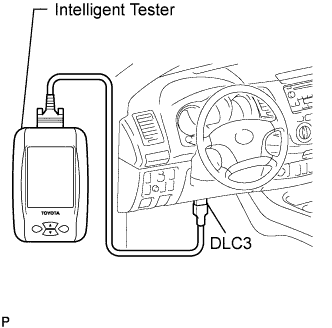
Connect the intelligent tester to the DLC3.
-
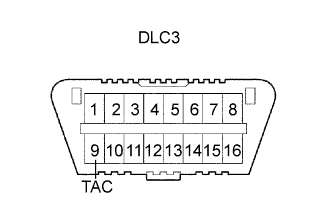
If a tester is not available, connect a tester probe of a tachometer to terminal 9 (TAC) of the DLC3 with SST.
- SST
- 09843-18040
-
Inspect the idle speed.
Tech Tips
-
The engine is warmed up.
-
The A/C switch is OFF.
-
Start the engine and measure the idle speed.
Standard idle speed 700 to 800 rpm If the idle speed is not as specified, perform the troubleshooting procedures in the Diagnostics section.
-
-
Inspect the maximum speed.
-
Start the engine.
-
Fully depress the accelerator pedal.
-
Measure the maximum speed.
Standard maximum speed 4450 to 4750 rpm If the maximum speed is not as specified, perform the troubleshooting in the Diagnostics section.
-
-
If the tester probe of the tachometer is connected to the DLC3, disconnect the tester probe with SST from terminal 9 of the DLC3.
-
Disconnect the intelligent tester from the DLC3.
-
-
INSPECT CYLINDER COMPRESSION PRESSURE
Tech Tips
Measure the compression pressure if the engine power is insufficient, oil is consumed excessively and/or fuel economy is poor.
-
Remove the 4 glow plugs.
-
Disconnect the 4 injector connectors.
-
Turn the ignition switch to START to expel soot and other foreign matter from the inside of the cylinder.
-
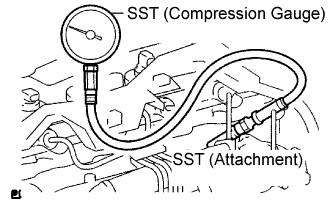
Measure the compression pressure.
-
Set SST (attachment) into the glow plug hole.
- SST
- 09992-00025 ( 09992-00121 )
- Torque:
- 13 N*m { 133 kgf*cm, 10 ft.*lbf }
-
Connect SST (compression gauge) to SST (attachment).
- SST
- 09992-00025 ( 09992-00211 )
-
Measure the compression pressure while cranking the engine.
Tech Tips
Always use a fully charged battery to obtain an engine revolution of 250 rpm or more.
-
-
Perform the step above for each cylinder.
Note
This measurement must be done in as short a time as possible.
Standard compression pressure 2700 kPa (27.5 kgf/cm2, 391 psi) or more Minimum pressure 2200 kPa (22.5 kgf/cm2, 320 psi) Standard difference between each cylinder 500 kPa (5.0 kgf/cm2, 71 psi) or less If the compression in one or more cylinders is low, add a bit of engine oil into the glow plug hole. Then, repeat the step above for the low-compression cylinder(s).
Tech Tips
-
If poor compression improves after adding the engine oil, the piston rings and/or cylinder bore may be worn or damaged.
-
If pressure stays low, a valve may be stuck or seated improperly, or pressure may be leaking through the gasket.
-
-
Remove SST (attachment and compression gauge).
-
Connect the 4 injector connectors.
-
Install the 4 glow plugs.
-