PRE-COLLISION SYSTEM Pre-collision System Circuit
| DTC Code | DTC Name |
|---|---|
| Pre-collision System Circuit |
DESCRIPTION
When the ignition switch is ON, power is supplied to the pre-collision city sensor.
WIRING DIAGRAM
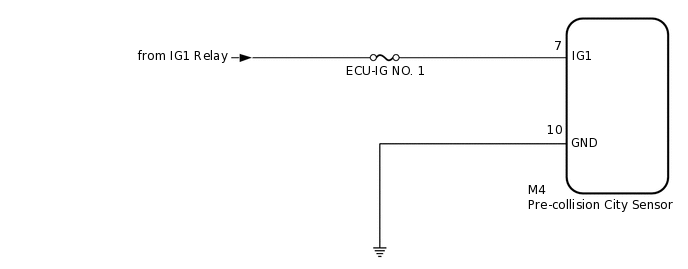
CAUTION / NOTICE / HINT
Inspect the fuses for circuits related to this system before performing the following procedure.
PROCEDURE
INSPECT BATTERY VOLTAGE
Measure the battery voltage.
Standard Voltage
11 to 14 V
If the voltage is below 11 V, replace or recharge the battery before proceeding to the next step.
Result
Proceed to
NEXT
CHECK PRE-COLLISION CITY SENSOR
Check pre-collision city sensor.
Note:DTCs may be output when connectors are disconnected during inspection. Therefore, make sure to clear the DTCs using the GTS once the inspection has been completed.
-
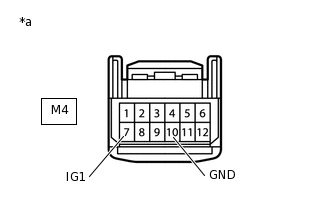
*a
Front view of wire harness connector
(to Pre-collision City Sensor)
Disconnect the pre-collision city sensor connector.
Measure the voltage according to the value(s) in the table below.
Standard Voltage
Tester Connection
Condition
Specified Condition
M4-7 (IG1) - Body ground
Ignition switch ON
11 to 14 V
M4-7 (IG1) - Body ground
Ignition switch off
Below 1 V
Measure the resistance according to the value(s) in the table below.
Standard Resistance
Tester Connection
Condition
Specified Condition
M4-10 (GND) - Body ground
Always
Below 1 Ω
-
Result
Proceed to
OK
NG
NG REPAIR OR REPLACE HARNESS OR CONNECTOR
CHECK CAN COMMUNICATION SYSTEM
Use the GTS to check if the CAN communication system is functioning normally.
Result
Result
Proceed to
CAN communication system DTCs are not output
A
CAN communication system DTCs are output
B