CRUISE CONTROL SYSTEM
-
FUNCTION OF MAIN COMPONENTS
-
The main components in the cruise control system have the following functions:
Component Function Cruise Control Main Switch Assembly "ON-OFF" Button Turns the power to the cruise control system on and off after the engine has started up. "CANCEL" A cancel signal can be output to the ECM through the operation of this switch. "+ RES" The acceleration function and resume control function can be performed by operating this switch. A signal is output to the ECM when this switch is operated. "- SET" The deceleration function and set control function can be performed by operating this switch. A signal is output to the ECM when this switch is operated. ECM
-
Controls the constant speed control mode in accordance with signals from the switches, sensors and ECUs.
-
If the ECM detects a malfunction in the cruise control system, it will store a Diagnostic Trouble Code (DTC).
Skid Control ECU Transmits the VSC operation signal and vehicle speed signal to the ECM. Combination Meter Assembly Cruise Main Indicator Light
-
Illuminates green when the "ON-OFF" button on the cruise control main switch assembly has been pressed, to turn the cruise control system on.
-
If the ECM detects a malfunction, this light illuminates amber to warn the driver.
Cruise SET Indicator Light Illuminates when the vehicle speed is set. Throttle Body with Motor Assembly Throttle Control Motor Adjusts the throttle valve to the limiter position in accordance with signals from the ECM. Throttle Position Sensor Transmits the throttle valve position information to the ECM. Front Speed Sensor LH/RH, Rear Speed Sensor LH/RH Detects the vehicle speed and transmits a signal via the skid control ECU to the combination meter assembly and the ECM. Accelerator Pedal Sensor Assembly Detects the accelerator pedal depression degree and outputs it to the ECM. Stop Light Switch Assembly Detects the depressing of the brake pedal and transmits a signal to the ECM. Clutch Switch Assembly*1 Detects the depressing of the clutch pedal and transmits a signal to the ECM. Neutral Position Switch Assembly*1 Detects the neutral position and transmits a signal to the ECM. Park/Neutral Position Switch Assembly*2 Detects the shift position and transmits a signal to the ECM and the transmission control ECU assembly. Transmission Control Switch*2 Detects the shift laver operation when it is moved from D or M, and transmits a signal to the transmission control ECU assembly. Transmission Shift Switch Assembly*2,*3 Detects the select operation and transmits a signal to the transmission control ECU assembly. Transmission Control ECU Assembly*2 Transmits the shift signal to the ECM.
-
*1: Models with M/T
-
*2: Models with A/T
-
*3: Models with shift paddle switch
-
-
-
FUNCTION
-
The cruise control has the following control functions:
Function Outline Constant Speed Control The ECM compares the actual vehicle speed and the set speed and if the vehicle speed is lower than the set speed, it uses the throttle control motor to increase the throttle opening. Set Control When the "ON-OFF" button is turned on and the cruise control main switch assembly is pressed in the "- SET" direction and released, the ECM stores the vehicle speed in the memory and continues to control the vehicle at that speed. The set speed is between 40 km/h (25 mph) and 200 km/h (125 mph)*1 [144 km/h (90 mph)]*2. Coast Control When the cruise control main switch assembly is held down in the "- SET" direction while the vehicle is running in the cruise control, the throttle control motor is energized in the throttle closing direction, and the vehicle keeps decelerating. The ECM stores the vehicle speed when the cruise control main switch assembly is released. From then on, the ECM continues to control the vehicle at that speed. Tap-down Control When the difference between the actual vehicle speed and the set speed is less than 4.4 km/h (3 mph)*3 [4 mph (6.8 km/h)]*4, the set speed can be lowered in steps of approximately 1 km/h (0.6 mph)*3 [1 mph (1.6 km/h)]*4 by operating the cruise control main switch assembly in the "- SET" direction quickly within approximately 0.3 seconds. However, if the difference between the actual vehicle speed and the set speed is greater than 4.4 km/h (3 mph)*3 [4 mph (6.8 km/h)]*4, the set speed will change to the speed at which the vehicle was traveling at when the switch was released. Accelerator Control When the cruise control main switch assembly is kept pushed to the "+ RES" direction while the vehicle is running in the cruise control, the throttle control motor is energized in the throttle opening direction. The vehicle keeps accelerating and the ECM stores the vehicle speed when the cruise control main switch assembly is released. From then on, the ECM continues to control the vehicle at that speed. Tap-up Control When the difference between the actual vehicle speed and the set speed is less than 4.4 km/h (3 mph)*3 [4 mph (6.8 km/h)]*4, the set speed can be increased in steps of approximately 1 km/h (0.6 mph)*3 [1 mph (1.6 km/h)]*4 by operating the cruise control main switch assembly in the "+ RES" direction quickly within approximately 0.3 seconds. However, if the difference between the actual vehicle speed and the set speed is greater than 4.4 km/h (3 mph)*3 [4 mph (6.8 km/h)]*4, the set speed will not change. Low Speed Limit Control The low speed limit is the lowest speed that the cruise control can be set to and is set at approximately 40 km/h (25 mph). The cruise control cannot be set below that speed. If the vehicle speed drops below that speed while running in the cruise control, the cruise control is canceled automatically. However the set speed is kept in memory. Resume Control When the cruise control has been canceled by something other than the "ON-OFF" button operation, the cruise control can be resumed and controlled at the set speed by operating the cruise control main switch assembly in the "+ RES" direction when the vehicle speed returns to above the low speed limit (approximately 32 km/h [20 mph]). Shift down Control*5 When the vehicle is traveling uphill using cruise control system, automatic transmission control may cause the transmission to shift down. During shift down control, when the end of uphill travel is determined, the transmission will shift up after a certain period of time. When the transmission shifts down during the accelerator control or resume control, the transmission will shift up after the accelerator control or resume control ends. Manual Cancel Control
-
If any of the following signals is sent to the ECM, the cruise control is cancelled accordingly.
-
Stop light switch assembly on signal (depress the brake pedal).
-
Signal to move the shift lever to any position other than D or M.*5
-
Signal to move the shift lever to neutral position.*6
-
Clutch switch assembly off signal (depress the clutch pedal).*6
-
"CANCEL" switch on signal.
-
"ON-OFF" button off signal.
-
VSC operation.
Automatic Cancel Control
-
When any of the following conditions occurs during cruise control operation, the set speed in the memory is cleared to cancel the cruise control. Furthermore, the cruise main indicator light illuminates amber and operation of the cruise control is disabled until the ignition is turned off.
-
The stop light switch assembly has an open or short circuit, or the stop light switch assembly input signal is abnormal.
-
The vehicle speed signal is abnormal.
-
The cancel circuit has a malfunction.
-
The cruise control main switch assembly circuit has a malfunction.
-
Throttle body with motor assembly has a malfunction.
-
Engine has a malfunction.
-
When any of the following conditions occurs during cruise control operation, the speed that is set in the memory is cleared and the cruise control is cancelled. Furthermore, the operation of the cruise control will be disabled until that condition is eliminated.
-
VSC system has a malfunction.
-
Transmission control ECU assembly has a malfunction.*5
-
Combination meter assembly has a malfunction.
-
When the following condition occurs during cruise control, the cruise control is cancelled.
-
Vehicle speed is below the low speed limit (approximately 32 km/h [20 mph]).
-
*1: Except models for Korea
-
*2: Models for Korea
-
*3: Models with km/h main meter indication
-
*4: Models with mph main meter indication
-
*5: Models with A/T
-
*6: Models with M/T
-
-
-
CONSTRUCTION
-
Cruise Control Main Switch Assembly
-
The cruise control main switch assembly consists of the "ON-OFF" button, "+ RES", "- SET" and "CANCEL" switches. The "+ RES", "- SET" and "CANCEL" switches are operated using a lever that operates in 3 directions.
-
The cruise control main switch assembly is an automatic reset (normally open) type that turns on only when the switch is being operated and turns off as soon as the driver releases the switch. Furthermore, the functions of the control switch are active only when the cruise control system has been turned on.
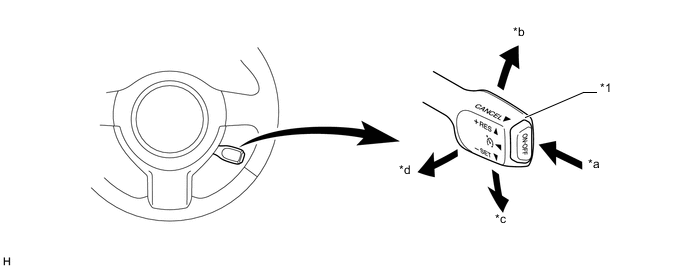
Text in Illustration *1 Cruise Control Main Switch Assembly - - *a "ON-OFF" Button *b "+ RES" *c "- SET" *d "CANCEL"
-
-
-
OPERATION
-
Combination Meter Assembly
-
The combination meter assembly provides a cruise main indicator light and cruise SET indicator light to indicate in the cruise control system.
Condition 

Set Standby Illuminates (green) - Being Controlled Illuminates (green) Illuminates System Malfunction Illuminates (amber) -
-
-
-
DIAGNOSIS
-
If a malfunction occurs in the cruise control system, the ECM cancels the cruise control system. The ECM makes the cruise main indicator light illuminate amber to inform the driver of a malfunction. At this time, the ECM memorizes the malfunction in the form of a 2-digit cancel code. For details of the cancel code, refer to the Repair Manual.
-