BRAKE CONTROL SYSTEM
-
SYSTEM CONTROL
-
If the vehicle is towing a trailer with an inappropriate hitch load trailer sway could be caused by crosswinds, imbalance caused by load, or the driver's steering. Trailer sway control reduces trailer sway by controlling the engine output and the braking of each wheel.
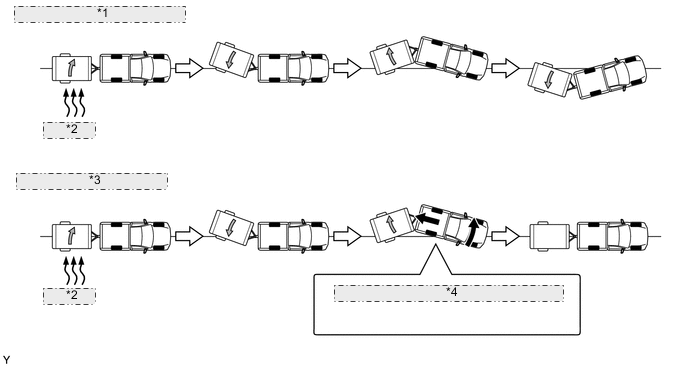
*1 Without Trailer Sway Control *2 Side Wind *3 With Trailer Sway Control *4 Brake Control + Engine Output Control Note
-
Trailer sway control is a part of the VSC function. Accordingly, if the VSC OFF mode is selected or VSC is not functioning normally, trailer sway control will not operate.
-
Trailer sway control will be unable to stabilize the vehicle if a trailer is being towed which cannot be physically controlled due to the influence of the vehicle, road surface, driving conditions, etc.
-
-
The skid control ECU detects the occurrence of trailer sway based on signals from the yawrate sensor, the deceleration sensor and the steering angle sensor.
-
Trailer sway can be reduced by decelerating the vehicle. When the skid control ECU detects trailer sway, it controls the brakes of each wheel while simultaneously requesting engine output control from the ECM and reducing vehicle speed.
-
Moreover, by using brake control to reduce the yaw moment caused by trailer sway, trailer sway can be reduced more quickly than by simply decelerating the vehicle.
-
The slip indicator light on the combination meter assembly flashes when trailer sway control is in operation. Also, the stop light illuminates to inform vehicles behind that the vehicle is decelerating.
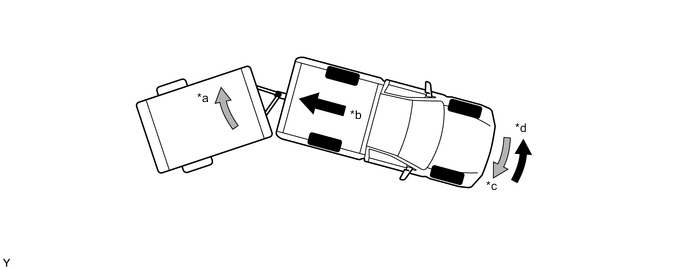
*a Trailer Sway *b Deceleration Force Caused by Brake Control and Engine Output Control *c Yaw Moment Caused by Trailer Sway *d Control Moment Caused by Brake Control 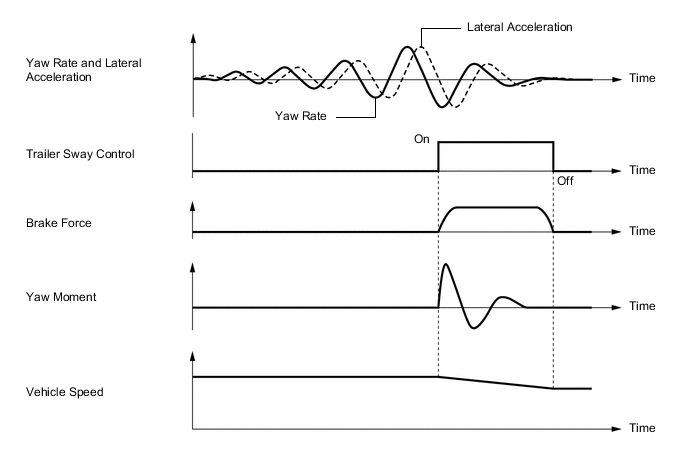
-