EMISSION CONTROL SYSTEM ON-VEHICLE INSPECTION
PROCEDURE
INSPECT FUEL CUT OFF/RESTART RPM
Start and warm up the engine.
Increase the engine speed to at least 2500 rpm.
Use a sound scope to check for injector operating sounds.
When the accelerator pedal is released, check that injector operating sounds stop momentarily and then resume.
Standard
Item
Specified Condition
Fuel cut off rpm
2500 rpm
Fuel injector restart rpm
1200 rpm
VISUALLY INSPECT HOSE, CONNECTIONS AND GASKETS
-
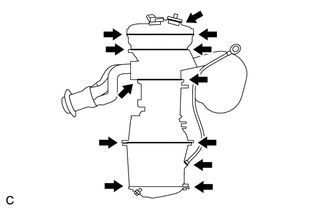
Visually check that the hoses, connections and gaskets have no cracks, leaks or damage.
Note:Detachment or other problems with the engine oil dipstick, filler cap, ventilation hose and other components may cause the engine to run improperly.
Air suction caused by disconnections, looseness or cracks in any part of the air induction system between the throttle body and cylinder head will cause an engine failure or engine malfunction.
If any defects are found, replace parts as necessary.
-
INSPECT EVAPORATIVE EMISSION CONTROL SYSTEM
Connect the intelligent tester to the DLC3.
-
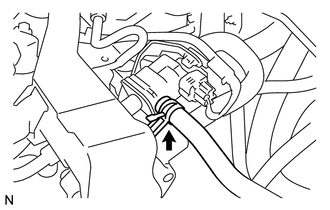
Disconnect the fuel vapor feed hose from the purge VSV as shown in the illustration.
Start the engine.
Enter the following menus: Powertrain / Engine and ECT / Active Test / Activate the VSV for Evap Control.
Check that vacuum occurs at the purge VSV port.
If vacuum does not occur, check the following items.
Purge VSV
Clogging in the fuel vapor feed hose connecting the intake manifold and purge VSV
Voltage at the ECM PRG terminal
Exit Active Test mode and reconnect the fuel vapor feed hose.
Enter the following menus: Powertrain / Engine and ECT / Data List / EVAP Purge VSV.
Warm up the engine and drive the vehicle.
Confirm that the purge valve opens.
If the result is not as specified, replace the purge VSV, wire harness or ECM.
INSPECT CANISTER
-
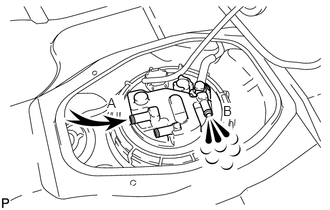
Apply compressed air into port A, and check that the air flows out from port B.
-
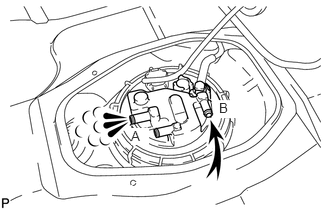
Apply compressed air into port B, and check that the air flows out from port A.
-
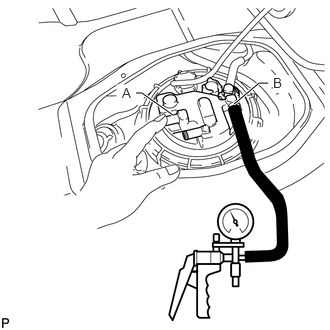
Close port A with your finger. Using a vacuum pump, apply a vacuum to port B and check the pressure.
OK
The pressure does not change even when vacuum is applied.
-
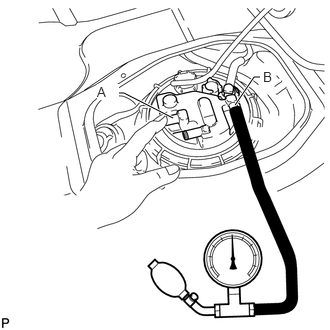
Close port A with your finger. Using SST, apply pressure to port B and check the pressure.
09992-00242
OK
The pressure does not change even when pressure is applied.
-