ENTRY AND START SYSTEM(for Entry Function) All Door Entry Lock/Unlock Functions do not Operate, but Wireless Functions Operate
| DTC Code | DTC Name |
|---|---|
| All Door Entry Lock/Unlock Functions do not Operate, but Wireless Functions Operate |
DESCRIPTION
When the wireless operation can be used to lock and unlock the doors, communication between the door control receiver and certification ECU is normal. If the entry luck and unlock functions do not operate, the entry cancel function may be set through the customize function, there may be communication problems between the key and vehicle, or there may be electric wave interference.
CAUTION / NOTICE / HINT
The entry and start system (for Entry Function) uses a multiplex communication system (LIN communication system) and the CAN communication system. Inspect the communication function by following How to Proceed with Troubleshooting (Click here). Troubleshoot the entry and start system (for Entry Function) after confirming that the communication systems are functioning properly.
When using the intelligent tester with the engine switch off to troubleshoot:
Connect the intelligent tester to the DLC3 and turn a courtesy light switch on and off at 1.5-second intervals until communication between the intelligent tester and vehicle begins.
Check that there are no electrical key transmitters in the vehicle.
Before performing the inspection, check that DTC B1242 (wireless door lock control) is not output (Click here).
When checking the entry lock operation multiple times, the lock operation may be limited to 2 consecutive operations depending on the settings. In order to perform the entry lock operation 3 or more times, an unlock operation must be performed once (any type of unlock operation is sufficient). However, only consecutive entry lock operations are limited. Using the wireless lock or other types of lock operations, it is possible to perform consecutive lock operations without this limitation.
Before replacing the certification ECU, refer to the entry and start system (for Entry Function) (Click here).
After repair, confirm DTC not reoccur with performing the "DTC Output Confirmation Operation".
PROCEDURE
READ VALUE USING INTELLIGENT TESTER (KEY CANCEL SWITCH)
Using the intelligent tester, read the Data List
Body Electrical > Entry&Start > Data List
Tester Display
Auto Entry Cancel SW
Body Electrical > Entry&Start > Data List
Tester Display
Measurement Item
Range
Normal Condition
Diagnostic Note
Auto Entry Cancel SW
Entry cancel function setting
OFF or ON
Mode status displayed
ON: entry and start system canceled
OFF: entry and start system not canceled
The default setting for the entry cancel function is OFF. If the customer requests that the entry and start system functions (locking and unlocking the doors while carrying the key, etc.) be canceled, the setting can be changed through the customize function.*
*: (see pageClick hereClick here)
Result
Result
Proceed to
Entry door lock function cancel is OFF
A
Entry door lock function cancel is ON
B
CHECK WAVE ENVIRONMENT
Move the electrical key transmitter as described below and perform the operation inspection
Tip:When the electrical key transmitter is brought near the front door outside handle assembly LH or electrical key antenna, the possibility of wave interference decreases, and it can be determined if wave interference is causing the problem symptom.
The transmitting wave of the wireless function and entry function are the same, but the wave logic is different. As a result, it is possible that only the wireless function or only the entry function is affected by wave interference.
-
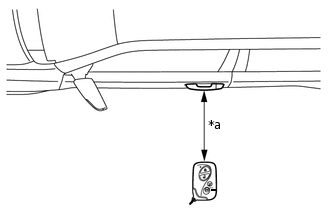
*a
Approximately 0.3 m (0.98 ft.)
Bring the electrical key transmitter approximately 0.3 m (0.98 ft.) from the front door outside handle assembly LH and perform a driver door entry lock and unlock operation check.
Note:If the key is brought within 0.2 m (0.66 ft.) of the door handle, communication may not possible.
-
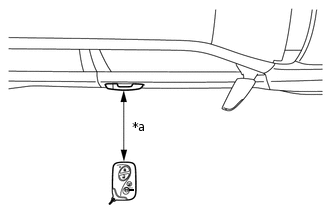
*a
Approximately 0.3 m (0.98 ft.)
Bring the electrical key transmitter approximately 0.3 m (0.98 ft.) from the front door outside handle assembly RH and perform a front passenger door entry lock and unlock operation check.
Note:If the key is brought within 0.2 m (0.66 ft.) of the door handle, communication may not possible.
-
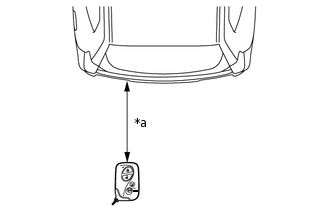
*a
Approximately 0.3 m (0.98 ft.)
Bring the electrical key transmitter approximately 0.3 m (0.98 ft.) from the electrical key antenna (outside luggage) and perform an entry back door unlock function check.
Note:If the key is brought within 0.2 m (0.66 ft.) of the rear bumper, communication may not possible.
Tip:If the inspection result is that the problem only occurs in certain locations or at certain times of day, the possibility of wave interference is high. Also, added vehicle components may cause wave interference. If installed, remove them and perform the operation check.
If electric wave interference seems to be the likely cause of the problem, ask the customer if the problem occurs in specific locations.
Move the vehicle to a different location, perform the following procedure and check if the symptoms can be reproduced.
-
If a tool for checking electric waves, such as a signal strength meter, is available, move around the area while observing both the LF band (used by the vehicle antenna to form the key detection area) and RF band (used by the key for transmission) to check for locations where there is wave interference.
Result
Result
Proceed to
All operation checks fail
A
All checks are normal
B
Some operation checks are normal
C
B AFFECTED BY WAVE INTERFERENCE
CHECK ELECTRICAL KEY ANTENNAS IN KEY DIAGNOSTIC MODE
Check the following antennas in the key diagnostic mode
-
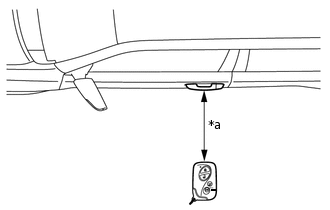
*a
0.7 to 1 m (2.30 to 3.28 ft.)
Check the electrical key antenna (for driver side):
When the electrical key transmitter is brought within 0.7 to 1 m (2.30 to 3.28 ft.) of the front door outside handle assembly LH, check that the wireless door lock buzzer sounds.
-
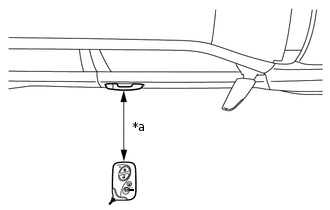
*a
0.7 to 1 m (2.30 to 3.28 ft.)
Check the electrical key antenna (for front passenger side):
When the electrical key transmitter is brought within 0.7 to 1 m (2.30 to 3.28 ft.) of the front door outside handle assembly RH, check that the wireless door lock buzzer sounds.
-
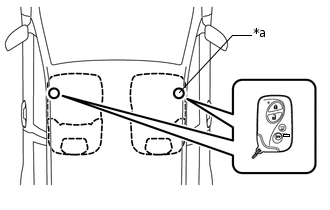
*a
Inspection Point
Check the indoor No. 1 electrical key antenna (front floor):
When the electrical key transmitter is at the inspection point, check that the wireless door lock buzzer sounds.
-
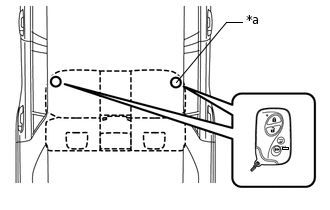
*a
Inspection Point
Check the indoor No. 2 electrical key antenna (rear floor):
When the electrical key transmitter is at the inspection point, check that the wireless door lock buzzer sounds.
Check the indoor No. 3 electrical key antenna (inside luggage):
When the electrical key transmitter is at the inspection point, check that the wireless door lock buzzer sounds.
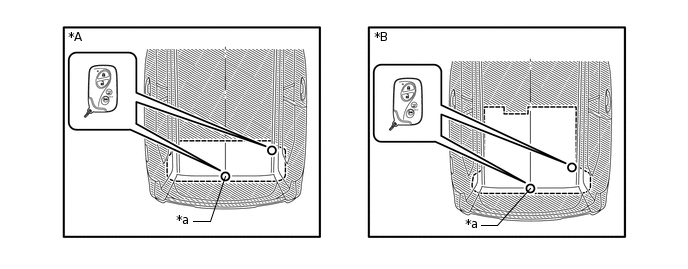
*A
w/ Rear No. 2 Seat Assembly
*B
w/o Rear No. 2 Seat Assembly
*a
Inspection Point
-
-
-
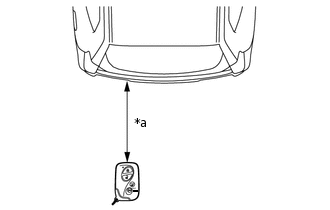
*a
0.7 to 1 m (2.30 to 3.28 ft.)
Check the electrical key antenna (outside luggage):
When the electrical key transmitter is brought within 0.7 to 1 m (2.30 to 3.28 ft.) of the electrical key antenna (outside luggage), check that the wireless door lock buzzer sounds.
OK
Wireless door lock buzzer sounds.
-
Result
Result
Proceed to
All diagnostic mode inspections fail
A
Some diagnostic mode inspections fail (door)
B
Some diagnostic mode inspections fail (interior)
C
Some diagnostic mode inspections fail (back door)
D
All diagnostic mode inspections are normal
E
E REPLACE CERTIFICATION ECU
INSPECT ELECTRICAL KEY TRANSMITTER
Check if there is another key available that is already registered to the vehicle.
Result
Result
Proceed to
Another registered key is not available
A
Another registered key is available
B
B CHECK OPERATIONClick here
REPLACE ELECTRICAL KEY TRANSMITTER
Replace the electrical key transmitter with a new one.
Perform the registration procedure (Refer to the Service Bulletin).
Result
Result
NEXT
CHECK OPERATION
Check the operation of the entry lock function
OK
Entry lock function operates normally.
Result
Result
OK
NG
OK END (ELECTRICAL KEY TRANSMITTER IS DEFECTIVE)
NG REPLACE CERTIFICATION ECU