FUEL SYSTEM(w/o Canister Pump Module) ON-VEHICLE INSPECTION
PROCEDURE
CHECK FUEL PUMP OPERATION AND INSPECT FOR FUEL LEAK
Check fuel pump operation.
Connect the GTS to the DLC3.
Turn the power switch on (IG).
Note:Do not start the engine.
Turn the GTS on.
Enter the following menus: Powertrain / Engine and ECT / Active Test / Control the Fuel Pump / Speed.
Powertrain > Engine and ECT > Active Test
Tester Display
Control the Fuel Pump / Speed
Check for pressure in the fuel tube sub-assembly from the fuel pipe. Check that sounds of fuel flowing from the fuel tank can be heard. If no sounds can be heard, check the integration relay, fuel pump, ECM and wiring connectors.
Inspect for fuel leaks.
Check that there are no fuel leaks from the fuel system after doing any maintenance or repairs. If there is a fuel leak, repair or replace parts as necessary.
Turn the power switch off.
Disconnect the GTS from the DLC3.
CHECK FUEL PRESSURE
Discharge the fuel system pressure.
Using a voltmeter, measure the auxiliary battery voltage.
Standard voltage
11 to 14 V
Disconnect the cable from the negative (-) auxiliary battery terminal.
Note:When disconnecting the cable, some systems need to be initialized after the cable is reconnected.
Remove the No. 1 fuel pipe clamp from the fuel tube sub-assembly.
Disconnect the fuel tube sub-assembly from the fuel pipe.
-
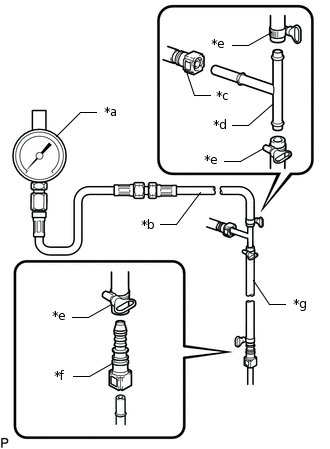
*a
SST (Pressure Gauge)
*b
SST (Hose Joint)
*c
Fuel Tube Sub-assembly
*d
SST (T Joint)
*e
SST (Hose Band)
*f
SST (Fuel Tube Connector)
*g
SST (Hose)
Install SST (EFI fuel pressure gauge and fuel pressure gauge adapter) as shown in the illustration.
09268-45101
09268-41260
09268-41700
09268-41280
95336-08070
09268-00010
09268-00020
09268-00030
Wipe up any spilled fuel.
Connect the cable to the negative (-) auxiliary battery terminal.
Note:When disconnecting the cable, some systems need to be initialized after the cable is reconnected.
Connect the GTS to the DLC3.
Enter the following menus: Powertrain / Engine and ECT / Active Test / Control the Fuel Pump / Speed.
Powertrain > Engine and ECT > Active Test
Tester Display
Control the Fuel Pump / Speed
Measure the fuel pressure.
Standard fuel pressure
304 to 343 kPa (3.1 to 3.5 kgf/cm2, 44 to 50 psi)
If the fuel pressure is higher than the specification, replace the fuel pressure regulator assembly.
If the fuel pressure is less than the standard, check the fuel hoses and connections, fuel pump, fuel filter and fuel pressure regulator assembly.
Disconnect the GTS from the DLC3.
Put the engine in inspection mode (maintenance mode).
Start the engine.
Measure the fuel pressure at idle.
Standard fuel pressure
304 to 343 kPa (3.1 to 3.5 kgf/cm2, 44 to 50 psi)
Stop the engine.
Check that the fuel pressure remains as specified for 5 minutes after the engine stops.
Standard fuel pressure
147 kPa (1.5 kgf/cm2, 21 psi) or more
If the fuel pressure is not as specified, check the fuel pump, fuel pressure regulator assembly and/or fuel injector assemblies.
After checking the fuel pressure, disconnect the cable from the negative (-) auxiliary battery terminal and carefully remove SST to prevent fuel from spraying.
Note:When disconnecting the cable, some systems need to be initialized after the cable is reconnected.
Install the fuel tube sub-assembly to the fuel pipe.
Install the No. 1 fuel pipe clamp to the fuel tube sub-assembly.
Inspect for fuel leaks (check fuel pump operation and inspect for fuel leak).
ACTIVE TEST (Control the Select Cylinder Fuel Cut)
Connect the GTS to the DLC3.
Put the engine in inspection mode (maintenance mode).
Turn the GTS on.
Start the engine, then enter the following menus: Active Test / Control the Select Cylinder Fuel Cut. Select a cylinder from #1 to #4.
Powertrain > Engine and ECT > Active Test
Tester Display
Control the Select Cylinder Fuel Cut
Tip:Perform this procedure with the vehicle stopped and the engine idling.
After stopping injection of the cylinder for which the Active Test was performed, check the idling state.
Standard
The idling speed varies.
Tip:Perform a test for each cylinder. It is not possible to test multiple cylinders at once.