PRE-CRASH SAFETY SYSTEM GENERAL GENERAL
OUTLINE
New models are available with ''Toyota Safety Sense'' , a pre-collision safety package, which consists of 2 driving support systems to support safe driving.
Pre-crash safety system (PCS)
Lane departure alert system (LDA)
The pre-crash safety system detects the preceding vehicle and obstructions in front of the vehicle based on data from a monocular camera and laser sensor built into the pre-crash safety city sensor.
If the pre-crash safety system determines that the possibility of a collision is high, pre-crash alarm control and pre-crash brake assist control is performed, and if a collision is unavoidable, pre-crash brake control will be performed in order to reduce the impact of the collision.
Due to the achievement of significant deceleration performance of pre-crash brake and pre-crash brake assist, a collision may be avoided or collision damage can be reduced. Pre-crash brake control can reduce the speed of the vehicle by at least 40 km/h (25 mph) *, and pre-crash brake assist control can assist braking throughout at least an 80 km/h (50 mph)* reduction in the speed of the vehicle.
*: In some circumstances, the reduction in the speed of the vehicle may be lower than specified due to factors such as a poor road surface or extreme weather.
PRECAUTION
Pre-crash System Cancel Switch Assembly Expressions
The type of Pre-crash system cancel switch assembly used on this model differs according to the specifications of the vehicle. The expressions listed in the table below are used in this section.
Vehicle Specification
Part Name in Manual
Actual Part Name
Models with Stop and Start System
Pre-crash System Cancel Switch Assembly
Combination Switch Assembly
Models without Stop and Start System
Pre-crash System Cancel Switch Assembly
Pre-crash System Cancel Switch Assembly
General Handling Precautions
Do not use the pre-crash safety system instead of normal braking operations under any circumstances. This system will not prevent collisions or lessen damage or injuries in every situation. Do not overly rely on this system. Failure to do so may lead to an accident, resulting in death or serious injury.
Do not attach stickers or labels, nor affix any ornaments to the windshield glass.
Do not install or attach anything to the windshield glass under the pre-crash safety city sensor.
Do not attach window tinting to the windshield glass.
Keep the windshield glass clean around the area where the pre-crash safety city sensor is mounted. The performance of pre-crash safety city sensor may be affected if dirt, raindrops, condensation, or snow is on the windshield glass.
If the inner side of the windshield glass where the pre-crash safety city sensor is installed is dirty, do not attempt to remove the pre-crash safety city sensor. contact your Toyota dealer.
If your windshield needs repairs, contact your Toyota dealer.
Do not install an antenna in front of the pre-crash safety city sensor.
Do not spill liquid onto the pre-crash safety city sensor.
Do not allow bright lights to shine into the pre-crash safety city sensor.
If the windshield glass is fogged up, use the windshield defogger to remove fog from the windshield glass. When it is cold, using the heater with air blowing to the feet may cause the upper part of the windshield glass to fog up. This will have a negative effect on the images.
Do not touch the lens of the pre-crash safety city sensor. Fingerprints left on the lens may cause inaccurate detection or non-detection and lane markers may not be detected accurately.
Do not damage or let the lenses of the front sensor get dirty.
Do not attach stickers or labels, nor affix any ornaments to the windshield glass.
Do not touch the lens of the pre-crash safety city sensor. Fingerprints left on the lens may cause inaccurate detection or non-detection and lane markers may not be detected accurately.
Do not subject the pre-crash safety city sensor to strong impacts.
Do not place reflective objects on top of the instrument panel.
When the pre-crash safety city sensor detects an object in front of the vehicle under the following conditions, the pre-crash safety city sensor may determine that the possibility of a collision is high or a collision is unavoidable, and operates the pre-crash safety system. This does not indicate a malfunction.
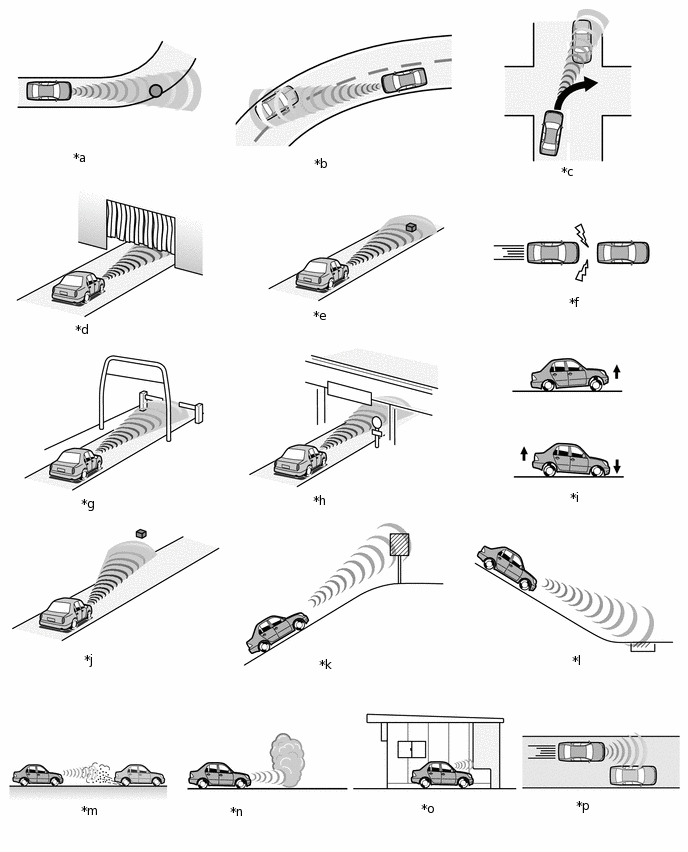
Number
Condition
*a
Object near outer edge of a curved road (guard rail, street light or sign)
*b
Oncoming traffic on a curved road
*c
Opposing traffic at an intersection
*d
Object such as a hanging screen or curtain
*e
Metal object, steel plate on the road
*f
Rapid approach to a preceding vehicle
*g
Barrier arm of electric toll collection gate or other gates
*h
Overpass or sign over the road
*i
Vehicle height changes significantly (front of vehicle inclined either upward or downward)
*j
Pre-crash safety city sensor is misaligned (such as after reinstallation or after a collision)
*k
Metal object such as a sign in front of the vehicle on an uphill slope
*l
Metal object or steel plate in the ground at the base of a downhill slope
*m
Water or snow stirred up by a preceding vehicle
*n
Steam, dense fog or smoke
*o
Parking close behind an object such as a wall or other vehicle
*p
Object such as a parked vehicle or guard rail close by the vehicle
The pre-crash safety city sensor might not be able to detect the following objects as collision objects:
Objects that cannot be detected
Plastic items (safety cones, etc.)
Objects that cannot be detected in a stable manner
People, bicycles, motorcycles, trees, animals, snow fences, etc.
Under the following conditions, the pre-crash safety city sensor may detect a detectable object and the pre-crash safety system may operate even if the driver judges that there is no possibility of collision. However, this is not a malfunction.
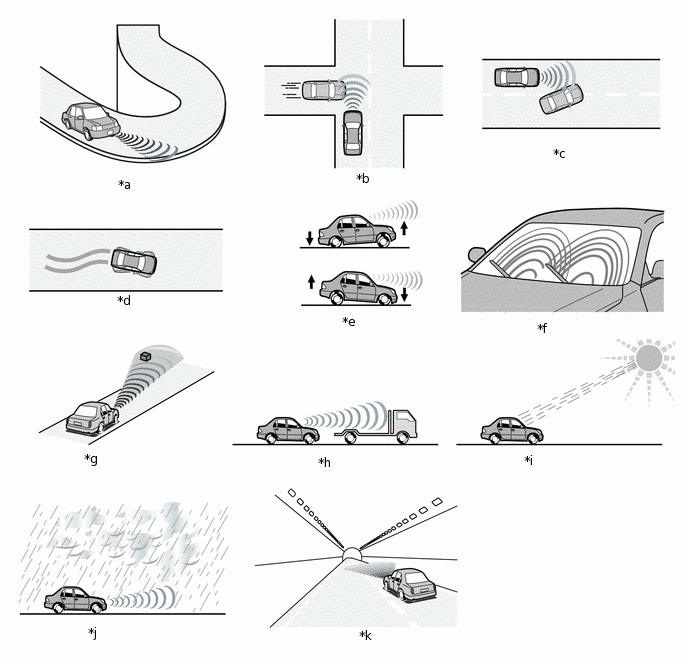
Number
Condition
*a
Object near outer edge of a curved road (guard rail, street light or sign)
*b
If a vehicle suddenly moves in front of your vehicle, such as at an intersection
*c
If a vehicle suddenly cuts in front of your vehicle
*d
If your vehicle is skidding
*e
When the front part of the vehicle is raised or lowere
*f
When the windshield is dirty or covered with raindrops, condensation, ice, snow, etc.
*g
When the sensor is misaligned due to a strong impact being applied to the sensor, etc.
*h
When a preceding vehicle is a poor reflector of laser (the rear part of the vehicle lowered, very dirty, etc.)
*i
When a very bright light, such as the sun or the headlights of oncoming traffic, shines directly into the front sensor
*j
When a preceding vehicle is a poor reflector of laser (the rear part of the vehicle lowered, very dirty, etc.)
*k
When the surrounding area is dark, such as while in a tunnel or during nighttime