AUTOMATIC TRANSAXLE SYSTEM
-
CONSTRUCTION
-
The TCM has been isolated from the ECM and directly fitted to the transaxle. Because of this, the wiring harness has been shortened, allowing weight to be reduced. All the solenoid valves and sensors used for automatic transaxle control are directly connected to the TCM through the connector located in front of the automatic transaxle.
-
The TCM maintains communication with the ECM through the Controller Area Network (CAN). Thus, engine control can be performed in coordination with ECT control.
-
A label, on which the automatic transaxle compensation values and Quick Response (QR) code are printed, is attached on the top of the automatic transaxle. The label contains encoded information about the characteristics of the automatic transaxle. When the automatic transaxle is replaced, allow the TCM to learn the characteristics of the automatic transaxle by inputting the automatic transaxle compensation values into the TCM using the intelligent tester II. In this way, the shift control performance is improved immediately after replacement of the automatic transaxle. For details, refer to the Repair Manual.
-
The QR code, which requires a special tool to be read, is used at the vehicle assembly plant.
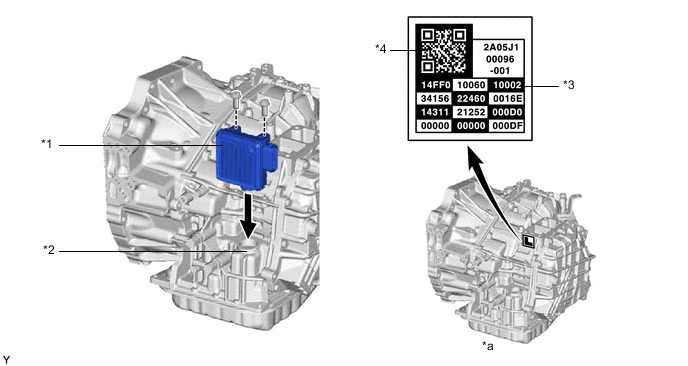
*1 TCM *2 Transaxle Connector *3 Automatic Transaxle Compensation Value *4 QR Code *a Front View - - Tech Tips
What are Quick Response (QR) Codes?
-
QR code, a matrix symbology consisting of an array of nominally square cells, allows omni-directional, high-speed reading of large amounts of data.
-
QR codes encode many types of data such as numeric, alphanumeric, kanji, kana and binary codes. A maximum of 7089 characters (numeric) can be encoded.
-
QR codes (2D code) contain information in the vertical and horizontal directions, whereas bar codes only contain data in one direction. QR codes (2D code) hold considerablygreater volumes of information than bar codes.
-
-