FUEL SYSTEM PRECAUTION
FUEL SYSTEM
When disconnecting the fuel line, fuel will spray. So perform following procedure.
Disconnect the fuel tube.
Release the pressure remaining in the fuel tank main tube sub-assembly.
Cover the disconnected fuel tank main tube sub-assembly (fuel tube joint and fuel tube connector) with a plastic bag to prevent damage and entry of foreign matter.
Perform the following procedure when disconnecting the fuel tube connector (quick type A).
Check if there is any foreign matter on the fuel pipe around the fuel tube connector before disconnecting it. Clean it if necessary.
-
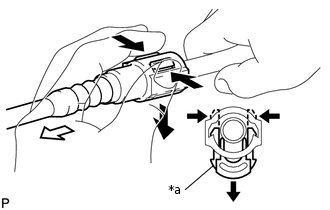
*a
Retainer
Disengage the 2 claws of the retainer. Pull down the retainer as shown in the illustration.
Disconnect the fuel tank main tube sub-assembly from the fuel pipe.
-
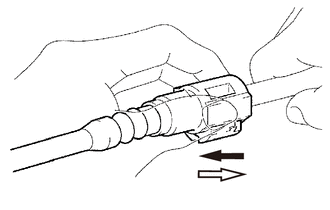
If the fuel tube connector and fuel pipe are stuck, hold the fuel pipe, and then push and pull the fuel tube connector to release and disconnect the fuel tube connector.
Note:Be sure to disconnect the fuel tube connector by hand.
After removing the fuel tube, check the sealing surface of the fuel pipe for dirt or foreign matter. Clean if necessary.
Cover the disconnected fuel tube connector and fuel pipe with plastic bags to prevent damage and entry of foreign matter.
-
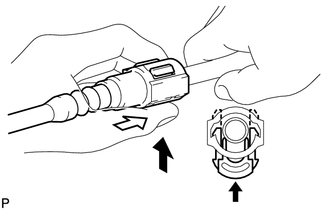
Observe the following precautions when connecting the fuel tube connector (quick type A).
Check if there is any damage or foreign matter on the connecting parts of the fuel pipes.
Align the fuel tube connector with the fuel pipe, and fully push the fuel tube connector and fuel pipe together until they are fully seated. Next, push the retainer into the fuel tube connector until its claws lock.
After connecting the fuel lines, check that the fuel pipe and fuel tube connector are securely connected by pulling on them.
Check for fuel leaks.
-
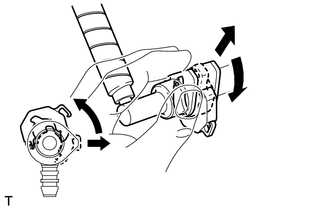
Observe these precautions when disconnecting the fuel tube connector (for quick type B).
Check if there is any foreign matter on the fuel pipe around the fuel tube connector before disconnecting it. Clean it if necessary.
Disengage the hook of the retainer, open the retainer, and then disconnect the fuel tube connector from the exhaust fuel addition injector.
Note:Be sure to disconnect the fuel tube connector by hand.
-
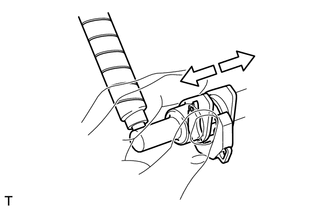
If the fuel tube connector and exhaust fuel addition injector are stuck, hold the fuel tube connector by hand, and push and pull the fuel tube connector to disconnect it.
After removing the fuel tube connector, check the sealing surface of the exhaust fuel addition injector for dirt or foreign matter. Clean them if necessary.
Cover the disconnected fuel tube connector and exhaust fuel addition injector with plastic bags to prevent damage and entry of foreign matter.
-
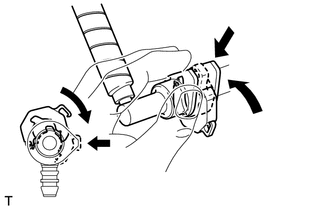
Observe these precautions when connecting the fuel tube connector (for quick type B).
Check for foreign matter on the injector and around the connector before connecting them. Clean if necessary.
Push the fuel tube connector onto the injector and close the retainer to connect the fuel tube connector.
-
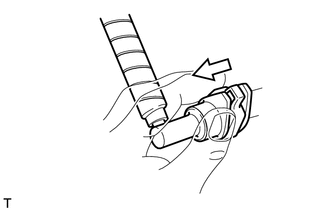
After connecting the injector and connector, try to pull them apart to confirm that they are securely connected.
Check for fuel leaks.
-
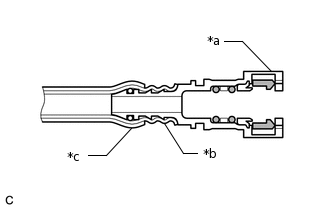
*a
Fuel Tube Connector
*b
Nylon Tube
*c
Ethylene Propylene Diene Monomer (EPDM) Rubber Protector
Observe the following precautions when handling a nylon tube:
Note:Do not twist the fuel tube connector part of the nylon tube or fuel tube connector when connecting them.
Do not remove the Ethylene Propylene Diene Monomer (EPDM) rubber protector on the outside of the nylon tube.
Do not pinch or kink the nylon tubes to prevent fuel leakage.
CHECK FOR FUEL LEAKAGE
Check that there is no fuel leakage after performing maintenance on the fuel system.
BLEED AIR FROM FUEL SYSTEM
-
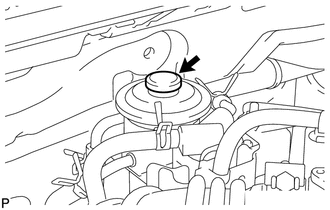
Using the hand pump mounted on the fuel filter cap, bleed the air from the fuel system. Continue pumping until the pump resistance increases.
Note:Hand pump pumping speed: Maximum 2 strokes/second.
Operate the hand pump in full strokes during pumping.
When the fuel pressure at the supply pump inlet port reaches a saturated pressure, the hand pump resistance increases.
If pumping is interrupted during the air bleeding process, fuel in the fuel line may return to the fuel tank. Continue pumping until the hand pump resistance increases.
If the hand pump resistance does not increase despite consecutively pumping 200 times or more, there may be a fuel leak between the fuel tank and fuel filter, the hand pump may be malfunctioning, or the vehicle may have run out of fuel.
If air bleeding using the hand pump is incomplete, the common rail pressure does not rise to the pressure range necessary for normal use, and the engine cannot be started.
Start the engine.
Note:Even if air bleeding using the hand pump has been completed, the starter may need to be cranked for 10 seconds or more to start the engine.
Do not crank the engine continuously for more than 20 seconds. The battery may be discharged.
Use a fully-charged battery.
When the engine can be started, proceed to the next step.
If the engine cannot be started, bleed the air again using the hand pump until the hand pump resistance increases (refer to the procedures above). Then start the engine.
Turn the ignition switch off.
Connect the GTS to the DLC3.
Turn the ignition switch to ON.
Turn the GTS on.
Clear DTCs.
Start the engine*1.
Enter the following menus: Powertrain / Engine and ECT / Active Test / Test the Fuel Leak*2.
Powertrain > Engine and ECT > Active Test
Tester Display
Test the Fuel Leak
Perform the following test 5 times at on/off intervals of 10 seconds: Active Test / Test the Fuel Leak *3.
Allow the engine to idle for 3 minutes or more.
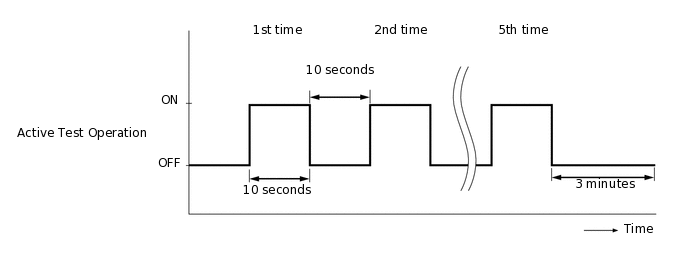 Tip:
Tip:When the Active Test "Test the Fuel Leak" is used to change the pump control mode, the actual fuel pressure inside the common rail drops below the target fuel pressure when the Active Test is off, but this is normal and does not indicate a pump malfunction.
Enter the following menus: Powertrain / Engine and ECT / DTC.
Check for DTCs.
When no DTCs are output, the air bleeding is completed.
If any DTCs are output, proceed to the next step.
Tip:DTC P1603 (Engine Stall History), DTC P1604 (Startability Malfunction) and DTC P1605 (Rough Idling) may be stored.
Clear the DTCs.
Repeat steps *1 to *3.
Enter the following menus: Powertrain / Engine and ECT / DTC.
Check for DTCs.
OK
DTCs are not output.
-