SFI SYSTEM(w/ Canister Pump Module) EVAP System
| DTC Code | DTC Name |
|---|---|
| EVAP System |
RELATED DTCS
DTC No. |
Monitoring Item |
Link |
|---|---|---|
P043E |
Reference orifice clogged (built into canister pump module) |
|
P043F |
Reference orifice high-flow (built into canister pump module) |
|
P0441 |
|
|
P0451 |
|
|
P0452 |
Canister pressure sensor (built into canister pump module) voltage low |
|
P0453 |
Canister pressure sensor (built into canister pump module) voltage high |
|
P0455 |
EVAP gross leak |
|
P0456 |
EVAP small leak |
|
P2401 |
Leak detection pump stuck off (built into canister pump module) |
|
P2402 |
Leak detection pump stuck on (built into canister pump module) |
|
P2419 |
Vent valve stuck closed (built into canister pump module) |
|
P2420 |
Vent valve stuck open (vent) (built into canister pump module) |
|
P2610 |
Soak timer (built into ECM) |
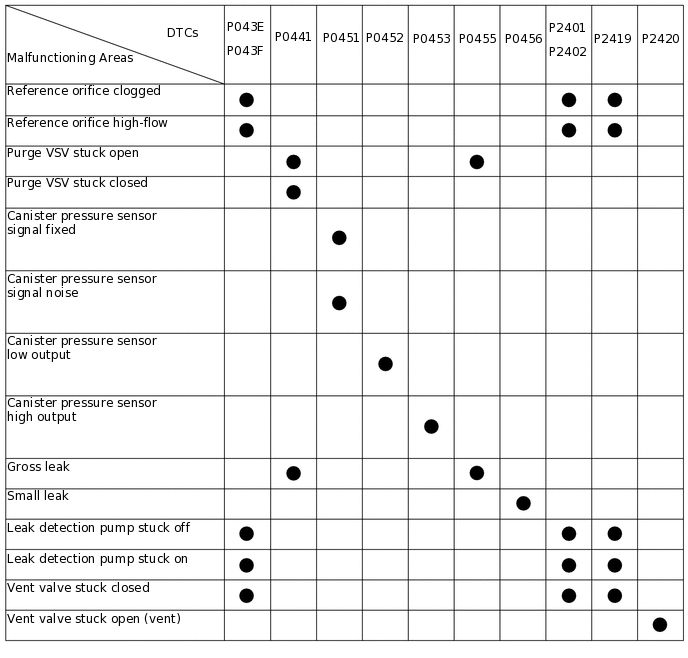
If any EVAP system DTCs are output, the malfunctioning area can be determined using the table below.
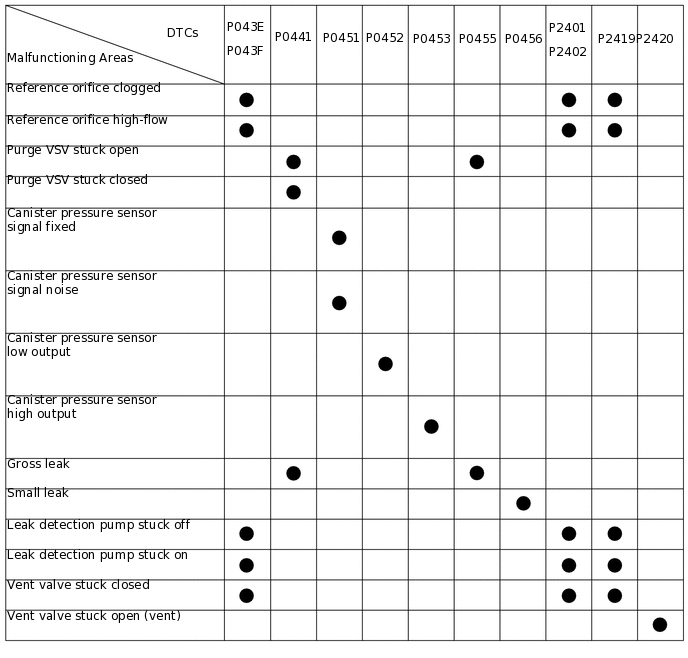
If the reference pressure difference between the first and second checks is more than the specification, all the DTCs relating to the reference pressure (P043E, P043F, P0441, P0455, P0456, P2401, P2420) will all be stored.
DESCRIPTION
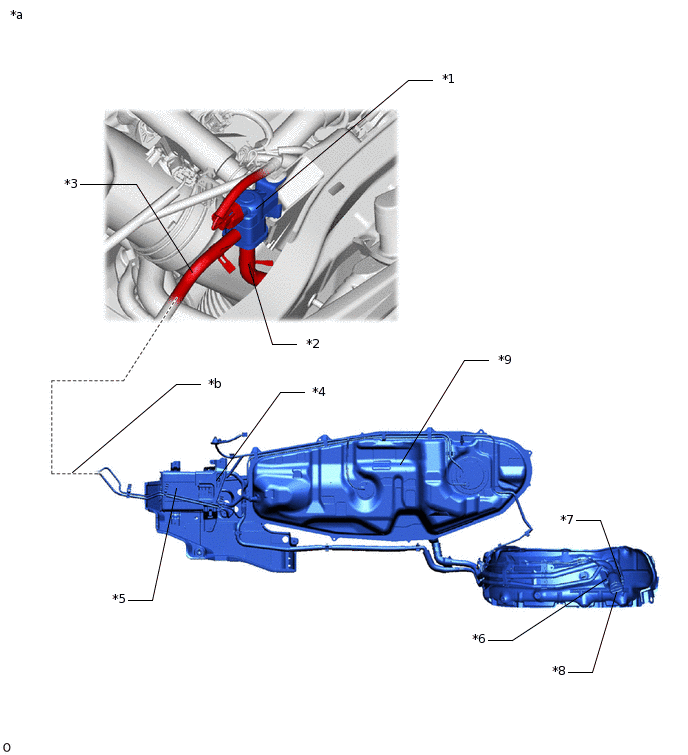
*1 |
Purge VSV |
*2 |
Fuel Vapor Feed Hose (EVAP Hose) (to Intake Manifold) |
*3 |
Fuel Vapor Feed Hose (EVAP Hose) (from Canister) |
*4 |
Canister Pump Module - Canister Pressure Sensor - Leak Detection Pump - Vent Valve |
*5 |
Charcoal Canister Assembly |
*6 |
Canister Filter |
*7 |
Air Inlet Port |
*8 |
Fuel Tank Cap |
*9 |
Fuel Tank |
- |
- |
*a |
Location of EVAP (Evaporative Emission) System |
*b |
Purge Line |
The canister pressure sensor, the leak detection pump and the vent valve are built into the canister pump module.
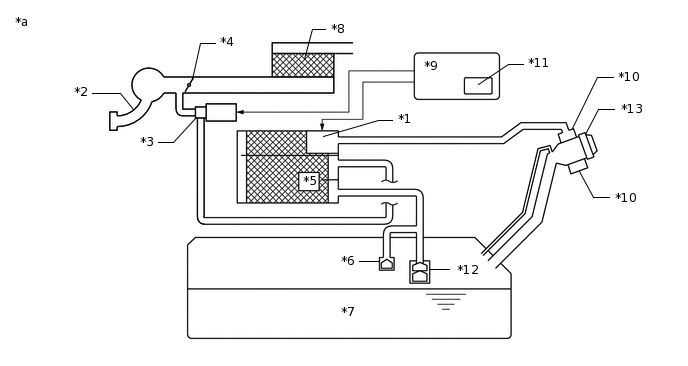
*1 |
Canister Pump Module |
*2 |
Intake Manifold |
*3 |
Purge VSV |
*4 |
Throttle Valve |
*5 |
Charcoal Canister Assembly |
*6 |
Cut-off Valve |
*7 |
Fuel Tank |
*8 |
Air Cleaner |
*9 |
ECM |
*10 |
Canister Filter |
*11 |
Soak Timer |
*12 |
Roll-Over Valve |
*13 |
Fuel Tank Cap |
- |
- |
*a |
EVAP System Circuit |
- |
- |
In the EVAP system of this vehicle, turning on the vent valve does not seal off the EVAP system. To check for leaks in the EVAP system, disconnect the air inlet vent hose and apply pressure from the atmospheric side of the canister.
While the engine is running, if a predetermined condition (closed-loop, etc.) is met, the purge VSV is opened by the ECM and fuel vapors stored in the canister are purged to the intake manifold. The ECM changes the duty cycle ratio of the purge VSV to control purge flow volume.
The purge flow volume is also determined by the intake manifold pressure. Atmospheric pressure is allowed into the canister through the vent valve to ensure that the purge flow is maintained when negative pressure (vacuum) is applied to the canister.
The following two monitors run to confirm appropriate EVAP system operation.
Key-off monitor
This monitor checks for EVAP (evaporative emission) system leaks and canister pump module malfunctions. The monitor starts 5 hours* after the engine switch is turned off. At least 5 hours are required for the fuel to cool down to stabilize the EVAP pressure, thus making the EVAP system monitor more accurate.
The leak detection pump creates negative pressure (vacuum) in the EVAP system and the pressure is measured. Finally, the ECM monitors for leaks from the EVAP system, and malfunctions in both the canister pump module and purge VSV based on the EVAP pressure.
Tip:*: If the engine coolant temperature is not below 35°C (95°F) 5 hours after the engine switch is turned off, the monitor check starts 2 hours later. If it is still not below 35°C (95°F) 7 hours after the engine switch is turned off, the monitor check starts 2.5 hours later.
Purge flow monitor
The purge flow monitor consists of the 2 monitors. The 1st monitor is conducted every time and the 2nd monitor is activated if necessary.
The 1st monitor
While the engine is running and the purge VSV (Vacuum Switching Valve) is on (open), the ECM monitors the purge flow by measuring the EVAP pressure change. If negative pressure is not created, the ECM begins the 2nd monitor.
The 2nd monitor
The vent valve is turned on (closed) and the EVAP pressure is then measured. If the variation in the pressure is less than 0.4 kPa(gauge) [3 mmHg(gauge)], the ECM interprets this as the purge VSV being stuck closed, illuminates the MIL and stores DTC P0441 (2 trip detection logic).
Atmospheric pressure check:
-
In order to ensure reliable malfunction detection, the variation between the atmospheric pressures, before and after of the purge flow monitor, is measured by the ECM.
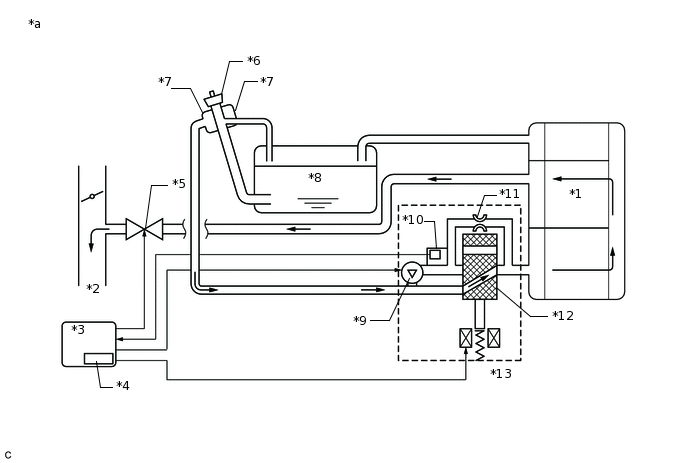
*1 |
Charcoal Canister Assembly |
*2 |
to Intake Manifold |
*3 |
ECM |
*4 |
Soak Timer |
*5 |
Purge VSV (On) |
*6 |
Fuel Tank Cap |
*7 |
Canister Filter |
*8 |
Fuel Tank |
*9 |
Leak Detection Pump (Off) |
*10 |
Canister Pressure Sensor |
*11 |
Reference Orifice (0.02 inches) |
*12 |
Vent Valve (Off) |
*13 |
Canister Pump Module |
- |
- |
*a |
EVAP Purge Flow |
- |
- |
Component |
Operation |
|---|---|
Charcoal Canister Assembly |
Contains activated charcoal to absorb EVAP (Evaporative Emissions) generated in fuel tank. |
Cut-off valve |
Located in fuel tank. Valve floats and closes when fuel tank is 100% full. |
Purge VSV (Vacuum Switching Valve) |
Opens or closes line between canister and intake manifold. ECM uses purge VSV to control EVAP purge flow. In order to discharge EVAP absorbed by canister to intake manifold, ECM opens purge VSV. EVAP discharge volume to intake manifold controlled by purge VSV duty cycle (current-carrying time). (Open: on, Close: off) |
Roll-over valve |
Located in fuel tank. Valve closes by its own weight when vehicle overturns to prevent fuel from spilling out. |
Soak timer |
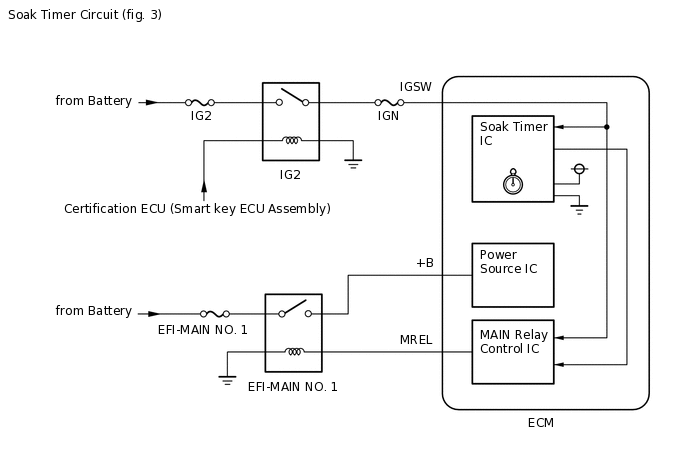
Built into ECM. To ensure accurate EVAP monitor, measures 5 hours (+/-15 min) after engine switch is turned off. This allows fuel to cool down, stabilizing EVAP pressure. When approximately 5 hours elapsed, ECM activates (refer to fig. 3). |
Canister pump module |
Consists of (a) to (d) below. Canister pump module cannot be disassembled. |
(a) Vent valve |
Vents and closes EVAP system. When ECM turns valve on, EVAP system is closed. When ECM turns valve off, EVAP system is vented. Negative pressure (vacuum) is created in EVAP system to check for EVAP leaks by closing purge VSV, turning on vent valve (closing it) and operating leak detection pump (refer to fig. 1). |
(b) Canister pressure sensor |
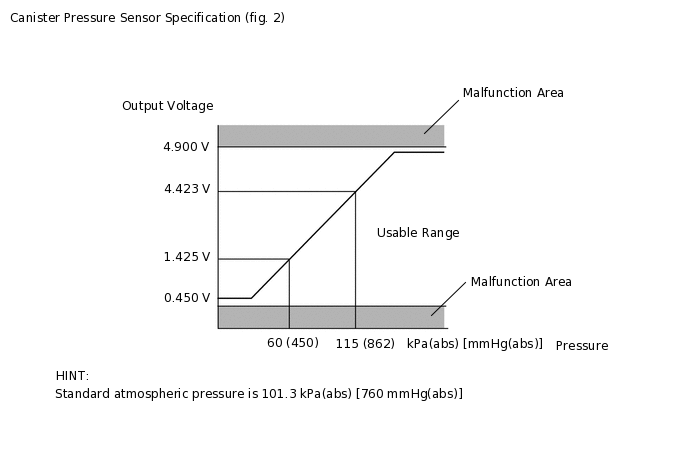
Indicates pressure as voltages. ECM supplies regulated 5 V to pressure sensor, and uses feedback from sensor to monitor EVAP system pressure (refer to fig. 2). |
(c) Leak detection pump |
Creates negative pressure (vacuum) in EVAP system for leak check. |
(d) Reference orifice |
Has opening with 0.02 inch diameter. Vacuum is produced through orifice by closing purge VSV, turning off vent valve and operating leak detection pump, to monitor reference pressure. Reference pressure is used when checking for small EVAP leaks. |
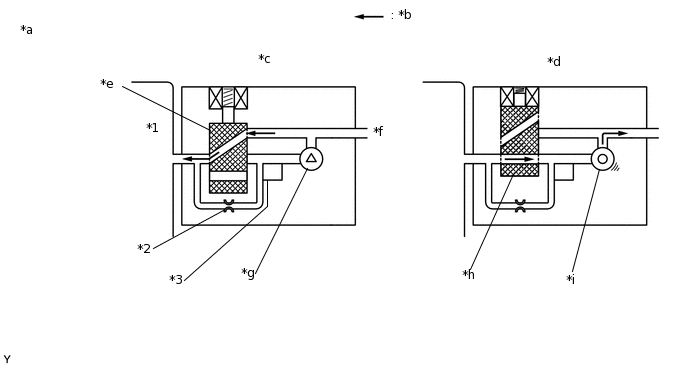
*1 |
Canister |
*2 |
Reference Orifice (0.02 Inch) |
*3 |
Canister Pressure Sensor |
- |
- |
*a |
Canister Pump Module (fig. 1) |
*b |
Airflow |
*c |
Condition: Purge Flow |
*d |
Condition: Leak Check |
*e |
Vent Valve: Off (vent) |
*f |
to Canister Filter (Atmosphere) |
*g |
Leak Detection Pump: Off |
*h |
Vent Valve: On (closed) |
*i |
Leak Detection Pump: On |
- |
- |
WIRING DIAGRAM
Refer to DTC P0451.
CAUTION / NOTICE / HINT
Inspect the fuses for circuits related to this system before performing the following procedure.
The GTS is required to conduct the following diagnostic troubleshooting procedure.
Using the GTS monitor results enables the EVAP (Evaporative Emission) system to be confirmed.
Read freeze frame data using the GTS. The ECM records vehicle and driving condition information as freeze frame data the moment a DTC is stored. When troubleshooting, freeze frame data can help determine if the vehicle was moving or stationary, if the engine was warmed up or not, if the air fuel ratio was lean or rich, and other data from the time the malfunction occurred.
CONFIRMATION DRIVING PATTERN
After a repair, check Monitor Status by performing the Key-Off Monitor Confirmation and Purge Flow Monitor Confirmation described below.
KEY-OFF MONITOR CONFIRMATION
Preconditions
The monitor will not run unless:
The vehicle has been driven for 10 minutes or more (in a city area or on a freeway).
The fuel tank is less than 90% full.
The altitude is less than 2400 m (7875 ft.).
The engine coolant temperature is between 4.4°C and 35°C (40°F and 95°F).
The intake air temperature is between 4.4°C and 35°C (40°F and 95°F).
The vehicle remains stationary (the vehicle speed is 0 km/h [0 mph]).
Monitor Conditions
Allow the engine to idle for at least 5 minutes.
Turn the engine switch off and wait for 6 hours (8 or 10.5 hours).
Tip:Do not start the engine until checking Monitor Status. If the engine is started, the steps described above must be repeated.
Monitor Status
Connect the GTS to the DLC3.
Turn the engine switch on (IG).
Turn the GTS on.
Enter the following menus: Powertrain / Engine and ECT / Monitor / Current Monitor.
Check the Monitor Status displayed on the GTS.
Tip:If Incomplete is displayed, the monitor did not complete. Make sure that the preconditions have been met, and perform the Monitor Conditions again.
PURGE FLOW MONITOR CONFIRMATION (P0441)
Tip:Perform this monitor confirmation after the Key-Off Monitor Confirmation shows Complete.
Preconditions
The monitor will not run unless:
The vehicle has been driven for 10 minutes or more (in a city area or on a freeway).
The engine coolant temperature is 4.4°C (40°F) or higher.
The intake air temperature is 4.4°C (40°F) or higher.
Monitor Conditions
Release the pressure from the fuel tank by removing and reinstalling the fuel tank cap.
Warm the engine up until the engine coolant temperature reaches higher than 75°C (167°F).
Increase the engine speed to 3000 rpm once.
Allow the engine to idle and turn the A/C switch on for 1 minute.
Monitor Status
Turn the engine switch off (if on (IG) or if the engine is running).
Connect the GTS to the DLC3.
Turn the engine switch on (IG).
Turn the GTS on.
Enter the following menus: Powertrain / Engine and ECT / Monitor / Current Monitor.
Check the Monitor Status displayed on the GTS.
Tip:If Incomplete is displayed, the monitor did not complete. Make sure that the preconditions have been met, and perform the Monitor Conditions again.
PROCEDURE
CONFIRM DTC
Turn the engine switch off and wait for 10 seconds.
Turn the engine switch on (IG).
Turn the engine switch off and wait for 10 seconds.
Connect the GTS to the DLC3.
Turn the engine switch on (IG) and turn the GTS on.
Enter the following menus: Powertrain / Engine and ECT / Trouble Codes.
Confirm DTCs and freeze frame data. If any EVAP system DTCs are stored, the malfunctioning area can be determined using the table below.
Powertrain > Engine and ECT > Trouble Codes
 Note:
Note:If the reference pressure difference between the first and second checks is greater than the specification, all the DTCs relating to the reference pressure (P043E, P043F, P2401, P2402 and P2419) are stored.
Result
Proceed to
NEXT
PERFORM EVAP SYSTEM CHECK (AUTOMATIC MODE)
NOTICE:
The Evaporative System Check (Automatic Mode) consists of 6 steps performed automatically by the GTS. It takes a maximum of approximately 24 minutes.
Do not perform the Evaporative System Check when the fuel tank is higher than 90% full because the cut-off valve may be closed, making the fuel tank leak check unavailable.
Do not run the engine during this operation.
When the temperature of the fuel is 35°C (95°F) or higher, a large amount of vapor forms and any check results become inaccurate. When performing the Evaporative System Check, keep the temperature below 35°C (95°F).
Connect the GTS to the DLC3.
Turn the engine switch on (IG).
Turn the GTS on.
Clear the DTCs.
Powertrain > Engine and ECT > Clear DTCs
Enter the following menus: Powertrain / Engine and ECT / Utility / Evaporative System Check / Automatic Mode.
Powertrain > Engine and ECT > Utility
Tester Display
Evaporative System Check
After the Evaporative System Check is completed, check for pending DTCs by entering the following menus: Powertrain / Engine and ECT / Trouble Codes.
Tip:If no pending DTCs are displayed, perform the Confirmation Driving Pattern. After this confirmation, check for pending DTCs. If no DTCs are displayed, the EVAP system is normal.
Powertrain > Engine and ECT > Trouble Codes
Result
Proceed to
NEXT
PERFORM EVAP SYSTEM CHECK (MANUAL MODE)
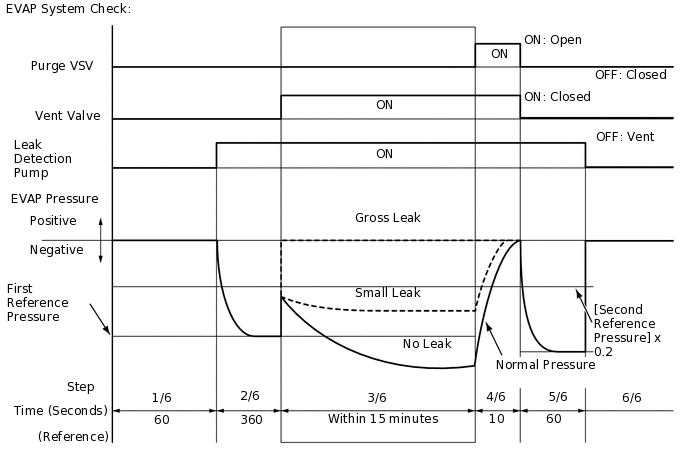
NOTICE:
In the Evaporative System Check (Manual Mode), the series of 6 Evaporative System Check steps are performed manually using the GTS.
Do not perform the Evaporative System Check when the fuel tank is higher than 90% full because the cut-off valve may be closed, making the fuel tank leak check unavailable.
Do not run the engine during this operation.
When the temperature of the fuel is 35°C (95°F) or higher, a large amount of vapor forms and any check results become inaccurate. When performing the Evaporative System Check, keep the temperature below 35°C (95°F).
Connect the GTS to the DLC3.
Turn the engine switch on (IG).
Turn the GTS on.
Clear the DTCs.
Enter the following menus: Powertrain / Engine and ECT / Utility / Evaporative System Check / Manual Mode.
Result
Proceed to
NEXT
PERFORM EVAP SYSTEM CHECK (STEP 1/6)
Check the EVAP pressure in step 1/6.
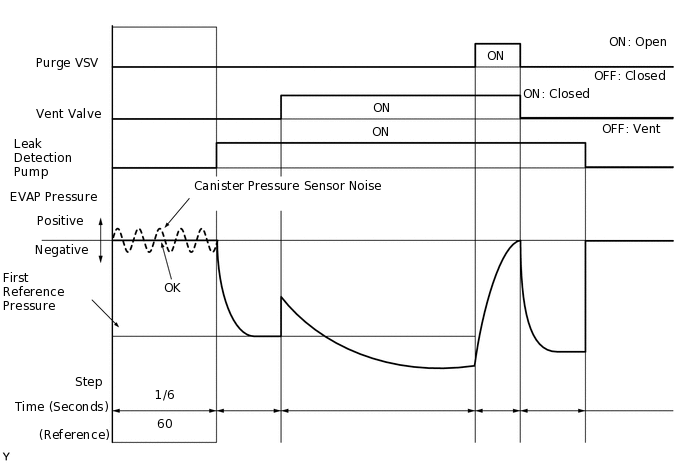
Result
DTC*1
Result
Suspected Trouble Area
Proceed to
-
Virtually no variation in EVAP pressure
Not yet determined
A
P0451
EVAP pressure fluctuates by +/-0.3 kPa(gauge) [2.25 mmHg(gauge)] or higher
Canister pressure sensor signal noise
B
(P0452 or P0453)*2
EVAP pressure is below 42.11 kPa(abs) [315.867 mmHg(abs)], or higher than 123.761 kPa(abs) [928.331 mmHg(abs)]
EVAP pressure deviates +/-10 kPa(gauge) [+/-75 mmHg(gauge)] from actual atmosphere pressure *3
Canister pressure sensor or its circuit has malfunction
C
*1: These DTCs are already present in the ECM when the vehicle arrives and are confirmed in the "Confirm DTC" procedure above.
*2: If the canister pressure sensor circuit has an open or short, DTC P0452 or P0453 is stored 0.5 seconds after the engine switch is turned on (IG).
Tip:*3: Canister pressure sensor standard output range is 70 to 110 kPa(abs) [525 to 825 mmHg(abs)]. This varies by weather.
B REPLACE CHARCOAL CANISTER LEAK DETECTION PUMP SUB-ASSEMBLY (CANISTER PUMP MODULE)Click here
C INSPECT CANISTER PUMP MODULE (CANISTER PRESSURE SENSOR CIRCUIT)Click here
PERFORM EVAP SYSTEM CHECK (STEP 1/6 TO 2/6)
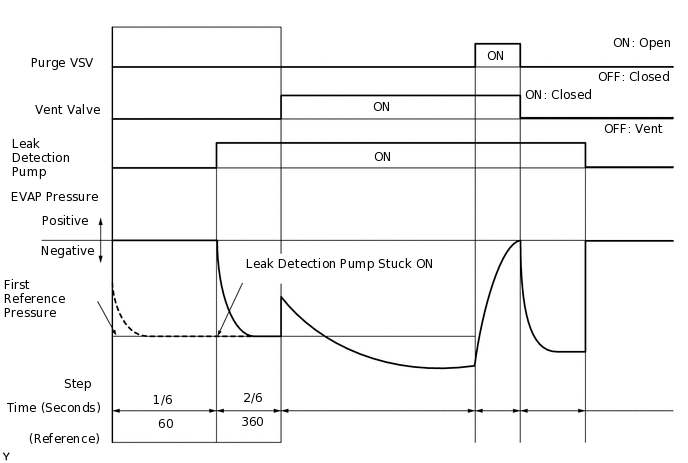
Check the EVAP pressure in steps 1/6 and 2/6.
Result
DTC*
Result
Suspected Trouble Area
Proceed to
-
Virtually no variation in EVAP pressure during step 1/6. Then decreases to reference pressure
Not yet determined
A
P2402
Small difference between EVAP pressures during steps 1/6 and 2/6
Leak detection pump stuck ON
B
*: These DTCs are already present in the ECM when the vehicle arrives and are confirmed in the "Confirm DTC" procedure above.
Tip:The first reference pressure is the value determined in step 2/6.
B CHECK HARNESS AND CONNECTOR (ECM - CANISTER PUMP MODULE)Click here
PERFORM EVAP SYSTEM CHECK (STEP 2/6)
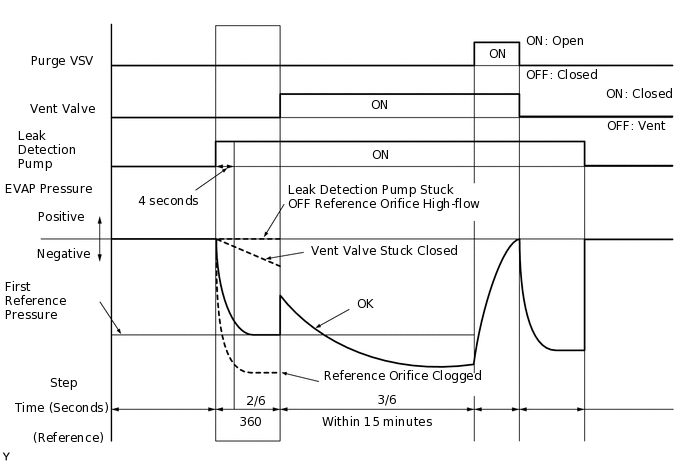 Tip:
Tip:Make a note of the pressures checked in inspection items (A) and (B) below.
Check the EVAP pressure 4 seconds after the leak detection pump is activated*1 (A).
*1: The leak detection pump begins to operate as step 1/6 finishes and step 2/6 starts.
Check the EVAP pressure again when it has stabilized. This pressure is the reference pressure (B).
Result
DTC*2
Result
Suspected Trouble Area
Proceed to
-
EVAP pressure in inspection item (B) is between -4.85 kPa(gauge) and -1.057 kPa(gauge) [-36.38 mmHg(gauge) and -7.929 mmHg(gauge)]
Not yet determined
A
P043F and P2401
EVAP pressure in inspection item (B) is -1.057 kPa(gauge) [-7.929 mmHg(gauge)] or higher
Reference orifice high-flow
Leak detection pump stuck OFF
B
P043E
EVAP pressure in inspection item (B) is below -4.85 kPa(gauge) [-36.38 mmHg(gauge)]
Reference orifice clogged
C
P2419
EVAP pressure in inspection item (A) is higher than -0.25 kPa(gauge) [-1.875 mmHg(gauge)]
Vent valve stuck closed
Leak detection pump performance deteriorates
Leak detection pump circuit malfunctioning (large resistance exists in the circuit)
D
*2: These DTCs are already present in the ECM when the vehicle arrives and are confirmed in the "Confirm DTC" procedure above.
B PERFORM EVAP SYSTEM CHECK (STEP 3/6)Click here
C REPLACE CHARCOAL CANISTER LEAK DETECTION PUMP SUB-ASSEMBLY (CANISTER PUMP MODULE)Click here
D INSPECT CANISTER PUMP MODULE (VENT VALVE OPERATION)Click here
PERFORM EVAP SYSTEM CHECK (STEP 2/6 TO 3/6)
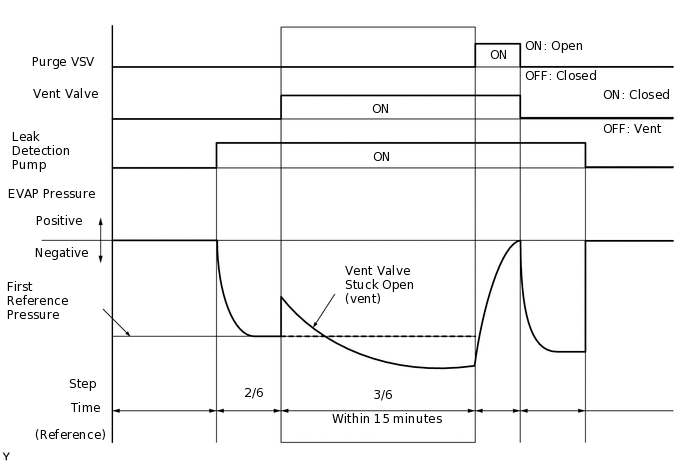
Check the EVAP pressure in step 3/6.
Result
DTC*
Result
Suspected Trouble Area
Proceed to
-
EVAP pressure increases by 0.3 kPa(gauge) [2.25 mmHg(gauge)] or higher within 10 seconds of proceeding from step 2/6 to step 3/6
Not yet determined
A
P2420
No variation in EVAP pressure even after proceeding from step 2/6 to step 3/6
Vent valve stuck open (vent)
Canister (charcoal filter inside canister) clogged
B
P0451
No variation in EVAP pressure during steps 1/6 through 3/6
Canister pressure sensor output value stuck
Vent valve broken (valve split in two)
Leak detection pump performance deteriorates
Leak detection pump circuit malfunctioning (large resistance exists in the circuit)
C
*: These DTCs are already present in the ECM when the vehicle arrives and are confirmed in the "Confirm DTC" procedure above.
B INSPECT CANISTER PUMP MODULE (POWER SOURCE FOR VENT VALVE)Click here
C CHECK HARNESS AND CONNECTOR (CANISTER PUMP MODULE - BODY GROUND)Click here
PERFORM EVAP SYSTEM CHECK (STEP 3/6)
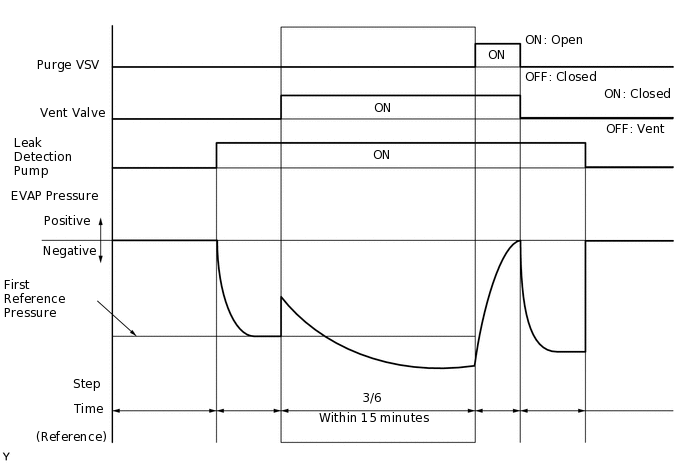
Wait until the EVAP pressure change is less than 0.12 kPa(gauge) [0.9 mmHg(gauge)] for 40 seconds.
Measure the EVAP pressure and record it.
Tip:A few minutes are required for the EVAP pressure to become saturated. When there is little fuel in the fuel tank, it takes up to 15 minutes.
Result
Proceed to
NEXT
PERFORM EVAP SYSTEM CHECK (STEP 4/6)
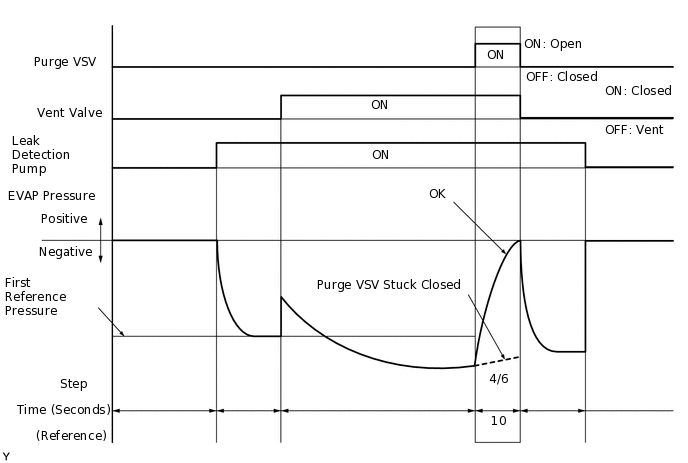
Check the EVAP pressure in step 4/6.
Result
DTC*1
Result
Suspected Trouble Area
Proceed to
-
EVAP pressure increases by 0.3 kPa(gauge) [2.25 mmHg(gauge)] or higher within 10 seconds of proceeding from step 3/6 to step 4/6
Not yet determined
A
P0441*2
EVAP pressure increases by 0.3 kPa(gauge) [2.25 mmHg(gauge)] or higher more within 10 seconds of proceeding from step 3/6 to step 4/6
Purge VSV
Purge VSV circuit
Problems in EVAP hose between purge VSV and intake manifold
Problems in EVAP hose between canister and purge VSV
ECM
B
P0441
Variation in EVAP pressure is less than 0.3 kPa(gauge) [2.25 mmHg(gauge)] for 10 seconds, after proceeding from step 3/6 to step 4/6
Purge VSV stuck closed
Purge VSV circuit
Canister (charcoal filter inside canister) clogged
Problems in EVAP hose between purge VSV and intake manifold
Problems in EVAP hose between canister and purge VSV
ECM
C
*1: These DTCs are already present in the ECM when the vehicle arrives and are confirmed in the "Confirm DTC" procedure above.
*2: This result suggests that due to purge line blockage or purge VSV malfunction, the DTC was stored by the purge flow monitor while the engine was running, or that key-off monitor test result were nearly borderline values.
B INSPECT EVAP HOSE (PURGE VSV - CANISTER)Click here
C PERFORM ACTIVE TEST USING GTS (PURGE VSV)Click here
PERFORM EVAP SYSTEM CHECK (STEP 5/6)
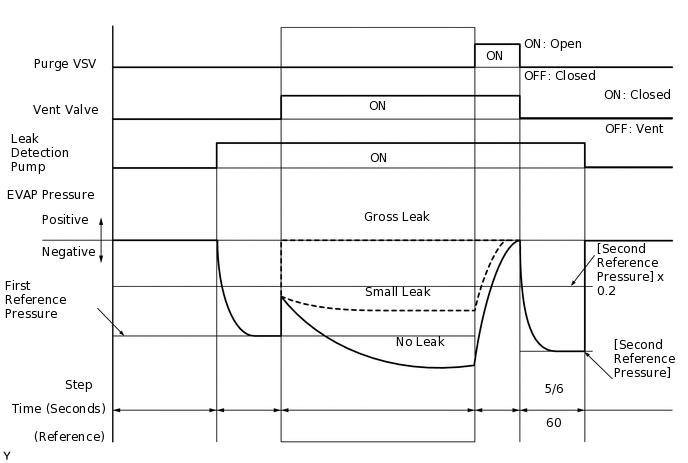
Check the EVAP pressure in step 5/6.
Compare the EVAP pressure in step 3/6 and the second reference pressure (step 5/6).
Result
DTC*
Result
Suspected Trouble Area
Proceed to
-
EVAP pressure from step 3/6 lower than second reference pressure (step 5/6)
Not yet determined (no leakage from EVAP system)
A
P0441 and P0455
EVAP pressure from step 3/6 higher than [second reference pressure (step 5/6) x 0.2]
Purge VSV stuck open
EVAP gross leak
B
P0456
EVAP pressure from step 3/6 higher than second reference pressure (step 5/6)
EVAP small leak
*: These DTCs are already present in the ECM when the vehicle arrives and are confirmed in the "Confirm DTC" procedure above.
B PERFORM ACTIVE TEST USING GTS (PURGE VSV)Click here
REPAIR OR REPLACE PARTS AND COMPONENTS INDICATED BY OUTPUT DTCS
Repair the malfunctioning areas indicated by the DTCs that had been confirmed when the vehicle was brought in.
Result
Proceed to
NEXT
NEXT PERFORM EVAP SYSTEM CHECK (AUTOMATIC MODE)Click here
PERFORM ACTIVE TEST USING GTS (PURGE VSV)
Enter the following menus: Powertrain / Engine and ECT / Active Test / Activate the VSV for EVAP Control.
Powertrain > Engine and ECT > Active Test
Tester Display
Activate the VSV for Evap Control
-
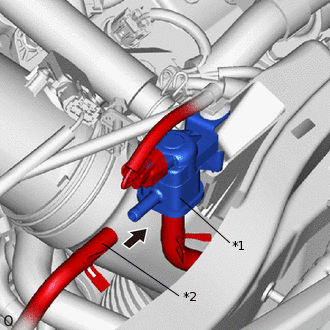
*1
Purge VSV
*2
Fuel Vapor Feed Hose
(to Canister)
Disconnect the fuel vapor feed hose (connected to the canister) from the purge VSV.
Start the engine.
Using the GTS, turn off the purge VSV (Activate the VSV for Evap Control: OFF).
Use your finger to confirm that the purge VSV has no suction.
Using the GTS, turn on the purge VSV (Activate the VSV for Evap Control: ON).
Use your finger to confirm that the purge VSV has suction.
Result
Test Result
Suspected Trouble Area
Proceed to
No suction when purge VSV turned off, and suction applied when turned on
Blockage in the purge line is considered (based on result of step 9):
Problems with EVAP hose between canister and purge VSV
Canister (charcoal filter inside canister) clogged
ECM
A
Leakage is considered (based on result of step 10):
Fuel tank cap
Leakage from EVAP line, fuel tank, or canister
B
Suction applied when purge VSV turned off
Purge VSV stuck open
C
No suction when purge VSV turned on
Purge VSV stuck closed
Problems with EVAP hose between purge VSV and intake manifold
D
B CHECK FUEL TANK CAP ASSEMBLYClick here
C INSPECT PURGE VSVClick here
D CHECK EVAP HOSE (PURGE VSV - INTAKE MANIFOLD)Click here
INSPECT EVAP HOSE (PURGE VSV - CANISTER)
Check for blockages in the EVAP purge line between the purge VSV and canister.
OK
No blockages in the EVAP purge line between the purge VSV and canister.
Result
Proceed to
OK
NG
NG REPAIR OR REPLACE EVAP PURGE LINE (PURGE VSV - CANISTER)Click here
INSPECT CHARCOAL CANISTER ASSEMBLY (CHARCOAL FILTER INSIDE CANISTER)
Check for filter blockage in the canister.
OK
No blockages in the canister.
Result
Proceed to
OK
NG
OK REPLACE ECMClick here
REPLACE CHARCOAL CANISTER ASSEMBLY
Replace the charcoal canister assembly.
Note:When replacing the canister, check the canister pump module interior and related pipes for water, fuel and other liquids. If liquids are present, check for disconnections and/or cracks in the following: 1) the pipe from the air inlet port to the canister pump module; 2) the canister filter; and 3) the fuel tank vent hose.
Check for filter blockage in the canister filter. if the canister filter has blockages, replace the canister filter.
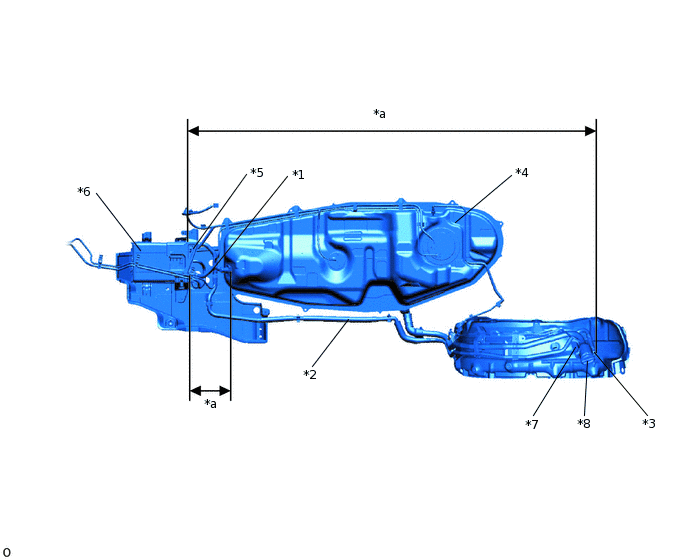
*1
Fuel Tank Vent Hose
*2
Vent Hose
*3
Air Inlet Port
*4
Fuel Tank
*5
Canister Pump Module
*6
Canister Assembly
*7
Fuel Tank Inlet Pipe Sub-assembly (Canister Filter)
*8
Fuel Tank Cap Assembly
*a
Inspection Area
(check for disconnection and/or cracks)
-
-
Result
Proceed to
NEXT
NEXT PERFORM EVAP SYSTEM CHECK (AUTOMATIC MODE)Click here
REPAIR OR REPLACE EVAP PURGE LINE (PURGE VSV - CANISTER)
Result
Proceed to
NEXT
NEXT PERFORM EVAP SYSTEM CHECK (AUTOMATIC MODE)Click here
CHECK FUEL TANK CAP ASSEMBLY
Check that the fuel tank cap is correctly installed and confirm that the fuel tank cap meets OEM specifications.
Tighten the fuel tank cap firmly (only one click sound could be heard).
Tip:If an EVAP tester is available, check the fuel tank cap using the tester.
Remove the fuel tank cap and install it onto a fuel tank cap adapter.
Connect an EVAP tester pump hose to the adapter, and pressurize the cap to 3.2 to 3.7 kPa(gauge) [24 to 27.75 mmHg(gauge)] using an EVAP tester pump.
Seal the adapter and wait for 2 minutes.
Check the pressure. If the pressure is 2 kPa(gauge) [15 mmHg(gauge)] or higher, the fuel tank cap is normal.
Result
Test Result
Suspected Trouble Area
Proceed to
Fuel tank cap correctly installed
-
A
Fuel tank cap loose
Fuel tank cap improperly installed
Defective fuel tank cap
Fuel tank cap does not meet OEM specifications
B
Defective fuel tank cap
-
No fuel tank cap
-
C
B CORRECTLY REINSTALL OR REPLACE FUEL TANK CAP ASSEMBLYClick here
C REPLACE FUEL TANK CAP ASSEMBLYClick here
LOCATE EVAP LEAK PART
Disconnect the vent hose.
*1
Fuel Tank Vent Hose
*2
Vent Hose
*3
Air Inlet Port
*4
Fuel Tank
*5
Canister Pump Module
*6
Canister Assembly
*7
Fuel Tank Inlet Pipe Sub-assembly (Canister Filter)
*8
Fuel Tank Cap Assembly
*a
Inspection Area (check for disconnection and/or cracks)
-
-
Connect the EVAP pressure tester tool to the canister pump module with the adapter.
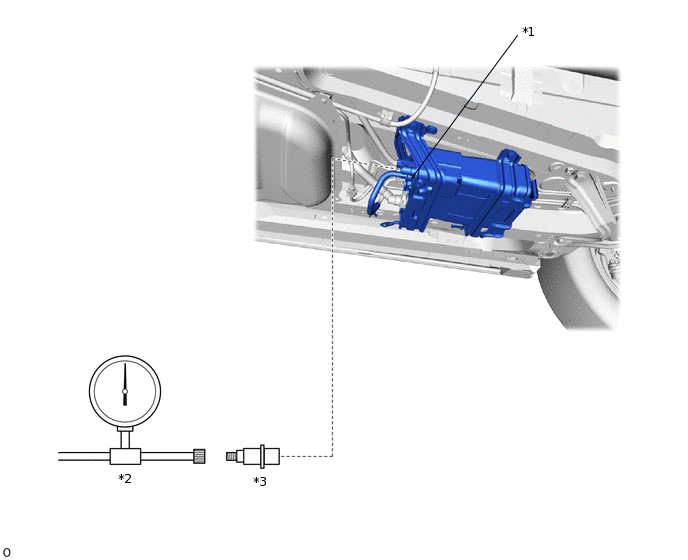
*1
Canister Pump Module
*2
EVAP Pressure Tester Tool
*3
Adapter
-
-
Pressurize the EVAP system to 3.2 to 3.7 kPa(gauge) [24 to 27.75 mmHg(gauge)].
Apply soapy water to the piping and connecting parts of the EVAP system.
Look for areas where bubbles appear. This indicates the leak point.
Repair or replace the leak point.
Tip:Disconnect the hose between the canister and fuel tank from the canister. Block the canister side and conduct an inspection. In this way, the fuel tank can be excluded as an area suspected of causing fuel leaks.
Result
Proceed to
NEXT
NEXT PERFORM EVAP SYSTEM CHECK (AUTOMATIC MODE)Click here
CORRECTLY REINSTALL OR REPLACE FUEL TANK CAP ASSEMBLY
Tip:When reinstalling the fuel tank cap, tighten it firmly (only one click sound could be heard).
When replacing the fuel tank cap, use a fuel tank cap that meets OEM specifications, and install it firmly.
Result
Proceed to
NEXT
NEXT PERFORM EVAP SYSTEM CHECK (AUTOMATIC MODE)Click here
REPLACE FUEL TANK CAP ASSEMBLY
Tip:When installing the fuel tank cap, tighten it firmly (only one click sound could be heard).
Result
Proceed to
NEXT
NEXT PERFORM EVAP SYSTEM CHECK (AUTOMATIC MODE)Click here
INSPECT PURGE VSV
Turn the engine switch off.
-
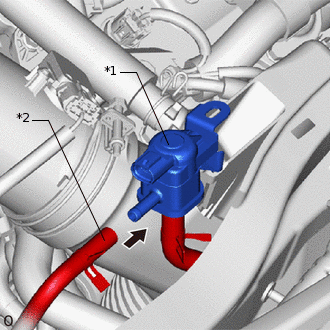
*1
Purge VSV
*2
Fuel Vapor Feed Hose (to Canister)
Disconnect the purge VSV connector.
Disconnect the fuel vapor feed hose (connected to the canister) from the purge VSV.
Start the engine.
Use your finger to confirm that the purge VSV has no suction.
Result
Test Result
Suspected Trouble Area
Proceed to
No suction
Wire harness or connector between purge VSV and ECM
ECM
A
Suction applied
Purge VSV
B
A CHECK HARNESS AND CONNECTOR (PURGE VSV - ECM)Click here
B REPLACE PURGE VSVClick here
INSPECT EVAP HOSE (PURGE VSV - CANISTER)
Check for blockages in the EVAP purge line between the purge VSV and canister.
OK
No blockages in the EVAP purge line between the purge VSV and canister.
Result
Proceed to
OK
NG
NG REPAIR OR REPLACE EVAP PURGE LINE (PURGE VSV - CANISTER)Click here
CHECK EVAP HOSE (PURGE VSV - INTAKE MANIFOLD)
-
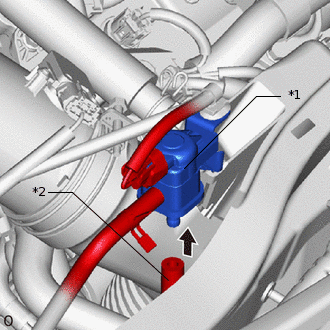
*1
Purge VSV
*2
Fuel Vapor Feed Hose
(to intake manifold)
Disconnect the fuel vapor feed hose (connected to the intake manifold) from the purge VSV.
Start the engine.
Use your finger to confirm that the fuel vapor feed hose has suction.
Result
Test Result
Suspected Trouble Area
Proceed to
Suction applied
EVAP hose between purge VSV and intake manifold normal
Purge VSV
Purge VSV power source
Wire harness or connector between purge VSV and ECM
A
No suction
Intake manifold port
EVAP hose between purge VSV and intake manifold
B
B INSPECT INTAKE MANIFOLD (EVAP PURGE PORT)Click here
-
INSPECT PURGE VSV
Remove the purge VSV.
-
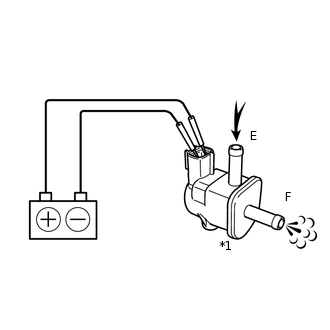
*1
Purge VSV
Apply battery voltage to the terminals of the purge VSV.
Confirm that air flows from port E to port F.
Result
Test Result
Condition
Suspected Trouble Area
Proceed to
Air flows
Battery voltage is applied to purge VSV terminals
Purge VSV normal
Purge VSV power source
Wire harness or connector between purge VSV and ECM
A
No air flow
Battery voltage is applied to purge VSV terminals
Purge VSV
B
B REPLACE PURGE VSVClick here
CHECK TERMINAL VOLTAGE (POWER SOURCE OF PURGE VSV)
Disconnect the purge VSV connector.
-
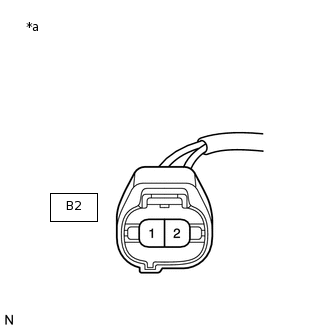
*a
Front view of wire harness connector
(to Purge VSV)
Turn the engine switch on (IG).
Measure the voltage according to the value(s) in the table below.
Result
Tester Connection
Switch Condition
Specified Condition
Suspected Trouble Area
Proceed to
B2-1 - Body ground
Engine switch on (IG)
11 to 14 V
Purge VSV power source normal
Wire harness or connector between purge VSV and ECM
A
Other than result above
Wire harness or connectors between purge VSV and battery
B
B REPAIR OR REPLACE HARNESS OR CONNECTORClick here
CHECK HARNESS AND CONNECTOR (PURGE VSV - ECM)
Disconnect the ECM connector.
Disconnect the purge VSV connector.
Measure the resistance according to the value(s) in the table below.
Standard Resistance
Tester Connection
Condition
Specified Condition
B2-2 - B77-68 (PRG)
Always
Below 1 Ω
B2-2 or B77-68 (PRG) - Body ground
Always
10 kΩ or higher
Result
Proceed to
OK
NG
OK REPLACE ECMClick here
NG REPAIR OR REPLACE HARNESS OR CONNECTORClick here
REPLACE PURGE VSV
Replace the purge VSV.
Result
Proceed to
NEXT
NEXT PERFORM EVAP SYSTEM CHECK (AUTOMATIC MODE)Click here
INSPECT INTAKE MANIFOLD (EVAP PURGE PORT)
Stop the engine.
Disconnect the EVAP hose from the intake manifold.
Start the engine.
Use your finger to confirm that the port of the intake manifold has suction.
Result
Tester Connection
Suspected Trouble Area
Proceed to
Suction applied
EVAP hose between intake manifold and purge VSV
A
No suction
Intake manifold (upper intake manifold)
B
B INSPECT INTAKE MANIFOLD (EVAP PURGE PORT)Click here
REPAIR OR REPLACE EVAP PURGE LINE (INTAKE MANIFOLD - PURGE VSV)
Result
Proceed to
NEXT
NEXT PERFORM EVAP SYSTEM CHECK (AUTOMATIC MODE)Click here
INSPECT INTAKE MANIFOLD (EVAP PURGE PORT)
Check that the EVAP purge port of the intake manifold is not clogged. If necessary, replace the intake manifold.
Result
Proceed to
NEXT
NEXT PERFORM EVAP SYSTEM CHECK (AUTOMATIC MODE)Click here
INSPECT CANISTER PUMP MODULE (POWER SOURCE FOR VENT VALVE)
-
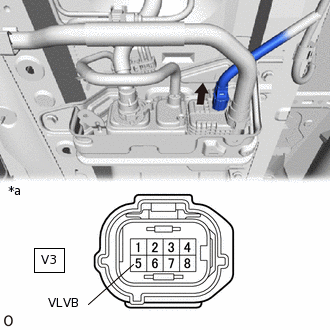
(to Canister Pump Module)
*a
Front view of wire harness connector
(to Canister Pump Module)
Turn the engine switch off.
Disconnect the canister pump module connector.
Turn the engine switch on (IG).
Measure the voltage according to the value(s) in the table below.
Result
Tester Connection
Switch Condition
Specified Condition
Suspected Trouble Area
Proceed to
V3-5 (VLVB) - Body ground
Engine switch on (IG)
11 to 14 V
Wire harness or connector between vent valve and ECM
Vent valve
Canister (charcoal filter inside canister) clogged
ECM
A
Below 3 V
Power source wire harness of vent valve
B
B REPAIR OR REPLACE HARNESS OR CONNECTORClick here
-
INSPECT CANISTER PUMP MODULE (VENT VALVE OPERATION)
Turn the engine switch off.
-
*a
Component without harness connected
(Canister Pump Module)
Disconnect the canister pump module connector.
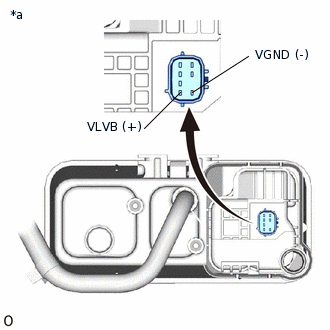
Apply the battery voltage to terminals VLVB and VGND of the pump module.
Touch the canister pump module to confirm the vent valve operation.
Result
Condition
Tester Result
Suspected Trouble Area
Proceed to
Apply battery voltage to terminals VLVB and VGND
Operating
Wire harness or connector between vent valve and ECM
Canister (charcoal filter inside canister) clogged
ECM
A
Not operating
Vent valve
B
B REPLACE CHARCOAL CANISTER LEAK DETECTION PUMP SUB-ASSEMBLY (CANISTER PUMP MODULE)Click here
CHECK HARNESS AND CONNECTOR (CANISTER PUMP MODULE - ECM)
Turn the engine switch off.
Disconnect the ECM connector.
Disconnect the canister pump module connector.
Measure the resistance according to the value(s) in the table below.
Result
Tester Connection
Condition
Test Result
Suspected Trouble Area
Proceed to
A62-7 (VPMP) - V3-1 (VGND)
Always
Below 1 Ω
Canister (charcoal filter inside canister) clogged
ECM
A
10 kΩ or higher
Wire harness or connector between ECM and canister pump module
B
B REPAIR OR REPLACE HARNESS OR CONNECTORClick here
INSPECT CHARCOAL CANISTER ASSEMBLY (CHARCOAL FILTER INSIDE CANISTER)
Check for filter blockage in the canister.
OK
No blockages in the canister.
Result
Proceed to
OK
NG
OK REPLACE ECMClick here
NG REPLACE CHARCOAL CANISTER ASSEMBLYClick here
CHECK HARNESS AND CONNECTOR (CANISTER PUMP MODULE - BODY GROUND)
Disconnect the canister pump module connector.
Measure the resistance according to the value(s) in the table below.
Result
Tester Connection
Condition
Specified Condition
Suspected Trouble Area
Proceed to
V3-4 (MGND) - Body ground
Always
Below 1 Ω
Canister pump module
Wire harness or connector between canister pump module and ECM
ECM
A
10 kΩ or higher
Wire harness or connector between canister pump module and body ground
B
B REPAIR OR REPLACE HARNESS OR CONNECTORClick here
CHECK HARNESS AND CONNECTOR (ECM - CANISTER PUMP MODULE)
Disconnect the canister pump module connector.
Disconnect the ECM connector.
Measure the resistance according to the value(s) in the table below.
Result
Tester Connection
Condition
Specified Condition
Suspected Trouble Area
Proceed to
A62-19 (MPMP) - V3-3 (MTRB)
Always
Below 1 Ω
Canister pump module
ECM
A
10 kΩ or higher
Wire harness or connector between ECM and canister pump module
B
B REPAIR OR REPLACE HARNESS OR CONNECTORClick here
REPLACE CHARCOAL CANISTER LEAK DETECTION PUMP SUB-ASSEMBLY (CANISTER PUMP MODULE)
Replace the canister pump module.
Note:When replacing the canister pump module, check the canister pump module interior, canister interior and related pipes for water, fuel and other liquids. If liquids are present, check for disconnections and/or cracks in the following: 1) the pipe from the air inlet port to the canister pump module; 2) the canister filter; and 3) the fuel tank vent hose. If liquids are present in the canister interior, replace canister and canister pump module together.
Check for filter blockage in the canister. If the charcoal filter inside the canister is clogged, replace the canister and canister pump module together.
Check for filter blockage in the canister filter. if the canister filter has blockages, replace the canister filter.
*1
Fuel Tank Vent Hose
*2
Vent Hose
*3
Air Inlet Port
*4
Fuel Tank
*5
Canister Pump Module
*6
Canister Assembly
*7
Fuel Tank Inlet Pipe Sub-assembly (Canister Filter)
*8
Fuel Tank Cap Assembly
*a
Inspection Area
(check for disconnection and/or cracks)
-
-
Result
Proceed to
NEXT
PERFORM EVAP SYSTEM CHECK (AUTOMATIC MODE)
Note:The Evaporative System Check (Automatic Mode) consists of 6 steps performed automatically by the GTS. It takes a maximum of approximately 24 minutes.
Do not perform the Evaporative System Check when the fuel tank is higher than 90% full because the cut-off valve may be closed, making the fuel tank leak check unavailable.
Do not run the engine in this step.
When the temperature of the fuel is 35°C (95°F) or higher, a large amount of vapor forms and any check results become inaccurate. When performing an Evaporative System Check, keep the fuel temperature below 35°C (95°F).
Connect the GTS to the DLC3.
Turn the engine switch on (IG).
Turn the GTS on.
Clear the DTCs.
Powertrain > Engine and ECT > Clear DTCs
Enter the following menus: Powertrain / Engine and ECT / Utility / Evaporative System Check / Automatic Mode.
Powertrain > Engine and ECT > Utility
Tester Display
Evaporative System Check
After the Evaporative System Check is completed, check for pending DTCs by entering the following menus: Powertrain / Engine and ECT / Trouble Codes.
Powertrain > Engine and ECT > Trouble Codes
Result
Result
Proceed to
EVAP system DTCs are output
A
No DTCs output
(No pending DTCs output)
B
A REPLACE ECMClick here
B END
PERFORM EVAP SYSTEM CHECK (STEP 3/6)
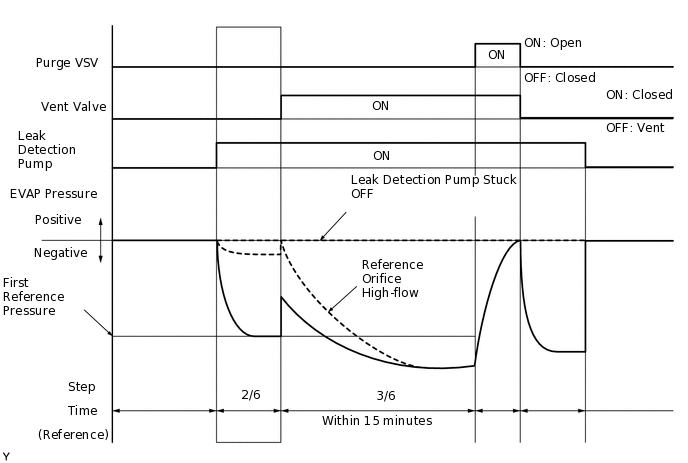
Check the EVAP pressure in step 3/6.
Result
DTC*
Result
Suspected Trouble Area
Proceed to
P043F
EVAP pressure less than [reference pressure] measured in step 2/6
Reference orifice high-flow
A
P2401
EVAP pressure almost same as [reference pressure] measured in step 2/6
Leak detection pump stuck off
B
*: These DTCs are already present in the ECM when the vehicle arrives and are confirmed in the "Confirm DTC" procedure above.
Tip:The first reference pressure is the value determined in step 2/6.
A REPLACE CHARCOAL CANISTER LEAK DETECTION PUMP SUB-ASSEMBLY (CANISTER PUMP MODULE)Click here
B CHECK TERMINAL VOLTAGE (CANISTER PUMP MODULE)Click here
INSPECT CANISTER PUMP MODULE (VENT VALVE OPERATION)
Turn the engine switch off.
-
*a
Component without harness connected
(Canister Pump Module)
Disconnect the canister pump module connector.
Apply the battery voltage to terminals VLVB and VGND of the pump module.
Touch the canister pump module to confirm the vent valve operation.
Result
Condition
Test Result
Suspected Trouble Area
Proceed to
Apply battery voltage to terminals VLVB and VGND
Operating
Wire harness or connector between vent valve and ECM
Leak detection pump performance deteriorates
Leak detection pump circuit malfunctioning (large resistance exists in the circuit)
ECM
A
Not operating
Vent valve
B
B REPLACE CHARCOAL CANISTER LEAK DETECTION PUMP SUB-ASSEMBLY (CANISTER PUMP MODULE)Click here
CHECK HARNESS AND CONNECTOR (CANISTER PUMP MODULE - ECM)
Turn the engine switch off.
Disconnect the ECM connector.
Disconnect the canister pump module connector.
Measure the resistance according to the value(s) in the table below.
Standard Resistance
Tester Connection
Condition
Specified Condition
A62-7 (VPMP) - V3-1 (VGND)
Always
Below 1 Ω
A62-7 (VPMP) or V3-1 (VGND) - Body ground
Always
10 kΩ or higher
Result
Result
Suspected Trouble Area
Proceed to
OK
Leak detection pump performance deteriorates
Leak detection pump circuit malfunctioning (large resistance exists in the circuit)
ECM
A
NG
Wire harness or connector between ECM and canister pump module
B
A CHECK HARNESS AND CONNECTOR (CANISTER PUMP MODULE - BODY GROUND)Click here
B REPAIR OR REPLACE HARNESS OR CONNECTORClick here
CHECK TERMINAL VOLTAGE (CANISTER PUMP MODULE)
Turn the engine switch off.
-
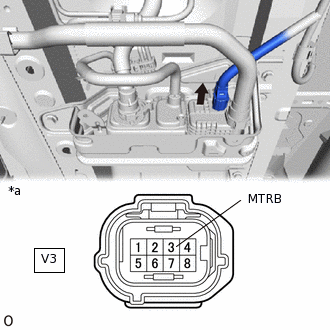
*a
Front view of wire harness connector
(to Canister Pump Module)
Disconnect the canister pump module connector.
Turn the engine switch on (IG).
Measure the voltage according to the value(s) in the table below.
Result
Tester Connection
Condition
Test Result
Suspected Trouble Area
Proceed to
V3-3 (MTRB) - Body ground
Engine switch on (IG)
9 to 14 V
Wire harness or connector between leak detection pump and body ground
Leak detection pump
A
Below 3 V
Wire harness or connector between leak detection pump and ECM
ECM
B
B CHECK HARNESS AND CONNECTOR (ECM - CANISTER PUMP MODULE)Click here
CHECK HARNESS AND CONNECTOR (CANISTER PUMP MODULE - BODY GROUND)
Turn the engine switch off.
Disconnect the canister pump module connector.
Measure the resistance according to the value(s) in the table below.
Result
Tester Connection
Condition
Specified Condition
Suspected Trouble Area
Proceed to
V3-4 (MGND) - Body ground
Always
Below 1 Ω
Leak detection pump
A
10 kΩ or higher
Wire harness or connector between canister pump module and body ground
B
A REPLACE CHARCOAL CANISTER LEAK DETECTION PUMP SUB-ASSEMBLY (CANISTER PUMP MODULE)Click here
REPAIR OR REPLACE HARNESS OR CONNECTOR
Result
Proceed to
NEXT
NEXT PERFORM EVAP SYSTEM CHECK (AUTOMATIC MODE)Click here
CHECK HARNESS AND CONNECTOR (ECM - CANISTER PUMP MODULE)
Turn the engine switch off.
Disconnect the canister pump module connector.
Disconnect the ECM connector.
Measure the resistance according to the value(s) in the table below.
Standard Resistance
Tester Connection
Condition
Specified Condition
A62-19 (MPMP) - V3-3 (MTRB)
Always
Below 1 Ω
A62-19 (MPMP) or V3-3 (MTRB) - Body ground
Always
10 kΩ or higher
Result
Result
Suspected Trouble Area
Proceed to
OK
ECM
A
NG
Wire harness or connector between ECM and canister pump module
B
B REPAIR OR REPLACE HARNESS OR CONNECTORClick here
REPLACE ECM
Replace the ECM.
Result
Proceed to
NEXT
NEXT PERFORM EVAP SYSTEM CHECK (AUTOMATIC MODE)Click here
REPLACE CHARCOAL CANISTER LEAK DETECTION PUMP SUB-ASSEMBLY (CANISTER PUMP MODULE)
Replace the canister pump module.
Note:When replacing the canister pump module, check the canister pump module interior, canister interior and related pipes for water, fuel and other liquids. If liquids are present, check for disconnections and/or cracks in the following: 1) the pipe from the air inlet port to the canister pump module; 2) the canister filter; and 3) the fuel tank vent hose. If liquids are present in the canister interior, replace canister and canister pump module together.
Check for filter blockage in the canister. If the charcoal filter inside the canister is clogged, replace the canister and canister pump module together.
Check for filter blockage in the canister filter. if the canister filter has blockages, replace the canister filter.
*1
Fuel Tank Vent Hose
*2
Vent Hose
*3
Air Inlet Port
*4
Fuel Tank
*5
Canister Pump Module
*6
Canister Assembly
*7
Fuel Tank Inlet Pipe Sub-assembly (Canister Filter)
*8
Fuel Tank Cap Assembly
*a
Inspection Area
(check for disconnection and/or cracks)
-
-
Result
Proceed to
NEXT
PERFORM EVAP SYSTEM CHECK (AUTOMATIC MODE)
Note:The Evaporative System Check (Automatic Mode) consists of 6 steps performed automatically by the GTS. It takes a maximum of approximately 24 minutes.
Do not perform the Evaporative System Check when the fuel tank is higher than 90% full because the cut-off valve may be closed, making the fuel tank leak check unavailable.
Do not run the engine in this step.
When the temperature of the fuel is 35°C (95°F) or higher, a large amount of vapor forms and any check results become inaccurate. When performing an Evaporative System Check, keep the fuel temperature below 35°C (95°F).
Connect the GTS to the DLC3.
Turn the engine switch on (IG).
Turn the GTS on.
Clear the DTCs.
Powertrain > Engine and ECT > Clear DTCs
Enter the following menus: Powertrain / Engine and ECT / Utility / Evaporative System Check / Automatic Mode.
Powertrain > Engine and ECT > Utility
Tester Display
Evaporative System Check
After the Evaporative System Check is completed, check for pending DTCs by entering the following menus: Powertrain / Engine and ECT / Trouble Codes.
Powertrain > Engine and ECT > Trouble Codes
Tip:If no pending DTCs are found, the repair has been successfully completed.
Result
Proceed to
NEXT
NEXT END
INSPECT CANISTER PUMP MODULE (CANISTER PRESSURE SENSOR CIRCUIT)
Check the canister pressure sensor circuit, referring to DTC P0451 canister pressure sensor circuit procedure.
Result
Proceed to
NEXT
NEXT PERFORM EVAP SYSTEM CHECK (AUTOMATIC MODE)Click here